Pabau Engage inbox

Pabau Engage is here — every patient conversation in one inbox.

Learn more
Book a demo Book a demo
Clinical guides

Postural stability exercises: the complete clinical guide

Avatar photo Despina Petrushevska
Last Updated: September 9, 2026
Reviewed by: Avatar photo Lucy Galloway
Key takeaways

Key takeaways

Postural stability exercises target the deep muscles of the spine, hips, and shoulders that hold your body in alignment during daily movement.

The three most common dysfunctions are forward head posture, rounded shoulders, and anterior pelvic tilt, and each one has its own corrective exercises.

Guidance from the American Physical Therapy Association supports combining strengthening, mobility, and motor control work in a single program.

Practice management software like Pabau helps physical therapy practices document postural programs and track patient progress between sessions.

Many adults spend more than seven hours a day sitting, according to NHS guidance on sitting time. That sustained load on the spine, hips, and shoulders gradually shifts muscles out of their optimal length-tension relationship. The result is the aching neck, stiff thoracic spine, and persistent low back pain that fill physical therapy waiting rooms.

Postural stability exercises address that imbalance directly. They load the muscles that poor positioning has lengthened and weakened, before symptoms turn chronic. This guide covers the anatomy, the exercises with sets and reps, modifications by population, and how to build a weekly program a patient will finish.

Found our content helpful?

What are postural stability exercises and why do they matter?

Postural stability exercises are targeted movements designed to strengthen and coordinate the deep stabilizing muscles of the spine, pelvis, and shoulder girdle. Unlike general fitness training, they prioritize precise activation over load or speed. The goal is balanced muscular control, so the body holds neutral alignment when still and when moving.

Poor postural stability has consequences beyond appearance. NICE guidelines for low back pain recommend exercise as a first-line treatment for persistent symptoms. Clinicians who understand the muscular drivers can prescribe corrective work that targets the mechanics, rather than managing pain alone.

Key muscles responsible for postural stability

Before selecting exercises, it helps to know which muscles govern postural control. Research by Hodges and Richardson established the transversus abdominis and multifidus as the primary deep spinal stabilizers. They fire before limb movement begins, creating a stiffness reaction that protects the spine from shear and compression.

Muscle group Primary postural role Common dysfunction when weak
Transversus abdominis Deep abdominal compression, spinal pre-stiffening Anterior pelvic tilt, low back pain
Multifidus Segmental vertebral stabilization Lumbar instability, recurrent back pain
Gluteus medius Lateral pelvic stability during single-leg stance Trendelenburg gait, hip drop, knee valgus
Lower trapezius and rhomboids Scapular depression and retraction Rounded shoulders, upper back pain
Deep cervical flexors Cervical spine stabilization and head position Forward head posture, neck pain

Common postural dysfunctions and the exercises that correct them

Three postural dysfunctions account for most of the musculoskeletal complaints that physical therapists treat. Each one pairs tight, overactive muscles with lengthened, inhibited ones. That pairing decides which exercises to prescribe.

Dysfunction Tight/overactive Weak/inhibited Key corrective exercises
Forward head posture Suboccipitals, upper trapezius, sternocleidomastoid Deep cervical flexors, lower trapezius Chin tucks, cervical retraction, thoracic extension
Rounded shoulders Pectorals, anterior deltoids, subscapularis Rhomboids, lower trapezius, rotator cuff Shoulder blade squeezes, face pulls, rows
Anterior pelvic tilt Hip flexors, lumbar erectors Glutes, transversus abdominis, hamstrings Glute bridges, dead bug, hip flexor stretches

The pairing matters more than the exercise list. An inhibited muscle needs activation work, while a short muscle needs length. Prescribe a generic core routine and you can reinforce the imbalance instead of correcting it. Recording the dysfunction pattern in the treatment note keeps that reasoning visible to the next clinician who sees the patient.

Best postural stability exercises: step-by-step instructions

The exercises below cover the full postural chain, from the cervical spine to the hips. None of them need equipment, so patients can run the program at home between sessions. Sets, reps, and the most common technique error are listed for each.

Core and lower back exercises for spinal stability

  • Dead bug: Lie on your back, arms pointing to the ceiling, hips and knees at 90 degrees. Slowly lower your right arm overhead while straightening your left leg, keeping your lower back flat against the floor. Return and repeat on the opposite side. 3 sets of 8 per side. Common error: letting the lower back arch as the limbs extend.
  • Bird dog: From a four-point kneeling position, brace your core and extend your right arm and left leg until both are horizontal. Hold for two seconds, return with control, and alternate sides. 3 sets of 10 per side. Common error: rotating the hips to reach a higher limb position.
  • Plank: Forearm or full-arm position, body in a straight line from heels to head. Draw the navel gently toward the spine to activate the transversus abdominis, rather than holding the position by holding your breath. 3 sets of 20-30 seconds, progressing to 60 seconds. Common error: hips sagging or elevated, which breaks the neutral spinal position.
  • Pelvic tilt: Lie on your back with knees bent. Gently flatten your lower back against the floor by tilting the pelvis posteriorly, engaging the lower abdominals. Hold for 5 seconds and release. 3 sets of 15. This is a low-load introduction to deep core activation, before the dead bug or bird dog.

Upper back and shoulder exercises for postural alignment

  • Shoulder blade squeezes (scapular retraction): Seated or standing, pinch your shoulder blades together and slightly downward. Hold for 5 seconds and release. 3 sets of 15. This directly activates the rhomboids and lower trapezius, which are inhibited in rounded-shoulder posture.
  • Thoracic extension over a rolled towel: Place a rolled towel horizontally across your mid-back at the level of the shoulder blades. Support your head with your hands and gently extend over the roll for 30 seconds. Move the towel one segment higher and repeat, covering 3-4 positions along the thoracic spine. This addresses the kyphosis that perpetuates both rounded shoulders and forward head posture.
  • Resistance band rows: Anchor a resistance band at chest height. Grip the band with both hands and step back to create tension. Pull the handles toward your lower ribs, squeezing your shoulder blades together, then return slowly. 3 sets of 12. Common error: shrugging the shoulders toward the ears during the pull.

Hip and gluteal exercises for pelvic stability

  • Glute bridge: Lie on your back with knees bent and feet flat. Drive through your heels to lift your hips until your body forms a straight line from shoulders to knees. Squeeze the glutes at the top for 2 seconds and lower with control. 3 sets of 12-15. Progress to single-leg bridges to increase gluteus medius demand.
  • Clamshell: Lie on your side with knees stacked and bent to about 45 degrees, feet together. Keeping the pelvis still, rotate the top knee upward as far as possible without letting the hips roll back. Lower slowly. 3 sets of 15. This isolates the gluteus medius, the primary lateral pelvic stabilizer.
  • Hip flexor stretch (kneeling lunge): Take a long kneeling lunge position, rear knee on the floor. Tuck the pelvis posteriorly, as in the pelvic tilt. Shift your weight forward until you feel a stretch at the front of the rear hip. Hold for 30-45 seconds per side. Sustained hip flexor tightness drives anterior pelvic tilt, so pair this stretch with strengthening work or the gain will not hold.

Cervical and neck exercises for head posture

  • Chin tuck: Sitting or standing, gently draw the chin directly backward rather than downward, to create a double chin. You should feel a stretch at the base of the skull. Hold for 5 seconds, release, and repeat 10-15 times. This activates the deep cervical flexors and lengthens the suboccipitals, which addresses forward head posture directly.
  • Cervical rotation with retraction: Take up the chin tuck position first. Then slowly rotate the head to each side, looking over each shoulder while holding the retraction. Return to center before rotating the other way. 2 sets of 8 per side. This trains rotational mobility within a corrected cervical alignment.

Taken together, the four regions form one reference a patient can work from at home. The card below pairs each region’s weak stabilizer with the exercise that loads it first.
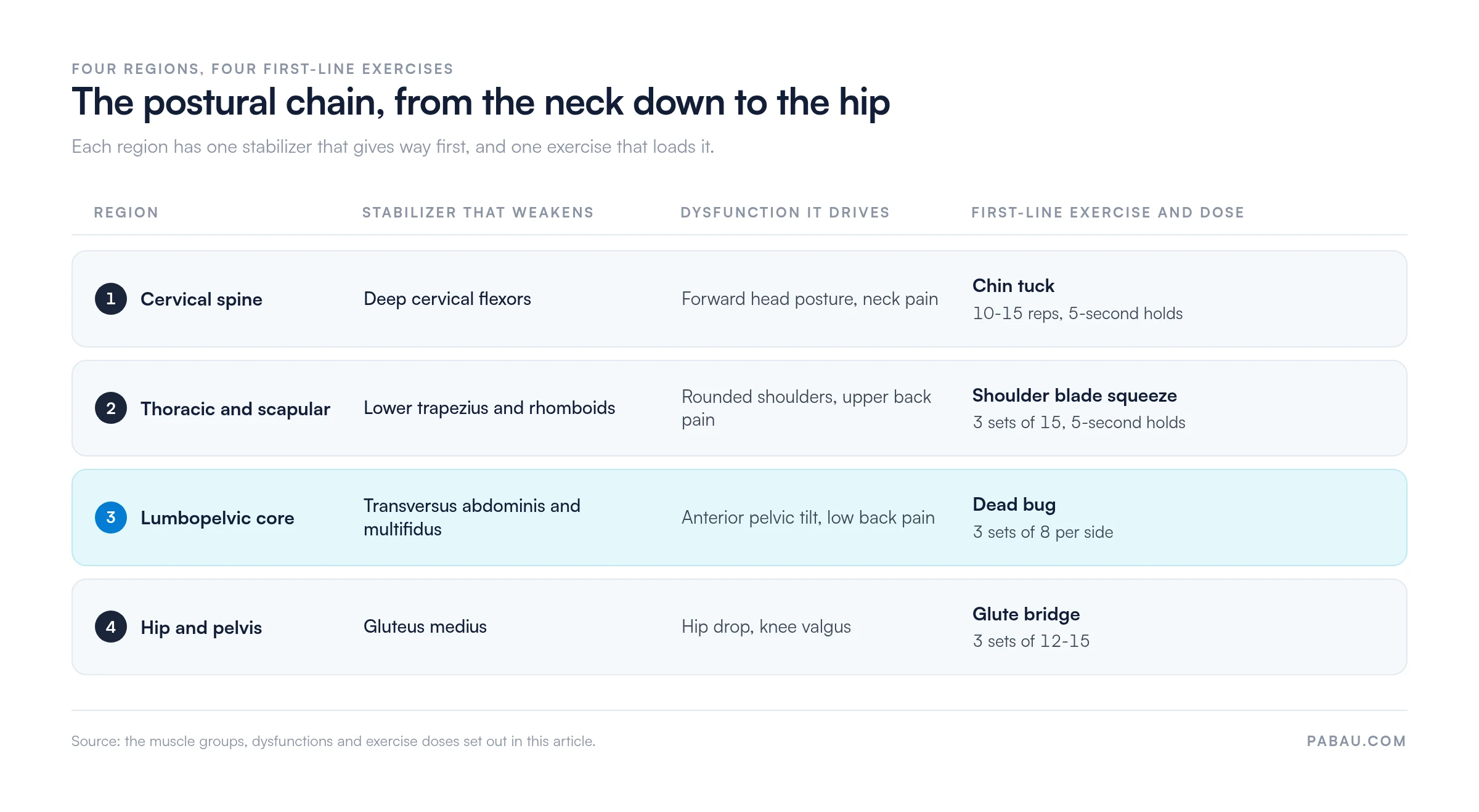
Reference card mapping four postural regions to the stabilizer that weakens and its first-line exercise: cervical spine, deep cervical flexors, chin tuck 10-15 reps with 5-second holds; thoracic and scapular, lower trapezius and rhomboids, shoulder blade squeeze 3 sets of 15; lumbopelvic core, transversus abdominis and multifidus, dead bug 3 sets of 8 per side; hip and pelvis, gluteus medius, glute bridge 3 sets of 12-15
The lumbopelvic core sits in the middle of the chain, which is why a dead bug usually precedes any standing correction. Doses come from the exercise prescriptions above.

Pro Tip

Document baseline postural assessment photos and mobility measurements at the start of a rehabilitation program. Comparing these against reassessment data at 6 and 12 weeks gives patients concrete evidence of progress. That lands harder than a subjective report of feeling better, and it justifies continuing treatment.

How to build a weekly program

Frequency matters. The American Physical Therapy Association (APTA) recommends that postural rehabilitation combine strengthening, mobility, and motor control work. No single universal frequency protocol exists. Clinical consensus supports targeted postural exercise at least four to five days a week for meaningful adaptation.

A sensible weekly structure for a patient at the early-to-intermediate stage looks like this:

Day Focus Key exercises
Monday Core activation and hip flexor mobility Pelvic tilts, dead bug, hip flexor stretch
Tuesday Cervical and upper back Chin tucks, thoracic extension, shoulder blade squeezes
Wednesday Rest or light walking Active rest, 20-30 minute brisk walk
Thursday Posterior chain and gluteal stability Glute bridges, clamshells, bird dog
Friday Full-program integration Plank, rows, chin tucks, clamshell, bird dog
Weekend Active recovery Gentle stretching, yoga, swimming

A patient who can see the week laid out is more likely to follow it than one told to do their exercises. Send the schedule through the patient portal so it sits beside their appointments. The return-to-running protocol shows how a phased protocol is staged and progressed, and the same structure adapts to postural work.

Progression follows one rule. Once a patient completes all prescribed repetitions with good form and no pain, progress the exercise. Add duration to the holds, add repetitions, or move to a harder variation. Bilateral glute bridges become single-leg bridges, and a forearm plank becomes a full plank with shoulder taps.

Modifications for specific patient populations

A program for a 28-year-old desk worker looks quite different from one for a 70-year-old with low balance confidence. An elite swimmer needs something different again. The modifications below cover the four populations that turn up most often.

  • Desk workers: Thoracic mobility and cervical retraction are the priority here, because forward head posture and rounded shoulders are the dominant pattern. Build in hourly micro-breaks at the desk, with 10 chin tucks and 10 shoulder blade squeezes. Changes to screen and chair height support the exercises rather than replace them.
  • Older adults (65+): Balance work sits alongside the postural exercises. Single-leg balance progressions with a hand on the kitchen counter, seated clamshells, and standing thoracic extensions are sensible starting points. Keep plank work in the modified kneeling version at first. Screen balance with a graded test such as the 4-stage balance test before prescribing unsupervised standing work.
  • Post-surgical patients: Surgical clearance dictates the pace. After spinal surgery, deep core activation such as the dead bug and pelvic tilts typically starts around weeks 6 to 12. That timing is subject to surgeon guidance. Defer to the treating surgeon’s protocol, and record every change to the prescription in the treatment note.
  • Athletes: The emphasis shifts to dynamic postural stability under load and at speed. The same foundation applies, but progressions to single-leg Romanian deadlifts, lateral band walks, and rotational core work come earlier. Sports medicine software that tracks training load next to postural assessment data shows when an athlete’s control starts degrading under fatigue.

Population fit is a safety question as much as a programming one. A standing balance progression that suits an athlete can put an unsteady older patient on the floor. Screen first, then modify, then prescribe.

The Journal of Orthopaedic and Sports Physical Therapy publishes peer-reviewed work on population-specific rehabilitation outcomes. It is a useful place to check whether a protocol still reflects current evidence.

How Pabau supports postural rehabilitation programs

Structured postural rehabilitation creates a documentation load that manual systems handle poorly. Every patient has a different dysfunction pattern, a different progression timeline, and a different home exercise load. Keeping that current and visible to every clinician is where practice management software like Pabau earns its place.

Physical therapy and rehabilitation practices use Pabau as their physical therapy EMR, which covers both the clinical and the administrative side of a program:

  • Treatment plan documentation: Record postural assessment findings, the dysfunction pattern, and the exercise prescription in the patient record. A locum or cover clinician can then see where the program stands without calling anyone.
  • Digital intake forms: Send postural questionnaires out before the appointment. Pain scores, movement limitations, and self-reported compliance arrive ahead of the session, so the time in the room goes on treatment.
  • Automated recall and follow-up: Postural rehabilitation usually runs 6 to 12 weeks. Automated workflows handle reminders, between-session check-ins, and recall prompts at each milestone, so reception is not chasing them by hand.

The result is one program the whole team can see and continue. It also leaves a reassessment record you can put in front of the patient at week 6 and week 12.

Manage your postural rehabilitation programs in one place

Pabau helps physical therapy and rehabilitation practices document treatment plans, send home exercise programs digitally, and track progress across every session. See how it fits your clinical workflow.

Pabau practice management dashboard for physical therapy practices

Conclusion

Chronic postural problems rarely resolve on awareness alone. The stabilizers of the spine, pelvis, and shoulder girdle need consistent, targeted loading before they hold a neutral position again. That is why the pairing in this guide matters more than the exercise names.

So name the dysfunction, prescribe its pairing, set a dose, and reassess at week 6. The trade-off worth remembering is dose against adherence. A shorter program the patient completes beats a thorough one abandoned in week two.

The documentation is what makes that reassessment possible. Book a demo to see how Pabau stores a postural program and the progress data behind it.

Continue your research

Continue your research

Need the compliance requirements for running a physical therapy service? Mandatory compliance for physiotherapy clinics covers the standards practitioners must meet when delivering musculoskeletal rehabilitation.

Thinking about opening your own practice? Opening a physiotherapy clinic walks through the operational, staffing, and software decisions involved in launching one.

Opening in a specific state? Physical therapy clinic requirements in Arizona shows how licensing and facility rules work in practice at state level.

Comparing software for a rehabilitation practice? Physiotherapy clinic management software sets out what to look for in scheduling, notes, and home exercise delivery.

Need a functional baseline before you prescribe? 30-second chair stand test gives you a scored lower-limb measure you can repeat at every reassessment.

Frequently asked questions

What are postural stability exercises?

Postural stability exercises are targeted movements that strengthen the deep stabilizing muscles of the spine, pelvis, and shoulder girdle. That group includes the transversus abdominis, multifidus, gluteus medius, and the scapular retractors. They differ from general strengthening because they prioritize precise activation and neutral alignment over load or speed.

How often should you do posture exercises?

Most clinical guidance points to four to five sessions a week for meaningful muscular adaptation. No single universal protocol exists, and the right frequency depends on the dysfunction, the fitness level, and recovery capacity. Short daily sessions of 15 to 20 minutes usually beat infrequent long ones, because motor control improvements need repetition to embed.

Can postural stability exercises reduce back pain?

Evidence supports postural stability exercises as part of a multimodal approach to low back pain, especially when they target the imbalance driving the symptoms. NICE guidelines for low back pain recommend exercise as a first-line intervention. Musculoskeletal pain is multifactorial, so exercise alone may not clear symptoms without attention to sleep, stress, and ergonomics.

What muscles are responsible for postural stability?

The lumbar spine relies on the transversus abdominis and multifidus, and the pelvis on the gluteus medius. Scapular control comes from the lower trapezius and rhomboids, and head position from the deep cervical flexors. What sets these muscles apart is anticipatory activation, since they fire before movement begins to pre-stiffen the joint.

When should you see a physical therapist for posture problems?

See a physical therapist when the postural problem comes with pain, or with neurological symptoms such as numbness or tingling. Self-directed exercise that produces no change in four to six weeks is another reason to go. A therapist can name the dysfunction pattern, rule out a structural cause, and match the program to your imbalance.

Found our content helpful?
×