Pleural effusion is fluid collecting between the lung and the chest wall, so nursing care centers on breathing, comfort, and complication watch.
The downloadable form is blank by design. It carries fields for medical history, assessment, diagnosis, goals, interventions, rationale, and evaluation that you complete yourself.
Five NANDA-I diagnoses cover most presentations: impaired gas exchange, ineffective breathing pattern, acute pain, activity intolerance, and risk for infection.
The form has no thoracentesis or discharge section, so record procedure care and teaching under interventions, evaluation, and additional notes.
Practice management software like Pabau holds the same field list as a form on the client record, so each entry is timestamped.
Download your free pleural effusion nursing care plan
A printable, blank form covering patient information, medical history, subjective and objective assessment, nursing diagnosis, goals, interventions, rationale, and evaluation. It closes with additional notes and the nurse’s name, license number, and contact number. Nothing is pre-filled, so fill it in by hand or use it as the field list for a digital form.
Pleural effusion crowds the lung from the outside. Fluid gathers between the pleural layers, the lung cannot expand fully, and the patient reports breathlessness that worsens when lying flat.
This guide covers what to assess, which NANDA-I diagnoses fit, how to word a measurable goal, and which interventions belong beside which rationale. It also shows two worked examples mapped onto the blank form.
What is a pleural effusion nursing care plan?
A pleural effusion nursing care plan is the written record of the nursing process for one patient. You assess, name the problem, set a goal, act, and judge the result. It applies the standard nursing process to a patient whose lung is compressed by pleural fluid.
The effusion itself is an abnormal collection of fluid between the lung and the chest wall. Transudative effusions usually follow heart failure or low albumin. Exudative effusions follow infection, malignancy, or pulmonary embolism. The cause shapes the plan, because a drained malignant effusion often refills.
The plan earns its keep at handoff. The next nurse needs the baseline saturation, the position that relieved the breathlessness, and what changed after the last dose of analgesia. Digital nursing forms keep those details in one place instead of across three sheets of paper.
Pabau’s digital forms builder holds the same care plan fields as the printable form, so each entry is timestamped as you chart it.
What the downloadable form includes
The template is a blank two-page form, not a pre-written care plan. It gives you the structure and the field labels, and you supply the clinical content. The sections run in this order:
Patient information: name, age, and gender at the top of the sheet.
Medical history: a field sitting directly under those patient details.
Assessment: split into a subjective space for what the patient reports and an objective space for what you measure.
Nursing diagnosis: an open field marked for you to specify.
Goals and outcomes: separate long-term and short-term boxes, with no date field.
Nursing interventions: an open field for the actions you will take.
Rationale: an open field for the reason behind each action.
Evaluation: space to record whether the goal was met.
Additional notes: space for what the fixed fields do not cover.
Nurse’s information: name, license number, and contact number.
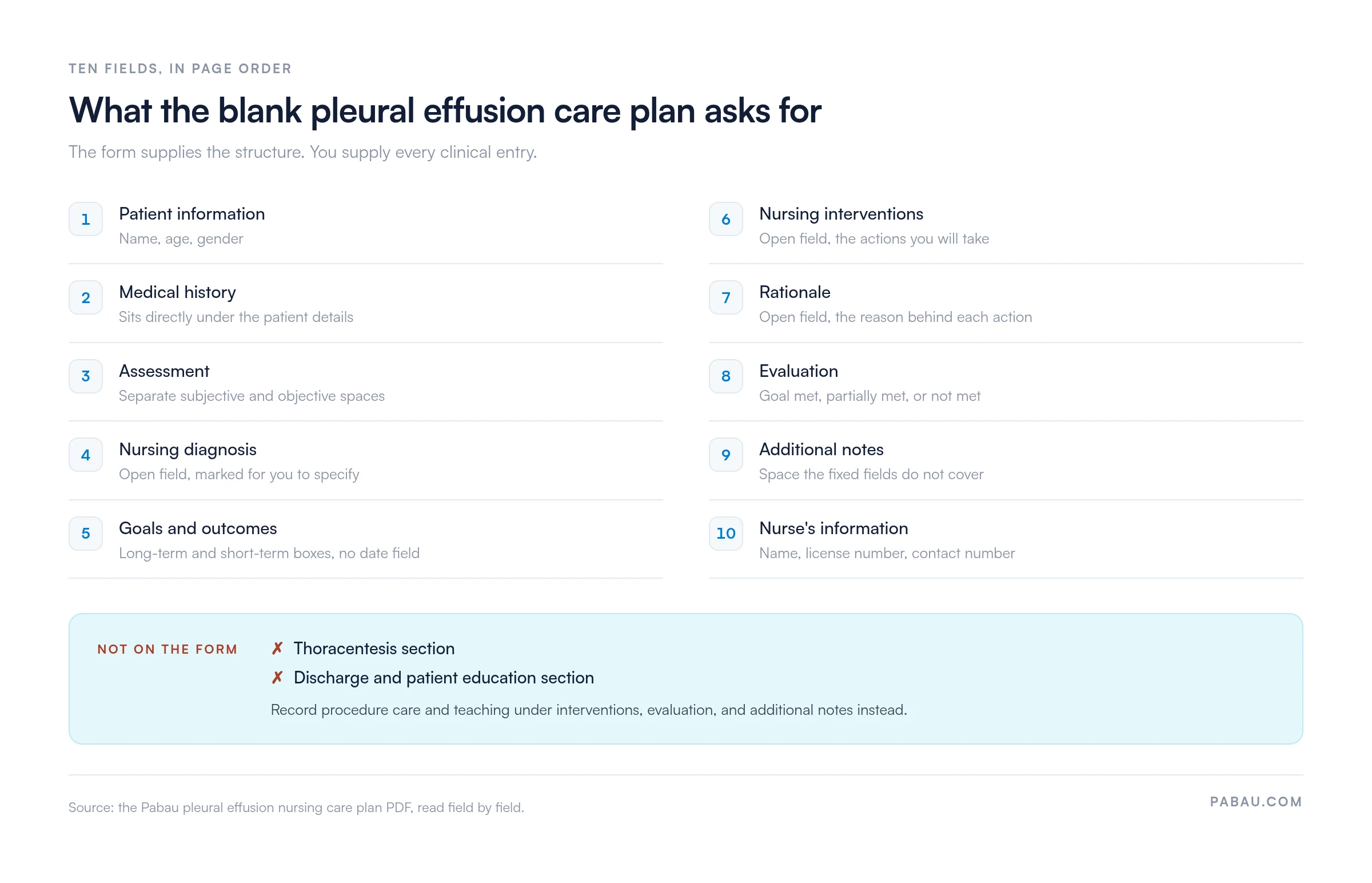
The form carries no pre-written diagnoses, interventions, or rationale. It also has no thoracentesis section and no discharge section, so procedure care and teaching go into the fields above. The panel below maps the whole field list in page order, and names the two sections the form leaves out.
The form carries ten fields but no thoracentesis or discharge section, so procedure care needs a home in the open fields. Field list read directly from the template PDF.
How to fill in the template, step by step
The form’s ten fields follow clinical workflow, so work down the page in order.
Record the assessment first. Put the reported symptoms in the subjective space, including dyspnea onset, pain character, and what the patient can no longer do. Put respiratory rate, breath sounds, oxygen saturation, and imaging findings in the objective space.
Write the diagnosis in your own words. Use the NANDA-I table below to pick the label, then attach the related factor your assessment supports. One problem per statement keeps the plan usable.
Set a goal you can measure. Use the long-term and short-term boxes, and name the target, the condition, and the deadline. For example, the patient maintains oxygen saturation at or above 94 percent on room air within 48 hours.
List the interventions in the order you will perform them. Include the frequency, because a plan that says monitor respirations tells the next nurse nothing.
Give each intervention a rationale. The rationale field is where clinical reasoning becomes visible to the rest of the team, and it is what an auditor reads first.
Evaluate at shift change and date every revision. Say whether the goal was met, partially met, or not met, and what you changed as a result. AI-assisted clinical documentation can carry yesterday’s entry forward so you edit rather than retype.
NANDA-I diagnoses that fit pleural effusion
These five diagnoses cover most pleural effusion presentations. Use the table as a reference when you write the diagnosis field, and link each related factor to a finding you recorded. The impaired gas exchange care plan works that first diagnosis through in more detail.
Pleural fluid restricting lung expansion; pain on inspiration
Shallow breathing, dyspnea, use of accessory muscles
Acute pain
Pleural inflammation; chest drain or post-thoracentesis site
Pain rating above 3 out of 10, guarding, grimacing, limited movement
Activity intolerance
Reduced oxygenation; dyspnea on exertion
Breathlessness with minimal activity, fatigue, rising heart rate on exertion
Risk for infection
Risk factors: thoracentesis or chest drain insertion; immunosuppression
No signs yet, so the diagnosis rests on the risk factor alone
Risk for infection is a prevention diagnosis, so NANDA-I labels its factors risk factors rather than related factors. Because no signs are present, it takes the two-part format and carries no as-evidenced-by clause.
What to assess before you write the diagnosis
The diagnosis is only as good as the assessment under it. Work through five domains and record both what the patient says and what you find. Client record documentation keeps the two side by side.
Pabau’s client record keeps assessment findings and the care plan side by side. The next nurse reads one timeline instead of hunting for the paper sheet.
Respiratory status: auscultate both sides and expect diminished sounds over the effusion. Note rate, depth, and pattern, plus any accessory muscle use.
Oxygenation: measure saturation at rest and after activity. Record the oxygen flow needed to hold the target, and what triggers a drop.
Pain: ask about site, character, and radiation. Pleuritic pain sharpens on coughing and deep breathing. Score it on the 0 to 10 scale each time.
Positioning tolerance: note which positions ease the breathlessness and which worsen it. This single line saves the next shift a trial and error round.
Psychosocial: gauge anxiety and what the patient understands about the diagnosis. Breathlessness frightens people, and fear raises the respiratory rate further.
Goals and outcomes you can measure
A goal that cannot be measured cannot be evaluated. Give each one a number and a deadline, then copy it into the long-term or short-term box.
Nursing diagnosis
Sample goal statement
How you evaluate it
Impaired gas exchange
Patient maintains oxygen saturation at or above 94 percent on room air by day two
Saturation readings across three consecutive shifts
Ineffective breathing pattern
Patient keeps a respiratory rate of 12 to 20 at rest within 24 hours
Counted rate at rest, recorded each shift
Acute pain
Patient reports pain of 3 or less out of 10 within one hour of analgesia
Pain score before and after each dose
Activity intolerance
Patient walks 20 meters without desaturating below 90 percent before discharge
Walk test with continuous oximetry
Risk for infection
Patient stays free of fever and site inflammation through discharge
Temperature trend and daily site inspection
Nursing interventions and the rationale behind them
The form gives you one field for interventions and one for rationale. Pair them as you write, so the reasoning travels with the action and the handoff stays auditable.
Diagnosis
Intervention
Rationale
Impaired gas exchange
Sit the patient upright in high Fowler’s and titrate oxygen to the ordered target
An upright chest drops the diaphragm and frees the unaffected lung, which improves ventilation
Impaired gas exchange
Check saturation at rest and after activity, and record both numbers
Resting readings can look normal while exertion exposes the true reserve
Ineffective breathing pattern
Coach pursed-lip and diaphragmatic breathing every few hours
Slower expiration holds small airways open and cuts the work of each breath
Ineffective breathing pattern
Count respirations for a full minute rather than trusting the monitor
Rate and depth change before saturation falls, so counting catches deterioration earlier
Acute pain
Give analgesia on a schedule, timed before deep breathing and coughing
Pleuritic pain suppresses inspiration, and unrelieved pain leads to atelectasis
Acute pain
Splint the chest wall with a pillow while the patient coughs
Support limits movement of the inflamed pleura, so the cough is completed rather than aborted
Activity intolerance
Pace activity with seated rest periods and watch the response
Graded activity preserves conditioning without pushing the patient into desaturation
Risk for infection
Inspect the puncture or drain site every shift and trend temperature
Site infection usually shows locally before it shows systemically
Risk for infection
Keep the drainage system closed and use sterile technique at every access
Each break in the circuit is an entry point for organisms
Write the frequency you used, not the one you intended. That detail is what makes the evaluation field meaningful two days later.
Thoracentesis nursing care before, during, and after
Thoracentesis is often both diagnostic and therapeutic in pleural effusion. The form has no dedicated section for it, so these steps belong in the interventions, evaluation, and additional notes fields.
Before: confirm consent is in place, record baseline vital signs and saturation, and check that imaging is available. Sit the patient upright with arms resting on a table, or in semi-Fowler’s if sitting is not tolerated. Keep emergency equipment at the bedside.
During: hold the position and keep the patient informed. Watch for chest pain, breathlessness, cough, and faintness. Assist with the sterile field and label specimens at the bedside.
After: assess for pneumothorax, hemothorax, and infection. Check vital signs every 15 minutes for the first hour, then hourly. Draining much more than 1.5 liters in one sitting raises the risk of re-expansion pulmonary edema, so stop for chest tightness or persistent cough.
Before the patient leaves: explain the site care and the restriction on heavy lifting for 24 to 48 hours. Name the symptoms that mean call us today.
Two worked examples on the blank form
These examples show the main clinical fields completed for two common presentations. Adapt the wording to your patient and your unit protocol.
Example 1: Large effusion awaiting thoracentesis
Field on the form
What you would write
Assessment, subjective
Breathless on walking to the bathroom for the past week. Sharp right-sided pain on deep breaths, rated 6 out of 10. Cannot sleep flat.
Assessment, objective
Respiratory rate 26. Saturation 91 percent on room air. Breath sounds absent at the right base with dullness on percussion. Chest radiograph shows a large right effusion.
Nursing diagnosis
Impaired gas exchange related to compression of lung tissue by pleural fluid, as evidenced by saturation of 91 percent and a respiratory rate of 26.
Goals and outcomes
Short-term: saturation holds at or above 94 percent on 2 liters by nasal cannula within 8 hours. Long-term: pain stays at 3 or less out of 10 on scheduled analgesia.
Nursing interventions
Position in high Fowler’s. Give oxygen at 2 liters and titrate to target. Check saturation and respiratory rate hourly. Give scheduled analgesia before physiotherapy. Prepare the patient for thoracentesis and confirm consent.
Rationale
Upright positioning and supplemental oxygen support ventilation until the fluid is drained. Scheduled analgesia allows deeper breaths, which reduces the atelectasis risk.
Evaluation, 8 hours
Goal partially met. Saturation 93 percent on 2 liters, respiratory rate 22. Pain 3 out of 10. Thoracentesis booked for the morning list.
Additional notes
Sleeps best at 60 degrees with two pillows. Daughter present for the consent conversation.
Example 2: Recurrent malignant effusion with an indwelling catheter
Field on the form
What you would write
Assessment, subjective
Breathless again four days after the last drainage. Tired by mid-morning. Worried about the catheter site.
Assessment, objective
Respiratory rate 22. Saturation 94 percent at rest and 88 percent after walking 15 meters. Indwelling pleural catheter site clean and dry. Temperature 36.9 degrees Celsius.
Nursing diagnosis
Activity intolerance related to reduced oxygenation from recurrent pleural fluid, as evidenced by desaturation to 88 percent after 15 meters.
Goals and outcomes
Short-term: catheter site stays free of infection through the review date. Long-term: patient walks 30 meters with saturation staying above 90 percent.
Nursing interventions
Plan drainage to the agreed schedule. Pace walking with seated rests and record the distance. Inspect and redress the site using sterile technique. Teach the family the signs that need a call.
Rationale
Scheduled drainage keeps symptoms ahead of the refill. Graded activity rebuilds tolerance without desaturation, and sterile handling protects a long-term entry point.
Evaluation, one week
Goal met. Walked 30 meters with a low of 91 percent. Site remains clean, no fever. Family confident with the drainage routine.
Additional notes
Palliative care team reviewing symptom control. Comfort and family support goals added to the plan.
Patient education and discharge topics to record
The form has no discharge section, so teaching goes in the interventions field or in additional notes. Adherence improves when the instructions are written down and read back to you. Cover four topics before the patient leaves:
Medications: each drug, its dose, its timing, and why it matters. Diuretics for a transudative effusion, analgesia for pleuritic pain, and antibiotics where they were prescribed.
Activity: a graded return to normal activity. After a needle thoracentesis, avoid heavy lifting and straining for 24 to 48 hours unless the team says otherwise.
Warning signs: sudden severe breathlessness, chest pain that no position relieves, a temperature above 38.5 degrees Celsius, or coughing up blood.
Monitoring: a simple diary of breathlessness, pain scores, and what the patient managed each day, brought to the follow-up appointment.
Evaluating and revising the plan
Evaluation is a judgment, not a summary. Say whether the goal was met, partially met, or not met, then say what you changed.
Met: quote the number that proves it, such as saturation of 95 percent on room air across three shifts.
Partially met: record how far the patient got and keep the goal with a new deadline.
Not met: revisit the related factor. If the fluid has refilled, the plan needs the drainage conversation rather than more oxygen.
Escalate rather than revise when saturation falls despite oxygen. Do the same for new severe pain after a procedure, or a fever at a drain site. Those findings belong to the medical team the same hour.
Who uses this template
Nursing students use the blank form to practice the structure and the NANDA-I wording before placement. Registered nurses in acute, critical, and respiratory settings use it to keep documentation consistent across a shift pattern. Nurse practitioners use it to track patients after thoracentesis, and home health nurses use it for follow-up visits.
Adapt the emphasis to the setting. Acute care leans on gas exchange and procedure care. Outpatient rehabilitation leans on activity intolerance. Palliative care for a malignant effusion adds comfort, anxiety, and family support goals to the same fields.
Where the clinical content comes from
The diagnosis labels follow the NANDA-I taxonomy, currently the 2024 to 2026 edition. The assessment and intervention guidance follows the American Thoracic Society and British Thoracic Society pleural disease guidelines, alongside peer-reviewed nursing literature.
Guidance is not a substitute for local protocol. Check the drainage volumes, monitoring intervals, and escalation thresholds your unit uses, and record those figures on the plan. A pleural fluid analysis result often changes the plan, so read it before you revise the goals.
How Pabau keeps a pleural effusion care plan current
Most care plans still start on a paper sheet. The nurse notes findings in one place, charts interventions in another, and copies both into the record at the end of the shift.
Detail goes missing in that transfer. The next nurse inherits a plan that is already a shift out of date. That matters when the diagnosis turns on catching a change early.
Practice management software like Pabau replaces the paper with a fillable form attached to the client record. You build the plan once, with fields for assessment, diagnosis, goals, interventions, rationale, and evaluation. Every entry then carries a timestamp and the name of the staff member who made it.
The whole team reads the same plan, so a saturation logged at 2 AM is visible on the morning round. Reporting across records also shows which steps get documented consistently and which get skipped.
Keep every care plan current at the bedside
Pabau’s digital forms attach the care plan to the client record, so assessment findings, interventions, and evaluations are documented as they happen.
The value of a pleural effusion care plan sits in the specifics, not the labels. Name the position that helped, the saturation you measured, and the analgesia timing that let the patient breathe deeply.
The downloadable form gives you the structure and leaves the clinical judgment to you. Use the tables above as your reference, write the frequency you used, and date every revision.
Download the form, fill it in against your own assessment, and keep the escalation thresholds where the next shift can see them. Book a demo to see how Pabau keeps care plan documentation attached to the client record.
Watching a puncture or drain site?Risk for infection nursing care plan covers the prevention diagnosis after thoracentesis or chest drain insertion.
Unsure how to word the evaluation step?Evaluation nursing care plan shows how to judge a goal met, partially met, or not met.
Handing the plan over at shift change?Bedside shift report structures the handoff so saturation trends and pain thresholds carry across.
Moving care plans off paper?Clinical documentation software compares what to look for when nursing documentation goes digital.
Frequently asked questions
Does the template arrive with the nursing diagnoses already filled in?
No. The form is blank on every clinical field, including nursing diagnosis, interventions, and rationale. Each one is an open space marked for you to specify. Use the NANDA-I table and the intervention table in this guide as your reference while you write.
What are the primary NANDA-I nursing diagnoses for pleural effusion?
Five diagnoses cover most presentations. They are impaired gas exchange from alveolar compression, ineffective breathing pattern from restricted lung expansion, and acute pain from pleural inflammation. The other two are activity intolerance from reduced oxygenation and risk for infection after a procedure. Choose the ones your assessment supports, then write your own related factors.
How often should nursing interventions be reassessed in a pleural effusion care plan?
Review the plan daily, and ideally at every shift handoff. Reassess every four to eight hours during an acute admission or after thoracentesis. Once respiratory status is stable, an outpatient or home review every 24 to 48 hours is usually enough.
What positioning provides the most comfort for a pleural effusion patient?
High Fowler’s position, with the head of the bed raised 60 to 90 degrees, usually eases breathlessness the most. Semi-Fowler’s at 30 to 45 degrees helps patients who cannot tolerate sitting fully upright. Some prefer to sit up and lean slightly forward. Test each position and record what worked.
Is there a thoracentesis or discharge section in the downloadable form?
No. The form is a general-purpose nursing care plan, so it has neither. Record pre-procedure checks and post-procedure monitoring in the interventions and evaluation fields. Put discharge teaching and follow-up arrangements in the interventions field or in additional notes.