CRM for chiropractors: how to manage patients, bookings and marketing
A CRM for chiropractors is a patient relationship management system built around...

Last Updated: Oct 13, 2026

A patient satisfaction questionnaire scores the visit across the seven PSQ-18 dimensions, from communication to accessibility.
The template on this page carries 14 agree-scale questions, two open-ended prompts, and a free-text notes field.
Financial aspects is the one PSQ-18 dimension the file leaves out, so add your own billing question.
Paper forms handed out on site draw the highest reported response rates, at 60% to 70%.
Practice management software like Pabau sends the questionnaire after each visit and files responses in the patient record.
Fourteen agree-or-disagree statements on a single 5-point scale, covering scheduling, wait times, communication, courtesy, provider expertise, and cleanliness. Two open-ended questions and a free-text notes field close the form.
Download templateA patient satisfaction questionnaire asks patients to rate their care on a fixed scale, so answers can be compared week to week. The file above is ready to print or send today, and needs no edits first.
This page maps all 14 questions to the dimension each one measures. So you know what the form covers before you hand it out. It also names the one dimension you have to add yourself.
Scores only matter once someone acts on them. The sections below cover scoring by dimension, the average that signals a problem, and how to send the form without extra admin.
A patient satisfaction questionnaire is a structured survey that asks patients to rate their care on a fixed scale. Every patient answers the same statements, so scores can be compared across weeks, providers, and locations.
The questions name specific parts of the visit, such as how clearly the provider explained the treatment and how long the wait ran. That specificity is what makes a score usable.
Questionnaires do two jobs. Operationally, they point at the part of the visit to fix next. For compliance, they document that you collect feedback and act on it, which CQC inspectors and CMS programs both look for. Validated instruments such as the PSQ-18 and HCAHPS sit behind most of this work.
A review tells you a patient was unhappy. A questionnaire tells you which part of the visit caused it, and it reaches you before the review is written. Measuring patient satisfaction is now standard across aesthetics, primary care, mental health, and specialist practices.
The data also settles arguments. Staffing, opening hours, appointment length, and training all get decided on scores rather than on the loudest complaint of the week.
The PSQ-18, the most widely used validated instrument, measures satisfaction across seven dimensions. Each one has been tested across thousands of patients, and each predicts whether patients return and recommend the practice.
How you collect the answers matters as much as the wording. Consistent patient feedback collection is what keeps one month comparable with the next.
The template on this page covers six of those seven. Financial aspects has no question in the current file, so add one yourself if patients pay you directly.
The file spreads its 14 statements unevenly across those dimensions. Communication takes four of them, while time spent with the provider and facility environment take one each.
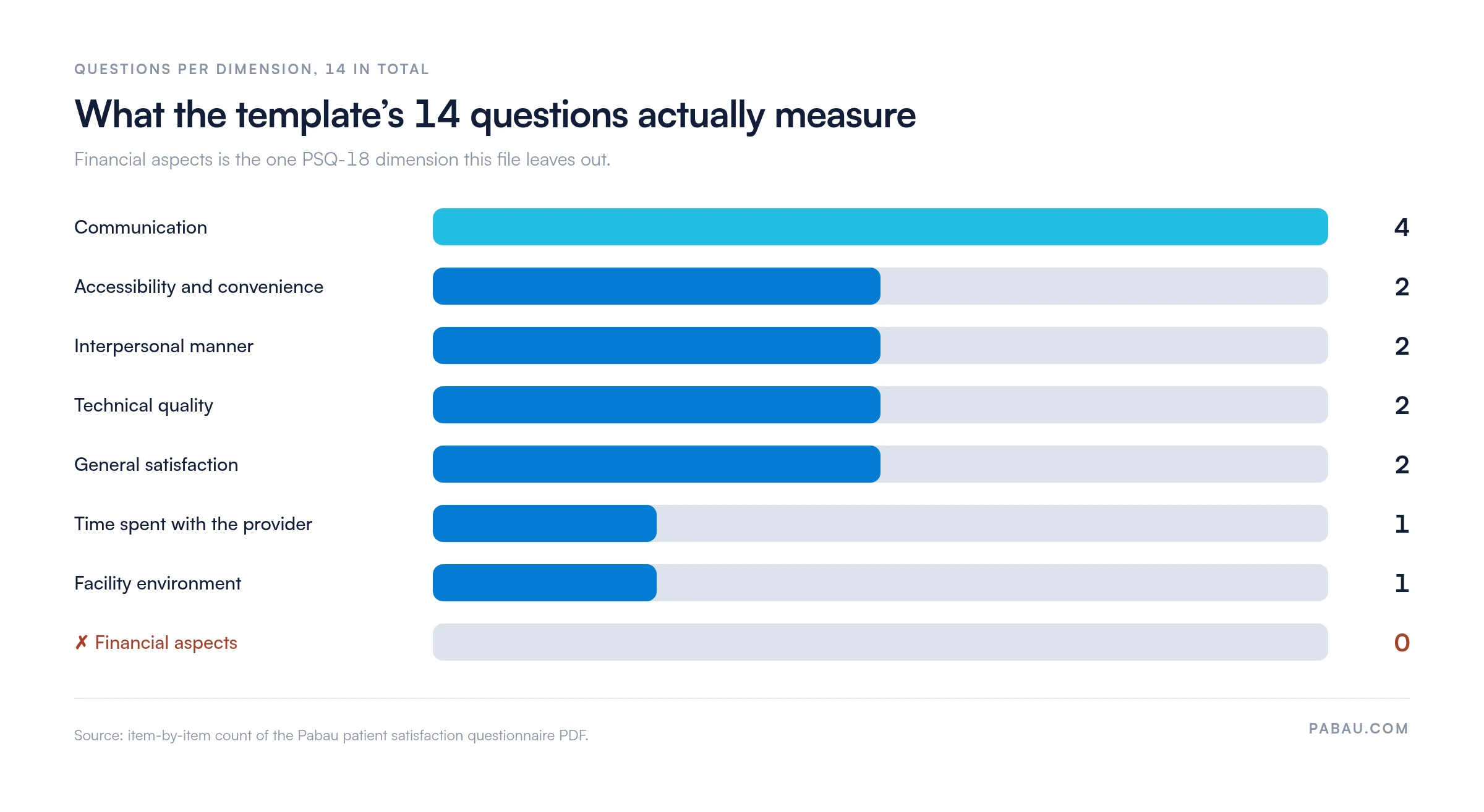
Read the chart before you deploy the form. A dimension with one question moves on a single answer. Treat a low score there as a prompt to ask more, not as a finding.
Facility environment sits outside the PSQ-18 set, and the cleanliness question that covers it is worth keeping. HCAHPS measures the same ground for hospitals, under room cleanliness.
Three approaches are in general use. The PSQ-18, developed by RAND Health, is a peer-reviewed short form of the 50-item PSQ-III. It takes about five minutes to complete, which is why private practices reach for it.
HCAHPS is the CMS-mandated survey for inpatient hospital stays. It measures nurse communication, doctor communication, staff responsiveness, communication about pain, medication side effects, discharge planning, and room cleanliness.
Custom questionnaires add specialty-specific items, such as injectable outcomes or skin improvement four weeks after treatment. Scale formats differ across the three. The PSQ-18 uses a 5-point Likert scale, HCAHPS mixes response formats, and the template above uses one 5-point agree scale throughout.
A 5-point agree scale works because patients recognize it instantly. The answers also spread widely enough for an average to mean something.
The file’s two open-ended prompts ask what the patient appreciated and what could improve. For most practices that is enough narrative feedback to work with.
The file is ready to deploy as it stands. Print it, email it, or copy the questions into a digital form. Here is how a typical round works.
Any practice collecting feedback benefits from a structured form, from a solo provider to a multi-location group. The questions carry across specialties:
Operational: Scores point at the part of the visit to fix next. Staff training, scheduling, and facility spend all get decided on evidence rather than guesswork.
Compliance: CQC, NHS commissioners, and accreditation bodies expect documented feedback and documented action. A survey program with dated results and an action log supplies both.
Retention and growth: Practices that collect and respond to feedback report higher rebooking rates and stronger word of mouth. Being asked is itself part of the experience.
Staff engagement: A dimension score reads as a system problem rather than a personal failure, so teams fix workflows instead of defending themselves.
Review results every quarter and publish one action each time. For example, patient feedback showed wait times were too long, so Thursdays now carry an extra appointment slot.
The distribution method decides how many answers you get back. Paper handed out on site returns 60% to 70%, because patients are still in the building when you ask.
Email sent after the visit returns 20% to 35%, since the patient has to remember to open it. Digital in-app or SMS sends land between the two at 40% to 50%, completed on the phone before the patient gets home.
So paper wins on volume, and digital wins on staff effort. Run paper in the waiting room when you need the highest response rate. Automate the send when nobody has time to hand out forms.
Analysis is arithmetic. Average the items in each dimension, then track those averages over time. A dimension average below 3.5 flags a problem, and below 3.0 needs attention this month.
Code the open-ended answers into themes such as wait time, staff manner, and cleanliness, then count them. Patient care workflows improve fastest when a theme is tied to a named change in the schedule or the protocol.
UK private practices and NHS contractors work to specific expectations on feedback. CQC inspectors ask whether a practice collects patient feedback and acts on it. A survey program with dated scores is among the strongest Well-Led evidence available.
NHS England’s GP Patient Survey is an annual national survey of registered patients. Results are published, benchmarked against peers, and discussed with integrated care boards.
The Friends and Family Test asks whether patients would recommend the service to friends and family. It runs continuously across NHS services, and private practices often track the same single question.
Practices with dated questionnaires, an action plan, and follow-up scores are more likely to be rated Good or Outstanding than practices relying on anecdote.
Manual distribution eats staff time. Someone prints the forms, hands them out, types the answers into a spreadsheet, and chases the patients who never replied.
Practice management software like Pabau replaces that with a trigger. When an appointment is marked complete, Pabau’s automated workflows email or text the questionnaire, and the answer lands in the patient’s record.
Contact details come from the booking itself. Patients who book through our online booking software arrive with a verified email and mobile number, so the send needs no extra data entry.
Pabau’s reporting then groups responses by dimension, provider, and location. An automated text send returns 40% to 50%, against 20% to 35% for an email someone has to remember to write.
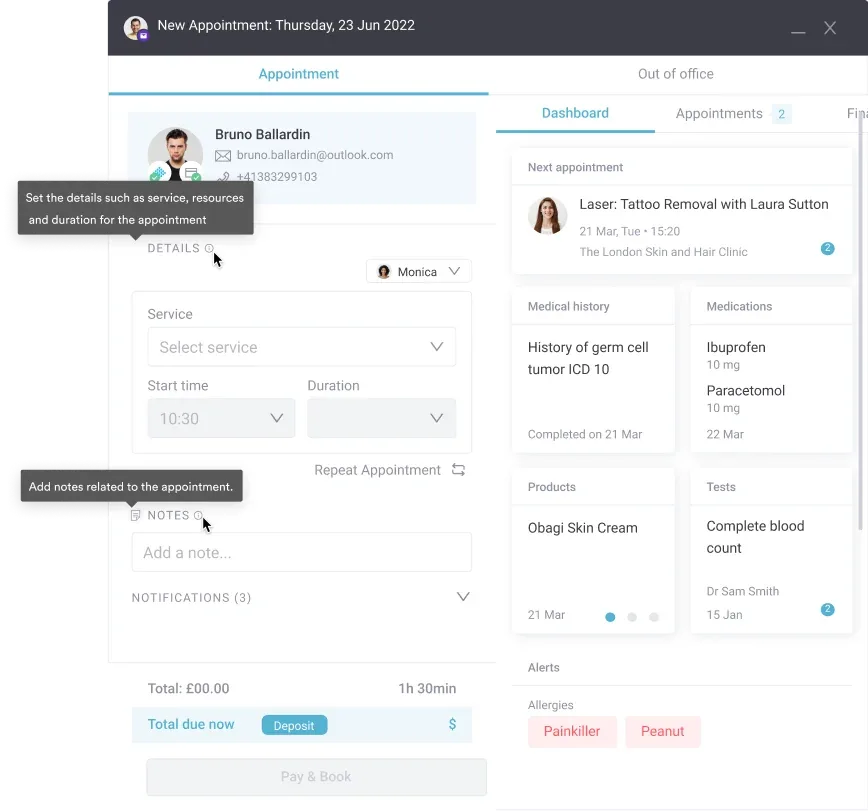

Automated post-visit sends, responses filed in the patient record, and dimension scores in one reporting dashboard.

The template is worth deploying as it stands, provided you know what it measures. Six dimensions are covered, communication carries the most weight, and billing feedback is yours to add.
The trade-off worth remembering is volume against effort. Paper in the waiting room gets the most answers, and an automated send gets answers with no admin work.
Whichever route you pick, the scores pay off only when one change follows each round. Book a demo to see how Pabau sends the questionnaire after every visit and files the answers in the patient record.

Choosing a tool to run the surveys? Patient satisfaction survey software compares the platforms that automate the send and the scoring.
Not sure how satisfaction differs from experience? Patient satisfaction vs patient experience separates the two measures and shows when each one matters.
Have the scores and need a plan? Improving patient experience turns dimension scores into changes patients actually notice.
Want the feedback to drive rebooking? Patient retention strategies covers the follow-up that keeps satisfied patients coming back.
Cover the seven PSQ-18 dimensions: general satisfaction, technical quality, interpersonal manner, communication, financial aspects, time spent with the provider, and accessibility. Two to four rated items per dimension is enough, plus two or three open-ended questions. The template on this page carries 14 rated items covering six of those dimensions, and no question on financial aspects.
The PSQ-18 is an 18-item short form of the original 50-item Patient Satisfaction Questionnaire (PSQ-III) developed by RAND Health. It measures seven dimensions of healthcare satisfaction and has been validated across primary care, specialty clinics, and hospital settings. Each item uses a 5-point Likert scale, and it takes about five minutes to complete.
Patient satisfaction is measured with structured questionnaires that ask patients to rate named parts of the visit on a fixed scale. Responses are averaged by dimension and tracked over time. A 5-point agree scale is standard. Averages above 3.5 out of 5 indicate satisfaction, and averages below 3.0 signal a problem. Open-ended answers explain why a score moved.
No. The current file has no question on billing, insurance, or value for money, so financial aspects is the one PSQ-18 dimension it leaves uncovered. Add a single item, such as whether costs were explained clearly before treatment, if patients pay you directly.
Most practices send one every four to eight weeks, which works out at roughly quarterly. Monthly sends mostly add noise and tire patients out, while annual sends miss the window where feedback is still actionable. Aesthetic practices often survey after specific treatments, such as two weeks after a Botox appointment. NHS practices also take part in the annual GP Patient Survey.