OSHA respirator medical evaluation questionnaire
The OSHA respirator medical evaluation questionnaire is the mandatory health for...

3
Last Updated: Oct 15, 2026

Kidney stone pain typically scores 7 to 10 on a 0-10 scale, putting it in the same band as labor pain.
The Numerical Rating Scale (NRS) and Visual Analogue Scale (VAS) are the standardized tools clinicians use to document severity and track progression.
Stone location and the degree of obstruction predict pain severity better than stone size, with the ureteropelvic junction the worst spot.
Management escalates with the score. NSAIDs carry the mild and moderate bands, opioids start at 7, and fever or a single kidney means emergency referral.
A score that stops falling by day seven, or a score of 8 to 10 with fever, is the signal to re-image rather than re-dose.
A one-page assessment form covering NRS and VAS scoring, pain location, associated symptoms, and analgesia given. It also lists the escalation triggers that send a patient straight to the emergency department.
Download templateKidney stone pain, known clinically as renal colic, ranks among the most severe acute pain a patient can present with. Scoring it consistently is what separates a defensible record from a note that reads “severe pain” and nothing more.
The score only helps if it is captured the same way every time. That holds in the emergency department, during watchful waiting, and after treatment. Standardized digital patient intake forms in practice management software like Pabau keep it repeatable across visits and clinicians.
This guide covers what each number on the scale means at the bedside. It also shows how the pain moves as the stone travels, and when the score itself is the reason to escalate.

The pain scale of kidney stones measures how intensely a patient experiences renal colic on a standardized numerical or visual axis. Two validated scales dominate clinical practice. The Numerical Rating Scale (NRS) asks patients to rate pain from 0 (no pain) to 10 (worst pain imaginable). The Visual Analogue Scale (VAS) asks them to mark a point on a 10-cm line.
Scores consistently land in the 7-10 range, which makes renal colic one of the highest-rated acute pain states in medicine. Research published in a peer-reviewed medical journal found that stone location and the degree of urinary obstruction predict pain severity on the VAS. Stone size on its own does not.
Teams use these scales to track whether pain is improving with treatment, and to justify imaging or intervention when it is not. AI-assisted clinical documentation captures the assessment during the consultation itself, so the number never gets reconstructed from memory afterward.
Below is the clinical reference for how renal colic presents at each level of the 10-point scale.
Individual variation is wide. A 7-mm stone in one patient may score 6, while a 5-mm stone in another scores 8. Obstruction degree and ureteral location are stronger predictors than size.
Kidney stone pain does not stay in one place. As the stone travels from the kidney through the ureter to the bladder, the patient feels it at different sites:
This migration helps you predict which imaging to order, since flank pain with hematuria strongly suggests a stone. It also reassures patients that a change in location means progress. Ask patients to mark the site on a body map, then file it with the imaging in your medical records system. The trail then stays visible across the whole episode.
Stone size correlates loosely with pain, but it is not the main driver. A small stone impacted at the ureteropelvic junction can outscore a larger one sitting in a partly obstructed lower ureter. How completely the flow is blocked matters more than diameter.
Document both the size on imaging and the patient’s reported score. A mismatch usually points to how completely the ureter is obstructed, or to how well the analgesia is working.
Two validated tools cover almost every renal colic encounter, and they answer slightly different questions.
Numerical Rating Scale (NRS): Ask the patient to rate their pain right now, from 0 to 10. Explain that 0 is no pain and 10 is the worst pain they can imagine. Then document the number. NRS is fast, plain-language, and reproducible across visits, which suits emergency departments and routine practice workflows alike.
Visual Analogue Scale (VAS): Give the patient a 10-cm unmarked line, labeled “no pain” at one end and “worst pain imaginable” at the other. They mark a point, and you measure from the left end in centimeters. VAS picks up smaller changes and is preferred in research, but it takes longer and asks more of the patient.
Recording scores in a standardized digital form means emergency handoffs, follow-up reviews, and billing documentation all reference the same baseline assessment.
Renal colic unfolds in predictable phases, each with its own clinical signature:
Plotted against the scale, those four phases form a descending band. It is easy to recognize on a chart, and easy to miss in free text.
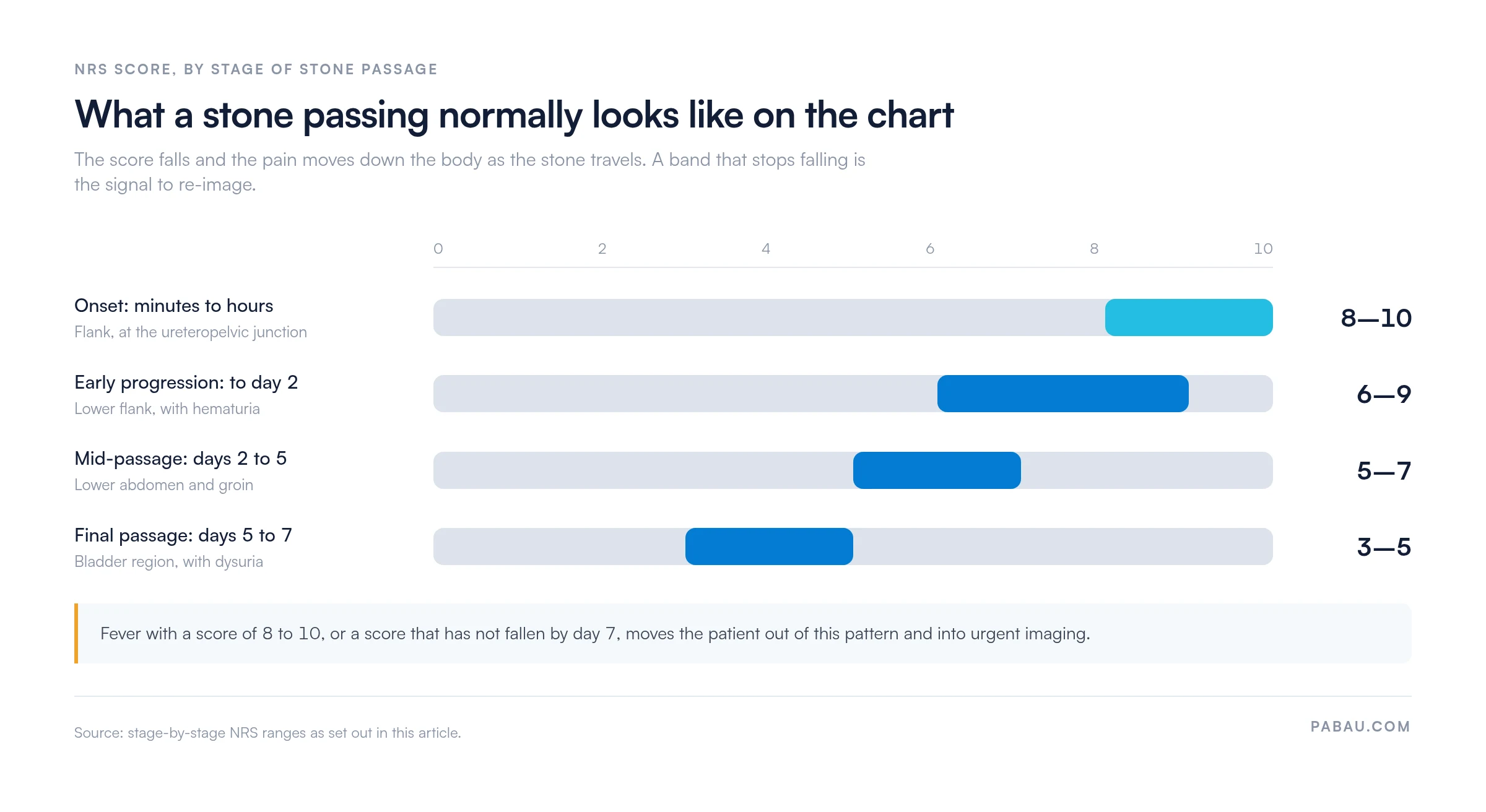
Deviation from this timeline points to a complication. Fever alongside a score of 8-10 suggests an infected obstructed kidney. Pain that persists past seven days without passage suggests an impacted stone that needs intervention.
The comparison rests on two separate data sets, both cited by Keck Medicine of USC. A 1996 Scandinavian study asked first-time mothers to rate their worst labor pain, and they averaged 7 to 8 out of 10. Mothers who had given birth before rated it 6 to 7.
In a separate 2016 survey of 287 kidney stone patients, the average worst score was 7.9.
So the two sit in the same band rather than one clearly beating the other. What differs is the shape. Labor pain is prolonged but purposeful, and it has a defined endpoint. Renal colic arrives without warning and offers no such promise.
Childbirth also brings relief between contractions. Renal colic comes in waves 20 to 60 minutes apart with little reprieve. Patients often describe it as the worse of the two. Take that at face value when you set analgesia, and never dismiss a high rating as “just a stone”.
Renal colic is rarely isolated. The symptoms that travel with it amplify distress and can complicate the diagnosis:
Record the accompanying symptoms alongside the score. A high score with fever means escalate now. A high score with nausea and hematuria but no fever is typical renal colic, managed with analgesia and hydration. Logging temperature and observations in a vital signs record keeps the two readings side by side.
Analgesic choice and intensity scale with the reported score:
Read the bands alongside the red flags that override them, since either one can decide the next step.
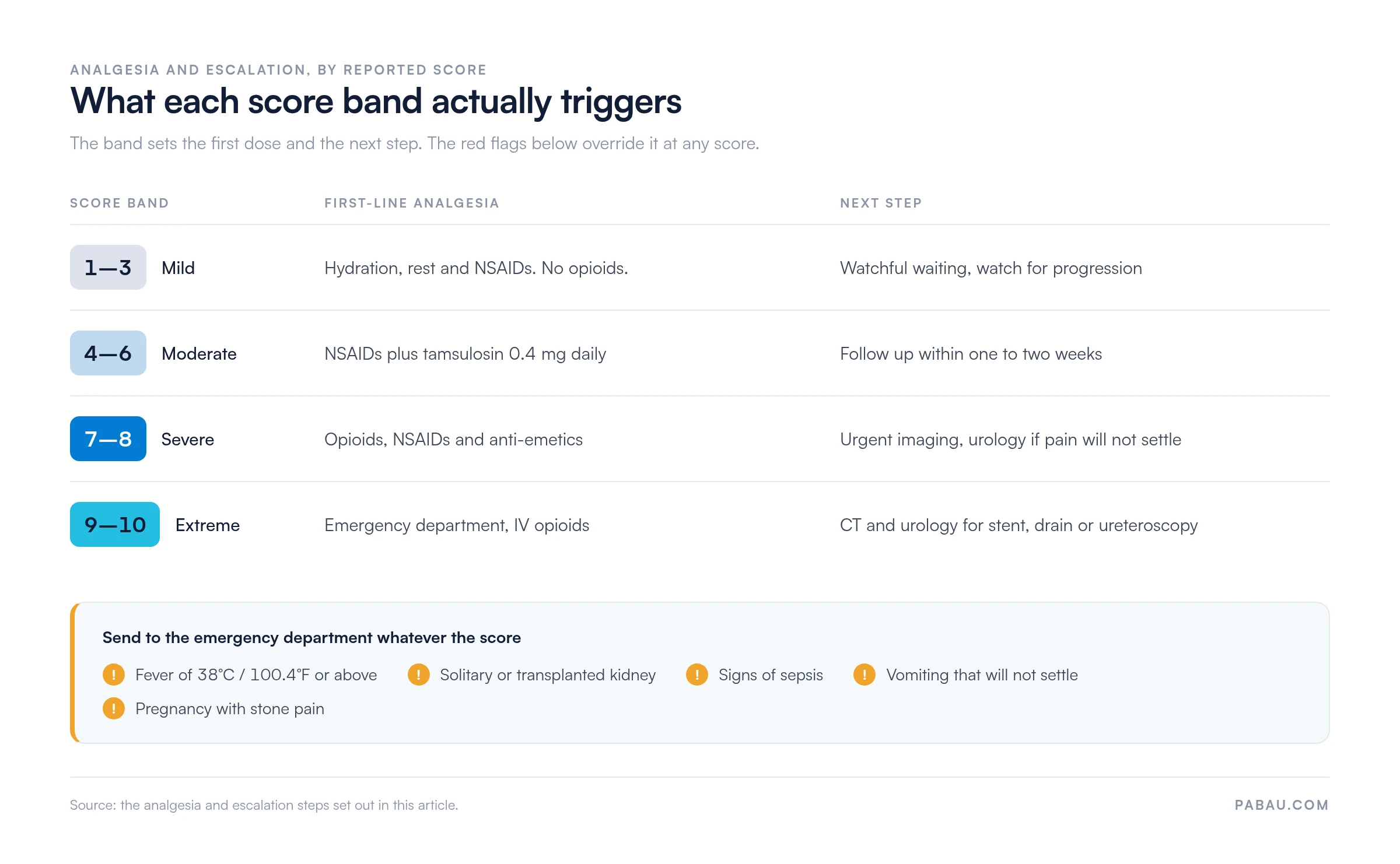
Scores are dynamic, so re-assess 30 to 60 minutes after each intervention. A patient who rated 9 and received IV morphine should report 4 to 5 within the hour. If they still report 8 to 9, repeat the dose or escalate to intervention.
Refer to the emergency department immediately, without waiting for office imaging or a urology appointment, if the patient has:
When a patient presents at 8-10, keep a low threshold for immediate referral or same-day imaging. For after-hours calls, ask about fever, vomiting, and whether they can keep fluids down. An emergency nursing assessment template gives that triage call a fixed set of questions. The answer then does not depend on who picks up the phone.
Document the score and the location together at every encounter. Use a body diagram so patients mark exactly where they feel it. Over two to three days, pain that migrates from flank to groin signals normal passage. Pain that stays in one place, or worsens, suggests impaction. Tracking the location gives you an early warning the score alone would miss.
Pain scores usually live in free-text notes. One clinician writes “8/10”, the next writes “severe”, and a third records nothing at all. By the follow-up visit, nobody can say whether the number is falling.
Pabau puts the scale into a structured form instead. You build the pain assessment once, then attach it to every renal colic encounter. Patients can complete it on their own phone before they reach the exam room.
Because the form sits in the patient record beside the imaging, allergies, and prescribing history, the score is comparable across visits by default. Pabau Scribe drafts the note from the consultation, so the number you said out loud reaches the chart. Sharing the whole episode with a urology team then takes a couple of clicks.

Pabau turns your pain assessment into a structured form that patients complete before the visit, then files each score against the record. You get a comparable trend instead of scattered free text.

Renal colic sits at the top of the acute pain range, and the number a patient gives you carries clinical weight. Score it with the same tool every time, and the trend does most of the diagnostic work for you.
The trade-off worth remembering is that a single score tells you very little. A score falling from 9 to 5 over four days is reassurance. The same 9 recorded three days running is a reason to re-image. You only see the difference if both were written down.
Download the template above and use it on the next patient with flank pain. You will have a comparable record from the first encounter onward. Book a demo to see how Pabau turns that form into a scored, searchable part of the patient record.

Triaging a patient who may need the emergency department? Emergency nursing assessment sets out the questions to ask before you decide to refer.
Need the observations that sit beside the pain score? Vital signs record gives you a single sheet for temperature, pulse, and blood pressure across the episode.
Documenting a pre-hospital assessment? EMT patient assessment covers the structured handover an ambulance crew gives the receiving team.
Patient too distressed to answer reliably? Level of consciousness assessment helps you record responsiveness when a numeric pain score is not obtainable.
Planning care across the whole episode? Kidney stones nursing care plan turns the pain score into goals, interventions, and an evaluation step.
The pain scale of kidney stones measures renal colic intensity on a 0-10 numerical scale (NRS) or a 10-cm visual scale (VAS). Scores usually sit between 7 and 10 during active obstruction. Clinicians use these tools to document severity, track treatment response, and justify imaging or intervention.
Most patients rate their worst kidney stone pain between 7 and 10. In a 2016 survey of 287 patients cited by Keck Medicine of USC, the average worst score was 7.9. The highest scores occur when a stone is lodged at the ureteropelvic junction.
Go to the emergency department immediately if pain of 9-10 will not settle with medication. The same applies with fever and flank pain, obstruction in a single kidney, signs of sepsis, or vomiting that prevents fluid intake. Each points to a complication needing urgent imaging and possible surgery.
Pain typically comes in waves of 20 to 60 minutes. Most episodes subside within 3 to 5 days as the stone passes through the ureter. If pain persists beyond 7 days without passage, or worsens, that suggests a large impacted stone or a complication requiring intervention.
They sit in the same band. First-time mothers in a 1996 Scandinavian study averaged 7 to 8 for their worst labor pain. In a 2016 survey, 287 kidney stone patients averaged 7.9. The shapes differ. Labor is prolonged but has a defined endpoint, while renal colic arrives without warning.
The Numerical Rating Scale (NRS, 0-10) and the Visual Analogue Scale (VAS, a 10-cm line) are the two most common. NRS is faster and preferred in emergency settings, while VAS picks up smaller changes and is used in research. Both are validated and reproducible.