Anemia nursing care plan
An anemia nursing care plan is a structured document that guides a nurse from as...

1
Last Updated: Oct 9, 2026

A pain killer tablet is an analgesic. It dampens pain signals in the nervous system without causing unconsciousness.
Tablets fall into four classes: NSAIDs, acetaminophen, prescription opioids, and adjuvant analgesics for nerve pain.
Only NSAIDs treat the inflammation behind the pain. Acetaminophen works centrally and does not touch it.
Opioid tablets sit at DEA Schedule II to IV, so they need EPCS-compliant electronic prescribing.
Practice management software like Pabau keeps medication histories, allergies, and prescribing decisions in one patient record.
Every class on one page, with generic names, common brand names, typical strengths, and the DEA schedule where one applies. Print it, adapt it to your own formulary, and keep it where staff can reach it.
Download templateA pain killer tablet is an analgesic. It blocks or dampens pain signals in the nervous system without putting the patient to sleep.
Tablets fall into four classes: NSAIDs, acetaminophen, prescription opioids, and adjuvant analgesics for nerve pain. Each class brings its own brand names, dose ranges, and control status.
This reference lists the tablet names you meet in practice, class by class. It also flags what each class needs in the patient record, from an acetaminophen daily total to the DEA schedule on an opioid script. Download the list above to print it or adapt it for your own practice.
Analgesics are grouped by how they work, how strong they are, and how tightly they are controlled. Five forms come up in day-to-day prescribing.
The four tablet classes split on more than potency. Inflammation, over-the-counter access, DEA control, and dependence risk each divide them in a different place.
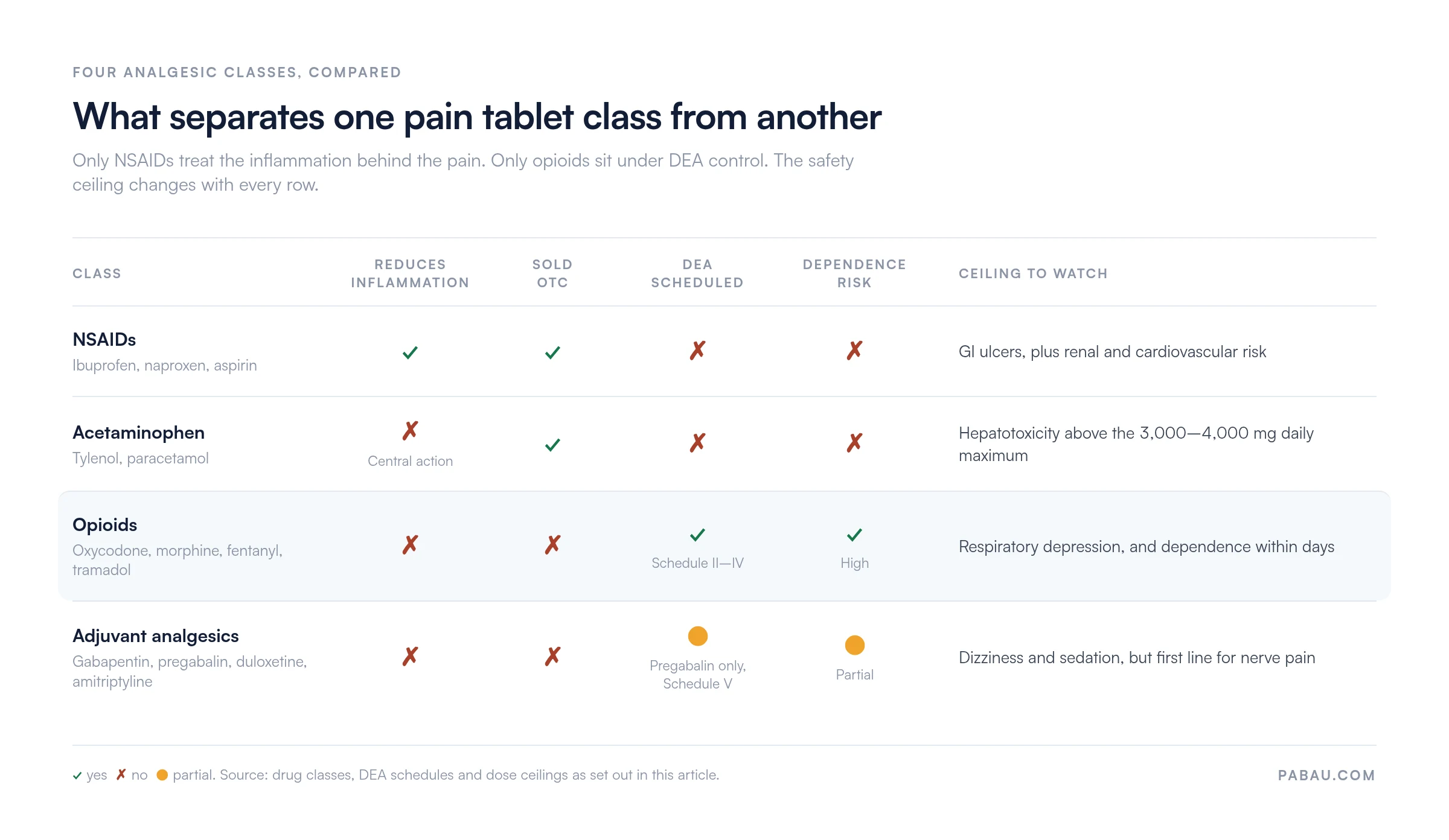
Over-the-counter tablets cover mild-to-moderate pain and fever without a script. They split into NSAIDs and acetaminophen, and each suits a different patient.
NSAIDs (ibuprofen, naproxen, aspirin): these block prostaglandins, so they bring down swelling as well as pain. That makes them the first choice where inflammation is driving the problem. Long-term use risks gastrointestinal ulcers, cardiovascular events, and renal impairment, so some patients cannot take them at all.
Acetaminophen (Tylenol, paracetamol): this works centrally on pain and temperature, not on inflammation. It is the safer option for patients with GI disease or an aspirin allergy. Overdose causes liver damage, and the daily maximum is 3,000 to 4,000 mg depending on region and formulation.
Prescription analgesics take over where over-the-counter options run out. The list covers Schedule II to IV opioids alongside non-narcotic prescription alternatives.
Opioid analgesics carry documentation duties the other classes do not. The CDC opioid prescribing guidelines recommend the lowest effective dose, monitoring for dependence, and co-prescribing naloxone where the risk warrants it. Schedule II tablets such as oxycodone, morphine, and fentanyl must go out through EPCS, the DEA route for electronic prescribing of controlled substances.
Neuropathic pain rarely answers to an NSAID. The first-line options are adjuvant analgesics, drugs developed as antidepressants or anticonvulsants that turned out to work on nerve pain pathways.
Safety comes down to picking the right drug, dosing it properly, and watching what happens next. Four checks matter more than the rest.
Record an adverse reaction while the detail is still fresh. A standard adverse reaction form records what the patient took, what happened, and what you did about it, in the same shape every time.
Patient education matters. Collecting medication history, allergies, and contraindications through patient intake software means the answers are on file before you prescribe. For counseling patients on opioids, the NIH MedlinePlus opioid guidance covers storage, disposal, and warning signs in plain language.
The tablet name is only half the record. What makes a medication note hold up months later is the detail specific to that class, written down at the time.
A shared medication log keeps those details in one place across visits, instead of scattered through consultation notes. For staff still learning a class, a drug card puts the mechanism, dose range, and cautions on a single page.
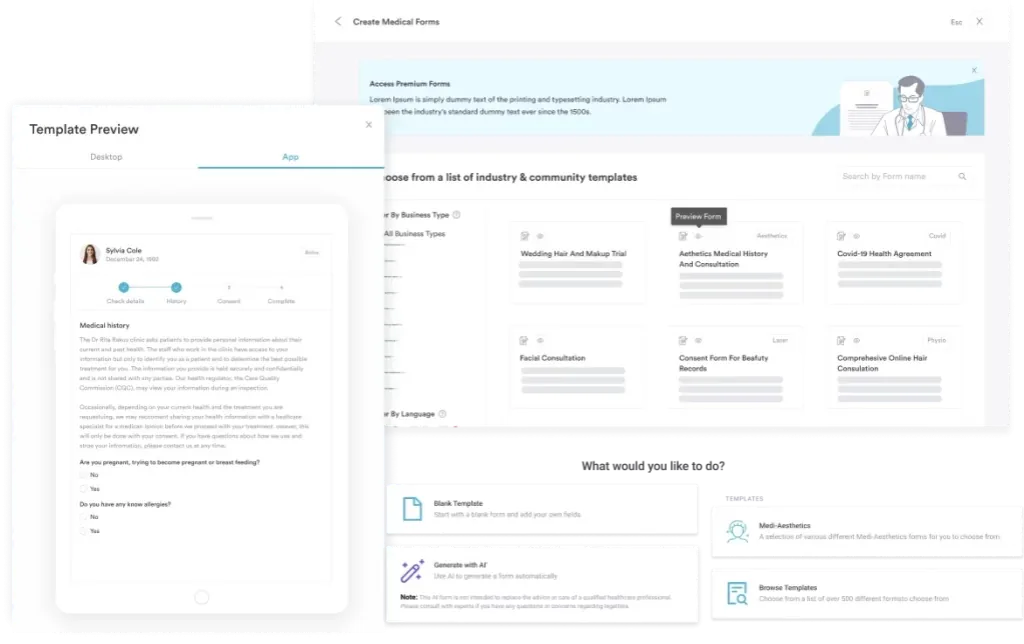
Pain medications usually get tracked in two places at once. The prescription lives in one system, and the reason for it lives in a consultation note somewhere else. When the patient comes back still in pain, someone has to reconcile the two before anyone can prescribe again.
Practice management software like Pabau puts both in the same patient record. Our prescription management software issues the script electronically and files it against the visit that prompted it. Pabau Scribe, our AI scribe, writes the consultation note in the background, so the clinical reason sits beside the medication.
Your team then reads the medication history in seconds. Allergies, past analgesics, and every dose change appear on one screen, so the next prescriber is not reconstructing the story from three separate notes.
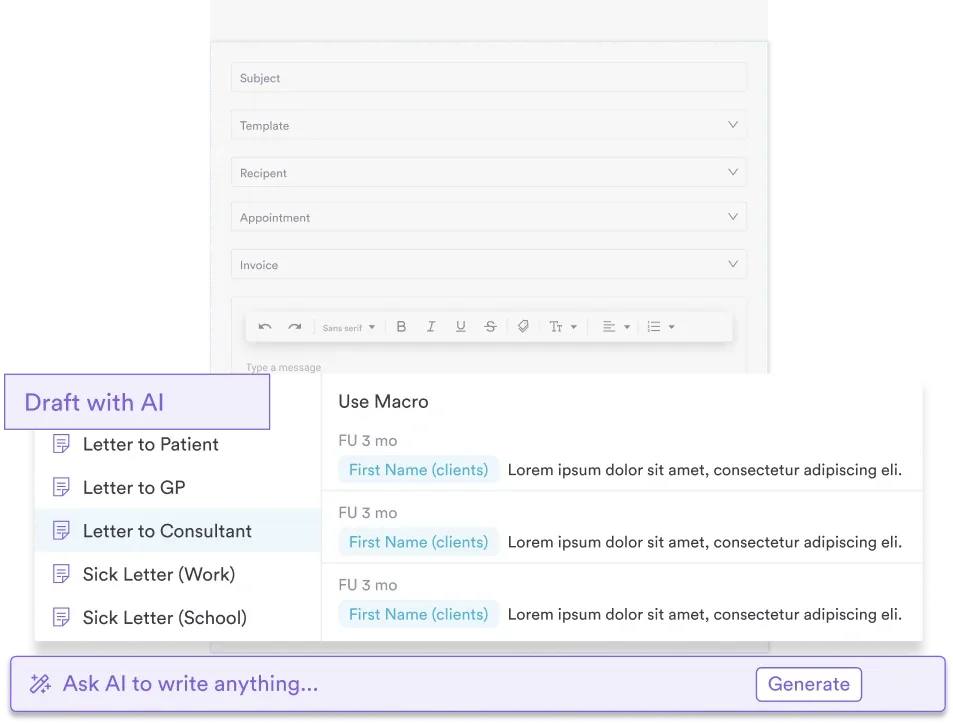

Pabau files each prescription against the visit that prompted it, and keeps allergies and dose changes on one screen. Your next prescriber sees the whole history.

Pick the class before you pick the tablet. Inflammatory pain wants an NSAID, a GI or renal risk pushes you toward acetaminophen, and nerve pain answers to neither. The brand name is the last decision you make, not the first.
The other half of the job is the record. An opioid script nobody can trace back to an indication becomes a compliance problem months later, when a reviewer asks why it was written. Put the reason down while the patient is still in the room.
Print the list, adapt it to your own formulary, and keep it somewhere staff can reach it mid-consultation. Book a demo to see how Pabau keeps prescriptions, allergies, and consultation notes in one patient record.

Need a running record of what a patient takes? Medication schedule template sets out dosing times and quantities in a format patients can follow at home.
Want the note written while you consult? Clinical notes software structures the consultation into a searchable chart record. AI scribes cut around seven minutes off a typical note.
Monitoring a patient on long-term opioids? 5-panel drug test template explains what the panel screens for, so the result lands in the chart in a consistent format.
Acetaminophen and low-dose NSAIDs are safer over the long term than opioids, which carry dependence risk. NSAIDs still raise cardiovascular and renal risk with prolonged use. Acetaminophen carries hepatotoxicity risk above 3,000 to 4,000 mg a day. The safest choice depends on the patient’s comorbidities and the type of pain. For chronic neuropathic pain, gabapentin or duloxetine is usually preferred.
Naproxen (Aleve) is the strongest over-the-counter option, because one dose lasts longer than ibuprofen or acetaminophen. A single 220 mg naproxen sodium tablet covers 8 to 12 hours. Ibuprofen needs redosing every 4 to 6 hours. Strength is not the same as safety. Naproxen carries the same NSAID risks and is contraindicated in renal impairment.
NSAIDs block prostaglandins, so they reduce inflammation and pain together. They are not addictive, and they sell over the counter as well as on prescription. Opioids act on the central nervous system to block pain perception, and they carry high abuse and dependence potential. That is why they sit at DEA Schedule II to IV. NSAIDs suit inflammatory or mild-to-moderate pain, while opioids are reserved for severe or cancer pain.
For acute muscle pain, an NSAID such as ibuprofen or naproxen works best, because it treats the inflammation and the pain together. Pair it with rest, ice, and physical therapy. For fibromyalgia or myofascial pain, gabapentin or duloxetine usually outperforms an NSAID on its own. A short course of a muscle relaxant helps where spasm is the main problem.
Yes. Tramadol sits at Schedule IV. The adjuvant analgesics, meaning gabapentin, pregabalin, duloxetine, and amitriptyline, carry far less dependence risk. Prescription-strength NSAIDs are another option. Tramadol combines weak opioid activity with norepinephrine and serotonin reuptake inhibition. Gabapentin and pregabalin target neuropathic pain specifically.
NSAIDs cause gastrointestinal upset and ulcers, and raise cardiovascular and renal risk over the long term. An acetaminophen overdose damages the liver. Opioids cause nausea, constipation, dizziness, and respiratory depression at higher doses, and chronic use leads to tolerance and dependence. Gabapentin and the antidepressants cause dizziness, dry mouth, and sedation. Counsel every patient on what to watch for.