Cervix length during pregnancy chart
A cervix length during pregnancy chart records cervical length in millimeters ag...

Last Updated: Oct 14, 2026
A sample reference letter to recommend an employee gives you a tested structure for a credible endorsement. You start from a working draft instead of a blank page. A strong letter fits on one page and has five parts: header, opening, body, closing, and signature. The body carries two or three strengths, each backed by an example the next employer can check.
Below you get the template itself, the four writing steps, and the mistakes that quietly weaken a reference. If your team keeps staff records in one place, staff management software makes it easier to pull the role dates and achievements you need first.
A one-page letter with every section laid out, from the header and greeting through to the endorsement and signature block. Bracketed fields show exactly what to replace, so you can send it the same day the request lands.
Download template
A reference letter is a one-page endorsement of an employee’s work.
Confirm permission and role details before you draft a single sentence.
Back every strength with a specific example you can verify.
Leave out protected characteristics, patient details, and claims you cannot check.
Keep role dates and achievements in one staff record, inside practice software such as Pabau.
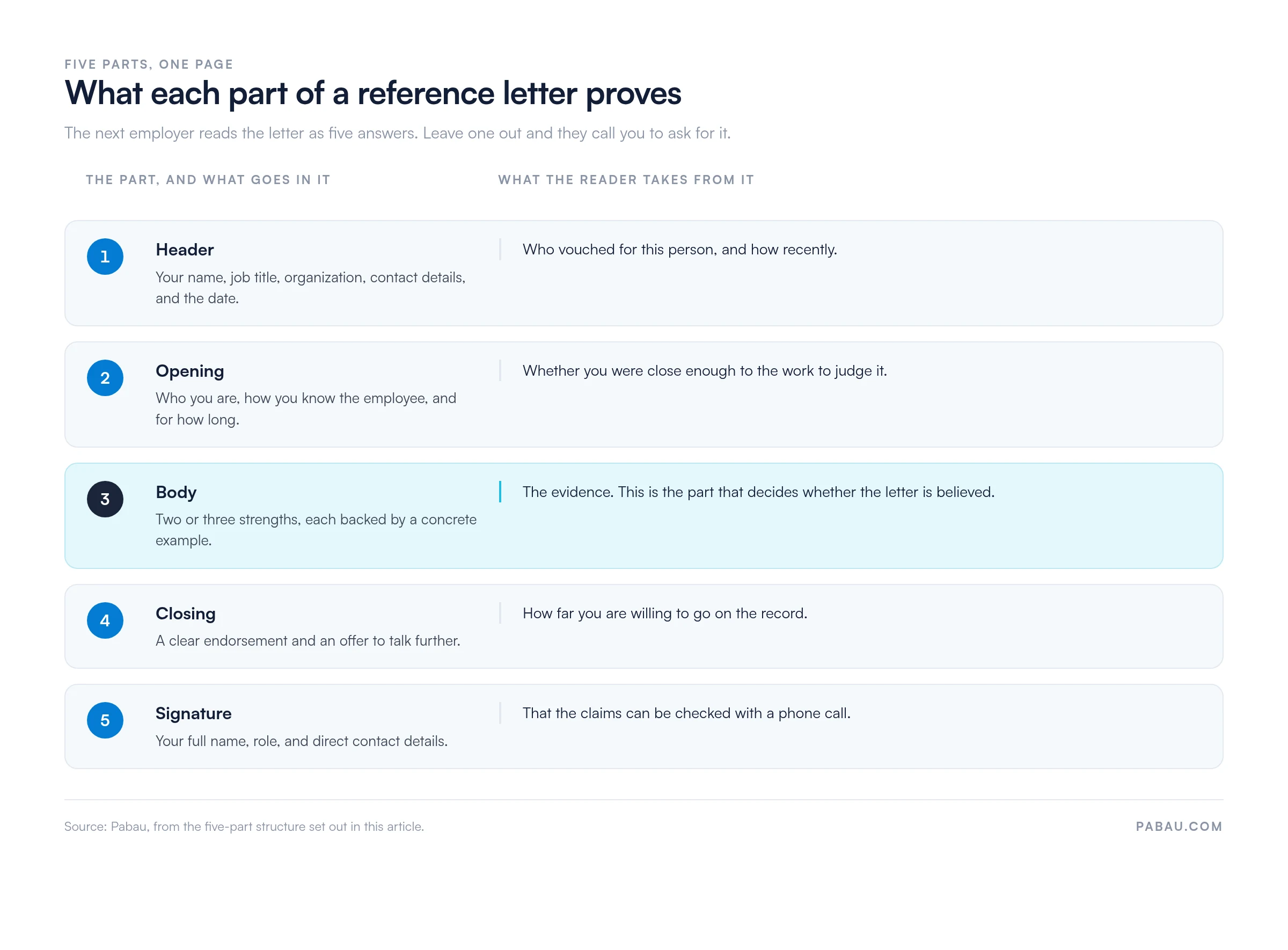
A strong letter has five parts, and each one answers a question the next employer will ask.
Those five parts do different jobs, and the chart below maps each one to what the reader actually takes from it.
Keep the whole letter to one page. Standard HR guidance points to that length, and busy readers skim longer documents.
The date and contact details matter more than people expect. A reader needs to see who wrote the letter and when, so never skip them.
Writing the letter takes four steps, and the first one happens before you type a word.
Work from the staff record rather than from memory, because specific facts are what keep the letter accurate. A past annual review is the fastest place to find dates, results, and wording you can quote.
Practices that collect staff details on digital forms already hold most of this on file.
Use this sample reference letter to recommend an employee as a starting point. Replace each bracketed field with details from the employee’s record, and delete any line you cannot verify.
[Date]
To whom it may concern,
I am writing to recommend [Employee Name], who worked as [Job Title] at [Organization] from [start month and year] to [end month and year]. I supervised [Employee Name] directly as [Your Job Title], so I can speak to their day-to-day work.
[Employee Name] consistently demonstrated [strength one], most clearly when [specific example and outcome]. [He/She/They] also showed [strength two], which [concrete result for the team or patients].
I recommend [Employee Name] without reservation for [type of role]. Please contact me at [phone] or [email] if you would like to discuss their work further.
Sincerely,
[Your Full Name]
[Your Job Title], [Organization]
Adapt the tone to your organization, but keep the facts. A warm, specific letter reads as more credible than one that stacks superlatives.
The core structure stays the same, but the emphasis shifts with the role. Adjust the strengths and examples to match what the next employer will care about.
Practice managers writing for nurses, therapists, or administrative staff should focus on reliability, communication, and following protocols. Describe conduct in workplace terms, such as how the employee handled a full schedule or recorded information accurately.
Never name patients, diagnoses, or treatment details. HIPAA privacy guidance protects patient information in the United States, so keep case details out of the letter entirely.
Clinical note-taking sits outside this process. Tools such as Pabau Scribe, our AI scribe, keep treatment notes in the patient record, so clinical detail never reaches a staff reference.
When an employee moved up, emphasize growth and added responsibility. Name the change in scope, such as supervising a new team or leading a rollout, and tie it to a result you observed.
Keep a running achievements log for each team member. Add a line each time a project lands or a target is hit, so writing the reference letter later takes far less time.
A reference letter fails when it is vague, and most problems come from a few predictable habits.
A false or misleading negative statement can create legal exposure, and the rules vary by jurisdiction. Treat this article as general guidance, not legal advice, and check your HR policy before sending. UK employers can also review data handling duties in UK ICO data protection guidance.
Employment facts usually sit in several places at once. Start dates come out of a payroll export, achievements out of a manager’s inbox, and shift history out of a spreadsheet. Writing one short letter then means three searches before the first sentence.
Pabau is software for practice managers who want staff records, schedules, and documents in one system. Each team member has a profile holding their role, their working history, and their licenses and certificates, with renewal dates tracked against them.
So when a reference request lands, the dates and the evidence are already in front of you. You spend your time on the wording instead of the hunt.

Pabau holds each team member’s role, dates, documents, and certificates in one profile, so a reference request takes minutes rather than an afternoon of searching.

A reference letter is a short document with a long memory. Write it from the record, keep it to one page, and say only what you would repeat on a phone call.
The trade-off worth remembering is warmth against precision, and precision wins. A plain letter full of checkable detail does more for the employee than a glowing one nobody can verify. Book a demo to see how Pabau keeps staff dates, roles, and achievements ready before the request arrives.

Want to see how the system behind staff records works? What is practice management software explains the core tasks one system handles for a practice.
Planning your staffing further ahead? Healthcare workforce planning sets out how practice leaders forecast cover and hiring needs.
Need to document a difficult conversation instead? Employee counseling form gives you a free template and a guide to filling it in.
Supporting someone whose performance has slipped? Performance improvement plan template covers goals, review dates, and the support you commit to.
A reference letter for an employee is a written endorsement from a current or former manager. It confirms the person’s role, performance, and suitability for future work. It is usually one page long and written in a professional tone.
A reference letter should usually fit on one page. Keep it to the points that matter for the role, because readers skim longer documents.
The two terms are used interchangeably in most employment contexts. The main difference is usage, with recommendation letters more common in academic settings.
Yes, a line manager is usually the most credible writer, provided they worked closely with the employee. Where the manager has left, a former colleague who supervised the work can also write one.
Leave out protected characteristics, unverifiable claims, and any confidential patient information. Keep every statement factual and tied to the employee’s work.