Punch excision aftercare instructions template
Punch excision is a minor procedure that removes a small cylinder of skin with a...

2
Last Updated: Oct 15, 2026

A no-suicide contract is a written agreement in which a patient pledges not to harm themselves between sessions.
Research does not support the contract as a suicide prevention tool, and a signed copy does not reduce malpractice liability.
Safety planning is the evidence-based alternative, built on coping steps and crisis contacts agreed on in session.
Use the contract as an adjunct to a safety plan, never as your only intervention.
Keep the signed form, the risk assessment and the follow-up date in one client record, in software like Pabau.
A ready-to-use no-suicide contract form covering patient identification, safety commitment, crisis resources, clinician contact information, and signature blocks for mental health practice.
Download templateA no-suicide contract is a written agreement in which a patient pledges not to harm themselves. Clinicians have used it since the 1970s, but the research behind it is weak, and a signed copy does not reduce your liability.
That does not make the form useless. It makes it one part of a wider safety workflow. This guide covers what the contract contains and what the evidence says. It also shows how to pair it with safety planning and documentation that stands up to review.
A no-suicide contract, often shortened to NSC, is a written agreement between a mental health clinician and a patient. The patient pledges not to engage in self-harm or suicidal behavior. The form usually carries the patient’s commitment, emergency numbers, crisis resources, and the clinician’s contact details.
Therapists, psychiatrists, counselors, and nurses have used the tool since the 1970s. It gave them a structure for talking about suicide safety during periods of elevated risk. Clinicians working in mental health EMR systems now record those agreements inside the clinical record.
The contract does two jobs at once. Therapeutically, it creates an explicit commitment between clinician and patient. Administratively, it documents that a safety conversation took place on a particular date.
A standard no-suicide contract template contains these core elements:
Practices running software for therapy practices can adapt the template to their treatment setting. Common additions are tiered safety levels for low, moderate, and high risk, plus a field for the next follow-up appointment.
No. The evidence on no-suicide contracts is mixed and mostly unsupportive, despite decades of clinical use. A peer-reviewed study on suicide intervention practices found that clinicians keep using NSCs while guidelines move toward safety planning.
Key research findings:
Three limitations matter most. An NSC cannot stop a patient from attempting suicide, because a person in crisis may disregard the agreement entirely. It can also breed clinician overconfidence, which reduces ongoing risk monitoring. And it can damage the therapeutic alliance if the patient reads it as punitive rather than collaborative.
Legally, a signed no-suicide contract offers no malpractice protection if a patient harms themselves. Courts have consistently ruled that an NSC alone does not amount to adequate suicide risk assessment. Check with your licensing board and malpractice insurer on the documentation standards in your jurisdiction.
Crisis intervention strategies and repeated risk assessment are far more defensible than a signature on a page. That is why many practices now pair the form with structured safety planning, or lead with the safety plan and treat the contract as optional.
Safety planning has become the evidence-based alternative. The two approaches differ on every axis that matters clinically:
Psychiatric evaluation templates increasingly build safety planning into the assessment itself, which reflects the same shift in practice.
Whether you use the contract, the safety plan, or both, the documentation is what protects the patient and you. A risk assessment should record:
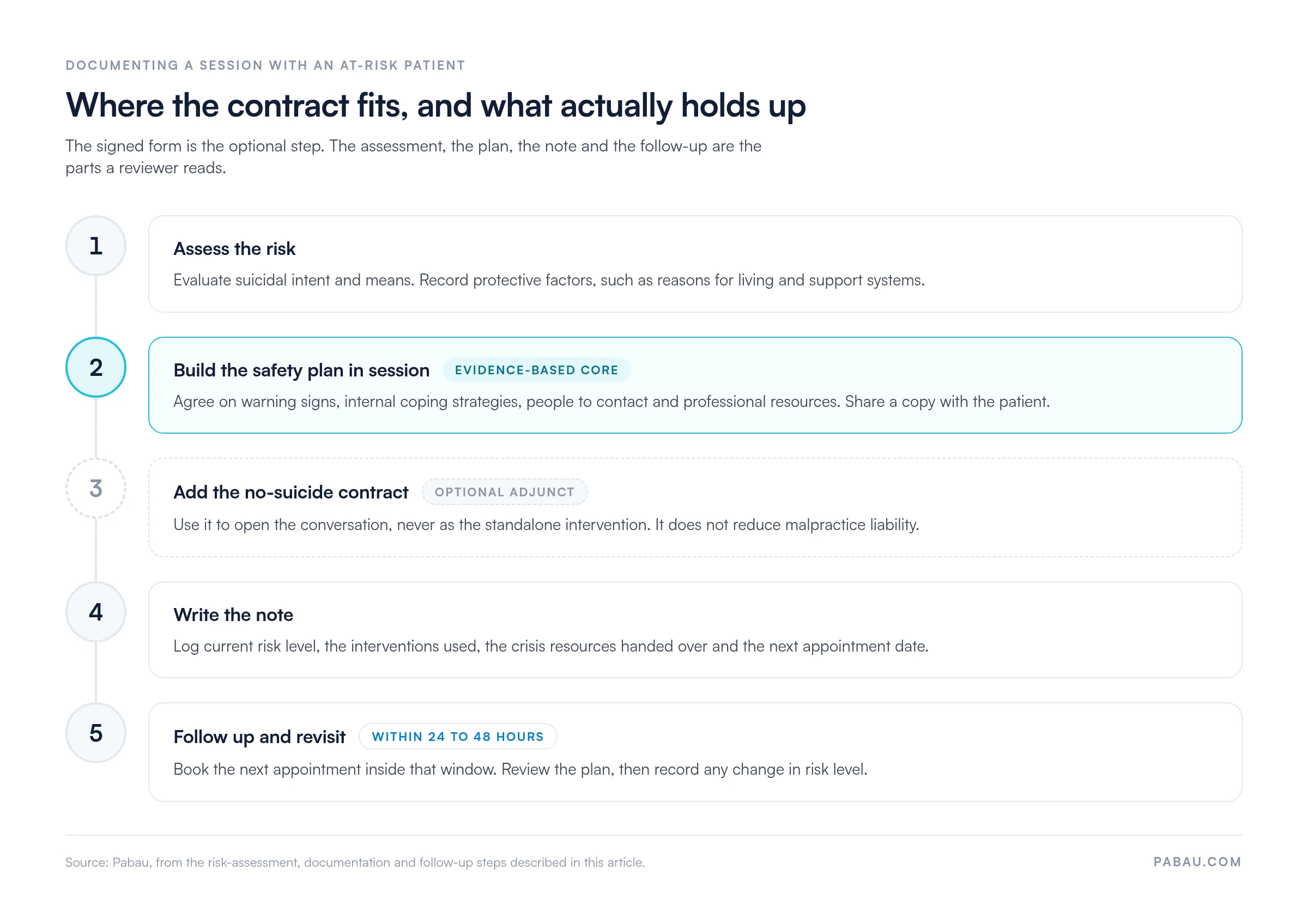
Put in order, those steps show where the signed form sits and how little of the work it carries on its own.
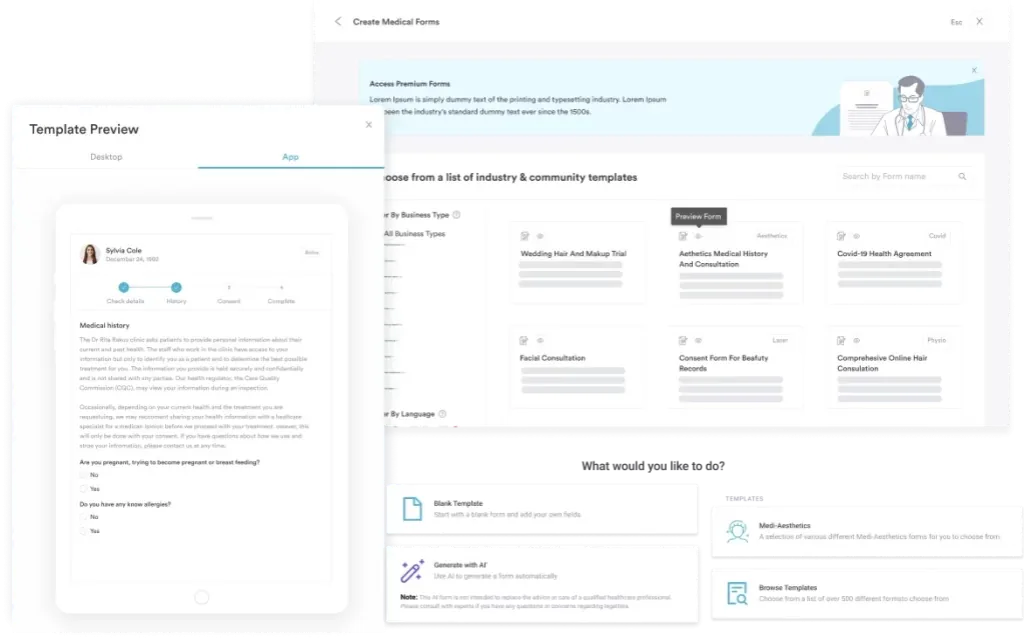
Store every safety agreement and risk assessment in a secure clinical record with timestamps and clinician signatures. Digital forms let therapists complete and file these documents electronically, which creates an audit trail. The history also stays intact if the patient transfers to another clinician.
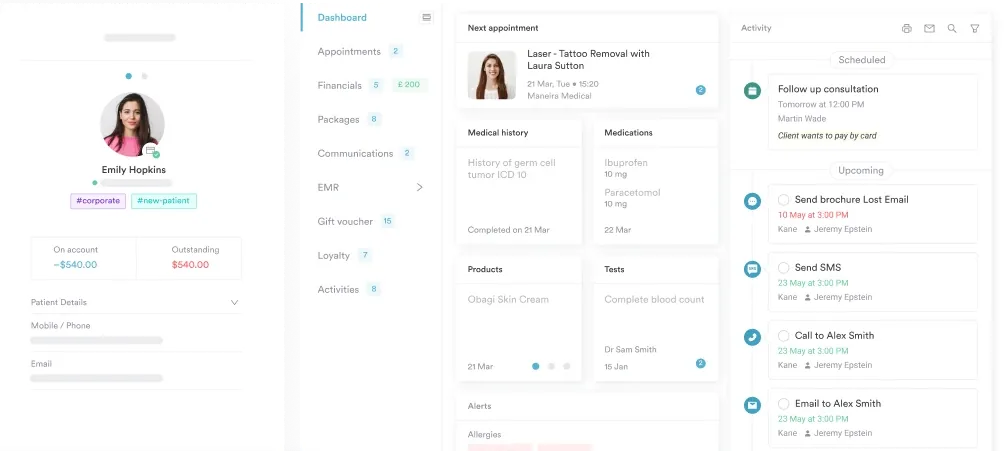
Follow-up documentation carries as much weight as the session note. Record whether the patient attended the next appointment, how the risk level moved, and when the safety plan was reviewed. Keeping crisis notes access-logged also satisfies your HIPAA obligations.
A client record that holds treatment planning, risk assessment, and follow-up scheduling together leaves fewer holes in the history. It also lets you show a reviewer that monitoring continued, which is a key defense in liability cases.
Documentation best practice: after each session with an at-risk patient, update the note with the current risk level and the interventions used. Add the crisis resources you handed over and the next appointment date. That sequence is what a continuous record of clinician vigilance looks like.
Inpatient psychiatry units, emergency departments, and crisis stabilization programs still reach for NSCs as one element of a broader safety protocol. Clinicians in those settings value the form as a way into a difficult conversation, and as a shared record that the conversation happened.
If you use one, wrap it in the rest of the workflow rather than leaning on it. Book the follow-up appointment within 24 to 48 hours of identifying risk, and document the crisis response. Agree in advance on the escalation steps if risk climbs.
The Joint Commission’s National Patient Safety Goals (NPSG.15.01.01) require healthcare organizations to run suicide risk reduction programs. Evidence-based tools and rigorous documentation are how you demonstrate compliance with that standard.
A safety plan works because the patient helps build it. In session, identify the warning signs, the internal coping strategies, the people to call, and the professional resources to use. Document the plan, hand the patient a copy, and review it at every follow-up.
Our suicide safety plan template gives you that structure in a form you can complete with the patient. Store the finished plan next to the signed contract, the treatment goals, and the risk history, so the whole file reads as one narrative.
Give patients a way to see their own plan between appointments, whether through a client portal or a copy they keep. A plan the patient can find at 2AM is doing more work than one filed in your office.
Every safety agreement should carry current crisis resources. These are the services worth listing for clinicians and patients:
Add your own emergency procedure and after-hours contact protocol to every agreement you sign. Patients need to know how to reach help at any hour, not just during your opening times.
On paper, a signed contract ends up in a folder, away from the note that explains why it was signed. When a colleague covers the patient, or a licensing board asks for the file, someone has to reassemble the story from two places.
Practice management software like Pabau keeps both in the same client record. You can send the contract or the safety plan out as a digital form before the session. The patient reads and signs it on their own device. The signed copy files itself against the appointment it belongs to.
The treatment note, the current risk level, and the next appointment then sit beside it, and every view or edit is logged. So you can hand a reviewer one continuous record instead of a folder and a hope. Forms, records, and reporting are included in every subscription.

Pabau’s digital forms and client records let therapists send, sign, and store no-suicide contracts and safety plans against the patient’s file. Risk notes, follow-up appointments, and access logs stay in the same place.

Use the contract for what it genuinely does. It gives you a structured way to say the words out loud in session, and it records that the conversation happened on a given date.
What it cannot do is carry the weight alone. What holds up under review is a structured risk assessment and a safety plan the patient helped write. The note that captures both, plus the follow-up you actually kept, is what turns that work into evidence.
Download the template above and adapt it to your setting. Then decide where the signed copy will live, who updates it, and what happens at the next appointment. Book a demo to see how Pabau keeps signed agreements, risk notes, and follow-ups in one client record.

Ready to build the evidence-based version? The mental health safety plan template walks through warning signs, coping steps, and crisis contacts with the patient.
Want a structured in-session exercise? The suicide prevention worksheet gives you prompts for exploring risk and protective factors together.
Treating adolescents? The safety plan for teenagers adapts the same structure for younger patients and their caregivers.
Need a response for the session itself? Crisis intervention strategies for clinicians covers what to do when risk escalates mid-appointment.
Writing the session up afterwards? The mental health note template keeps risk level, interventions, and follow-up in one consistent format.
A no-suicide contract is a written agreement in which a patient commits to not harming themselves. It also commits them to contacting crisis resources if suicidal thoughts intensify. Most versions include crisis phone numbers, the clinician’s contact details, and signature blocks.
No. Research does not support their effectiveness in preventing suicidal behavior. They may also create false clinician confidence, so pair the form with ongoing risk assessment and safety planning rather than using it alone.
A no-suicide contract is a patient pledge. Safety planning is a structured, collaborative action plan with specific coping steps and crisis resources. It has stronger empirical support and is recommended by the American Psychiatric Association and SAMHSA.
No. Courts have ruled that a signed no-suicide contract does not reduce clinician liability. Thorough risk assessment, ongoing documentation, and evidence-based interventions are far more defensible. Consult your malpractice insurer and licensing board for guidance.
Yes. Registered nurses, licensed practical nurses, and psychiatric nurses may use them within suicide risk assessment protocols. Follow your facility’s risk assessment standards and your state’s nursing practice guidelines when you document the session.
Review it at every session where the risk level changes, and at minimum every three to six months during ongoing treatment. Major life changes, medication adjustments, or rising suicidal ideation should trigger an immediate reassessment.