Physician credentialing checklist
A physician credentialing checklist lists every license, certificate, verificati...

Last Updated: Oct 23, 2026
A military diet chart lays out a three-day, very-low-calorie menu followed by four days of ordinary eating. Patients bring printouts of it to consultations all the time, and no two printouts match. No armed force endorses the plan, so dozens of versions circulate with different foods and portions.
The standard menu keeps active days at roughly 1,100 to 1,400 calories, which is low enough to need screening first. Share the wrong version, and the calorie math, swaps and safety advice all drift. Below, you’ll find the standard menu, the swaps that hold up and the checks to run before you share it.
A printable 3-day eating plan with patient details, breakfast, lunch, dinner and snack fields, and a notes section. It also lists the foods the standard menu allows, so you can check swaps quickly.
Download template
A military diet chart sets a fixed menu for three days, then leaves four days with no set menu.
Active days run at roughly 1,100 to 1,400 calories, so screen each patient before you share the plan.
A swap only works when the replacement matches the original food’s calories per portion.
Grapefruit can interact with some medicines, so check the medication list before it goes on the plan.
The plan isn’t nutritionally complete, so discuss protein, fiber and micronutrients with every patient.
A military diet chart is a planning sheet for a three-day eating plan, followed by four days with no set menu. Despite the name, it’s not an official US military program. So avoid calling it military-endorsed when you talk patients through it.
Most charts follow the same 3-days-on, 4-days-off cycle. Each active day lists breakfast, lunch and dinner with a rough calorie figure. Patients who want more time usually repeat the cycle.
The standard menu below is the version most sources agree on, and each day has a fixed structure. Every day pairs toast or crackers with a protein and fruit, and dinner ends with vanilla ice cream.
Check these portions against each patient’s needs before use. They’re small, and the calorie totals are approximate.
Day 1 is the highest-calorie active day in most versions, at roughly 1,400 calories. Grapefruit opens the plan, and it’s also the item patients most often want to swap.
Day 2 leans on eggs, cottage cheese and hot dogs for protein. Day 3 then drops to roughly 1,100 calories, which is why patients most often report hunger that day. The weekly rhythm below shows where that low point falls and where your review fits.
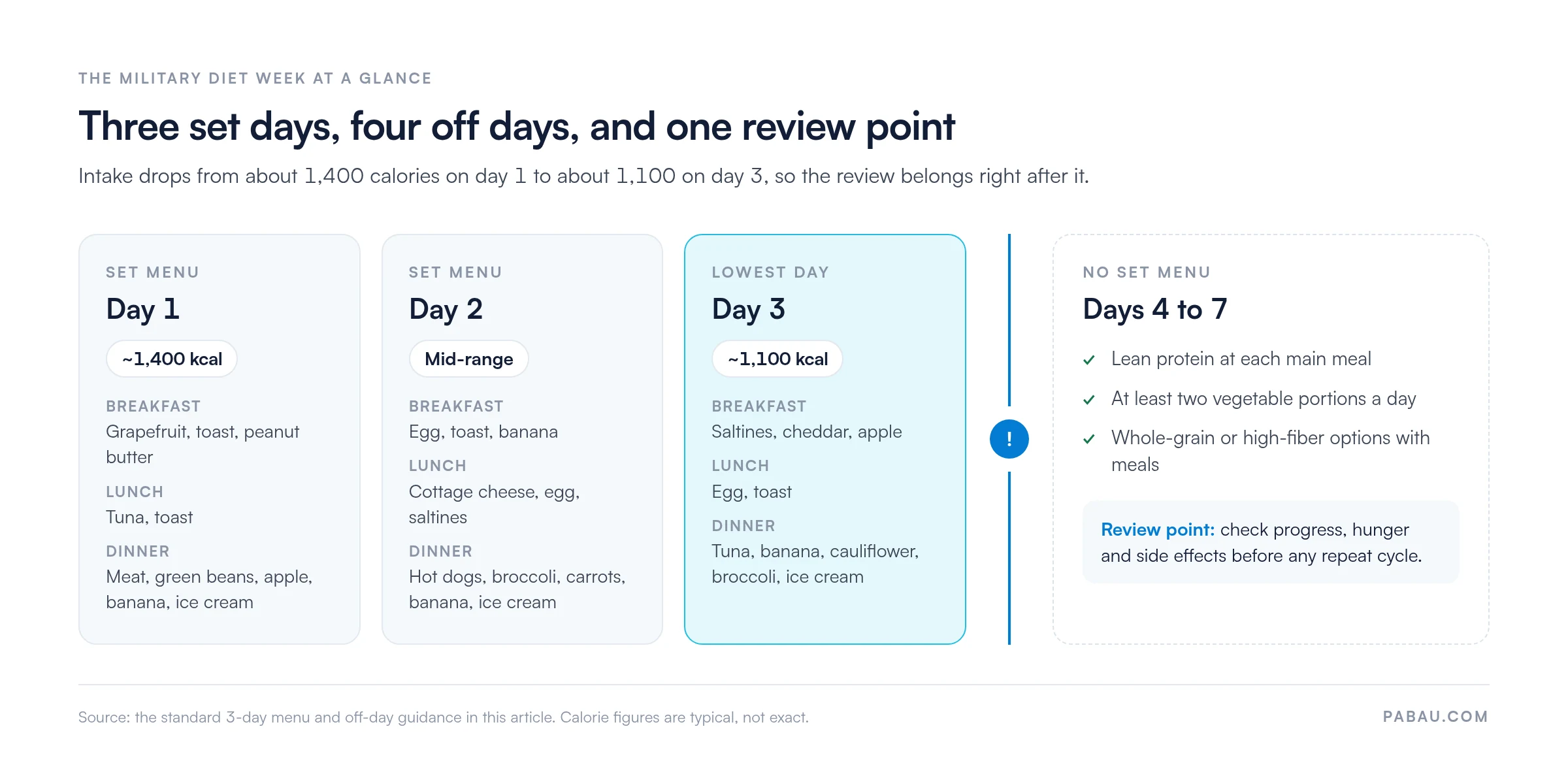
The four off days have no set menu, and that’s when many patients drift off plan. A short brief keeps protein, vegetables and fiber in place.
A printable food diary helps here too. Patients log what they eat on the off days and bring it to the review, so you’re not relying on memory.
Substitutions are the most searched part of this plan, and they’re also where calorie accuracy slips. The table pairs each common swap with what to check before you agree to it.
An orange or half a cup of berries is the most common replacement for grapefruit. The swap matters for safety as well, because grapefruit can change how some medicines work, as the FDA warns. Some charts suggest baking soda in water instead, but no reliable evidence supports that, so we don’t recommend it.
Chicken, cottage cheese or a small handful of almonds can replace tuna. Measure the portion, though, because protein swaps change the calorie total quickly. A food calorie chart makes that check faster during the consultation.
Women on this plan often find the active-day totals leave too little room for iron and protein. So before you agree to it, review the patient’s age, activity level and any history of disordered eating.
Treat the PDF as a shared reference during the consultation rather than a standalone instruction sheet. Work through these steps with the patient before you agree on a plan.
A structured nutrition assessment form covers step 1 well. It also gives you a baseline to compare against at the review.
Most problems with this plan come from small changes patients make at home. Watch for these five at the review.
Only as a short, supervised trial. It’s a very-low-calorie approach that isn’t nutritionally complete, so it doesn’t work as a standard weight-management plan.
The diet isn’t designed for long-term use, so follow your local protocols for very-low-calorie diets. If a patient wants a longer structure, a two-week diet plan gives you more room to build in balance.
Weight-loss practices, med spas and wellness practices hear about this plan most often, usually from patients who found it online. Practitioners in metabolic health tend to use it as a discussion point rather than a prescribed program.
One shared chart cuts the variation between those online versions. Your team can also record which version was discussed, which swaps were agreed and when the review happens.
Audit your intake forms before you share any diet chart. Check that they ask about medication, pregnancy, eating disorder history and diabetes. Then flag any patient who answers yes for clinician review before the plan goes out.
Many practices email a diet PDF, ask the screening questions at the appointment and write the agreed swaps on a paper note. Those answers end up in three places, and the review date depends on someone remembering it.
Pabau, the weight loss practice software we build, sends the screening questions through digital forms before the visit. Patients answer at home, and anyone who flags a contraindication is visible before the consultation starts.
Those answers then land in Client records, next to the agreed substitutions and the review date. So when the patient comes back after day 3, the clinician sees the whole plan on one screen.


See how Pabau’s digital forms and Client records keep screening answers, consent and plan notes in one place for your team.

A military diet chart is only as safe as the conversation around it. Pick one standard version, screen before you share it and book the review for the day after day 3.
Do that every time, and patients stop arriving with mismatched printouts. The trade-off is a few extra minutes at intake, which costs far less than managing a patient who felt faint on day 3.
Book a demo to see how Pabau keeps diet screening, agreed swaps and review dates together for your weight loss patients.

Comparing short fad plans? Original cabbage soup diet 7-day plan sets out another short, restrictive menu that patients often ask about.
Need a fixed daily calorie target? 1,000-calorie diet plan lays out a full day of meals at one calorie level.
Checking swaps against calories? Food calorie chart lists calorie values for common foods so portions can be compared.
Supporting heart-healthy eating? TLC diet food list covers the foods allowed on the Therapeutic Lifestyle Changes diet.
Planning meals for GLP-1 patients? GLP-1 diet plan shows how to structure meals alongside GLP-1 medication.
Usually, yes. Many sites call the same three-day menu the 3-day diet or the army diet. Menus still differ between sources, so check any version against the standard chart.
Yes. The standard menu allows coffee or tea with breakfast and lunch on day 1. Added sugar and cream raise the calorie total, so note any extras in the plan.
Results vary, and online claims are often inflated. Most early loss on a very-low-calorie plan is water and glycogen, so some of it usually returns once normal eating resumes.
Some sources describe repeating the cycle for several weeks. Extended use beyond one to two weeks should only happen under medical supervision, with a review between cycles.