List of vitamins: All 13 with RDAs and deficiency signs
A list of vitamins names the 13 essential vitamins the body needs from food or s...

1
Last Updated: Oct 8, 2026
A day diet plan for 1000 calories is a structured very low calorie diet (VLCD) that caps daily energy intake at roughly 1,000 kilocalories. It runs under clinical supervision for rapid weight loss, not as a self-directed diet. This template hands you the meal structure, the macronutrient targets, and the safety checks that go with them.
The day splits across four meals: breakfast at about 250 kcal, lunch at 300, dinner at 350, and one 100 kcal snack. Protein carries 115 to 120 g of that budget, which protects lean mass while the deficit does its work.
Against a typical adult basal rate of 1,400 to 1,800 kcal, the plan runs a deficit of 400 to 800 kcal a day. In structured programs that supports roughly 1 to 2 pounds of weight loss a week. The restriction carries documented risks, so supplementation and scheduled monitoring belong in the protocol.
Tracking all of that by hand is what eats a practitioner’s week. Weight loss clinic software keeps the baseline assessment, the issued plan, and every check-in on one patient record.
A printable 7-day plan with per-meal calorie targets, macronutrient goals, and food group serving sizes. It also carries the baseline tests and the monitoring schedule to run alongside it.
Download template
A 1000 calorie meal plan is a very low calorie diet (VLCD), so it is not suited to unsupervised or long-term use.
The macro split leans hard on protein, at 115 to 120 g a day, to limit lean muscle loss.
Candidates need a BMI above 30, medical stability, and no history of eating disorders, pregnancy, or severe organ disease.
Baseline bloods, daily multivitamin supplementation, and reviews every 2 to 4 weeks are the minimum monitoring standard.
Cap the program at 12 to 16 weeks, then step calories back up by 100 to 200 kcal a week.
A 1000 calorie meal plan is a very low calorie diet protocol in which a patient eats 1,000 kilocalories a day. The intake is usually spread across three meals and one snack, with the macronutrient ratios set in advance.
That sets it apart from an ordinary weight loss diet, which targets 1,200 to 1,500 kcal a day. A VLCD is a medical intervention, and it needs professional oversight from the first day.
The mechanism is simple. A 400 to 800 kcal daily deficit against adult basal metabolic rates drives fat mobilization. What makes the protocol demanding is the narrow margin for error. Protein has to stay high, micronutrients have to be supplemented, and adverse effects have to be caught early.
Before a patient starts, you need a baseline of their health status and their tolerance for restriction. Digital intake forms capture that once and store it against the record, so the next review has something to compare against.

Not every patient is a candidate. Guidance from the Academy of Nutrition and Dietetics points VLCDs at adults with a body mass index (BMI) above 30 kg/m².
It also covers patients whose comorbidities call for fast weight loss, such as poorly controlled type 2 diabetes or severe obstructive sleep apnea. Patients preparing for bariatric surgery are a third group. Across all of them, the patient has to be medically stable, motivated, and able to stick to a structured plan.
Some contraindications are absolute: pregnancy, breastfeeding, an active eating disorder, severe hepatic or renal disease, and poorly controlled cardiovascular disease. Relative contraindications include depression, uncontrolled hypertension, and medications that affect metabolism.
Book the first review before the patient leaves, then repeat it every 2 to 4 weeks. That cadence is what lets you catch intolerance while there is still time to adjust the plan.
The table below spreads roughly 1,000 kcal across breakfast, lunch, dinner, and a snack for each of seven days. Portion sizes line up with the food group guide further down. Adapt the examples to patient preference and cultural dietary practice. What has to hold is the calorie and macro envelope.
The split is deliberately back-loaded. Dinner takes the largest share, which makes the evening easier for patients who find the last few hours the hardest.
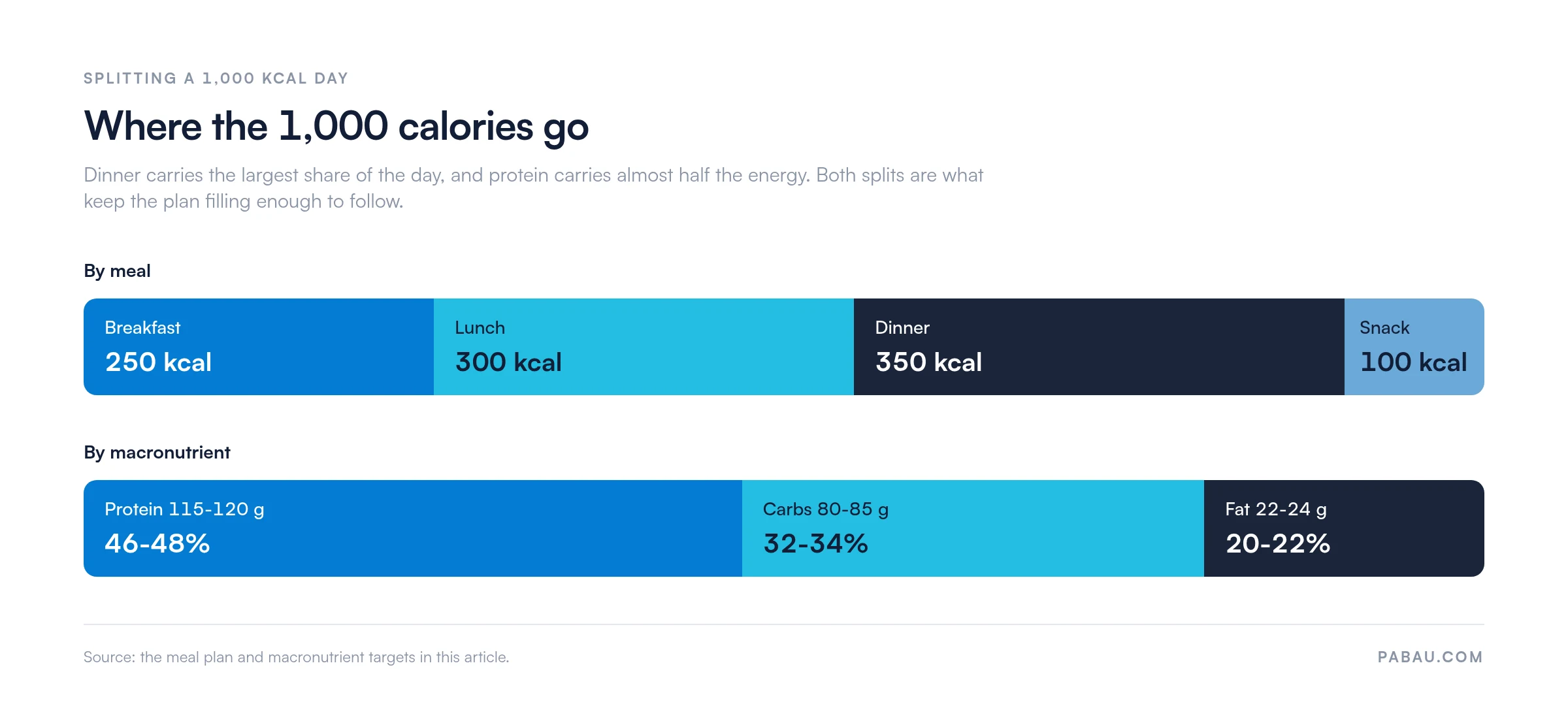
Macronutrient composition is what limits lean muscle loss on a VLCD, and it is also what makes the plan tolerable. The table below sets the targets for a day diet plan for 1000 calories. Adjust the individual ratios against metabolic assessment and patient response.
Those three ranges are built to land close to 1,000 kcal at either end. At the low end they total about 980 kcal, and at the high end about 1,035. Ranges that overshoot on both sides are a common flaw in published VLCD tables, and they leave the patient guessing.
Prescribe a comprehensive multivitamin alongside the plan, covering B vitamins, vitamin C, vitamin D, iron, zinc, and calcium. Add electrolyte monitoring for sodium and potassium, given how hard the restriction bites. A 1,000 kcal day without micronutrient support runs straight into deficiency.
This reference maps food groups to daily serving targets and portion examples inside the 1,000 kcal budget. Use it when you build an individual plan rather than issuing the 7-day template as-is.
Safe delivery of a day diet plan for 1000 calories comes down to five operational steps. Run them before, during, and after the intervention.
SMS reminders, pre-visit questionnaires, and progress charts all help patients hold the line between appointments.
Very low calorie diets carry documented risks. Walk every patient through this list before they start.
This is why the contraindication list is strict and the supervision requirement is not negotiable. A day diet plan for 1000 calories works as a time-limited clinical intervention with a defined end date.
If 1,000 kcal is too aggressive for a patient, gentler options work. Most people chasing weight loss get durable results from a smaller deficit.
A 1,200 to 1,500 kcal day supports 1 to 1.5 lbs of loss a week with fewer adverse effects. It also works without supervision, which makes it the default for self-directed patients. Our 1200 calorie diet plan covers that tier if you need a ready-made handout.
A 1,500 to 1,800 kcal maintenance level suits long-term adherence and metabolic recovery after a VLCD ends. Moderate deficits also keep hunger, fatigue, and social friction low enough that patients stay engaged.
For patients with an eating disorder history or low motivation, dietary restriction is the wrong lever. Cognitive behavioral therapy, motivational interviewing, or pharmaceutical support such as GLP-1 agonists will do more.
Most practices run these programs across three or four tools. By week four, nobody can say from a single screen whether a patient took their multivitamin or turned up for their bloods.
Practice management software like Pabau puts those four jobs on one patient record. You build the baseline assessment as a digital form and issue the meal plan through the patient portal. Every 2 to 4 week review is recorded against the same file.
Automated reminders chase the appointments, so you are not phoning patients the morning of a review. Progress figures build up in one place, so the decision to extend, adjust, or stop the program comes from the patient’s own numbers.
Every Pabau subscription includes every feature, so the forms, the portal, and the automations are there from day one. Onboarding is structured rather than self-serve, which is how a program like this gets configured properly before the first patient starts.

Pabau keeps the baseline assessment, the meal plan, and every check-in on one patient record. Automated reminders chase the reviews, so the cadence holds without anyone tracking it by hand.

A 1,000 kcal day gets weight off fast, and that speed is exactly why it needs a clinician attached to it. The plan itself is the easy part. What decides the outcome is the baseline work before it starts and the review cadence once it does.
So set the end date on day one. Twelve to sixteen weeks is the ceiling, followed by a planned step back up to maintenance. Skip that taper and the weight comes back.
And for most patients, 1,200 to 1,500 kcal will do the job with far less to monitor. Reserve the 1,000 kcal protocol for the cases that genuinely need the speed. Book a demo to see how Pabau keeps VLCD assessments, meal plans, and review notes on one patient record.

Planning a longer program? 30 day meal plan for weight loss stretches the same structure across a full month.
Want a shorter reset? 2 week diet plan covers the two-week window patients ask for most often.
Prefer a macro-led split? 30 30 40 diet plan sets the ratios first and builds the meals around them.
Working with surgical patients? Bariatric diet plan covers the pre-operative and post-operative eating stages.
It can be, under medical supervision. A 1000 calorie day is a very low calorie diet (VLCD), so safety depends on baseline health, supplementation, and monitoring for deficiency and electrolyte disturbance. Keep it to 12 to 16 weeks. Without oversight, the risk of complications rises sharply.
About 1 to 2 pounds a week, from the 400 to 800 kcal daily deficit against adult basal metabolic rates. Over 12 weeks that usually lands between 12 and 24 pounds. Results vary with baseline metabolism and activity level. Loss often plateaus after 8 to 12 weeks even when adherence holds.
Vitamin B12, folate, iron, zinc, calcium, and magnesium are the ones most at risk. Prescribe a daily multivitamin covering B vitamins, vitamin C, and vitamin D. Add calcium at 1,000 to 1,200 mg a day. Those steps prevent anemia, neuropathy, and bone density loss.
Not vigorously. The energy deficit raises the risk of hypoglycemia, muscle wasting, and injury. Light activity such as walking or gentle yoga is fine, and strength training should stay minimal. Once intake is back above 1,200 kcal, progressive resistance training becomes appropriate again.
Yes. Supervision is the standard of care for starting a VLCD. That means a baseline metabolic assessment, follow-up every 2 to 4 weeks, oversight of supplementation, and monitoring for adverse effects.
Raise intake by 100 to 200 kcal a week over 4 to 6 weeks. The target is a maintenance level of 1,500 to 1,800 kcal a day, set by activity and metabolism. Stopping abruptly invites rapid regain. Long term, a moderate deficit of 300 to 500 kcal below maintenance holds the result.