Physician credentialing checklist
A physician credentialing checklist lists every license, certificate, verificati...

Last Updated: Oct 23, 2026

A medical amnesty policy protects both the person in the emergency and the person who calls for help.
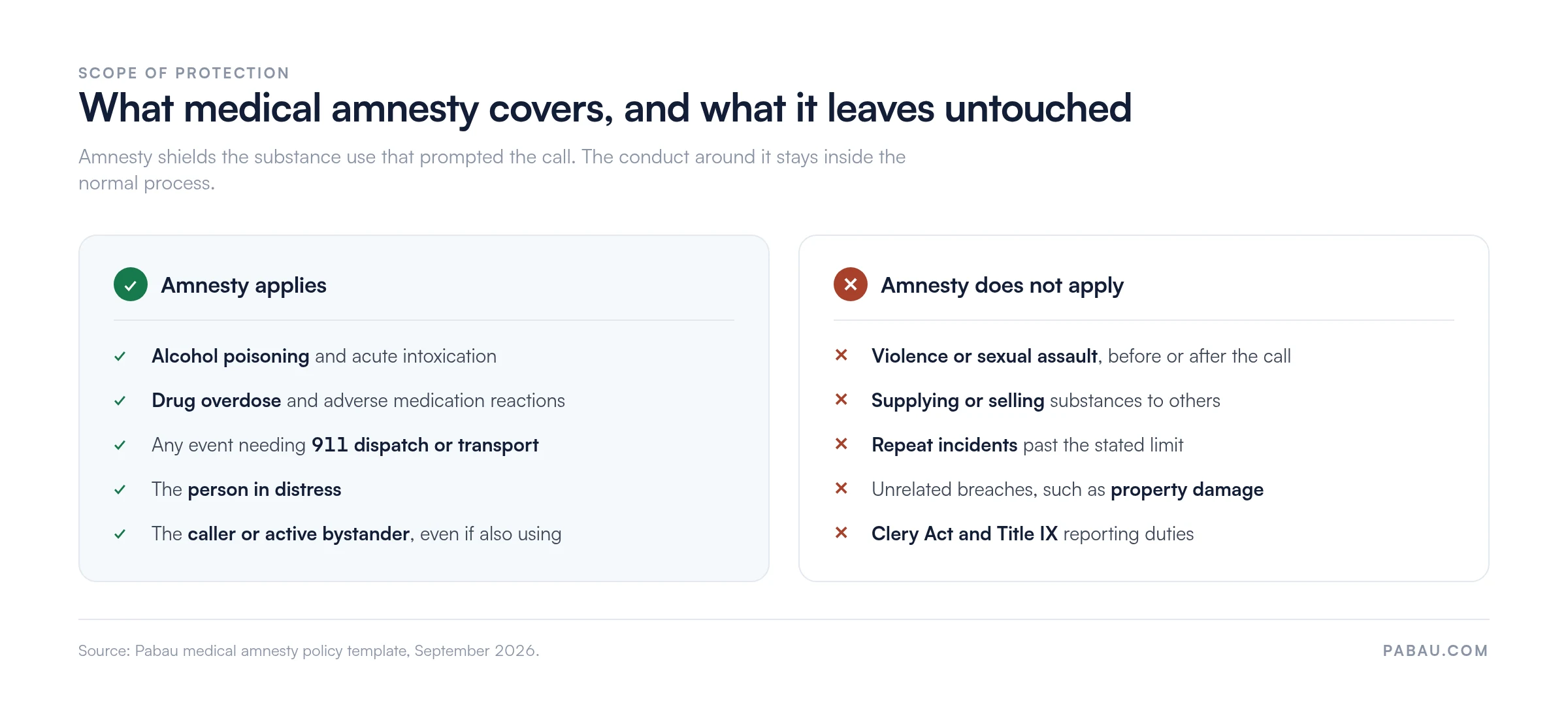
Protection covers the substance use that prompted the call, not violence, dealing, or unrelated policy breaches.
Federal duties under the Clery Act and Title IX stay in force, so the policy has to say so in writing.
Most policies attach an education requirement, with a stated deadline and a stated consequence for skipping it.
Practice management software like Pabau can hold the incident form and the follow-up record in one client file.
A blank policy skeleton laid out in the eight sections an amnesty policy needs. It covers purpose, scope, definitions, responsibilities, procedure, records, training, and monitoring. Version control and a review date sit at the foot.
Download templateA medical amnesty policy tells your people that calling 911 will not get them disciplined, protecting the person in the emergency and the person who raised the alarm, so nobody has to weigh a conduct hearing against a life.
A vague policy still leaves staff guessing at 2 AM, though, leaving the organization exposed. Below you will find what amnesty covers, where it stops, how to put it in place, plus a template to start from.
The promise is narrow and specific. If someone calls for emergency help during a drug or alcohol emergency, no conduct case follows. No suspension, no disciplinary file, no referral to a hearing panel for that substance use.
Behind it sits a harm reduction argument. During an active medical emergency, the job is keeping someone alive, and enforcement can wait until the ambulance has gone. The policy simply writes that priority down so nobody has to improvise it under pressure.
Two people are usually covered by name:
Without the second clause, the person best placed to act is the person with the most to lose. Some organizations widen it further, covering witnesses who were present but never made the call.
Amnesty applies to alcohol poisoning, overdose, acute intoxication, adverse medication reactions, and any event that needs 911 dispatch or transport. It does not wipe the slate for whatever else happened that night. Forcing a locked door to reach the person is still a separate matter, and so is a fight before the call.
Every workable policy names its limits up front:
Naming the limits is what makes the promise credible. Set the two lists side by side and the shape of the policy becomes obvious in a few seconds.
Drafting is a group job. Legal counsel, clinical leadership, safety, health services, and whoever owns conduct all need a say before the document goes out.
Work through it in this order:
Then train the people who will be first on the scene, because a policy only works if the responder remembers it exists. Our guide to crisis intervention strategies covers how to structure that training and what to rehearse.
Universities wrote the first versions, and most US four-year institutions now run one. The idea has since spread to any setting where fear of consequences could slow down a 911 call.
Therapy and counseling practices are a good example, which is why therapy practice management software increasingly has to store this kind of incident record.
The common thread is a population that might hesitate. Wherever hesitation could cost minutes, the policy earns its place.
Three changes follow, and they arrive on different timescales.
The National Institute on Alcohol Abuse and Alcoholism points to fear of discipline as one reason people delay calling for help. Removing that fear buys minutes, and minutes are the whole point in an overdose.
A documented policy shows that the organization put life safety first and followed accepted practice. That matters in a negligence claim after a preventable death. It also cuts the opposite risk. A policy that preserves Clery Act and Title IX duties in writing is hard to call a cover-up.
Standardized incident forms turn scattered emergencies into a countable record. After a year you can see which locations, months, and populations generate the most calls. Prevention spending then follows the evidence instead of the loudest complaint.
Communicate the policy through more than one channel: posters, email, orientation, staff training, and peer education. People routinely report not knowing their organization has amnesty at all. Assign one person to own that communication each year, and give the job a date rather than a good intention.
Amnesty rarely stands alone. It works as one piece of a harm reduction approach, which accepts that substance use happens and concentrates on reducing what it costs people.
Practices already using harm reduction worksheets with clients will recognize the same logic applied at policy level.
It touches three parts of that approach at once:
That third point is where most of the long-term value sits. The follow-up session is the moment to hand over something structured, such as a substance abuse treatment plan, rather than a leaflet and a hope.
Organizations that pair amnesty with naloxone access, fentanyl test strips, and peer support tend to get more out of all of them. Both the Substance Abuse and Mental Health Services Administration and the Drug Policy Alliance report better outcomes from harm reduction models than from punitive ones.
The amnesty record usually starts life on paper. Someone writes up the incident, emails it to two colleagues, and books the education session in a personal calendar. A year later, when a board or an insurer asks what happened, the pieces are in four places and one of them has left.
Practice management software like Pabau handles it differently. The amnesty incident report becomes a digital form attached to the client record. That single form holds the write-up, the consent, the education referral, and the completion date. There is no email thread to reassemble a year later.
Access controls decide who can open that file, which matters when the record describes an overdose. Behavioral health clinics and addiction treatment programs can keep the detail open to the clinicians who need it. Everyone else stays locked out, and there is no second filing cabinet to manage.
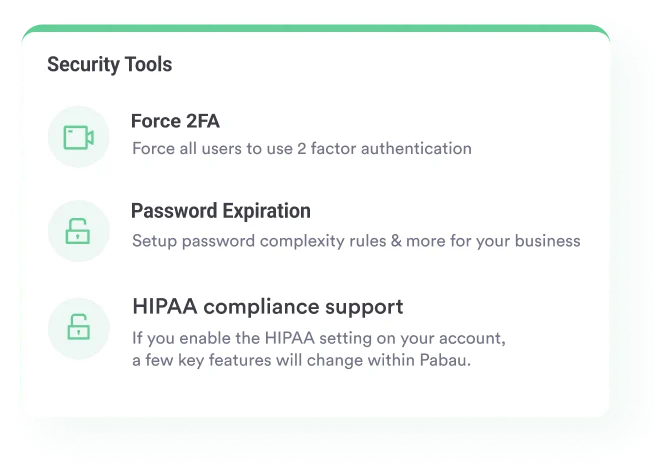

Behavioral health clinics and addiction treatment programs use Pabau’s digital forms to log an amnesty incident in the client record. Compliance tools then track the education follow-up and keep the file audit-ready.

Writing a medical amnesty policy is the easy part. The work is making sure the people it protects know it exists before they need it. A policy nobody has read does not shorten a single 911 call.
So take the template and sit down with your legal counsel. Come out with three decisions: who is covered, what is excluded, and who owns the document next year. Then say it out loud, repeatedly, to the people it applies to.
One trade-off is worth holding on to. Every exclusion you add makes the policy easier to defend and slightly less reassuring to the person deciding whether to dial. Write the exclusions you can justify, and no more.
Once it is live, the work turns into record-keeping. Book a demo to see how Pabau logs each amnesty incident and its follow-up in the client’s own file.

Screening before opioid therapy starts? Opioid risk tool (ORT) gives you the scoring bands and a free template for judging misuse risk.
Planning what happens after the incident? Relapse prevention plan worksheet turns the mandatory follow-up into a plan the client keeps.
Need a structured substance use assessment? Drug and alcohol evaluation walks through the intake most treatment programs run first.
Choosing the system that stores these files? Behavioral health practice management EHR covers what to look for before you commit.
Not to what the police do. Your policy governs institutional discipline only, so it cannot stop an officer acting under state law. State Good Samaritan statutes are the layer that limits criminal exposure, and their scope varies by state. Say that plainly in the policy, or people will assume the promise is broader than it is.
They overlap, but they are not interchangeable. Good-faith reporting usually covers anyone raising a concern, from hazing to a safety hazard. Medical amnesty is narrower and applies to substance-related medical emergencies. Some organizations fold amnesty into a wider reporting policy, which works as long as the medical scope is written out separately.
Once a year is the usual cadence, and a change in state law should trigger an earlier look. Review the exclusions, the education requirement, and the incident numbers together. If staff have been applying the policy inconsistently, that shows up in the records long before it shows up in a complaint.
One named person, not a committee. Committees write a policy well and then let it drift. Give ownership to whoever already handles compliance or clinical governance. Their job list is fixed: annual review, staff training, and the yearly reminder that the policy exists.