My current medication list
A “my current medication list” is a one-page record of every medicin...

Last Updated: Oct 5, 2026
A pre-interview questionnaire template is a short written form you send candidates after they apply and before you book an interview. It asks every applicant the same five to eight questions on availability, pay, qualifications, motivation and role-specific skills. That lets you shortlist quickly and fairly.
For a practice hiring around a full patient schedule, it replaces a round of phone calls with answers you can compare side by side. This guide covers what to ask for each role, how to score the answers, a phone-screen script and which questions to avoid before an offer.
A printable two-page PDF with fields for employee name, job title, department and date completed. It lists 10 statements rated from Never to Always, then a free-text notes box and an office-use panel for the total score and reviewer sign-off.
Download template
A pre-interview questionnaire collects the same five to eight answers from every candidate, so you shortlist on job-related facts rather than first impressions.
Cover availability, salary expectations, licenses, motivation and role-specific skills. Drop any question that doesn’t filter for the job.
Leave out protected-characteristic questions. Check salary-history rules too, because some US states ban or restrict them, while UK EHRC guidance only discourages them.
Pabau, the practice management platform we build, collects questionnaire responses through digital forms and sends reminders and follow-ups through automated workflows.
The questionnaire sits between the job application and the formal interview. It works as a lightweight screening tool that gives every applicant the same early-stage questions.
A full application asks for a resume, employment history and a cover letter. A pre-interview questionnaire narrows that down to five to eight key questions that tell you who’s worth meeting in person. For practices hiring alongside a full patient schedule, that saves hours spent on unsuitable candidates.
Common questions cover availability, salary expectations, relevant qualifications, motivation for the role and logistics, such as “Can you work weekends?” for spa or front-desk roles. Some practices add role-specific technical questions.
A written screen standardizes hiring and saves time at every stage:
A strong questionnaire covers five areas. Here’s what to ask in each, and why:
Keep the total form to five to eight questions. Longer questionnaires lower response rates and feel like a burden before the interview stage.
A six-step workflow gets the most out of the questionnaire:
Below is a ready-to-use set of screening questions for common practice roles. Adapt the wording to your practice’s culture and legal jurisdiction.
Once a nurse candidate clears this screen, our list of LPN interview questions covers what to ask in the formal interview.
Some practices prefer a short phone screen before sending the written questionnaire, or after the answers are in. Here’s a script you can follow:
Opening (1 minute): “Hi [Name], thanks for taking the call. I’m [Manager Name] from [Practice]. I want to walk through your background for the [Role] position. Does this time still work for you?”
Core questions (8 minutes): “What attracted you to this role?” / “What’s your experience with [key requirement]?” / “What’s your ideal salary range?” / “When could you start?” / “Do you have any questions for me?”
Closing (1 minute): “Thanks [Name]. We’ll be in touch by [date] with next steps.” (Document notes: tone, engagement, clarity, answers to key questions.)
Keep phone screens to about 10 minutes, and score the call against the same criteria as the written form.
Before you use any pre-interview questionnaire, review the hiring rules that apply to you. Several depend on where you hire:
The panel below sorts the most common questions by how safe they are to ask before an offer.
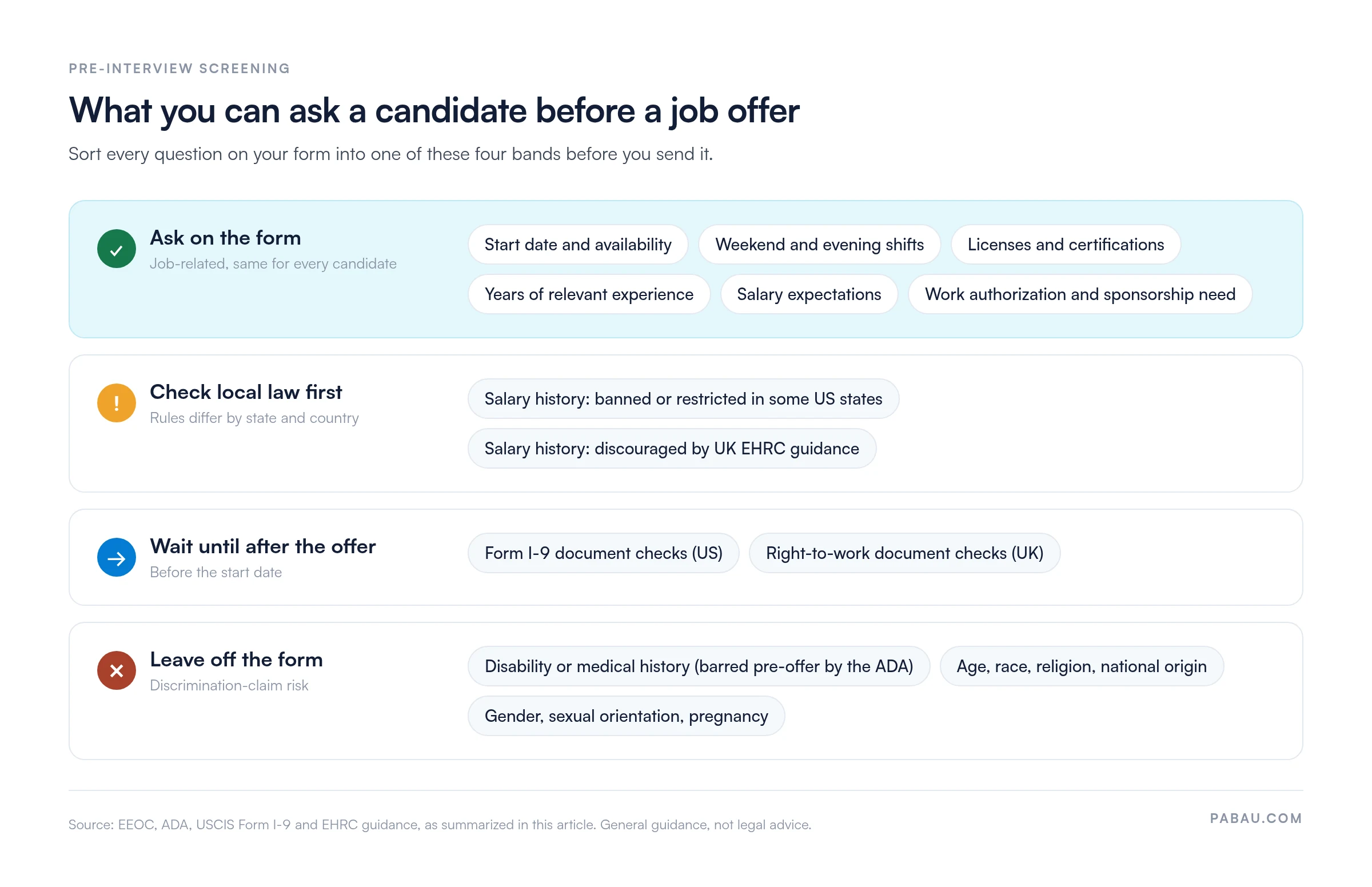
If your practice hires across several states or countries, ask an employment lawyer to review the form for each jurisdiction. A form that’s compliant in California may break UK rules, and vice versa.
Strong questions produce answers you can score. Weak ones waste everyone’s time. Use these guidelines:
Test the questionnaire on a trusted colleague first. If they find questions confusing, awkwardly phrased or too numerous, revise it before sending it to candidates.
Screening by hand means opening emails, copying answers into a spreadsheet and chasing people who haven’t replied. Those hours usually come out of time a small practice team would spend with patients.
Pabau moves that paperwork online. Its digital forms collect questionnaire responses, and automated workflows send the reminders and follow-ups your team would otherwise send by hand.
Once you hire, Pabau’s team management tools store the new team member’s qualifications and contracts. They also build shifts and set role-based permissions for what each person can see. It all runs in the same practice management app you use for scheduling and patient records.

Collect questionnaire responses with Pabau’s digital forms and let automated workflows send reminders and follow-ups. Then keep new hires’ qualifications and contracts in one place.

A pre-interview questionnaire earns its place when every question filters for the job. Five to eight well-chosen questions, scored the same way for every candidate, give you a shortlist you can defend.
Start by sorting your draft questions against the legal panel above. Then run the form on your next opening and compare the scores with who performed best at interview. After a round or two, you’ll know which questions predict a good hire and which ones to cut.
The trade-off is effort up front, because scoring criteria take time to build. In return, you skip a round of phone calls on every hire. Book a demo to see how Pabau’s digital forms and automated reminders cut the admin around candidate screening.

Moving a nurse candidate to interview? 11 interview questions to hire your next LPN covers what to ask once they clear the screen.
Planning your first review with a new hire? Annual review template for healthcare practices gives you a repeatable format for performance conversations.
Need a plan when a hire falls short? Performance improvement plan template for healthcare staff sets out goals, support and timelines.
Documenting a conduct conversation? Employee counseling form records the discussion and the next steps you agreed.
A strong template covers availability and logistics, salary expectations, relevant qualifications, motivation for the role and optional role-specific questions. Aim for five to eight questions to keep response rates high.
Keep it to five to eight questions and under two pages. Longer forms lower response rates and feel burdensome before an interview. The goal is quick screening, not a full application.
It depends on where you hire. Some US states, including California, New York, Illinois and Colorado, ban or restrict salary-history questions. UK EHRC guidance discourages them, though there’s no statutory ban. Asking about salary expectations is generally safer than asking what someone earned before.
No. EEOC rules in the US and the UK Equality Act cover age, race, religion, disability, national origin, gender and pregnancy. Questions about them are prohibited or strongly discouraged, and they also create discrimination-claim risk, and pre-offer disability and medical questions are barred under the ADA. Stick to job-related questions.
Assign points for each question based on your criteria: full marks for ideal answers, partial marks for acceptable answers, zero for deal-breakers. For example, +2 for your target start date, +1 for a flexible timeline and 0 if unavailable. Sum the scores and rank candidates. Document your scoring to show the process was fair if a hiring decision is challenged.
Our template is a printable PDF, so it can be completed by hand or used as a question guide. If you’d rather collect answers online, digital forms in practice software gather responses in one place, so nobody retypes them from paper.