Yeoman’s Test Template
Yeoman’s test is a prone provocation test for sacroiliac joint (SIJ) pain....

1
Last Updated: Sep 28, 2026
The Roos stress test is a provocative orthopedic assessment that screens for thoracic outlet syndrome (TOS).
The patient holds both arms abducted and externally rotated at 90 degrees, opening and closing the hands for three minutes. Reproducing the patient’s own symptoms inside that window is a positive result. Plain arm fatigue is not.
Research published in Frontiers in Physiology (PMC6393400) found the maneuver reliable, though not perfectly so, and recommends performing it at least twice. The test is also known as the Elevated Arm Stress Test (EAST). This guide covers how to position the patient, how to read the result, what the accuracy data supports, and how to document findings.

The Roos stress test (EAST) screens for thoracic outlet syndrome by loading the neurovascular structures for three minutes of arm abduction and repeated hand movement.
A positive result is reproduction of heaviness, pain, tingling, numbness, or arm weakness within the three-minute window, not general fatigue.
Sensitivity for neurogenic TOS is high, but specificity varies widely, so treat the test as a screen rather than a diagnosis.
Record the minute mark at which symptoms start, because onset inside 60 seconds suggests more significant outlet compromise.
Practice management software like Pabau captures onset timing, reproduced symptoms, and laterality in structured fields at the point of care.
The Roos stress test is a provocative orthopedic special test for thoracic outlet syndrome. It puts the brachial plexus and subclavian vessels under sustained mechanical stress. Vascular surgeon David Roos developed it. The position it uses is the one that most reliably reproduces a patient’s symptoms, which matters in neurogenic TOS, where imaging is often unremarkable.
Its formal alternative name, the Elevated Arm Stress Test (EAST), describes the mechanism. Elevation combined with external rotation narrows the thoracic outlet and compresses the neurovascular bundle running through it. Static position tests such as the Adson maneuver stop there. The EAST adds repetitive hand opening and closing, which brings symptoms on faster in patients with genuine neurovascular compromise.
Clinicians in physical therapy, chiropractic, and sports medicine reach for it often. The trigger is upper limb pain, paresthesia, or fatigue that worsens with overhead activity. It answers one question. Does holding the arm abducted and externally rotated reproduce the complaint the patient came in with?
The thoracic outlet is a narrow corridor. The first rib bounds it below, the clavicle in front, and the scalene muscles behind and to the side. The brachial plexus, subclavian artery, and subclavian vein all pass through it on the way to the upper limb.
Abducting the shoulder to 90 degrees and externally rotating it tightens the scalene triangle and compresses the costoclavicular space at the same time. Flexing the elbow to 90 degrees tethers the brachial plexus further upstream.
Repeated fist opening and closing then raises blood demand in the forearm. Arterial flow through the compressed outlet cannot keep up. In neurogenic TOS the nerve roots take the load first. In arterial TOS the radial pulse fades. In venous TOS, congestion produces arm heaviness and cyanosis.
Knowing why the position provokes symptoms changes how you use it. You can explain the test to a patient, adapt the positioning for a restricted shoulder, and reason through an atypical result instead of discarding it. For physical therapists, that reasoning belongs in the notes and the referral letter. A purpose-built physical therapy EMR holds it better than free text does.
TOS is three conditions, not one. Each subtype needs different management, and the Roos stress test carries different weight for each.
Neurogenic TOS accounts for the large majority of clinical presentations. That is why the Roos stress test turns up so often in musculoskeletal physical therapy and chiropractic practice. Acute arterial or venous TOS can be a contraindication to provocative testing, which is covered further down.
Consistent technique is non-negotiable. Variation in arm angle, elbow position, or instruction quality introduces measurement error. It also reduces sensitivity and makes repeat assessments harder to compare.
Seat the patient in a supported upright posture with the spine neutral. Then instruct them to assume the EAST position:
The resulting posture resembles a hands-up or cactus position. Check that the shoulders are not shrugged. A shrugged posture reduces the provocative load and commonly produces false negatives in patients with significant TOS.
The examiner’s job does not end once the patient is positioned. Responsibilities during the three-minute window include:
Recording both the onset timing and the nature of the symptoms is what makes a repeat assessment meaningful. Multi-clinician practices should standardize the recording protocol across the team. One clinician’s baseline is then directly comparable to another’s follow-up finding.

A positive Roos stress test means the patient’s presenting symptoms are reproduced inside the three-minute window. Reproduction is the operative word. General arm fatigue or muscular discomfort from holding an unusual posture does not count.
Symptoms that count as a positive finding include:
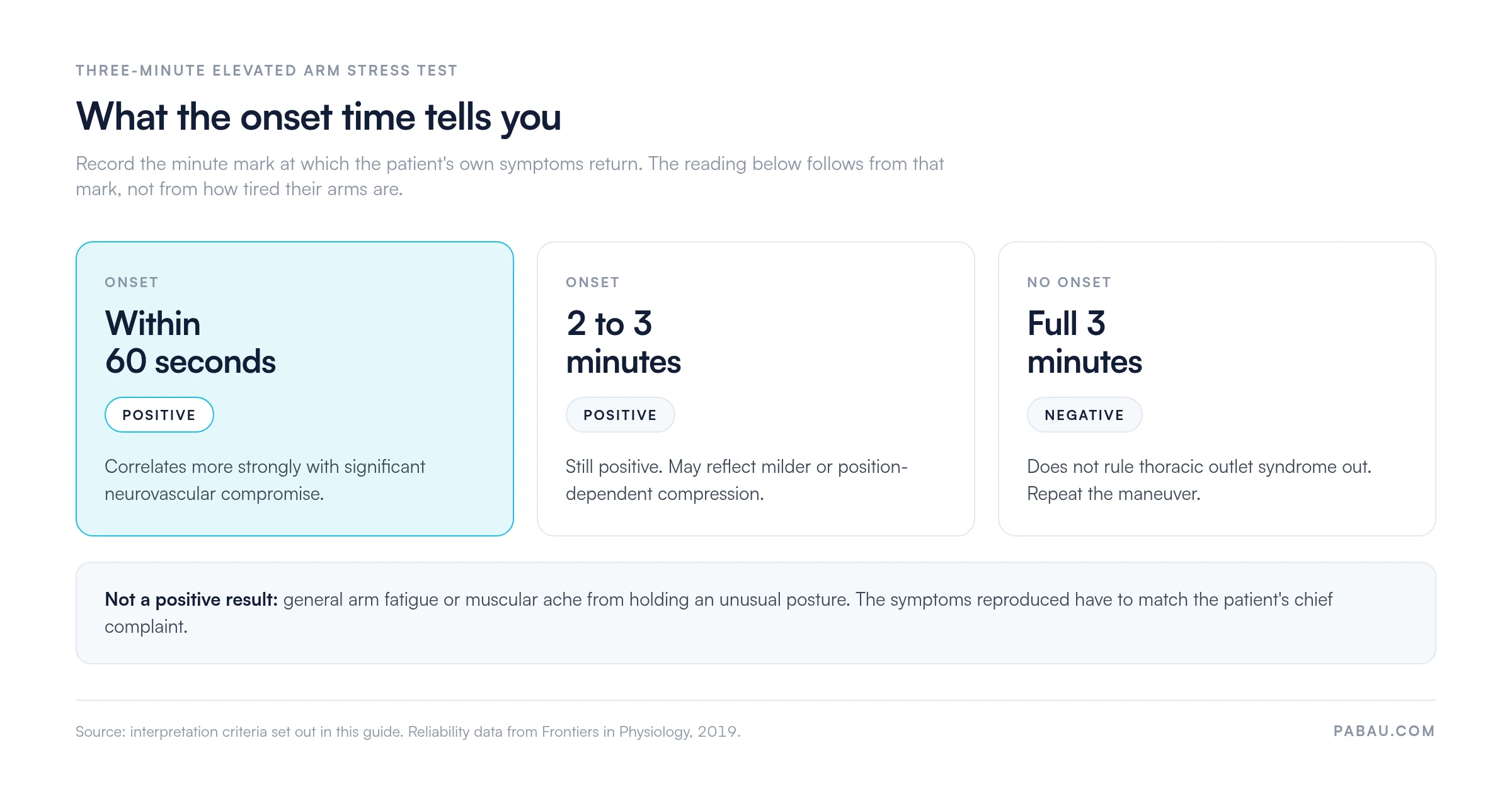
Onset timing adds clinical nuance, and the three bands below are what a recorded minute mark buys you. Symptoms appearing inside the first 60 seconds suggest a more significant degree of outlet compromise. Symptoms appearing between two and three minutes are still positive, but may reflect milder or position-dependent compression. A patient who completes three minutes with no reproduction has a negative result.
The Roos stress test performs well as a screening instrument and poorly as a confirmatory one. Published sensitivity and specificity figures vary across study designs, patient populations, and TOS subtype definitions.
The clinical takeaway is straightforward. A positive Roos stress test raises suspicion for TOS and warrants further investigation, while a negative result does not rule it out. That matters for overhead athletes, whose TOS can present without classic paresthesia. Combine the Roos stress test with at least two other provocative tests, such as the Wright test, before forming a clinical impression.
Run the Roos stress test alongside the Adson test and the Wright test as a three-test cluster. A positive result on two or more of the three raises your post-test probability for neurogenic TOS. A single positive test in isolation tells you much less.
The Roos stress test sits within a family of TOS provocative tests. Knowing what each one stresses prevents redundant or inappropriate test selection during assessment.
The Adson test is the better choice when arterial TOS from scalene compression is suspected. The Roos stress test captures the demand-supply mismatch that mimics overhead activity. For swimmers, throwers, and manual workers it is usually the highest-yield first choice. If you run both in the same session, an Adson test template keeps the two records in a comparable format.
Several conditions produce upper limb pain and paresthesia during provocative testing and can yield a false positive. Clinical reasoning after a positive result has to account for them before TOS is presumed.
Note the differential diagnoses you considered and the reasoning that moved you toward or away from each. This matters most when you refer for vascular surgery assessment or nerve conduction studies. A cervical screen that includes Spurling’s test is the quickest way to rule the neck in or out first.
The Roos stress test is a useful screening tool with clear boundaries. Several scenarios limit its reliability or rule it out altogether.
Best practice is a cluster approach. Combine the Roos stress test with at least two other TOS provocative tests, a cervical spine screen, and an appropriate neurological and vascular examination. A standalone positive or negative result carries limited diagnostic weight.
A well-performed Roos stress test generates information that has to be recorded accurately to be useful later. A note that reads “EAST positive” gives the next clinician almost nothing to work with.
A complete entry captures:
Structured digital assessment forms enforce these fields better than free-text recall does. Practices running several practitioners and frequent repeat assessments usually get there through physiotherapy practice management software rather than a template pinned above the desk.
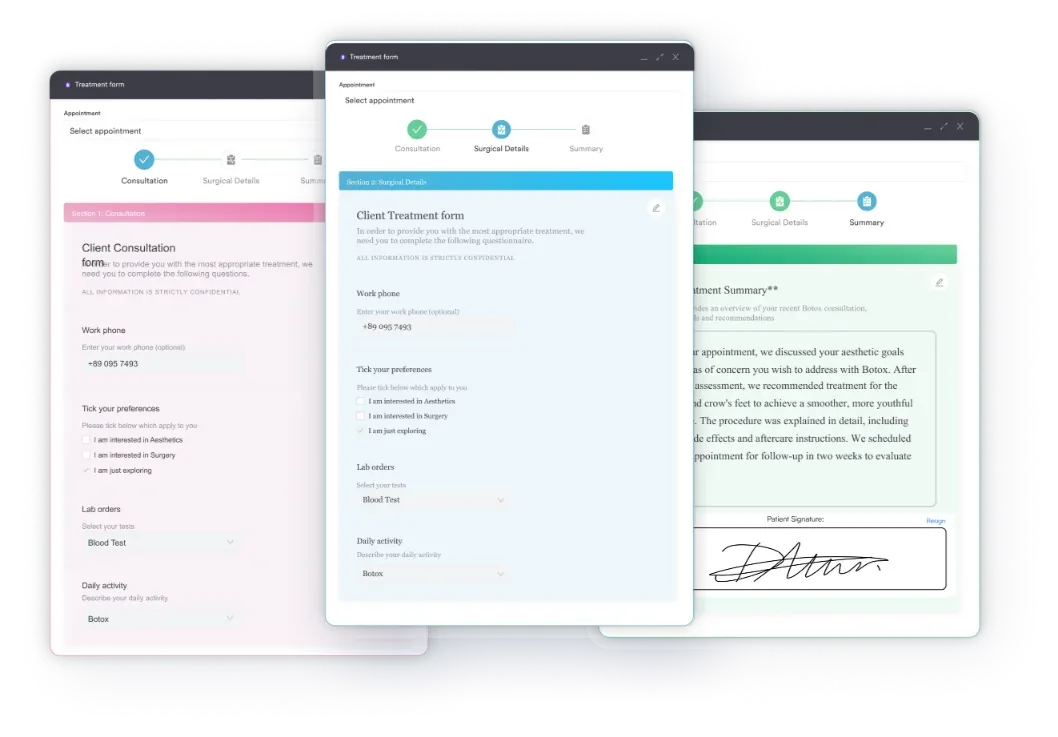
For a multi-clinician practice, standardized documentation means a follow-up assessment by a different therapist is still comparable to the baseline. Inconsistent recording between clinicians is a common reason why repeat assessments fail to show progress clearly.
In many practices a special test gets recorded twice. The therapist notes it on paper or holds it in their head during the session, then types it up afterward, often hours later. Onset time is the first detail to go.
Practice management software like Pabau removes that second step. Structured clinical notes give the Roos stress test its own fields for laterality, onset time, symptom quality, distribution, and pulse findings. Pabau Scribe, our AI scribe, can also capture what you say during the assessment and file it against the patient record.
The result is a baseline the next clinician can compare against, without chasing anybody for what they meant by “EAST positive”. The same fields feed the referral letter, so a vascular surgery or nerve conduction request goes out with the timing and distribution already in it.

Structured clinical notes in Pabau capture onset timing, reproduced symptoms, and laterality at the point of assessment. The record is complete before the patient leaves.

The Roos stress test earns its place because it reproduces the arm position that provokes symptoms during overhead activity. It does not settle the diagnosis. Treat a positive result as a reason to keep investigating, and a negative one as weak evidence against TOS.
What changes the outcome is the detail you write down. Onset time, laterality, symptom quality, and distribution turn a single assessment into a baseline. Six weeks later, that baseline is what tells you whether treatment worked.
Build the recording format once and the whole team works from it. Book a demo to see how Pabau structures special test documentation for physical therapy and chiropractic teams.

Comparing TOS provocative tests? Halstead maneuver covers the traction-based test that sits alongside the Roos and Adson tests in the same cluster.
Need a supraclavicular screen too? Morley test explains the brachial plexus compression test used alongside the elevated arm stress test.
Opening or scaling a musculoskeletal practice? Opening a physiotherapy clinic walks through the compliance, staffing, and software decisions that affect clinical workflow from launch day.
The Roos stress test screens for thoracic outlet syndrome by reproducing neurovascular compression symptoms through sustained arm elevation and repetitive hand movement. It is most sensitive for neurogenic TOS. Physical therapists, chiropractors, and sports medicine clinicians use it during upper extremity assessment.
The patient holds the EAST position for up to three minutes while repeatedly opening and closing the hands. That means shoulders abducted to 90 degrees, elbows flexed to 90 degrees, and shoulders externally rotated. Stopping early because symptoms were reproduced still counts as a positive result.
A positive Roos stress test indicates reproduction of the patient’s presenting symptoms within three minutes, such as arm heaviness, pain, tingling, numbness, or weakness. General arm fatigue from holding an overhead posture does not count. Earlier onset, within 60 seconds, suggests more significant neurovascular compromise.
The EAST test (Elevated Arm Stress Test) is the formal alternative name for the Roos stress test. Both names refer to the same assessment. The patient holds arm abduction and external rotation at 90 degrees. Opening and closing the hands for three minutes provokes thoracic outlet syndrome symptoms.
The Roos stress test is dynamic. The patient opens and closes the hands for three minutes, stressing the whole neurovascular bundle through a demand-supply mismatch. The Adson test is static, using head rotation and deep inspiration to stress the scalene triangle. Its positive sign is loss of the radial pulse rather than symptom reproduction. The Adson test mainly targets arterial TOS, while the Roos stress test is most sensitive for neurogenic TOS.
No. The Roos stress test is a screening and provocative test, not a standalone diagnostic instrument. A positive result indicates that TOS is clinically plausible and warrants further investigation, such as nerve conduction studies, Doppler ultrasound, or vascular surgery referral. A negative result does not definitively exclude TOS, particularly in milder or position-dependent presentations.