CMMC compliance checklist
A CMMC compliance checklist lists every security practice a Department of Defens...

Last Updated: Oct 6, 2026

The Indiana medical power of attorney form lets you name a health care representative to make medical decisions when you cannot.
Indiana Code 16-36-1 calls that person your health care representative, so the older healthcare power of attorney label now looks out of date.
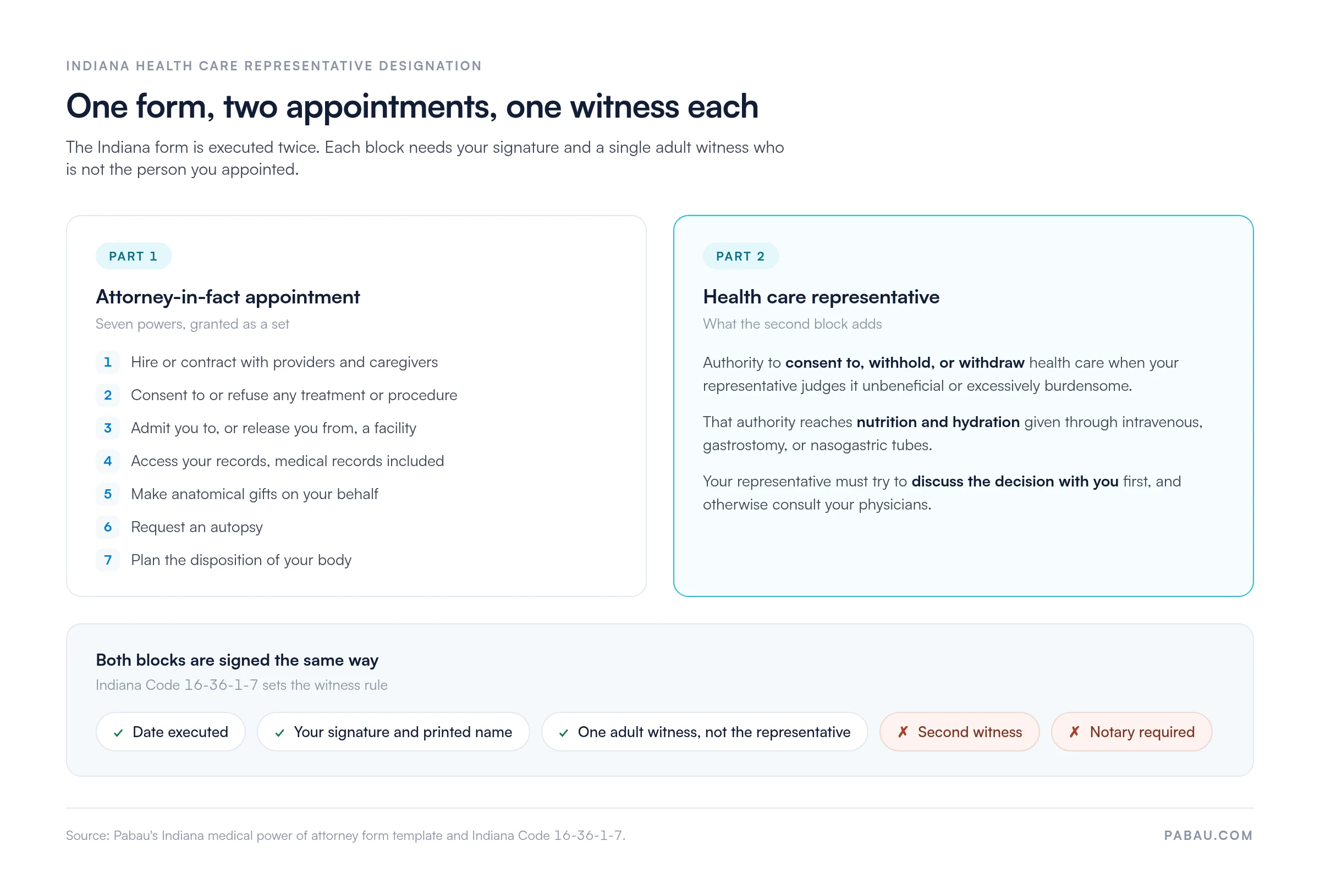
Indiana Code 16-36-1-7 asks for your signature plus one adult witness who is not your representative. A second witness and a notary are not required.
You can revoke the designation at any time by telling your representative or your health care provider, out loud or in writing.
Digital forms in practice management software like Pabau keep the signed document in the patient record, ready to open during an emergency.
A two-page form carrying both appointment blocks Indiana expects. Part one grants the seven attorney-in-fact powers, and part two designates your health care representative for decisions about withholding or withdrawing care. Each block has its own date, signature, and witness lines.
Download templateAn Indiana medical power of attorney names the person who speaks for you when illness or injury takes your ability to decide. Indiana law puts that designation under Indiana Code 16-36-1, and calls the person you name your health care representative.
The signing rule is shorter than most versions of this form suggest. You sign, and one adult witness who is not your representative signs after you. There is no second witness and no notary step. Witness rules change from state to state, so anyone outside Indiana should start from the general medical power of attorney template.

It hands one named adult the authority to consent to or refuse care on your behalf, but only once you cannot decide for yourself. Until that point you keep every decision. Your representative also gains access to your records, which is what lets them weigh a treatment choice properly.
The form does two jobs in two separate blocks. The first appoints an attorney-in-fact and grants seven enumerated powers, from hiring providers to planning the disposition of your body. The second appoints that same person as your health care representative. It reaches the hardest decisions, including withholding nutrition and hydration given through a tube.
That second block is why the wording matters. Indiana Code 16-36-1 replaced the old healthcare power of attorney language, and the state publishes its own version of the designation. Reading the state guidance next to the template is worth doing before you sign.
Work through it block by block. The two appointment sections look similar. Skipping the second one is the most common way a completed form ends up doing half its job.
Practices that collect this at registration usually fold it into their patient intake forms, so the representative is on file before anyone needs them.
Indiana Code 16-36-1-7 sets a short list. The witness rule is where published guides most often go wrong, so it is worth reading against your own copy.
Any competent adult can, and some patient groups have a stronger reason than others:

A power of attorney names a decision-maker. A living will records the decisions themselves. Confusing the two is common, and it matters at the bedside because they answer different questions.
Many Indiana residents complete both, alongside the routine consent for medical treatment a practice collects anyway. The two advance directives cover each other: the living will speaks to the situations you anticipated, and the representative handles the ones you did not.
For a practice, a filed directive is only useful if the front desk can find it and the clinician can trust it. Four habits make that work:
When a representative’s decision precedes an adverse event, your incident form should name who consented and under what authority. That single line saves a great deal of reconstruction later.

Most practices store a signed directive as a scan in a documents folder, filed under the date it arrived. It is there, technically. Nobody finds it during the ten minutes when it matters. Staff phone whichever relative answers first and hope that person is named on the form.
Practice management software like Pabau puts the document in the chart instead. Digital forms capture the representative and alternate as searchable fields. The signed PDF attaches to the same record, and access is controlled per user. Whoever opens the chart sees who holds the authority and what the patient limited.
Our compliance tools then keep the audit side quiet. Every view of the document is logged, expiry reminders prompt a review conversation, and reporting shows which active patients have no directive on file. So the practice can chase the missing ones deliberately, rather than discovering them in an emergency.

Store the signed form against the patient record, tag the named representative, and control who can open it. Your team sees the authority and its limits before anyone acts on a decision.


The Indiana form asks less of you than its reputation suggests. One witness, twice, and the document is done. The part worth slowing down for is the second block, because that is where the authority over withheld and withdrawn care actually lives.
For the practice, the trade-off is storage against retrieval. Any system can hold a scan. The question is whether the person taking the call at 7pm can find it, read the limits, and act with confidence. Book a demo to see how Pabau keeps advance directives, consent, and the patient record in one place.

Live outside Indiana, or need a form that is not state-specific? Medical power of attorney template covers the same appointment without Indiana’s statutory wording.
Want the consent paperwork that sits alongside it? Medical consent form for adults covers treatment-by-treatment consent, which the representative may end up signing.
Handling records requests from a representative? HIPAA medical release form gives you a release to keep on file when the request reaches beyond treatment decisions.
Need your front desk to handle these documents correctly? HIPAA training for employees sets out what staff may confirm to a representative, and what they may not.
They describe the same document. Indiana Code 16-36-1 uses the term health care representative, and the older healthcare power of attorney label no longer appears in state law. Both name someone to make medical decisions for you.
No. Indiana Code 16-36-1-7 sets out no notarization requirement for this document, and no notary alternative to the witness. You need your own signature plus one adult witness who is not your health care representative.
Notify your health care representative, or notify your health care provider. Indiana Code 16-36-1-7 accepts either notice, given orally or in writing. Ask your practice to record the revocation so the old form is not acted on.
Only when you lose the capacity to make decisions yourself. Until then you keep full decision-making rights. A physician usually documents the loss of capacity in your record, which is the point staff look for.
It depends. Indiana-executed forms are often honored elsewhere, but some states set strict rules for out-of-state advance directives. If you spend a lot of time outside Indiana, ask an attorney about preparing documents in each state.
Any adult you trust can serve. The exceptions are your health care provider, the facility treating you, and anyone who would benefit financially from your death. Family, friends, clergy, and professional advocates are common choices.