Maja Popovska

Good character traits list
What is a good character traits list? A good character traits list is a structur...

3
Last Updated: Oct 30, 2026
Free PDF 4 pages, print-ready Clinician-reviewed
Home health documentation is the clinical record a home health agency keeps for each patient, from referral to discharge. It covers assessments, OASIS, practitioner orders, the plan of care, visit notes and the discharge summary. For Medicare patients, it has to show the patient is homebound, needs skilled care and gets care that follows a signed plan. This free template is an 11-page visit record, and the guide maps each field to the CMS rule it supports.
An 11-page home visit record with fields for patient and insurance details, vital signs and an eight-part physical assessment. It also covers medications, interventions, care plan updates, education, feedback and the next visit plan, closed by the provider's signature.
Start from scratch, or upload this PDF or any form you already use, and Pabau's AI Form rebuilds it with tick boxes, text fields and a signature. Attach it to the treatment once, and every patient gets it on time.
AI Form rebuilds the consent, history and aftercare forms you already use. You review each one, then publish.
Patients complete forms on their phone before they arrive, so the front desk stops retyping paper.
Every signed form is versioned and attached to the treatment record, ready when you need it.
Set how long a consent stays valid. Returning patients skip forms they have already signed.
Supports HIPAA and GDPR compliance AES-256 encryption 4.8 on G2 4.7 on Capterra Trusted by 4,000+ practices worldwide

This free home health documentation template is an 11-page visit record for vitals, a body-systems assessment, interventions, education and the next visit plan.
Medicare collects OASIS at start of care, resumption of care, the recertification window (days 56–60), transfer to an inpatient facility, death at home and discharge.
A physician or allowed practitioner must sign the plan of care, on CMS-485 or an equivalent form, before the agency bills the period.
The comprehensive assessment and the Notice of Admission are both due within five calendar days of the start of care.
Clinical records must be kept for five years after discharge, or longer where state law requires.
Home health documentation is the clinical record an agency keeps for each patient, from referral through discharge. It captures what clinicians assessed, what they did on each visit, how the patient responded, and what happens next.
Good documentation does two jobs. It supports the medical necessity of each visit, and it gives auditors a clear trail showing that care followed the plan. A complete Medicare home health record holds these documents:
Private-pay providers can use the same structure, even where Medicare rules do not apply. The template on this page covers the visit record, the document clinicians fill in most often.
The template is an 11-page PDF with one section per part of the visit. Each section maps to a rule in the Medicare Conditions of Participation. A completed form already answers most of what a reviewer asks about that visit.
The template does not replace the OASIS instrument, the plan of care or the Notice of Admission. Those have their own formats and deadlines, covered below. Use this form for the visit itself and file it alongside them.
Work through the record in visit order, from referral to discharge. These six steps cover one patient’s admission:
AI drafting tools can turn a recorded visit into narrative text. Clinicians still have to review and verify every statement before they sign, because the signature makes the note theirs.
If your agency still moves visit records from paper, book a demo. You’ll see how Pabau, the practice management platform we build, turns this form into a digital visit note.
Here is an illustrative note for a patient with heart failure, written field by field. The details are invented to show the level of detail a reviewer expects.
The note shows a skilled need, a measurable change, homebound evidence, a new order and a plan. A reviewer can trace each one without asking the clinician.
A complete form filed outside its window still fails review. The chart below puts every Medicare deadline for one 60-day certification period on a single timeline, counted from the start of care.
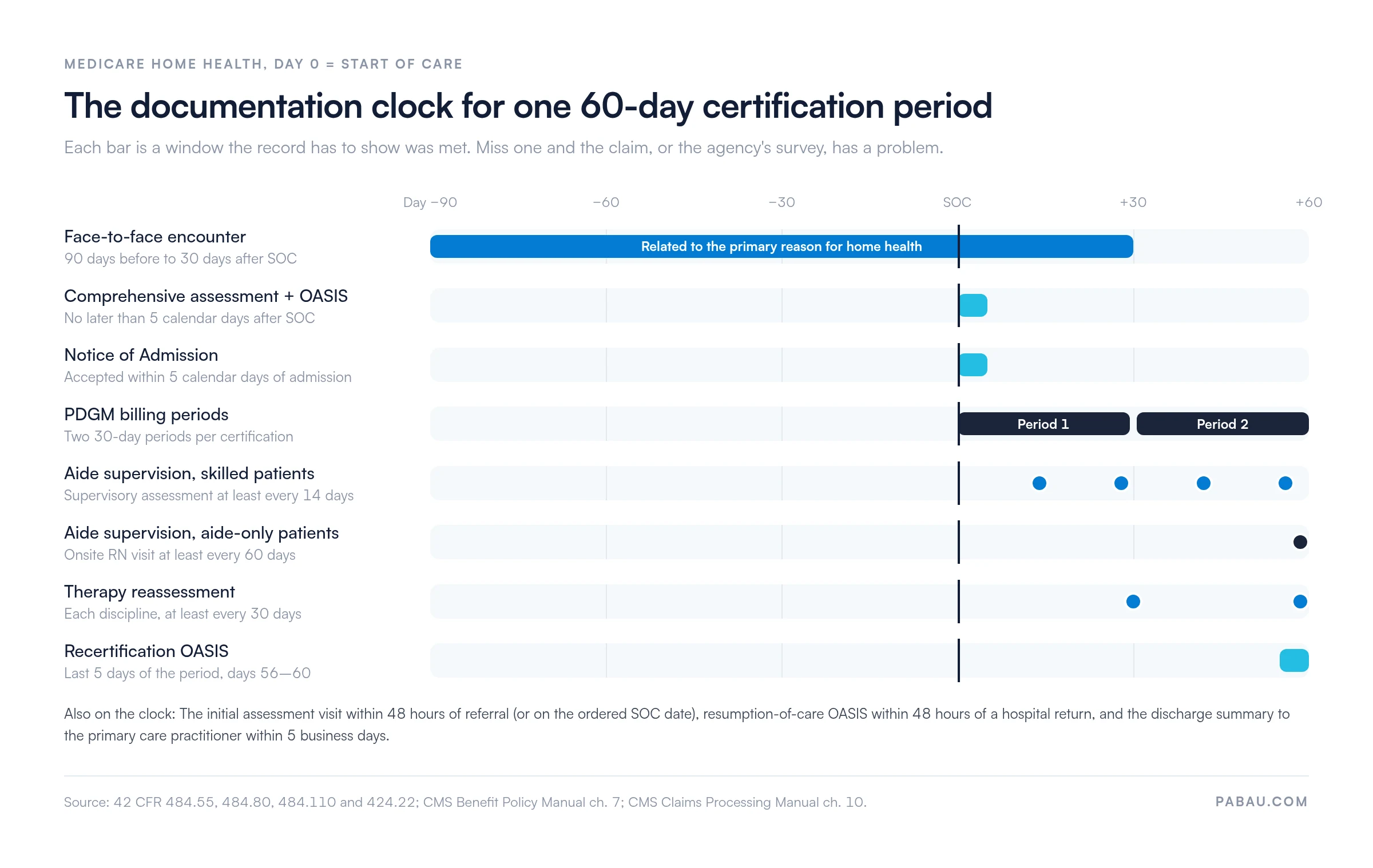
Build these dates into your scheduling, not just your charting. A recertification visit booked on day 50 produces an OASIS outside the window, however good the note is.
Medicare home health documentation requirements come from the Conditions of Participation in 42 CFR Part 484 and the Medicare Benefit Policy Manual, Chapter 7. Coverage depends on clear records of homebound status, skilled need, and certification by a physician or allowed practitioner.
A patient is homebound when they meet two criteria, and the notes need clinical detail for both. Medicare’s home health coverage guidance summarizes them.
CMS says stock phrases such as “taxing effort to leave the home” are neither required nor enough on their own. Show it with distance walked, assistance needed, oxygen use, shortness of breath or cognitive limits. Short absences for medical care, adult day care or religious services do not end homebound status.
The skilled need is the second half of eligibility. The patient must need intermittent skilled nursing, physical therapy or speech-language pathology, and each note shows why a licensed clinician had to deliver the service.
A physician, nurse practitioner, clinical nurse specialist, physician assistant or certified nurse-midwife must see the patient. The encounter can happen up to 90 days before or 30 days after the start of care, and telehealth counts where Medicare allows it.
The encounter must relate to the primary reason the patient needs home health, and the certifier documents its date on the certification. The supporting notes come from the certifying practitioner’s record or the discharging facility’s record. The agency’s own notes count only when those records corroborate them.
A physician or allowed practitioner certifies eligibility, and since the CARES Act that includes nurse practitioners, clinical nurse specialists and physician assistants. They also sign the plan of care. CMS-485 is one acceptable format, and any form with the required elements works.
Under 42 CFR 484.60, the plan of care must list these elements:
Care is certified in 60-day periods and paid in 30-day periods under the Patient-Driven Groupings Model (PDGM). Recertification is required at least every 60 days while care continues. The practitioner who reviews the plan signs and dates it, and does not need to estimate how much longer services will last.
The agency cannot submit the final claim for a period until the practitioner has signed the plan of care and every verbal order. Track unsigned documents daily.
A registered nurse makes the initial assessment visit within 48 hours of referral or of the patient’s return home. It can also happen on the ordered start date. Where therapy is the only ordered service, the therapist can do it.
The comprehensive assessment, with the OASIS items built in, is due no later than five calendar days after the start of care. It covers health, psychosocial, functional and cognitive status, goals, caregivers, and discharge planning needs. It also verifies homebound status and eligibility.
The Notice of Admission (NOA) tells the Medicare contractor that an admission has started. It must be submitted and accepted within five calendar days after the admission date, per the Medicare Claims Processing Manual, Chapter 10.
A late NOA reduces the period’s payment by one-thirtieth for each day it is late, and the agency cannot bill the patient for that loss. One NOA covers the whole admission until discharge.
Drugs, services and treatments are given only as ordered. A nurse or other qualified clinician who takes a verbal order records it in the clinical record, then signs, dates and times it. The ordering practitioner then authenticates and dates it under state law and agency policy.
Write a new order for any change in frequency, a new discipline, a new medication or a new treatment. A visit made outside the ordered frequency without an order is a visit the agency cannot support.
The comprehensive assessment includes a review of every medication the patient takes. The clinician checks for adverse effects, ineffective therapy, significant side effects, significant interactions, duplicate therapy and noncompliance.
Reconcile again after a hospital stay, a new order or a fall. Record what you found, who you told and what changed. A running medication log kept in the home helps catch doses the patient missed between visits.
During the initial evaluation visit, before care starts, the agency gives the patient written notice of rights and responsibilities. It also provides transfer and discharge policies, administrator contact details and an OASIS privacy notice. The record holds the patient’s or representative’s signature confirming receipt.
Each patient also needs an individual emergency plan as part of the comprehensive assessment, under 42 CFR 484.102. Record how the patient would be evacuated, who to contact and which services they would need in a disaster.
Strong visit notes record the skilled service, the patient’s response, and the next step, in that order. Reviewers read them to answer one question, which is whether this visit needed a licensed clinician.
General nursing documentation principles apply here too, from objective language to timely entries.
Every entry must be legible, complete, dated, timed and authenticated with a signature and title. A secure electronic entry tied to a unique login also counts. Medicare does not accept rubber-stamp signatures.
Medicare sets no single deadline for writing a visit note, so set an agency rule and audit against it. Same-day completion is the safest standard.
Label a late entry as late, with the date and time it was written. Correct an error with a single line through it, keeping the original readable, and add your initials and the date. In an electronic record, the system should keep the original entry alongside the amendment.
When a visit in the plan of care does not happen, write a missed-visit note the same day. Record the reason, any attempt to reschedule and the clinical risk.
If the missed visit means the ordered frequency won’t be met, tell the practitioner who orders the care. The agency must promptly alert the practitioner when outcomes are off track, so log that call too.
For each therapy discipline, a qualified therapist (not an assistant) must deliver the ordered service and functionally reassess the patient at least every 30 days. The note compares the new measurements with earlier ones and states whether therapy is working.
The 30-day clock starts with the first visit of that discipline and resets with each reassessment. With physical and occupational therapy both ordered, each discipline reassesses separately.
Agencies must coordinate care across every discipline and practitioner on the plan. Record case conferences, calls with physicians, and handoffs between nurse, therapist and aide.
Note who was contacted, what was discussed and what changed. These notes explain why a frequency or goal changed between two visit notes.
Under PDGM, each 30-day period is paid by grouping the patient on several factors, and the record has to support every one. The certification rules in 42 CFR 424.22 make the certifier’s record the main evidence.
Code the primary diagnosis to the highest specificity in ICD-10-CM, and make sure it is the main reason for home health. It should match the referral, the face-to-face note and the plan of care.
This template suits home health agencies, private-pay home care providers, and practices that run home visits alongside in-office care. Typical users include:
For non-medical personal care visits, a simpler home care form is a better fit. It skips the skilled assessment sections that only licensed clinicians complete.
Hospice records prove a terminal prognosis of six months or less if the illness runs its normal course. Home health records prove a homebound patient with an intermittent skilled need.
Hospice has no homebound requirement, and its notes focus on symptom control and decline. Don’t reuse home health language for a hospice patient, or the reverse.
Medicare certification sits on top of state licensure, and many states license home health agencies separately. State rules can set longer record retention, shorter signature deadlines or extra aide training.
Check your state health department’s rules before you finalize the template. Where state law is stricter, it wins.
A shared template removes guesswork about which fields each visit needs. Clinicians stop hunting for the right section, and required items such as visit times and signatures get skipped less often.
Consistency also helps new staff. Aides and newer nurses learn one structure instead of several, which shortens onboarding. A supervisor reviewing ten charts can spot a missing vital sign in seconds when it always sits in the same box.
For audits, the payoff is speed. A Medicare contractor’s additional documentation request gives the agency 45 days to send records, and a chart in a fixed layout is faster to assemble. Patients can also ask for their record, which must be ready at the next visit or within four business days.
Agencies that collect intake data before the first visit gain even more, because digital intake forms fill the patient information section in advance.
Prepare by confirming that every required document exists, is signed, and matches the visit history. Start with this checklist:
A denied claim can be appealed through five levels, and each one has its own filing window:
Keeping patient records up to date throughout the admission means fixes happen during care, rather than during a review. No checklist guarantees an audit outcome, and clinical judgment still decides what each record must say.
Many home visit teams still carry paper forms in the car and retype them at the office. Notes arrive days late, signatures go missing, and the medication list in the chart drifts from what’s in the home.
With Pabau, this template becomes a digital form your clinicians complete at the bedside. Pabau GO, our iOS app for practitioners, opens the patient’s file on the visit. Pabau Scribe, our AI scribe, drafts the narrative for the clinician to review and sign.
Assessments, visit notes, medications and signed consent forms then sit together in a single patient record. Pabau doesn’t submit OASIS or Medicare claims, so it suits private-pay home care and practices adding home visits.

Pabau’s digital forms, Pabau Scribe and mobile app let clinicians record each home visit at the bedside. The signed note files straight to the patient record.

Home health documentation succeeds or fails on timing more than wording. Put the deadlines on your schedule first, then let the template make each visit note complete.
Start with the visit record, adapt it to your disciplines and state rules, and audit ten charts against the checklist above. The errors you find there are the ones a reviewer would find.
Paper forms slow your clinicians down. Book a demo to see how Pabau lets them sign off each home visit before they leave the driveway.

Planning support with family caregivers? Caregiver care plan sets out who does what between home visits.
Discharging a patient from home care? Patient discharge instructions covers what to hand over so the next provider can pick up care.
Managing a pressure injury at home? Pressure ulcer nursing care plan gives goals and interventions you can carry into visit notes.
Need the patient to track their own medicines? My current medication list is a patient-held list that makes reconciliation faster.
A home health documentation template is a standard form that sets the fields clinicians complete for each assessment and visit. It keeps records consistent, but it does not replace clinical judgment or the agency’s own policies.
Medicare-certified agencies must keep clinical records for five years after the patient’s discharge, under 42 CFR 484.110. Where state law requires a longer period, the state rule applies.
Audit selection criteria are not fully public. Reviews often focus on billing patterns that stand out in PEPPER data, and on records that look incomplete. Missing practitioner signatures and vague homebound language are common findings.
Aides record the tasks performed from the aide care plan, the patient’s response, and any changes they report to the supervising nurse. When the patient also gets skilled care, a nurse or therapist assesses aide services at least every 14 days. For aide-only patients, an RN makes an onsite visit at least every 60 days.
A physician or an allowed practitioner can sign it. Since the CARES Act, allowed practitioners include nurse practitioners, clinical nurse specialists and physician assistants, acting within state law.
No. CMS-485 is one acceptable format for the plan of care. Any form that includes every element in 42 CFR 484.60 and carries the practitioner’s signature and date works.