Maja Popovska

Good character traits list
What is a good character traits list? A good character traits list is a structur...

3
Last Updated: Oct 30, 2026
Free PDF 2 pages, print-ready Clinician-reviewed
A caregiver assessment is a structured evaluation of the person who gives a family member unpaid care. It records their care tasks, stress, support and own health, and whether anyone could step in if they stopped. Clinicians use it to spot caregiver burden early, document what they find and refer the caregiver to the right support services.
Caregiver burden often goes unrecorded in busy practices, even though it shapes how well the person receiving care is supported at home. A consistent assessment gives your team a shared record to act on, rather than relying on a passing comment at a follow-up visit.
This guide explains what the assessment should cover and which validated scales clinicians add to it. It then walks through running the assessment and turning the results into a support plan. A free downloadable template is included.
A caregiver-completed questionnaire covering care tasks, how often care is given, who helps, stress levels, future care planning and the caregiver's own health.
Start from scratch, or upload this PDF or any form you already use, and Pabau's AI Form rebuilds it with tick boxes, text fields and a signature. Attach it to the treatment once, and every patient gets it on time.
AI Form rebuilds the consent, history and aftercare forms you already use. You review each one, then publish.
Patients complete forms on their phone before they arrive, so the front desk stops retyping paper.
Every signed form is versioned and attached to the treatment record, ready when you need it.
Set how long a consent stays valid. Returning patients skip forms they have already signed.
Supports HIPAA and GDPR compliance AES-256 encryption 4.8 on G2 4.7 on Capterra Trusted by 4,000+ practices worldwide

A caregiver assessment evaluates the unpaid family caregiver and records their tasks, stress, support, health and plans for future care.
Offer one at trigger points such as a new diagnosis, a hospital discharge or a decline in function, then reassess every three to six months.
The free template is a caregiver-completed questionnaire with no total score, so read each answer as a flag that points to an action.
The future-care questions show whether anyone could step in if the caregiver could no longer provide care.
Add one validated scale, such as the Zarit Burden Interview, when you need a score you can track across visits.
A caregiver assessment is a structured evaluation of the person who gives a patient unpaid care, usually a spouse, adult child, relative or friend. It records what care they provide, how that care affects them, and what support they need to keep providing it.
The person being assessed is the caregiver. A patient assessment asks what the care recipient needs. A caregiver assessment asks whether the person meeting those needs can keep doing so safely, and what happens if they can’t.
The Family Caregiver Alliance’s Caregivers Count Too! toolkit groups the information worth collecting into seven categories.
The toolkit is clear that a single assessment doesn’t need to measure all seven. A short screening form covers several of them, and a follow-up conversation with the caregiver fills in the rest.
Physicians, nurses, social workers, care coordinators and therapists all use caregiver assessments. Any team member who sees the caregiver regularly can hand out the form, and whoever owns the patient’s care plan should review it.
The toolkit advises offering an assessment to anyone who identifies as a family caregiver. That includes secondary helpers such as other relatives, friends and neighbors, alongside the primary caregiver. It also lists the events that commonly prompt one.
Plan for repeat assessments from the start. The toolkit suggests reassessing periodically, for example every three to six months, and a shorter version of the form is fine for follow-ups. The key question at each review is what has changed since the last one.
The free template is a questionnaire the caregiver completes, mostly with tick boxes and short written answers. Its questions run in a fixed order, so the caregiver can finish it in the waiting room or at home before the visit. The table below sums up each section and the answers that call for follow-up.
The form opens with the caregiver’s name, the name of the person receiving care, and their relationship. The relationship shapes what support will help. An elderly spouse and an adult child working full time face different limits, even when the tasks look the same.
The care question lists hands-on tasks such as lifting, bathing and feeding, plus transportation, grocery shopping and reminders to complete daily tasks. It also covers medical and financial decision-making, giving Medical and Financial Power of Attorney as examples. When the caregiver holds medical decision-making authority, keep a copy of their signed health care proxy form on file.
A frequency question follows, from no hands-on care up to care 24 hours a day. Read the two answers together. A caregiver who ticks lifting and bathing at round-the-clock coverage carries a physical load that a weekly shopping trip does not.
The next two questions ask who shares the care and how often the caregiver feels stressed. Help can come from a family member, a friend or a paid provider, or the caregiver can report working alone. Stress runs from daily, to now and then, to none.
These two answers are the quickest screen on the form. Follow up first with any caregiver who ticks both “I provide care on my own” and “I am stressed out on a daily basis.”
This section turns the form from a snapshot of today into a plan for what comes next. It asks how much care the caregiver expects to give in future, then four yes-or-no questions.
A question about how often they worry about the person’s future care closes the section. A “no” to the first contingency question means the whole care arrangement rests on one person, with no named backup. The team can help plan for that long before a hospital admission forces the decision.
The last two questions ask whether the caregiver has any health issues, and whether they worry those issues could affect the care they give. A “yes” to both is a prompt to check that the caregiver has their own physician and keeps their own appointments.
A clinician, care coordinator or social worker can run the assessment in one structured session. These seven steps keep each assessment consistent, so results stay comparable from one review to the next. The cycle below shows where they sit between one trigger event and the next review.
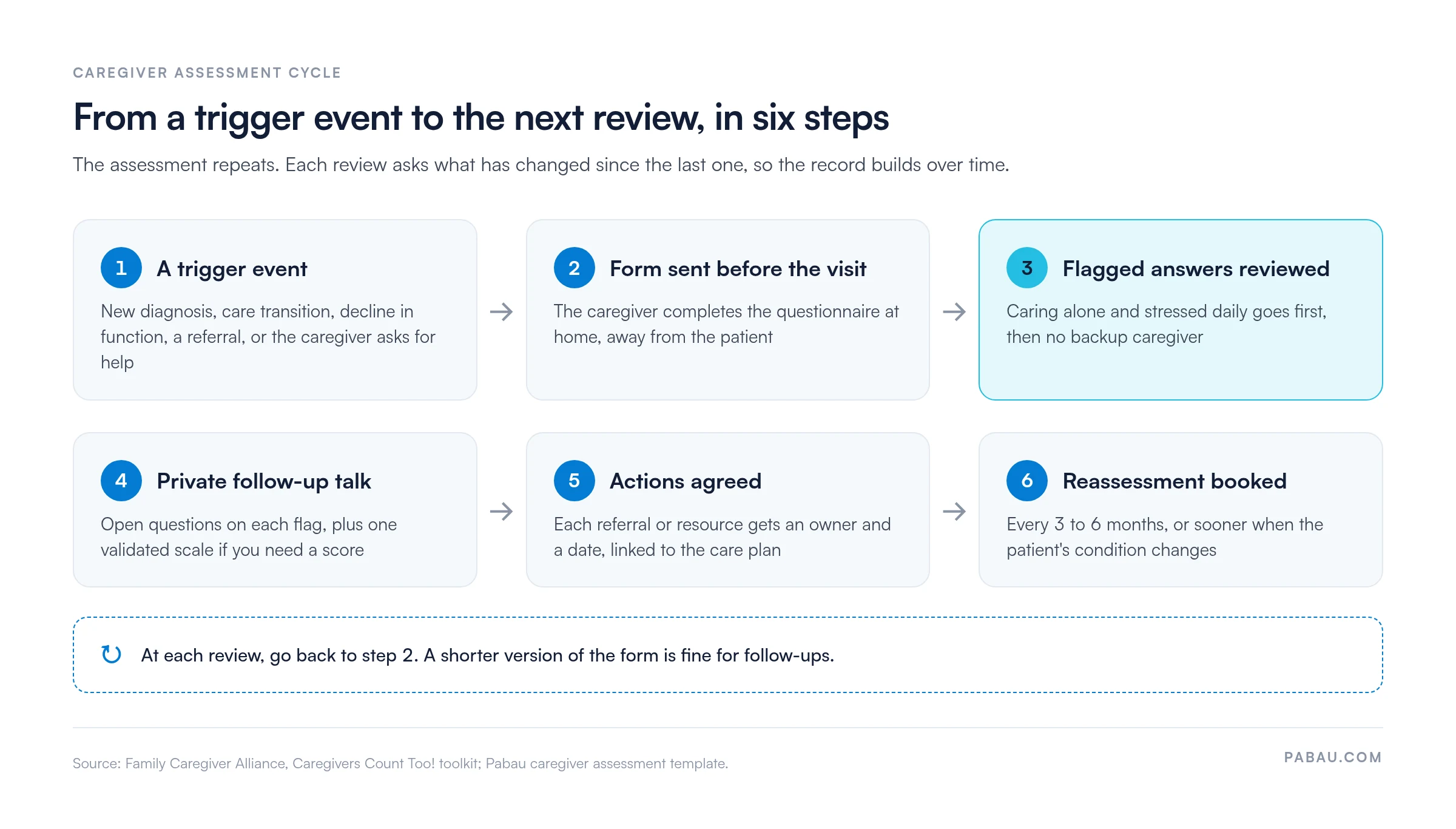
Some caregivers can’t leave the patient alone long enough to attend. The toolkit suggests offering respite cover for the assessment itself, or starting with a phone call and a home visit later.
Caregiver information is personal data, so store the completed form in the patient record in line with your privacy obligations. Limit access to staff involved in care. Have your compliance team review the template before first use, because consent and record-keeping rules vary by jurisdiction.
The template has no total score. Each question stands on its own, so read the form answer by answer. Treat each concerning answer as a flag that points to an action.
When you need a number you can track over time, pair the template with one validated scale. The three below are widely used, and each one measures something different.
Published severity bands for the ZBI differ between sources, and the MCSI has no official cutoffs. The Hartford Institute for Geriatric Nursing advises using professional judgment to interpret an MCSI total. Check each instrument’s original publication and licensing terms before you adopt it.
Use the same instrument at every review. A ZBI total at one visit and an MCSI total at the next can’t be compared, so the trend you wanted to track is lost.
The template is itself a caregiver self-assessment questionnaire. The caregiver completes it alone, so it can surface concerns they would not raise in front of the patient. Daily stress and doubts about continuing are common examples.
Caregiver burden is the accumulated strain of caring for someone else. Burnout is a state of exhaustion that can follow prolonged burden. Watch for these signs during the assessment and at routine visits.
When any of these appear, record them on the form and refer the caregiver to their own physician or a mental health professional. The assessment is a screening and referral tool, so never label a caregiver with a condition on the basis of the form alone.
An assessment helps only when its findings change what happens next. Turn each flagged answer into a referral, a resource or a change to the patient’s care plan.
Write each action with an owner and a date. For example, the care coordinator refers the caregiver to a local support program by Friday, with a review in three months. An action with no name attached tends to drift.
A caregiver who reports no help and no break in months may need a respite referral and a review of the patient’s day care options. Record the referral, the date and the person responsible on the form. If the daily routine changes too, update the caregiver care plan so its list of outside services stays current.
In the US, Area Agencies on Aging run local caregiver support programs, and the Eldercare Locator finds the nearest one. Outside the US, point caregivers to your regional caregiver support services.
With the caregiver’s consent, share relevant findings with the patient’s care team. Base the patient’s plan of care on the care the caregiver can keep giving now, which may be less than they managed last year.
The same questions apply across settings, but the follow-up conversation shifts its emphasis.
Change the emphasis of your questions, and keep the form itself the same. A consistent form keeps records comparable across patients and over time.
Paper caregiver forms often get completed in the waiting room, scanned later and filed where the next clinician won’t look. Review dates live in one person’s diary, so reassessment slips when that person is away.
With Pabau’s practice management software, you can rebuild the template as a digital form and send it before the appointment. The caregiver completes it on their phone, and the answers save to the patient’s record. The clinician can then review flagged answers before the conversation starts.
Keep the caregiver form alongside your other digital intake forms. Book the three- to six-month review as a follow-up appointment with automated reminders, so reassessment happens on time without anyone chasing it.

Pabau sends your caregiver assessment as a digital form before the appointment and saves the answers to the patient’s record. Your team reviews flagged answers in advance and books every reassessment on schedule.

Treat the caregiver assessment as part of the patient’s care plan, because that plan works only while the caregiver can keep it going. Start with the template at the next trigger point, read the answers as flags, and give each flag an owner and a date.
The cost is a few minutes per visit. In return, the team hears about an exhausted caregiver or a missing backup plan while there is still time to arrange help. Book a demo to see how Pabau collects caregiver assessments before the visit and keeps every review on schedule.

Need a care plan the whole family can follow? Caregiver care plan sets out conditions, medications, goals of care and outside caregiver services on one form.
Want a daily record of the care given? Caregiver note logs observations, activities and medications so the care team and family stay informed.
Is the patient starting care at home? Home care form covers intake, living situation, home safety, mobility and visit preferences.
Does the caregiver make medical decisions? Health care proxy form names the agent who decides if the patient loses capacity.
A caregiver assessment is a structured evaluation of the unpaid family member or friend who cares for a patient. It records their care tasks, stress, support and future care plans, so the team can refer them for help.
The caregiver completes the questionnaire, ideally before the visit. A physician, nurse, social worker or care coordinator then reviews the answers with them and agrees on next steps.
It should cover the caregiving situation, the care tasks and how often they happen, and who else helps. It should also cover stress, the caregiver’s own health and who would step in if they couldn’t continue.
The free template has no total score, so read each answer as a flag for follow-up. For a number, add a validated scale such as the 22-item Zarit Burden Interview, which totals 0 to 88.
Record the caregiver’s stress and support answers on the form, then discuss them in private. Add a validated scale such as the Zarit Burden Interview if you need a scored result to track over time.
The Family Caregiver Alliance suggests reassessing periodically, for example every three to six months. Reassess sooner when the patient’s condition or living situation changes.
Yes. The caregiver assessment template on this page is a free PDF you can print or adapt. Have your compliance team review it before first use.