CMMC compliance checklist
A CMMC compliance checklist lists every security practice a Department of Defens...

Last Updated: Oct 6, 2026

A HIPAA release form authorizes a provider to disclose protected health information to named people or organizations for purposes beyond routine treatment.
Ohio has a state-standard authorization form, published by the Ohio Department of Medicaid as form ODM 10221 under ORC 3798.10.
A valid authorization carries seven core elements, from the patient’s name and the records covered through to the right to revoke.
Practice management software like Pabau stores each signed authorization against the patient record, so staff can prove consent during an audit.
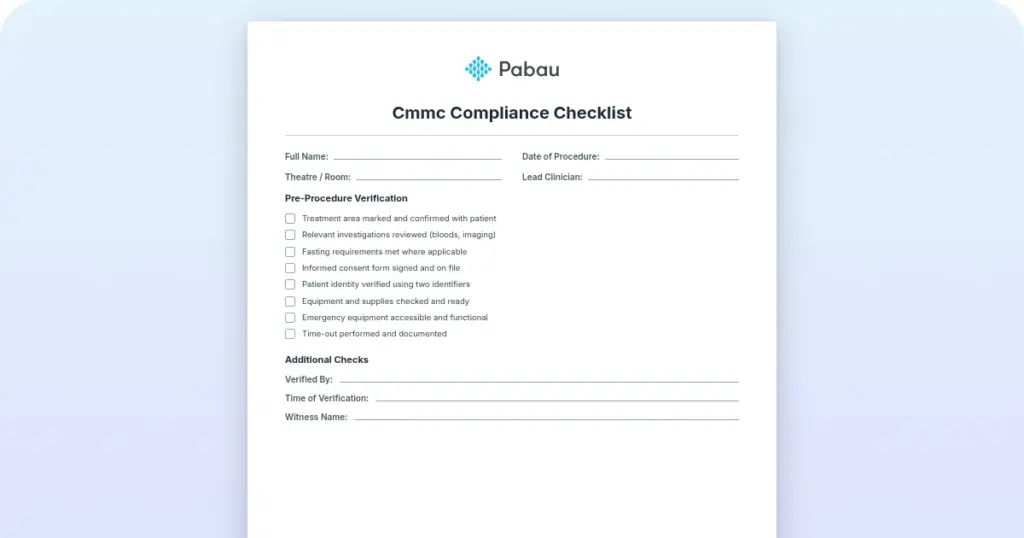
A ready-to-use authorization covering patient identification, the records being released, the recipient, the purpose, an expiration date, and the signature block. It follows both federal 45 CFR §164.508 and Ohio Revised Code requirements.
Download templateOhio healthcare providers work under two sets of privacy rules at once. Federal HIPAA sets the authorization standard in 45 CFR §164.508, and the Ohio Revised Code adds its own requirements on top.
A properly completed release form documents patient consent before you hand records to a family member, an insurer, or an attorney. This guide covers what the form must contain, how to fill it out, and who signs when the patient cannot.
A HIPAA release form is a legal document that lets a covered entity disclose a patient’s protected health information to named people or organizations. Treatment, payment, and healthcare operations disclosures need no written authorization. Every other purpose does.
The Ohio Department of Medicaid publishes the state-standard authorization form, ODM 10221, under ORC 3798.10 and OAC 5160-1-32.1. It folds the federal core elements and the Ohio requirements into one template, so staff stop guessing which form to reach for.
The form protects the patient and the provider at once. Patients keep control over who reads their records, and the practice keeps a dated document proving consent was given. Filed against the patient record, it can be produced during a compliance review or a dispute.
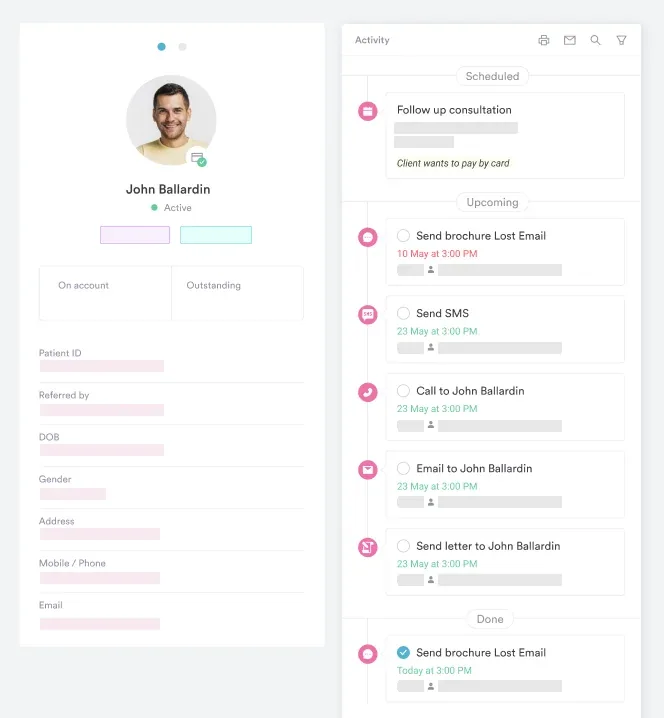
The federal authorization rule names seven core elements. Ohio’s state-standard form carries all seven, plus language pointing at the Ohio Revised Code.
A generic federal form carries none of the Ohio wording, which is what this template adds. That is the omission worth checking before you reuse a form written for another state, such as the Massachusetts release form.
The authorization also sits alongside your notice of privacy practices and does a different job. The notice explains routine uses of patient records, while the authorization approves one specific disclosure to one named recipient.
Five steps produce a form that holds up in a compliance review:
The patient then signs and dates the form, on paper or through digital intake forms if your practice collects signatures on screen. File it against the chart and keep it for at least six years. Read that alongside the wider rules on medical record retention, which apply to the chart as a whole.
A relative asking for a patient’s records is the request staff get wrong most often. Verbal permission does not satisfy HIPAA, and neither does a family relationship on its own.
Once a patient turns 18, parents and siblings hold no default right of access. An adult child asking for a parent’s records needs a signed authorization like anyone else.
Where the patient lacks decision-making capacity, the authority moves to a substitute decision-maker. ORC Chapter 1337 governs the health care power of attorney, which is the document naming who may sign for the patient. A court-appointed guardian signs instead where a medical power of attorney was never executed.
The chart below runs the three questions in the order staff should ask them.
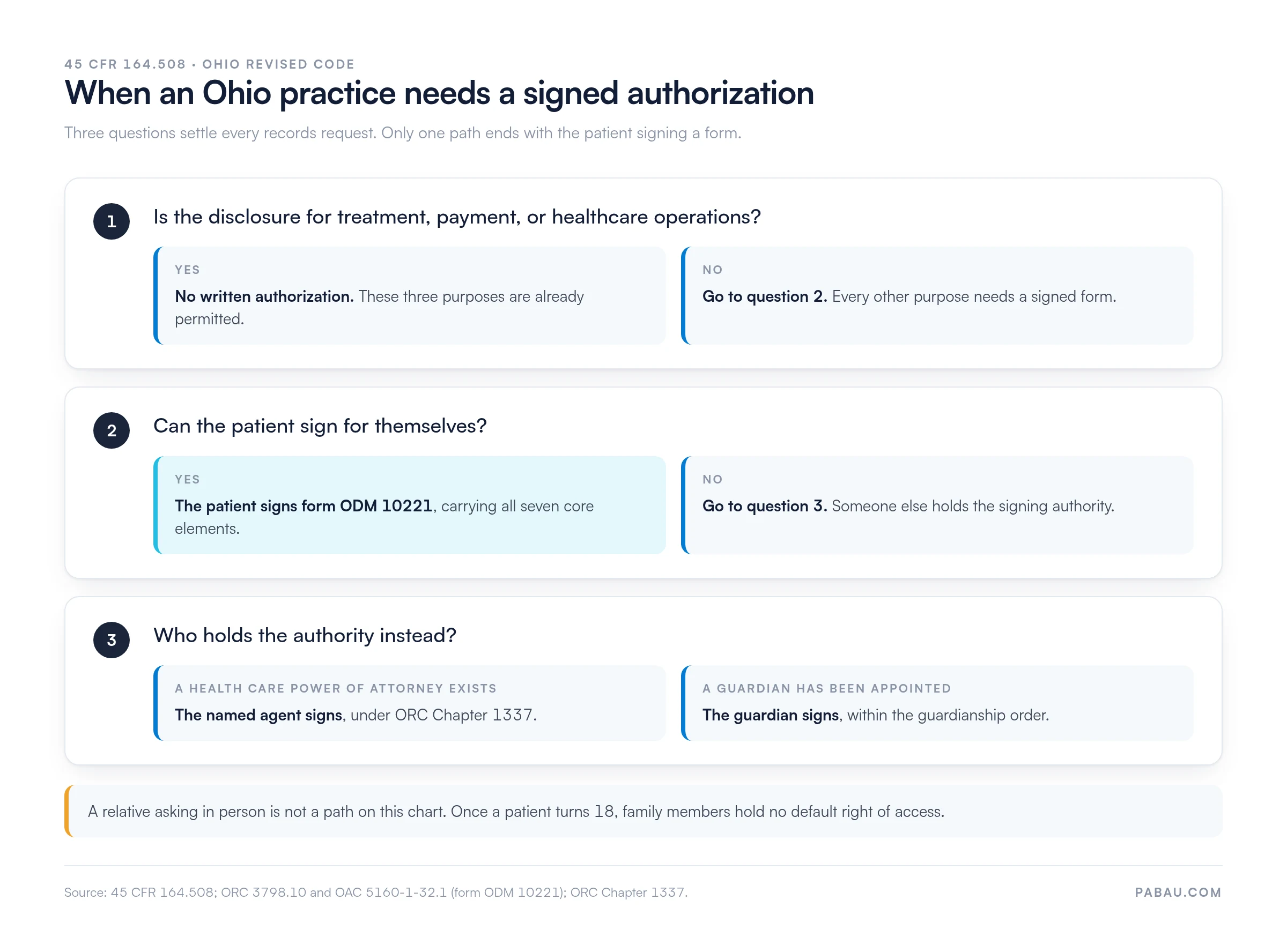
The template carries a line for the signer’s relationship to the patient. That detail helps front-desk staff verify who is standing in front of them before records leave the building.
Legal defensibility: Using the state-standard form shows a good-faith effort to comply with federal and Ohio law. If a patient later disputes a disclosure, the signed form is the practice’s evidence.
Less admin: Staff stop comparing form variants and deciding which Ohio wording to bolt on. One template speeds up completion and cuts transcription errors.
A clean audit trail: Stored in compliance management software, each signed authorization is timestamped and tied to the patient record. That is what an Office for Civil Rights investigator asks to see after a breach complaint.
Patient confidence: A form that reads as professionally drafted signals that the practice treats privacy as a standing obligation rather than a formality.
Ohio providers should work from the Ohio Department of Medicaid’s recommended template rather than a generic federal one. It quotes Ohio Revised Code language next to the federal requirements, which removes the question of which rules apply.
Electronic signatures are valid in Ohio under the Uniform Electronic Transactions Act. Patients can sign with a stylus, a touchpad, or a signature tool, which suits telehealth and patient portal intake.
Ohio Medicaid policy references the state-standard authorization form directly. Practices billing Medicaid that use the state-endorsed version demonstrate good-faith compliance and reduce the chance of an audit finding.
Questions about Ohio privacy law go to the Ohio Department of Health or the Ohio Department of Medicaid. For a question about your own practice, a healthcare attorney licensed in Ohio is the right call.
Most practices still treat the authorization as a piece of paper. It gets printed, signed at the desk, scanned, and filed somewhere a staff member has to remember. Finding it two years later during an audit is its own small project.
Practice management software like Pabau sends the authorization to the patient before they arrive and captures the signature on screen. The signed copy files itself against the patient record, so staff search by patient name rather than by filing cabinet.
The audit trail comes with it. Every release is logged against the staff member who made it and the recipient it went to. Reminders can be set against an expiry date, so a renewal is never an emergency request.
Practices running several Ohio locations get one more benefit. The same authorization template and the same tracking apply at every site, so consent handling does not drift between them.

Pabau collects the signed authorization at intake, files it against the patient record, and logs every release. Your practice can prove consent in seconds during an audit.

The paperwork question here is narrow. Ohio hands you a form that already satisfies both rulebooks, so drafting your own only creates a document a lawyer has to check.
The harder problem is what happens after the signature. An authorization the practice cannot locate during an audit does no work, and one that quietly expired does less.
Download the template, use the state-standard wording, and decide now where the signed copies will live. Book a demo to see how Pabau captures and stores Ohio HIPAA authorizations against the patient record.

Need software that tracks consent? HIPAA compliance software sets out what to look for in a system that stores signed authorizations.
Training the front desk? HIPAA training for employees covers the records-release rules staff get wrong most often.
Need the privacy notice as well? HIPAA privacy policy template gives you the companion document patients receive at intake.
Worried about a wrongful disclosure? What to do if you violate HIPAA walks through the breach response steps in order.
Practicing in more than one state? HIPAA release form Texas covers the same ground under Texas rules.
It is a signed document that lets a healthcare provider disclose a patient’s protected health information to named people or organizations. Ohio publishes a state-standard version, form ODM 10221, that satisfies both federal 45 CFR 164.508 and Ohio Revised Code requirements.
There are seven. The form must carry the patient’s identity, a description of the records released, the recipient, and the purpose. It also needs an expiration date or event, the patient’s signature and date, and a statement of the right to revoke.
Nothing substantive. Authorization is the term the HIPAA regulation uses, and release form is what most practices and patients call the same document.
Only if the patient signs an authorization naming that person. A spouse, adult child, parent, or sibling has no automatic right of access in Ohio without written consent.
For as long as the form itself states. There is no statutory period, so the document must name an end date or a triggering event. One to three years is common for routine disclosures. Disclosures already made stay valid after the authorization expires.
Yes, in writing, at any time. Revocation does not undo disclosures already made, so record the date you received it and flag the chart so staff make no further releases.
No. The Ohio Department of Medicaid publishes and recommends it. A custom form is acceptable if it carries all seven federal core elements and meets Ohio law. Most practices use the state-standard version to avoid a legal review.
The template at the top of this page is free to use. Form ODM 10221 is also available from the Ohio Department of Medicaid, and HHS publishes general authorization guidance. Our version is written to satisfy the federal rule and Ohio law together.