HIPAA compliant texting: What you can send patients & how to communicate securely
HIPAA compliant texting is possible when a text holds no protected health inform...

Last Updated: Oct 16, 2026
A GERD medication list sorts every treatment option by drug class, so you can see at a glance what each one does. Antacids neutralize acid within minutes, H2 blockers cut acid production for 8-12 hours, and PPIs suppress it for a full day or more. Prokinetics and baclofen sit behind those three, for motility problems and for symptoms that survive maximum acid suppression.
Treatment escalates one class at a time. Patients start with the mildest option that controls their symptoms and move up when it stops working. A shared reference keeps that sequence consistent across your team, and it keeps patients clear on what they are taking and why.
This guide covers each class with generic and brand names, OTC versus prescription status, mechanisms of action, and typical dosing. It also comes with a printable checklist you can keep alongside your practice’s medication protocols.
A printable companion checklist for GERD medication management. Keep it with your notes or hand it to a patient, and use the drug-class reference on this page for names, status, and dosing.
Download template
GERD medications fall into five classes: antacids (fast-acting), H2 blockers (moderate acid reduction), PPIs (strongest suppression), prokinetics (motility support), and baclofen (refractory cases).
OTC options include antacids, low-dose H2 blockers, and low-dose PPIs. Prescription options offer higher doses and specialized formulations for erosive esophagitis.
Antacids work within minutes but fade after 30-60 minutes, H2 blockers hold for 8-12 hours, and PPIs cover 24 hours or more.
Pabau’s prescription management software helps practices track GERD medication protocols, dosing histories, and follow-up reviews in one place.
A GERD medication list is a structured clinical reference that groups the available medications by drug class, mechanism of action, and indication. It standardizes how a practice treats reflux and keeps prescribing inside evidence-based guidelines. It also supports patient education and gives intake forms a shared vocabulary for medication histories.

GERD occurs when stomach acid repeatedly flows back into the esophagus, causing inflammation and symptoms like heartburn and regurgitation. Left untreated, chronic acid exposure can damage the esophageal lining, a condition called erosive esophagitis. Medications either reduce acid production or neutralize the acid already there, which lets the lining heal.
The American College of Gastroenterology (ACG) ties medication selection to symptom severity, symptom frequency, and whether tissue damage has occurred. A centralized list keeps your team aligned on that step-wise approach. It also gives patients a plain answer when they ask what each medication is for.
The list works as a clinical reference and as a patient education tool. Here are five practical steps for putting it to work in your workflow:
GERD medications fall into five classes. The table below gives each one a generic name, a common brand name, its mechanism, OTC or prescription status, and typical dosing. This is the core reference clinicians and patients work from.
The three acid-control classes differ more in how long they last than in how fast they start. That difference decides where each one belongs in a treatment plan.
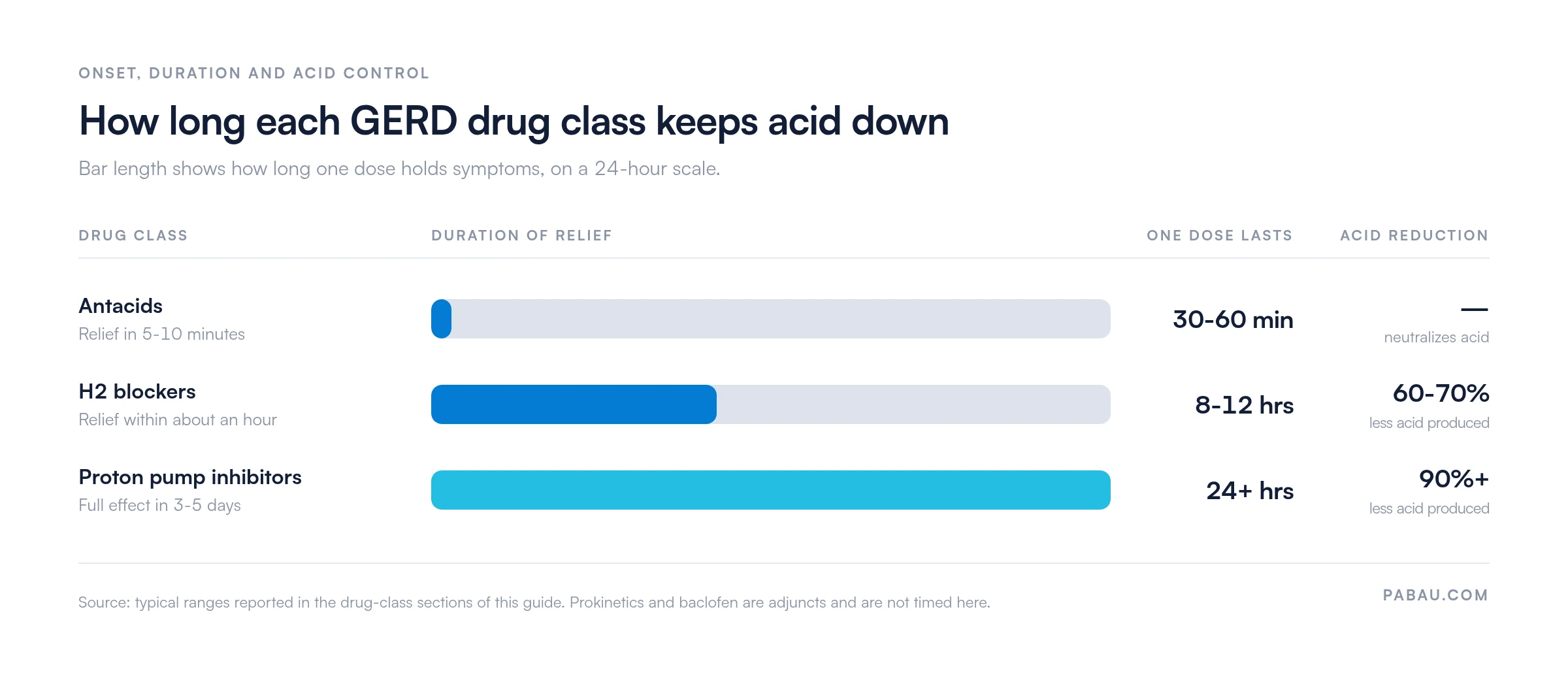
Antacids chemically neutralize the acid already in the stomach. Relief arrives in 5-10 minutes, but it fades after 30-60 minutes. Common OTC brands include Tums (calcium carbonate), Maalox (magnesium hydroxide), and Rolaids.
They are not a chronic GERD treatment. Frequent use brings side effects, since magnesium causes diarrhea and calcium constipates, and antacids do nothing to heal esophageal inflammation. Their place is occasional heartburn, or a bridge while another class takes hold. H2 blockers start working within about an hour, while PPIs need 3-5 days to reach full effect.
These H2 receptor antagonists cut acid production by about 60-70% and hold for 8-12 hours. The most common is famotidine (Pepcid), sold both OTC at 10 mg and by prescription at 20-40 mg. Cimetidine and nizatidine are the other options, though both are prescribed far less often today.
H2 blockers are well tolerated and suit mild-to-moderate GERD, particularly night-time symptoms. They are weaker than PPIs at healing erosive esophagitis. If a patient shows no improvement after 2-4 weeks on an H2 blocker, escalation to a PPI is usually the next step.
PPIs block the proton pump enzyme that produces stomach acid. They suppress secretion by more than 90% and cover 24 hours or longer. The options are omeprazole (Prilosec), esomeprazole (Nexium), lansoprazole (Prevacid), pantoprazole (Protonix), rabeprazole (Aciphex), and dexlansoprazole (Dexilant). Most come in both OTC and prescription formulations.
PPIs heal erosive esophagitis better than any other class and are first-line for moderate-to-severe GERD. They typically require 3-5 days to reach full effect. Long-term use has been associated with vitamin B12 deficiency, hypomagnesemia, and higher fracture risk in some studies, though causality remains debated. That makes periodic review part of the prescription rather than an optional extra.
Prokinetics such as metoclopramide and bethanechol strengthen the lower esophageal sphincter and speed up gastric emptying. They are adjunctive therapy, used when acid reduction alone is not enough or when motility dysfunction is driving the reflux. Metoclopramide carries a black box warning for tardive dyskinesia with long-term use, which limits its appeal.
Prokinetics are prescribed alongside an H2 blocker or a PPI rather than on their own. Evidence for their standalone efficacy in GERD is modest, and prescribing has declined in recent years.
Baclofen, a GABA agonist, is a prescription medication reserved for patients who fail high-dose PPI therapy. It reduces transient relaxations of the lower esophageal sphincter, which is the primary mechanism of GERD in many patients. Typical doses run from 5-20 mg three times daily.
Baclofen is off-label for GERD, and its side effects limit tolerability. Drowsiness, dizziness, and weakness are the common ones. It usually comes up when surgery is being evaluated, or when symptoms persist despite maximum medical therapy.
Patients can treat reflux without a visit, which is why many arrive already medicated. The OTC shelf carries every antacid, plus low-dose H2 blockers such as famotidine 10 mg. Low-dose PPIs are there too, including omeprazole 20 mg and lansoprazole 15 mg. These suit occasional heartburn, not daily use beyond two weeks without medical guidance.
Make clear that OTC status says nothing about how long a medication should be taken. Chronic GERD needs a diagnosis to rule out complications, plus periodic review. Pair that advice with a written acid reflux plan, so patients know which triggers to avoid between appointments.
Moving up to prescription strength buys higher doses and formulations the OTC shelf does not carry. Prescription PPIs typically run 40-80 mg daily, and high-dose H2 blockers sit at 20-40 mg. Prokinetics and baclofen are prescription-only in every form.
Four situations call for escalation to prescription therapy:
Record which of those four triggered the change. A note of the reasoning is what makes the next review quick, and it is what a covering clinician needs most.
Side effects track the class. Antacids cause diarrhea with magnesium and constipation with calcium. H2 blockers are well tolerated, though headache and fatigue turn up. PPIs rarely cause acute problems, but long-term use is associated with vitamin B12 deficiency, so monitoring matters. Metoclopramide carries a black box warning for tardive dyskinesia, and baclofen brings central nervous system effects.
Check current FDA drug labeling and ACG guidance before prescribing. Drug interactions need the same attention, since omeprazole reduces the effectiveness of clopidogrel.
Managing reflux well depends on knowing what each patient has already tried. Without one shared record, the prescribing logic is lost between visits, and patients end up on duplicate or conflicting therapy.
Most of that record belongs on the patient file rather than in a spreadsheet, which is what software for GP practices is built to hold. Four habits keep it usable:
In most practices a reflux history lives in three places at once. Part of it sits in the consultation note, part on a paper intake form, and part in whoever prescribed last. At the six-week review, someone has to reconstruct what the patient already tried.
Practice management software like Pabau holds that history against the patient record. Intake forms feed straight into the chart, so the antacid a patient bought over the counter is logged before the consultation starts. Prescriptions, dose changes, and outcomes then stack up on the same timeline.
That turns escalation into a quick decision. A clinician opening the record sees which classes failed, at what dose, and for how long. Follow-up reminders go out on their own, so a four-week PPI review does not depend on anyone remembering to book it.

Pabau’s prescription management system keeps medication histories, dosing, and follow-up reviews organized so your team stays coordinated on every patient’s GERD treatment plan.

Choosing between these classes comes down to how long a patient needs cover, not how strong the drug sounds. Occasional heartburn is an antacid problem. Symptoms that return every night, or esophagitis confirmed on endoscopy, need suppression that lasts a full day.
What usually slips is the record, not the prescribing. Write down what was tried, at what dose, and what happened, and the next review takes minutes instead of a fresh history. Book a demo to see how Pabau keeps GERD medication histories and follow-up reviews on one patient record.

Need the lifestyle side of reflux care? The acid reflux plan template gives patients a written set of triggers to avoid between appointments.
Running a structured medication review? The medication review template walks through dose, duration, outcome, and the decision you made at each step.
Documenting the abdominal exam? Abdominal exam documentation covers the findings that separate reflux from the conditions that mimic it.
Comparing systems for a primary care practice? Primary care software sets out what to look for in records, prescribing, and recall.
The best GERD medication depends on symptom severity and whether esophageal damage has occurred. Antacids and OTC H2 blockers work for occasional heartburn. Prescription-strength PPIs are most effective for chronic moderate-to-severe GERD and erosive esophagitis. Your clinician selects based on individual response.
PPIs are generally safe for chronic use. Prolonged therapy over several years has been associated with vitamin B12 deficiency, hypomagnesemia, and higher bone fracture risk in some observational studies. Annual monitoring and review with your clinician is advised. The benefit of healing esophagitis typically outweighs these risks when PPIs are used appropriately.
Medications manage GERD symptoms and allow the esophagus to heal, but they do not cure the underlying mechanism in most patients. Symptoms often return once medication stops. Lifestyle changes such as weight loss, dietary modification, and sleeping upright help, and severe cases may be offered fundoplication surgery. Both routes need individual assessment.
Lifestyle measures include raising the head of the bed, avoiding late-night meals, limiting acidic, spicy and fatty foods, cutting caffeine and alcohol, and losing weight. Some patients find relief with ginger or aloe vera, or with H. pylori eradication where it is present. These measures alone are insufficient for moderate-to-severe GERD and work best alongside medication.