GLP-1 usage by state: Who’s taking, searching and paying in 2026
GLP-1 usage by state peaks in West Virginia, America’s GLP-1 capital, with...

Last Updated: Oct 16, 2026
A ketone measurement chart is a clinical tracking record that logs blood, breath, or urine ketone readings against patient data and a reference range. Clinicians running ketogenic diet or metabolic therapy programs use it to follow trends across visits, rather than judging a single number.
A reading only means something when its method, units, and timing are recorded with it. Teams that already collect intake information through digital intake forms can keep the chart beside that record. The free printable PDF below gives your team one consistent format for every appointment.
A one-page chart with patient details, timed ketone readings in mmol/L marked fasting or post-meal, and notes on meals, exercise, and symptoms. It closes with observations, medication changes, a follow-up plan, and the clinician’s signature.
Download template
A ketone measurement chart logs readings against patient data and reference ranges.
Blood and urine readings measure different ketones, so keep their units separate.
Dehydration can push urine strip readings higher than blood levels suggest.
A high blood reading needs glucose context, because diabetic ketoacidosis is assessed using both.
Practice software such as Pabau keeps each reading in the patient file for trend review.
A ketone measurement chart is a structured log that places each reading next to its testing method, units, and reference range. It shows direction of travel across visits, which a single number cannot.
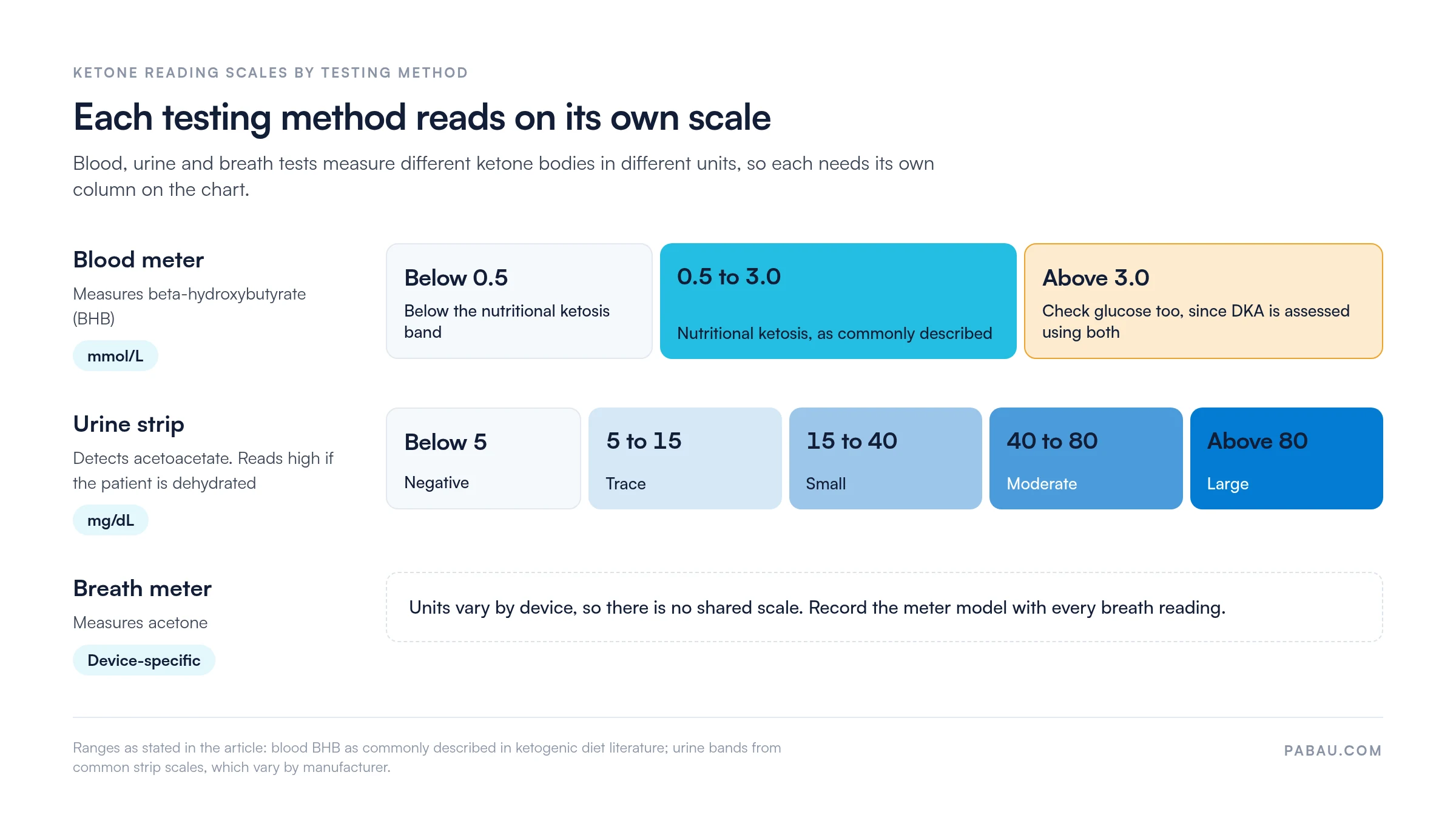
Charts usually cover one of three testing methods. Blood meters measure beta-hydroxybutyrate (BHB), urine strips detect acetoacetate, and breath meters measure acetone. These are different molecules, so a result from one method cannot simply stand in for another.
Reference ranges also depend on context. In nutritional ketosis, the state a ketogenic diet plan aims for, a blood BHB of 0.5 to 3.0 mmol/L is the commonly described range.
Above that band, glucose matters, because diabetic ketoacidosis is assessed using ketones and glucose together. A blood sugar chart kept alongside makes that check quick.
Each method reads on its own scale, as the chart below shows, and that’s why the three never share a column.
Record each reading against its testing method, then compare it with the range for that method. Following the same five steps every time keeps entries comparable across staff and visits.
The PDF’s reading column uses mmol/L as its unit. When you log a urine strip, write mg/dL beside the value so nobody reads it as a blood result.
Write the note while the reading is still in front of you, not at the end of the day. Pabau Scribe, our AI medical scribe, can draft the visit note from the consultation. A clinician still checks and signs every entry.
Each method measures a different ketone body, so readings cannot be swapped between methods. The table sets out what each method captures and where its limits sit.
Match the strip color to the scale printed on the bottle, then record the nearest band. Common scales run from negative to large, although manufacturers’ scales differ, so check the bottle against your chart.
A reading of 15 mg/dL falls on the boundary between trace and small, so record the exact color band rather than rounding up. Clinicians who want patient-facing context can also check Diabetes UK before sharing the chart.
A ketone measurement chart fits metabolic health practices, weight loss services, wellness practices, and longevity clinics. Any team that tests ketones at more than one visit can use it and adapt the workflow to its own patient group.
Weight loss practices often keep the chart next to weigh-ins and diet plans, which weight loss clinic software holds in one patient file. Metabolic health teams can do the same with a metabolic health EMR.
Diabetes teams can use the chart as a record, but they should not read it alone. Diabetic ketoacidosis is a medical emergency, and the NHS guidance on the condition sets out when urgent help is needed. Nursing teams can pair the chart with a DKA nursing care plan.
A shared chart makes readings comparable across staff, visits, and testing methods. That consistency is what turns a set of numbers into a readable trend.
Consistent records: every entry carries the same fields, so a colleague can pick up a case without re-asking questions.
Visible trends: a run of moderate strip readings across three visits prompts a conversation that one reading would not.
Faster escalation: reference ranges sit on the page, so staff know when a reading needs a clinician’s eye.
Check the units on every meter and strip box before you fill in the ketone measurement chart. A mmol/L value written in a mg/dL column is an easy mistake to make and a hard one to spot later. Add a units column, then read the entry back before saving it.
These errors start on the form, not in the test. Watch for them when you review a completed chart.
Good documentation records what was measured, how it was measured, and who took the reading. Readings are most useful when they sit next to clinical context, such as hydration, symptoms, and any changes to the plan the clinician has agreed.
Sign and date each entry, and note the meter or strip brand. If a value looks wrong at review, that detail tells the clinician whether to retest or escalate.
On paper, a ketone chart lives in a folder or a scanned PDF, apart from the treatment plan it is meant to inform. Spotting a trend then means flipping between visits by hand.
In Pabau, readings sit in the patient record alongside treatment history, notes, and intake answers. Clinicians review them at each visit, so a change in direction is visible before the next appointment.

Book a demo to see how Pabau keeps ketone readings with each patient’s notes, so trends are easy to review at the next visit.

Pick one testing method per patient and stick with it, because switching between strips and meters breaks the trend. Urine strips are cheap and quick, but dehydration skews them. Confirm with a blood reading when a decision rests on the number.
Print the chart for your next clinic day, then check the first completed sheets against the recording errors above. Fixing the form early is easier than correcting habits later.
Book a demo to see how Pabau keeps each ketone reading with the patient’s treatment history, ready for review at the next visit.

Planning foods for a keto patient? List of keto friendly foods gives patients a printable food list with net carbs.
Seeing acidosis outside ketosis? Metabolic acidosis template structures the assessment when acid-base results need a closer look.
Tracking insulin response too? Insulin resistance levels chart logs insulin resistance markers across visits.
Supporting patients with diabetes? Diabetes management plan sets out targets, medications, and monitoring in one plan.
Using fasting to reach ketosis? Intermittent fasting by age chart suggests fasting windows matched to each age group.
A negative result, below 5 mg/dL on common strip scales, is the usual reference for no detectable ketones. Readings above that band are recorded and interpreted against the ranges on your ketone measurement chart.
No, because they measure different ketone bodies, acetoacetate and BHB, so their numbers do not convert directly. Check current peer-reviewed evidence on accuracy before choosing a method for your service.
Yes, dehydration concentrates urine and can make strip readings look higher than blood levels suggest. Record fluid status alongside the reading where you can.
A high reading on its own is not a diagnosis. A high blood ketone reading with raised glucose, or symptoms such as vomiting or confusion, needs urgent medical assessment. Follow your local protocol and the NHS guidance on diabetic ketoacidosis.