Journal prompts for mental health
Journal prompts for mental health are guided questions that help people process ...

2
Last Updated: Oct 13, 2026

The Danger Assessment is a validated 20-item screening tool developed by Jacquelyn Campbell, PhD, RN, FAAN, to evaluate intimate partner violence lethality risk in healthcare settings.
Scores sort into four risk categories, from variable danger to extreme danger, that guide how urgently a clinician responds and what referrals follow.
The DA-5 is a validated 5-item short form for rapid risk screening when time is limited, though the full 20-item assessment gives a more complete picture.
Clinicians need to know their jurisdiction’s mandatory reporting rules and use trauma-informed methods when giving and documenting the assessment.
Download your free Danger Assessment template
A validated screening tool for evaluating intimate partner violence lethality risk, used by healthcare professionals to guide safety planning and intervention decisions.
Download templateA disclosure of abuse rarely comes with a clear read on how dangerous the situation really is. One patient might describe a pattern that’s frightening but stable. Another might be one incident away from being killed.
Telling the two apart from a few minutes of conversation is nearly impossible without a structured tool, which is exactly what the Danger Assessment provides.
Developed by nurse researcher Jacquelyn Campbell and used in emergency departments, primary care, and domestic violence services for decades, the Danger Assessment turns that judgment call into a scored, repeatable process, one that holds up whether the patient in front of you is describing a first argument or a decade of escalating violence.
The Danger Assessment is a validated clinical screening instrument developed by Jacquelyn Campbell, PhD, RN, FAAN, at Johns Hopkins University School of Nursing. It estimates the risk of serious harm or lethality in situations involving intimate partner violence (IPV), rather than simply confirming that abuse is happening.
Clinicians in emergency departments, mental health, primary care, and domestic violence services have used it for decades to identify patients at elevated risk and match their response to the actual level of danger.
Not every abusive relationship carries the same risk trajectory. Some involve a pattern of repeated but relatively stable conflict. Others escalate toward lethal violence. The Danger Assessment gives clinicians a structured, evidence-based way to tell the two apart, instead of relying on impression alone.
The full Danger Assessment has two parts: a calendar documenting the severity and frequency of physical violence over the past year, and 20 weighted yes/no questions covering relationship dynamics, substance use, weapon access, and escalation patterns. The calendar comes first, and it grounds the assessment in specific, recent events instead of a general impression of risk.
After the 20 items, clinicians sum the weighted responses into a total score. Validated cut-points then sort that score into four risk categories:
A low score doesn’t guarantee safety, and a high score doesn’t guarantee that lethal violence will happen. These categories describe relative risk, based on research across thousands of intimate partner violence cases, and they exist to guide how much urgency and which resources a case gets, not to predict any single outcome.
The Danger Assessment-5 (DA-5) is a validated 5-item version of the full 20-item scale, built for settings where the complete assessment isn’t practical, think a busy emergency department or a primary care visit with only a few minutes on the clock. It works best as a triage step: a quick read on risk before deciding whether to run the full assessment.
A few things worth knowing about it:
The DA-5 works well as an initial screen in therapy practices handling domestic violence disclosures. It flags patients who need a closer look, and when a DA-5 score raises concern, the full Danger Assessment provides the detail needed for safety planning.
How you administer the Danger Assessment matters almost as much as the score itself. The setting, your tone, and how you frame the questions all shape whether a patient tells you the truth or shuts down.
Rushing through the items, reacting visibly to what a patient discloses, or letting a partner stay in the room are the three mistakes that do the most damage. Survivors of intimate partner violence have often had their trust and boundaries violated repeatedly, so the assessment experience itself needs to communicate respect and safety, not just collect data.
Once you have a score, you’re facing legal decisions as well as clinical ones. Mandatory reporting laws for intimate partner violence differ significantly by US state and by country. Some states require clinicians to report suspected IPV to law enforcement or child protective services; others protect patient-clinician confidentiality by default.
UK practitioners work within GDPR and safeguarding rules instead, which route concerns through local safeguarding teams rather than automatic police notification.
Know your jurisdiction’s rules before you administer the assessment, not after a patient discloses something serious. When you’re unsure, check with legal counsel or your compliance officer.
Whatever you decide, document the score, the risk category, and your reasoning.
For example: “Patient scored 15 (severe danger); discussed safety planning and gave the National Domestic Violence Hotline number; patient declined law enforcement involvement at this time.”
A moderate-to-extreme score isn’t the end of the conversation. It’s the start of safety planning, and that shouldn’t wait until the next appointment. Before the patient leaves, work through this list:
Most Danger Assessment guidance focuses on the clinical moment: giving the tool, scoring it, and interpreting the result. Fitting it into daily practice workflow takes a bit more planning. Where does the assessment live in your intake process, and how does a high-risk score actually reach the right person?
Say a mental health intake includes the Danger Assessment as one of the standard questionnaires a new patient completes. In practice management software like Pabau.
Once it’s completed, the responses are captured directly in the client record, sitting alongside chart notes rather than existing as a loose paper form that’s easy to misplace.
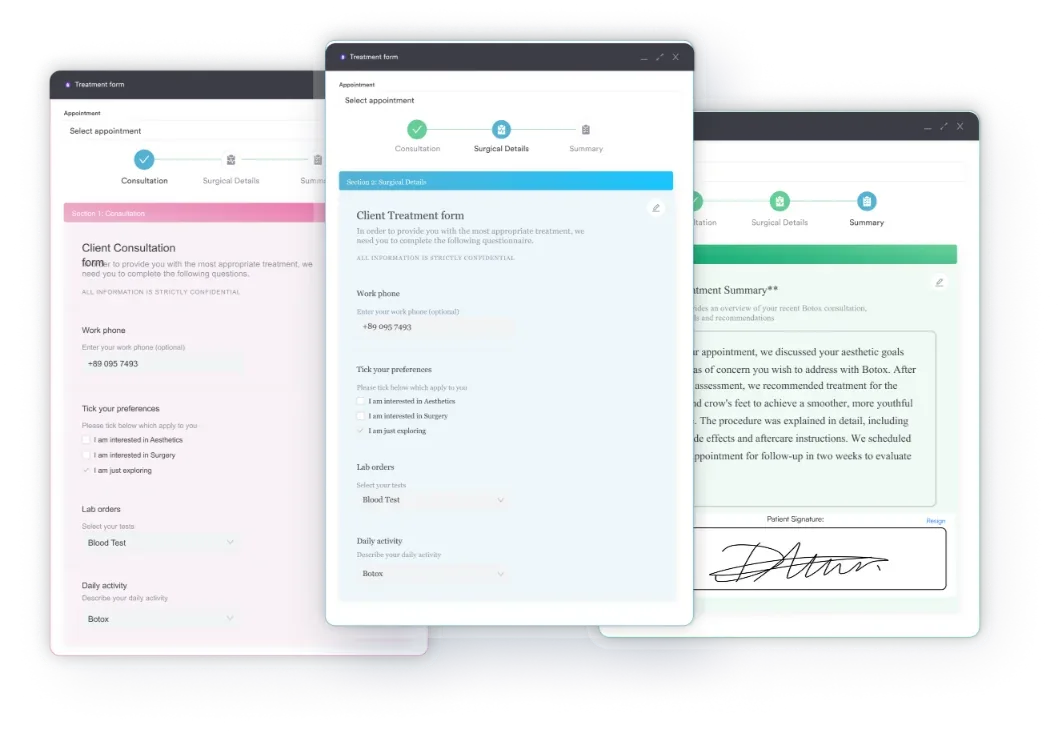
None of this replaces clinical judgment. It just means a completed high-risk assessment sits in the chart where the clinician can see it, rather than on a loose form that’s easy to misplace, and the safety-planning notes from a previous visit are right there the next time the patient comes in. Reading change across appointments depends on consistent recording, which psychology practice software enforces.

Pabau’s digital forms route the right intake to the right appointment and capture responses directly in the client record, so risk-assessment documentation stays organized without extra admin.

The Danger Assessment isn’t a diagnosis or a treatment. It’s a structured way to read risk in an intimate partner violence disclosure, so you can match urgency to the danger a patient is actually facing.
Whether you use the full 20-item instrument or the DA-5 for a faster read, the skill that matters is the same: ask with respect, score it accurately, and take the result seriously enough to act on it.
Getting that right consistently comes down to your practice’s systems more than any single clinician’s judgment. Documenting the score is the easy part. Keeping the safety plan attached to the record, and making sure follow-up doesn’t depend on one person’s memory, is where practices actually struggle.
Pabau keeps intake, documentation, and follow-up notes together in one client record instead of scattered across paper and memory. Book a demo to see how it fits into a workflow like yours.

Need a broader emotional workup alongside a Danger Assessment? Emotional vibration scale assessment template categorizes emotional states from low vibrations like fear to high vibrations like joy.
Screening a patient who has disclosed suicidal thoughts alongside abuse? Suicide Safety Plan Template walks through the same kind of collaborative, evidence-based planning for suicide risk.
Want a structured way to take a trauma history? Trauma Questionnaire Template gives you a validated format for documenting a patient’s trauma exposure.
The Danger Assessment is a validated 20-item screening tool developed by Jacquelyn Campbell, PhD, RN, FAAN, at Johns Hopkins University. It estimates the risk of serious harm or lethality in intimate partner violence and guides safety planning.
Jacquelyn Campbell, PhD, RN, FAAN, the Anna D. Wolf Chair and Professor at Johns Hopkins University School of Nursing, developed the Danger Assessment from research with intimate partner violence survivors and homicide cases. It’s since been validated across multiple populations and countries.
Clinicians sum weighted responses to 20 yes/no questions, then match the total to four categories: variable danger (0-7), increased danger (8-13), severe danger (14-17), and extreme danger (18+). Official scoring guidance comes from dangerassessment.org.
It can be. Tools like the myPlan app let survivors complete it directly. But research on court-based screening found that clinician- or screener-administered formats catch more violence and get completed more reliably than self-administered ones, which is one reason many practices still give it in person.
Yes. It has been validated in peer-reviewed research across diverse populations and clinical settings, and its sensitivity and specificity for identifying elevated lethality risk are well established internationally.
The validated instrument, training, and scoring guidance are available at dangerassessment.org. Pabau’s downloadable template above provides the same 20-item instrument formatted for practice use.