Fun journal prompts for adults
Fun journal prompts for adults are short, open-ended questions that make sitting...

Last Updated: Oct 6, 2026
The DD 2813 dental form is the Department of Defense record of a dental examination. It carries the dental readiness classification that follows from that examination. Specifically, its full official title is the Department of Defense Active Duty/Reserve/Guard/Civilian Forces Dental Examination. A licensed dentist completes and signs it, and the classification then decides whether a service member counts as dentally deployable.
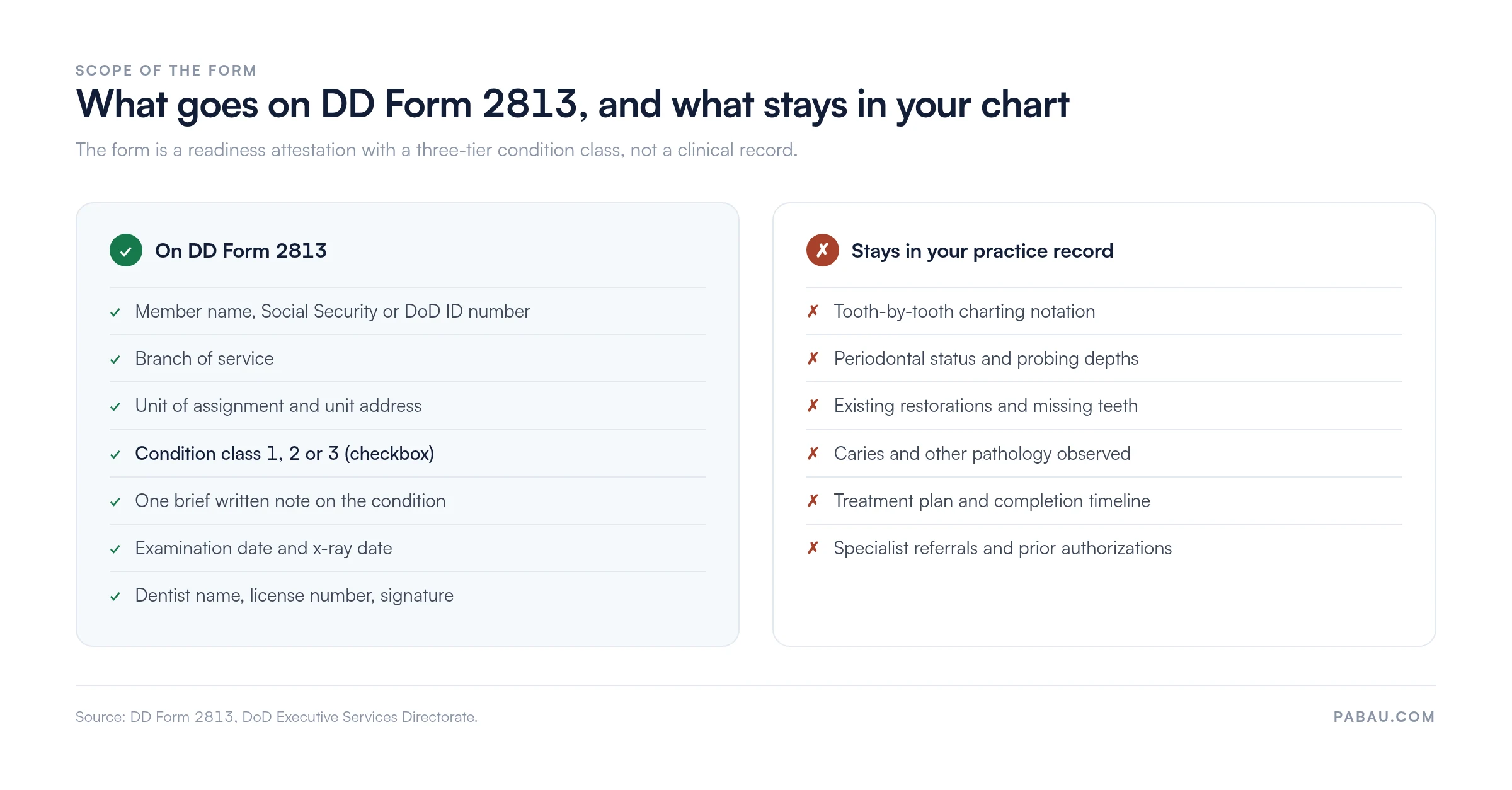
The form itself is short. It carries a five-field identification block, a three-tier checkbox for the member’s condition class, one brief written note, and the dentist’s signature. Instead, comprehensive charting stays in the practice’s own record. This guide, in turn, covers each field, who needs an examination, and how the two TRICARE dental programs use the result.
The official form is published by the Department of Defense. Instead, the free file below is a general patient information template that dental practices can use alongside it.

DD 2813 is the Department of Defense Active Duty/Reserve/Guard/Civilian Forces Dental Examination, completed and signed by a licensed dentist
The form records a three-tier condition class and one short written note, not a tooth-by-tooth clinical record
Dental readiness classification (DRC) categories 1 to 4 record oral health status and decide whether a service member is deployable
Examinations are documented under the TRICARE Active Duty Dental Program and the TRICARE Dental Program, both administered by United Concordia
The official form is published by the DoD Executive Services Directorate and downloaded from there
The free file on this page is a general patient information template, not a copy of the official form
A general patient information form for dental practices. It collects contact and record details, an emergency contact, the reason for the visit, relevant history, medication and allergies, patient declarations, and office-use notes. It is a companion to the official DD Form 2813, not a copy of it.
Download templateThe official DD Form 2813 is published by the DoD Executive Services Directorate and has to be downloaded from there. Use the template above to gather patient history before the appointment, then record the examination itself on the current DoD form.
The DD 2813 dental form is the official Department of Defense form for documenting dental examinations. Specifically, it covers Active Duty service members, Reserve Forces, National Guard personnel, and certain federal civilian employees. Its full title is the Department of Defense Active Duty/Reserve/Guard/Civilian Forces Dental Examination.
The Executive Services Directorate manages the form under the Office of the Secretary of Defense. As a result, it is the authoritative record used to establish a dental readiness classification, and that classification feeds DoD readiness reporting.
Without a current, correctly completed DD 2813 on file, a service member can be classified as non-deployable. In turn, that has immediate operational consequences for the unit. Accurate medical form documentation therefore carries operational weight in a practice that treats military patients.
The downloadable file is a general clinical intake form that any dental practice can hand to a patient before an examination. In particular, it is not a facsimile of DD Form 2813, and it does not reproduce that form’s layout or its readiness fields. It collects the following:
What it leaves out matters just as much. There is no condition class or readiness field, no DEERS identifier, and no branch or unit entry. It carries no examining-dentist license block either. Those fields sit only on the DoD form, so the readiness decision belongs there.
If you want a chairside record for the examination itself, use our dental examination form alongside this one. It gives you somewhere to write the findings that the DoD form deliberately leaves out.
First, the examination follows five stages, from patient identification through to the dentist’s signature. The sequence below reflects the field order described on the official TRICARE ADDP forms page and in the ESD source document. Always work from the current version of the form.
The brevity is deliberate. DD Form 2813 disclaims any role as a comprehensive dental record, so it asks for a classification and a signature rather than a clinical narrative. Tooth-by-tooth charting, periodontal status, restorations, caries, the treatment plan, and any specialist referral all stay in your own chart.
That split is where documentation errors start. The panel below sets the form’s fields against the ones your practice keeps.
The form reaches well beyond military dental facilities. Knowing which personnel categories need one prevents missed examinations and incorrect claim submissions.
Working from a structured, pre-formatted record rather than ad hoc notes reduces errors and shortens the write-up. It also protects the practice during a TRICARE audit or DoD review.
Check the form version date before each examination cycle. The ESD publishes updated versions of DD Form 2813 periodically, and the revision date is printed on the document. Using an outdated version can lead to a rejected claim or a readiness record flagged as incomplete.
Dental readiness classification is the core output of every DD 2813 examination. The DoD uses DRC categories to judge whether a service member’s oral health permits deployment. Four categories apply, though only the first three appear on the form. DRC 4 is applied administratively when no current examination is on record.
DRC 3 is the most operationally significant category. The form gives you one line to describe the condition behind it, so name the site and the problem. A class 3 box checked with no written description is a common reason a submitted form gets queried.
In practice, two TRICARE dental programs sit behind these examinations, and their eligibility rules differ. Confusing them is one of the most common documentation errors in practices that treat both military and civilian patients.
Practices that see both populations should keep separate workflow triggers for each program. ADDP examinations follow DoD-mandated intervals and are reported centrally. TDP examinations are driven by benefit eligibility and member-initiated access. In short, keeping each program’s records current stops readiness data and claims from crossing over.
A completed form has a defined submission pathway and a retention obligation. Practices that treat these steps as informal tend to run into claim delays and readiness reporting problems.
Data protection duties apply to military dental records exactly as they do to civilian ones. HIPAA obligations follow DoD-connected records held by civilian providers. Compliance management tools inside your practice software reduce the risk of an accidental disclosure during transfer and submission.
A single DD 2813 appointment produces four outputs: a compliance record, a readiness classification, a treatment plan, and a TRICARE claim. Practices that handle those on paper re-key the same patient details four times. They then chase the dentist for the entries nobody filled in.
Pabau keeps all four under one patient file. The intake form, the examination notes, the condition class, and the claim sit together with audit timestamps. Staff can pull a full record in seconds when TRICARE queries a submission.
Pabau Scribe, our AI scribe, structures the clinical note during the examination itself. Findings reach the record while the dentist is still with the patient. The documentation cycle then runs from patient identification to submission confirmation without a printed page leaving the practice.

Pabau brings digital intake forms, structured patient records, and documentation workflows into one system for dental practices serving military patients. Every examination record stays complete, timestamped, and easy to retrieve.

The DD 2813 dental form decides whether a service member is cleared for deployment, and it does that with a single checkbox. Complete it on the current DoD version, justify a class 3 with a written note, and keep a timestamped copy before you submit.
Treat the form as the summary it is, and keep the clinical detail somewhere you can retrieve it. A practice that splits those two records well answers a TRICARE query in minutes rather than days. To see how Pabau handles military dental documentation, book a demo with our team.

Clearing a patient before surgery or deployment? Dental clearance form covers the sign-off a referring provider needs before treatment goes ahead.
Onboarding a new military family? Dental new patient form collects the contact, insurance, and consent details you need before the first appointment.
Need a fuller history than intake captures? Dental medical history forms template walks through the conditions, medication, and allergies that change treatment planning.
Comparing systems for clinical records? Clinical documentation software explains what to look for when examination notes have to survive an audit.
The DD 2813 dental form is the official DoD form for documenting dental examinations for Active Duty, Reserve, and National Guard service members. A dentist checks one of three condition classes, adds a brief note where one is needed, and signs. As a result, that entry sets the member’s dental readiness and deployability.
A licensed dentist completes the form. It covers active duty service members, Reserve and National Guard personnel, and certain federal civilian employees under DoD dental programs. The examining dentist signs and dates the form, so it is not self-completed by the service member.
No. The form records a three-tier condition class and one short written note, not a tooth-by-tooth chart. Charting, periodontal status, and the treatment plan stay in your own patient record. The form attests to readiness rather than documenting the examination in full.
Yes. Reserve and National Guard personnel have to maintain dental readiness, and DD Form 2813 documents their examination status. Examinations are typically required before mobilization, during annual training, and ahead of deployment.
DoD policy generally requires an annual dental examination for active duty service members, with extra examinations triggered by pre-deployment requirements and mobilization orders. Reserve and Guard members usually need one at least annually and always before activation. Specific intervals vary by branch and by current DoD instruction.