Maja Popovska

Pain medication chart: Strength tiers, DEA schedules and free PDF
What is a pain medication chart and how do clinicians use it? A pain medication ...

1
Last Updated: Nov 4, 2026
Free PDF 1 page, print-ready Clinician-reviewed
The clock drawing test is a brief cognitive screen in which a patient draws a clock face and sets the hands to a stated time. It takes a few minutes and tests visuospatial skills, executive function and attention in one task. A clean drawing is reassuring, while an error-filled one flags the need for a fuller cognitive assessment. The test cannot confirm dementia by itself. Read each score alongside education, vision, hand function and the rest of the clinical picture.
A one-page form with patient and clinician details, a materials list and the exact wording for the time-setting instruction. It also prints the Shulman 0 to 5 scoring criteria, score checkboxes and a comments box.
Start from scratch, or upload this PDF or any form you already use, and Pabau's AI Form rebuilds it with tick boxes, text fields and a signature. Attach it to the treatment once, and every patient gets it on time.
AI Form rebuilds the consent, history and aftercare forms you already use. You review each one, then publish.
Patients complete forms on their phone before they arrive, so the front desk stops retyping paper.
Every signed form is versioned and attached to the treatment record, ready when you need it.
Set how long a consent stays valid. Returning patients skip forms they have already signed.
Supports HIPAA and GDPR compliance AES-256 encryption 4.8 on G2 4.7 on Capterra Trusted by 4,000+ practices worldwide

The clock drawing test is a brief screening tool for visuospatial and executive function, not a diagnostic test.
Scoring systems such as Shulman and Rouleau differ, so use the one your practice has adopted.
Education level, vision, and motor impairment can all lower scores independently of cognition.
Document the scoring method, the command or copy condition, and any confounders in the patient record.
The clock drawing test is a paper-and-pencil cognitive screen in which the patient draws a clock face from memory or from a stated time. It is widely used as a bedside tool in primary care, memory clinics, and mental health settings. The test was first described as a quick way to detect visuospatial and conceptual problems, and it remains part of several established screening batteries.
Clinicians use the test because it is short, inexpensive, and needs no special equipment. Its clinical purpose is to flag possible impairment that warrants a fuller cognitive function assessment. It is not designed to confirm dementia on its own.
The clock drawing test measures several cognitive domains at once. Because the task combines them, a single poor drawing can have more than one cause.
Administration is simple, but consistency matters. Use the same wording and materials every time so results can be compared over time.
Some protocols use a copy condition, where the patient copies a pre-drawn clock, instead of the command condition described above. The copy version tends to isolate visuospatial skills from memory. Whichever you use, state the condition in the record.
Several validated scoring systems exist, and none is universally superior. The most common approaches differ in how many points each feature earns and where the cut-off sits. Choose one system, apply it consistently, and avoid mixing criteria between sessions.
Cut-off scores differ between systems and between populations, so check the published validation for the scale you use before applying a threshold.
The printable template uses the Shulman system, where a perfect clock scores 5. Each step down marks a more serious kind of error, from uneven spacing to a clock that no longer holds its shape.
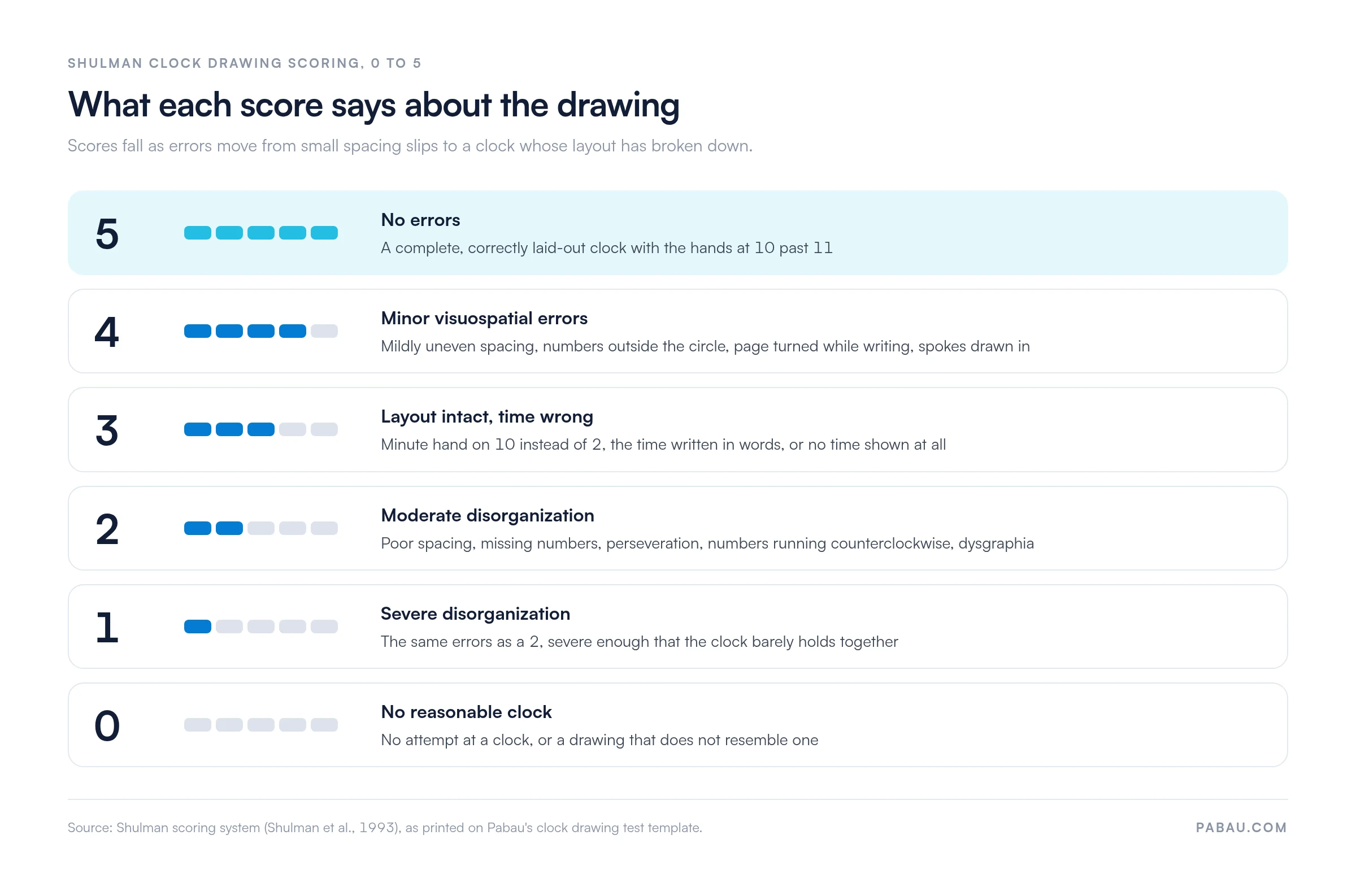
A low score tells you the drawing has errors, not why. The pattern of errors is often more useful than the total score.
A normal drawing has evenly spaced numbers, all twelve present, and hands clearly showing 11 and 2. An abnormal drawing might have all numbers bunched into the right half of the face, or hands that point to the wrong times. Compare each drawing against the scoring method you chose rather than relying on impression.
Drawing a clock wrong means the task has identified a problem in one or more cognitive domains. It does not establish a diagnosis by itself. Education, vision, hand function, and language can all affect the result, so follow up with a fuller assessment.
The clock drawing test is used to help identify cognitive decline that may be linked to dementia or Alzheimer’s disease. Its sensitivity and specificity vary across studies and populations, so it should never be the only measure used. Treat an abnormal result as a reason to investigate further, not as a finding in itself.
Because the test is quick, it can be repeated at follow-up visits to see whether performance changes over time. A consistent decline across visits is more informative than a single score. Once decline is confirmed, a staging tool such as the 7 stages of dementia chart helps describe where the patient sits.
The Mini-Cog combines a three-item word recall task with a clock drawing test. Clinicians score the recall items and the clock separately, then combine them into a single outcome. The clock component is the same test described above, scored on the Mini-Cog scale.
Clinicians also use the test beyond dementia. It has been studied in acute stroke, where it can reveal visuospatial neglect that is easy to miss on routine examination. Its use in schizophrenia is documented in the clinical literature. The evidence base there is smaller, so check current studies before you rely on it.
The test has limits that matter when interpreting results. Education level and cultural background influence performance, since familiarity with clocks and numbers varies. Visual impairment, tremor, or limited hand function can produce errors unrelated to cognition.
The test is a screening tool, not a diagnostic one. Always pair it with history, collateral information, and a fuller battery where indicated, such as the Montreal Cognitive Assessment or the Mini-Mental State Examination.
The printable version helps practice teams run the test the same way every time. It lists the materials, gives the instruction wording, and prints the Shulman criteria beside the score boxes.
If you store results electronically, keep them within your practice’s data protection controls. Under HIPAA in the US, clinical cognitive results are protected health information and must be handled accordingly.
On paper, a clock drawing is scored at the desk, scanned later, and filed as a loose upload. The next clinician then has to hunt through attachments to compare this drawing with the last one.
Pabau, the practice management platform we build for clinics and therapy services, turns the form into a digital questionnaire attached to the appointment. The Shulman score, the error pattern and any confounders land in the patient’s Client record. That record sits inside the wider therapy practice management setup, with scheduling and notes in the same system.
At a follow-up visit, the clinician opens one record and sees every earlier score in date order. A decline across visits, which this test shows best, is visible without pulling paper files. Pabau’s medical records management keeps those entries under the same access controls as the rest of the chart.

Pabau turns paper screening forms into digital questionnaires saved to the patient record. Scores, error patterns and notes stay together, so changes across visits are easy to see.

The clock drawing test earns its place because it is quick to repeat, and one drawing never settles a diagnosis. Pick one scoring system, use the same wording each time, and record the error pattern with the score. Then the second and third drawings tell you more than the first.
Treat an abnormal clock as the start of a fuller assessment, and weigh education, vision and hand function before reading it as cognitive change. Book a demo to see how Pabau keeps each score in the patient’s record, ready for the next visit.

Need a structured clinical form? Psychiatric evaluation template offers a structured format for comprehensive mental health assessments.
Supporting patients after a dementia diagnosis? Dementia worksheets template gives structured activities for memory, orientation and daily routines.
Want a longer dementia screen? SLUMS test template covers a 30-point exam that also includes a clock drawing task.
Screening older adults for mood as well? Geriatric depression scale scoring explains how to score and read the scale.
Comparing broader cognitive tools? Neurocognitive test outlines the batteries used when a screen comes back abnormal.
The clock drawing test is a brief cognitive screen in which a patient draws a clock and sets the hands to a stated time. It assesses visuospatial and executive function and is used to flag possible impairment for further assessment.
It measures visuospatial function, executive function, attention, semantic memory, and motor programming. A single drawing can reflect more than one domain, so the error pattern matters.
It means the test has found a possible problem in one or more cognitive domains. It does not confirm a diagnosis, and education, vision, and motor ability can all contribute.
No, it is a screening tool. An abnormal result should prompt a fuller assessment rather than a diagnosis on its own.