High protein grocery list: Free PDF with protein per serving
A high protein grocery list is a shopping guide that groups protein-rich foods b...

2
Last Updated: Oct 8, 2026
A crohn’s disease medication list is a single record of every drug a patient takes for inflammatory bowel disease, grouped by class. It carries the dose, the route, the side effects reported, and the monitoring each class needs. Six classes make up that list: aminosalicylates, corticosteroids, immunomodulators, biologics, JAK inhibitors, and antibiotics.
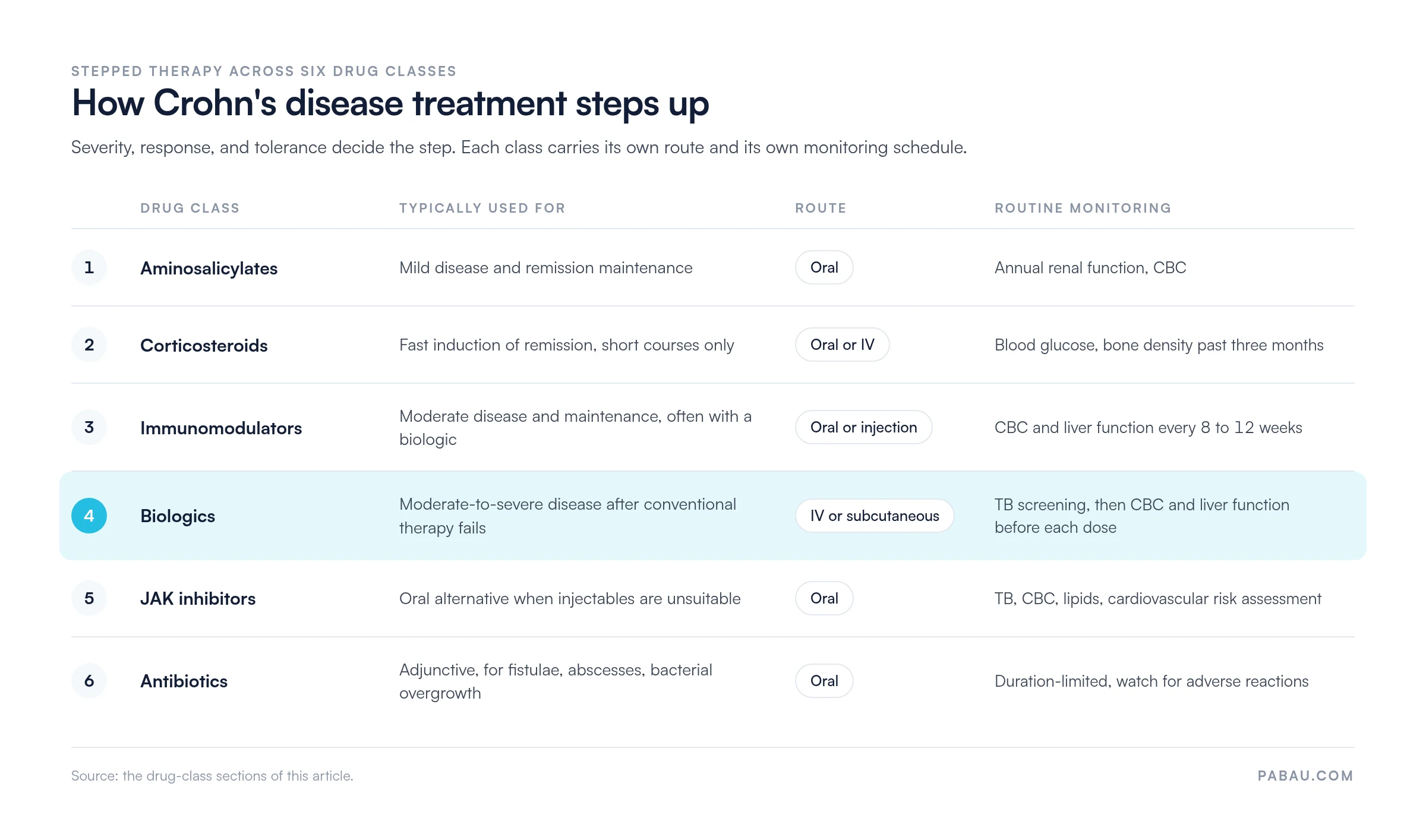
Treatment steps up rather than following one fixed path. Mild disease usually starts on aminosalicylates. Moderate-to-severe disease moves to biologics or immunosuppressants, and JAK inhibitors give an oral route when injections are unsuitable.
Each class also brings its own monitoring burden, from one blood test a year to labs before every infusion. The template below tracks all of that in one place. The sections after it give the dosing and clinical detail behind each row.
A tracking form with one row per medication: drug name, class, dose, frequency, route, prescriber, side effects noted, and the monitoring due. There is space to date each review, so the list shows when it was last checked.
Download template
A Crohn’s disease medication list spans six drug classes: aminosalicylates, corticosteroids, immunomodulators, biologics, JAK inhibitors, and antibiotics.
Treatment is stepped, so mild disease starts on aminosalicylates and moderate-to-severe disease moves to biologics or immunosuppressants.
Each class has its own monitoring schedule, from annual blood work to labs before every biologic dose.
Upadacitinib is the first JAK inhibitor approved for Crohn’s disease, dosed at 45 mg daily for induction.
Bring the list to every gastroenterology appointment and date each update, so the record stays current.
A Crohn’s disease medication list is a structured record of every drug a patient takes for inflammatory bowel disease. It holds the dose, frequency, route, side effects experienced, and the date of each review, grouped by drug class.
What makes it Crohn’s-specific is the monitoring column. Biologics and immunosuppressants need lab work, infection screening, and cardiovascular checks on a schedule. The list records what is due and when it was last done.
According to the Crohn’s & Colitis Foundation, medication goals focus on reducing inflammation and holding remission. Reaching either one takes coordination between the patient, the care team, and the gastroenterologist.
The form serves two readers. A patient or caregiver brings it to appointments so nothing is forgotten. The gastroenterologist uses it to track response, adjust therapy, and spot interactions.
Clinical practice guidelines from the American College of Gastroenterology emphasize shared decision-making, and a written list is what anchors that conversation.
The form is built to be completed during a visit. Start with the patient’s name, date of birth, primary gastroenterologist, and emergency contact. Then work through five steps.
Dating each update is what keeps the form useful. An undated list tells the next reader nothing about whether it is current. This form records what is prescribed. For a record of what the patient actually took, the medication log template covers that side.
Crohn’s therapy steps up rather than following one route from diagnosis. The class in use sets how the drug is given and how closely the patient has to be watched. That is the part a medication list has to capture.
Aminosalicylates are oral anti-inflammatory agents used mainly for mild Crohn’s disease and for holding remission. Common agents include mesalamine (Asacol, Pentasa, Apriso), sulfasalazine, and balsalazide.
Corticosteroids bring a flare under control quickly, but their side-effect burden rules them out for long-term maintenance. Agents include prednisone, methylprednisolone, and budesonide, which is formulated for ileal and ascending colon release.
Immunomodulators are used for moderate disease and for maintenance, often paired with a biologic. They work more slowly than steroids but carry a lighter side-effect burden. Common agents are azathioprine (Imuran), 6-mercaptopurine (6-MP), and methotrexate.
Biologics target specific immune pathways. They are used for moderate-to-severe disease when aminosalicylates and immunomodulators have failed. Four subclasses are in routine use, and they differ mainly in what they block and how they are given.
Infusion dates, response, and side effects all have to land somewhere. An AI medical scribe writes them into the visit note as the conversation happens, rather than at the end of the day.

TNF-alpha inhibitors were the first biologic class approved for Crohn’s disease. The agents are infliximab (Remicade), adalimumab (Humira), and certolizumab pegol (Cimzia).
These newer agents target interleukin pathways. Ustekinumab (Stelara, approved 2016) and risankizumab (Skyrizi, approved 2022) are both options when TNF inhibitors fail or are not tolerated.
Vedolizumab (Entyvio) is gut-selective. It targets the α4β7 integrin on immune cells in the gut, which keeps its effect largely out of the rest of the body.
JAK inhibitors are the newest oral class for Crohn’s disease. Upadacitinib (Rinvoq) was FDA-approved for Crohn’s disease in May 2023, the first JAK inhibitor cleared for the condition. It gives patients an oral alternative to injections and infusions.
The oral route matters most for patients who cannot tolerate injectables, or who struggle to get to an infusion center every eight weeks.
Antibiotics are adjunctive. They treat specific complications such as fistulae, abscesses, and bacterial overgrowth, rather than the underlying disease. Common agents are metronidazole (Flagyl) and ciprofloxacin (Cipro).
Symptom relief sits alongside the disease-modifying drugs, and it belongs on the same list. Keeping one complete patient record means the supplements and painkillers sit beside the biologic, not in a separate note.

Every Crohn’s medication carries its own checks, and they exist to catch toxicity early. The template groups them by class in the same order as the table below.
A medication list is only as good as its last update. Four habits keep it accurate between appointments, and all four are things a practice can build into its own routine.
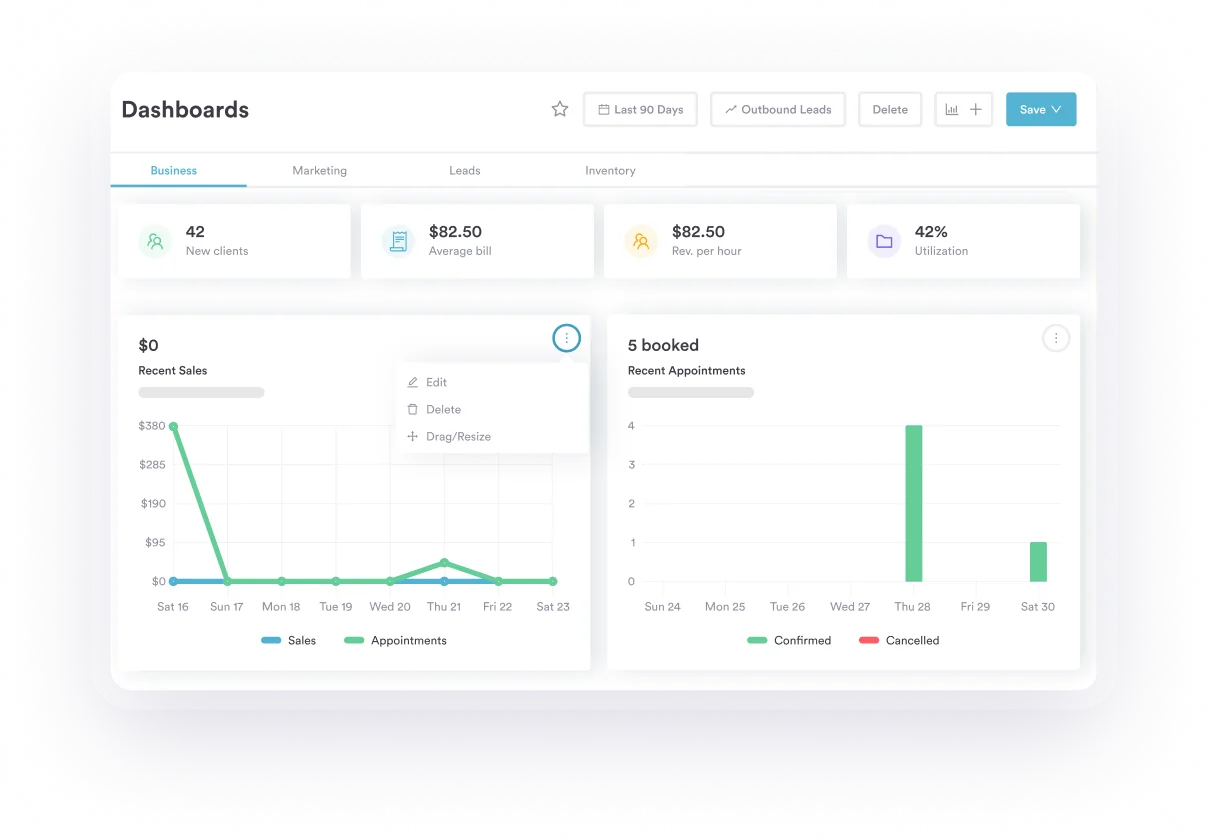
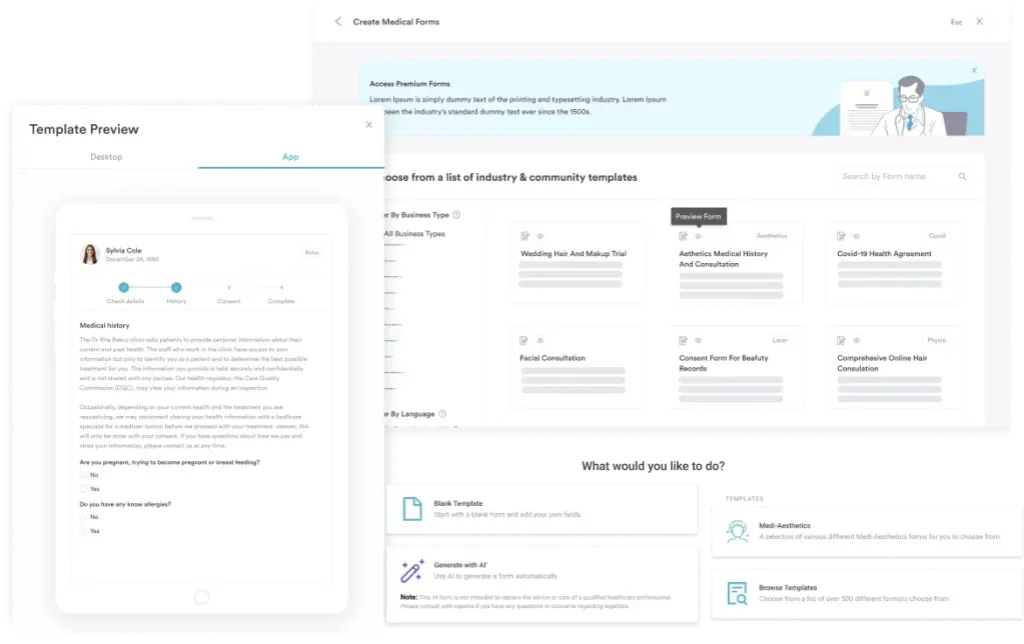
Medication questions can sit inside the intake forms patients complete before a visit, so each appointment starts with current therapy already on the screen.
The form works best as a shared decision-making tool. Print it, bring it to the appointment, and go through it with your gastroenterologist. Five questions are worth asking every time.
Working from the same document improves adherence and catches problems earlier. It also saves appointment time that would otherwise go on reconstructing the history.
A medication list is protected health information, so it needs the same handling as the rest of the chart. Compliance management software encrypts the record, logs every view, and limits access to the clinicians who need it.
A printed copy needs a locked cabinet and a private room for updates. Paper is easier to lose than a record, and far harder to audit afterwards.
Most practices hold medication information in more than one place. Some of it sits in the clinical note, some in a scanned letter from the gastroenterologist, and some on a printout the patient carries.
Practice management software like Pabau keeps the medication list inside the patient record itself. The intake form a patient completes before the visit writes into that same record. The clinician then opens the appointment with current therapy already on screen.
Monitoring is where that pays off. Lab reminders, recall dates, and follow-up tasks all run off the record. An overdue CBC or TB screen surfaces before the next dose is due.
The outcome is a single current list that everyone treating the patient can see. No second spreadsheet, and no chasing a printout the morning of the appointment.

Pabau keeps the medication list inside the patient record and updates it from the patient’s own intake form. Your team gets a reminder when monitoring labs fall due.

Crohn’s therapy changes often, and it changes across specialties. A patient can leave gastroenterology on a new biologic, see their primary care physician a week later, and be the only person carrying that information.
So decide where the list lives, and treat that copy as the only one. A printout and a chart entry that both get edited will disagree within a month.
Then date every update. An undated list gives the next clinician no way to tell current from stale. Book a demo to see how Pabau keeps a patient’s medication record current between gastroenterology visits.

Need a record of the doses actually taken? Medication log template gives patients a daily line to fill in between appointments.
Building a dosing timetable with a patient? Medication schedule template sets out what is taken when, across the day and the week.
Studying or teaching a single drug? Drug card template covers mechanism, dosing, contraindications and nursing considerations on one page.
Need to document a reaction to a biologic? Adverse reaction form captures the drug, the reaction, and the action taken.
Assessing the symptoms behind the prescription? Gastrointestinal assessment walks through the history and examination that inform treatment decisions.
Six classes cover Crohn’s disease. Aminosalicylates such as mesalamine treat mild disease. Corticosteroids like prednisone and budesonide induce remission. Immunomodulators such as azathioprine and methotrexate maintain it. Biologics cover moderate-to-severe disease, JAK inhibitors give an oral option, and antibiotics treat complications such as fistulae and abscesses.
No single medication is best for everyone. The choice depends on disease severity, location, history, and how the patient responds. Mild disease usually starts on aminosalicylates. Moderate-to-severe disease moves to biologics or immunosuppressants. Some patients do better on TNF inhibitors, others on IL-23 or JAK inhibitors. Your gastroenterologist will match the approach to your disease pattern and risk factors.
Biologics are injected or infused medications that block a specific immune pathway driving inflammation. TNF-alpha inhibitors such as infliximab and adalimumab block tumor necrosis factor. Ustekinumab targets interleukin signaling. Vedolizumab works only in the gut. All are used for moderate-to-severe disease when conventional therapy fails or is not tolerated.
JAK inhibitors are small-molecule oral drugs that suppress immune signaling. Upadacitinib (Rinvoq) was FDA-approved for Crohn’s disease in May 2023, the first of its class cleared for it. Induction is 45 mg once daily for 12 weeks, then 15 mg or 30 mg once daily for maintenance. It carries a black-box warning for serious infections, malignancy, cardiovascular events, and thrombosis.
Monitoring varies by class. Aminosalicylates need annual renal function and a CBC. Corticosteroids need glucose monitoring, plus bone density screening past three months. Immunomodulators need a CBC and liver function every 8 to 12 weeks. Biologics need TB screening and labs before each dose. JAK inhibitors add lipid panels and a cardiovascular risk assessment.