Vegan based diet plan: Free template and nutrition guide
A vegan based diet plan is a structured dietary plan that builds every meal arou...

2
Last Updated: Oct 14, 2026

Antidiarrheals fall into four working groups: opioid receptor agonists, adsorbents, bismuth compounds, and probiotics. Each one targets a different part of the problem.
Loperamide and bismuth subsalicylate are the over-the-counter options. Diphenoxylate, octreotide, and bile acid sequestrants need a prescription.
Antimotility agents are off the table in suspected Clostridioides difficile colitis or bloody diarrhea. Screen for red flags before you recommend one.
Current guidance advises avoiding bismuth subsalicylate for the whole of pregnancy, because of its salicylate content.
Download the medication list so every clinician works from the same doses, contraindications, and escalation criteria.
A one-page clinical reference listing every antidiarrheal by class, brand, prescription status, adult dose, and key contraindication. It covers loperamide, bismuth subsalicylate, diphenoxylate, octreotide, probiotics, adsorbents, and anticholinergics, with red-flag screening built in.
Download templateDiarrhea turns up every week in primary care, urgent care, and gastroenterology. Most clinicians reach for the same one or two agents and never work through the rest of the list. The harder questions are which drug fits which presentation, what the labeled adult dose is, and when a medication is the wrong answer.
This antidiarrheal medication list organizes the FDA-approved agents by class, mechanism, and prescribing status. It gives adult dosing, the indications for acute and chronic diarrhea, and the red flags that rule a drug out. Print it, laminate it, or keep it open on a tablet during rounds.
Inside you will find the drug classes, the over-the-counter and prescription split, antibiotic-associated diarrhea, the reference table, side effects, and escalation criteria.
Antidiarrheals are drugs that reduce the frequency and water content of loose stools. The clinical definition of diarrhea used by the WHO, the CDC and the NIH is three or more loose stools in 24 hours.
The agents reach that goal by different routes. Some slow intestinal motility, some bind pathogens and toxins, and others cut secretion or restore beneficial bacteria. For prescribing purposes they split into over-the-counter agents and prescription-only medications kept for more complex presentations.
Unlike antibiotics or antiemetics, antidiarrheals are symptom-management tools. They do not treat the underlying infectious, inflammatory, or functional cause. That distinction decides safety as much as it decides efficacy. Giving one to a patient with suspected Clostridioides difficile or bloody diarrhea can make the outcome worse.
So the clinician’s job is to pick the right agent for the right patient, or to pick none at all. Contraindication screening comes first, every time.
The template is built to follow the patient through the visit. Use it at five points:
Before you add an antidiarrheal for a patient already taking several drugs, work through a structured medication review. Anticholinergic and opioid overlap is the interaction that most often turns a routine recommendation into an adverse event.
Review the template quarterly, as new formulations and FDA safety communications appear. Give one person the job of keeping it current: a nurse, a pharmacist, or the practice manager.
This reference is written for:
Practices running on primary care practice software can attach the list to the intake template. It then opens with the chart, instead of sitting in a drawer at the nurses’ station.
Faster decisions: One printable page removes the search through three sources for a drug name, a dose, and a contraindication while the patient waits.
Consistent screening: A standardized list means every clinician applies the same red-flag check before recommending an agent. That is what keeps an antimotility drug away from the patient who should not have one.
Cleaner documentation: When staff record which antidiarrheal was recommended and why, the note is structured and auditable. Compliance review then has something to read rather than something to reconstruct.
Team alignment: Shared access means nurses, physicians, and front-desk staff describe loperamide, bismuth, and the prescription agents the same way. Patients hear one answer, which helps adherence.
Formulary control: Listing every available agent alongside its indication lets practice managers negotiate pricing and coverage on the options they actually use.
This table is the core of the download. It organizes the major FDA-approved agents by drug class, mechanism, and prescribing status. You can find a dose, a status, or a warning in one look.
All dosing reflects FDA labeling and current clinical guidance as of 2026. Availability differs outside the US, so check local formularies and regulatory databases for the UK, Australia, and Canada.
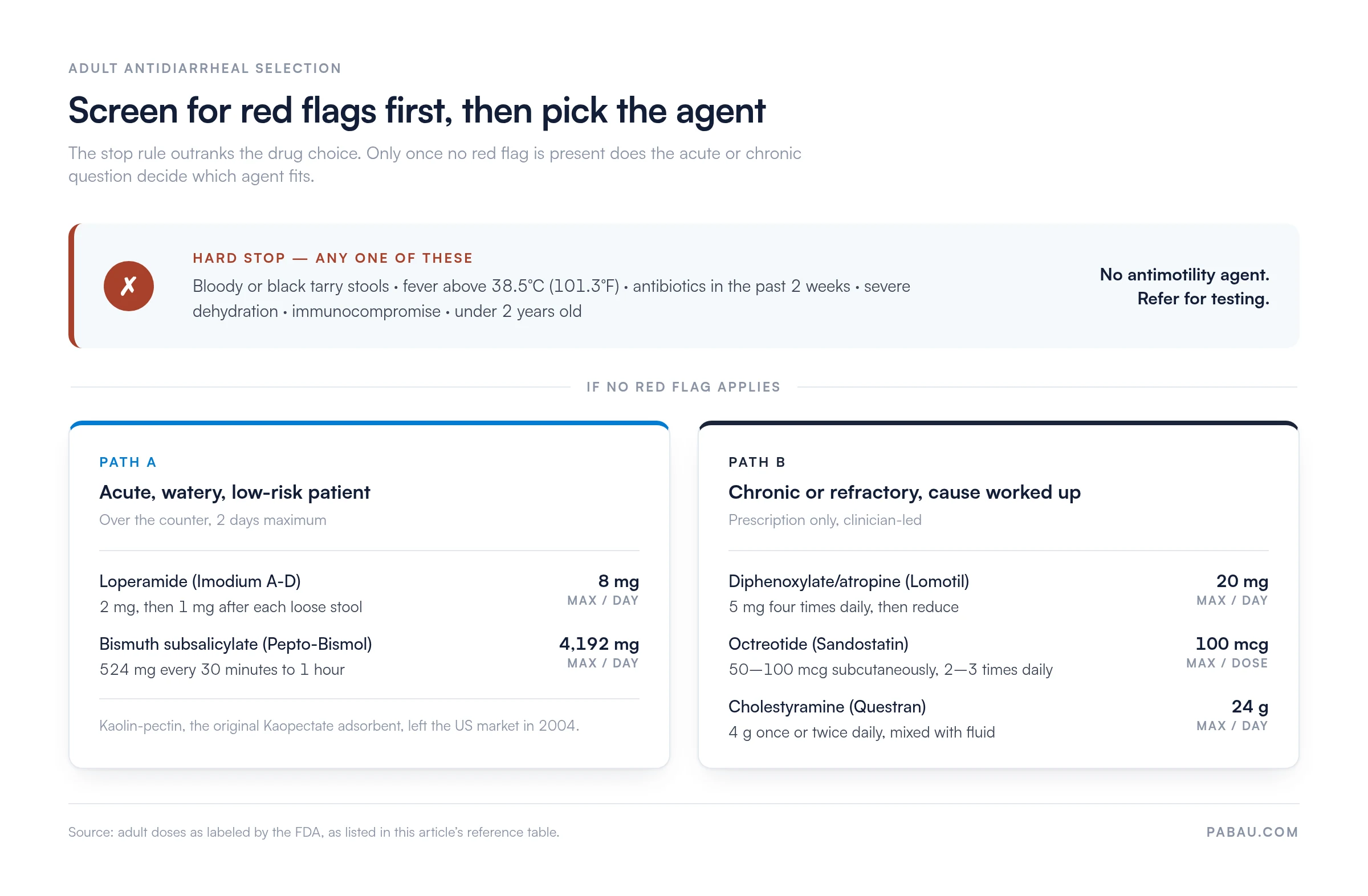
Always screen for red flags BEFORE you recommend an antidiarrheal. Ask about bloody or black tarry stools, fever above 38.5°C (101.3°F), antibiotic use in the past 2 weeks, severe dehydration, and immunocompromise. If the answer to any of them is yes, do not give an antimotility agent such as loperamide or diphenoxylate. Refer to urgent care or the ED instead. Antimotility agents in these patients can precipitate toxic megacolon or worsen Clostridioides difficile colitis, which is a medical emergency.
The list splits along two regulatory pathways. Over-the-counter agents, loperamide and bismuth subsalicylate, are sold without a prescription and suit acute, mild to moderate diarrhea in low-risk patients. Prescription agents are kept for chronic or refractory cases, once a clinician has ruled out an infectious or inflammatory cause.
The logic behind the split is exposure. The over-the-counter agents have decades of safety data and manageable risks for a patient who reads the label. The prescription agents carry more complexity, from DEA scheduling for diphenoxylate to the narrow secretory-diarrhea indication for octreotide.
Over-the-counter does not mean risk-free. Children under two, pregnant patients, and immunocompromised patients should avoid these drugs altogether.
The order of the decision matters more than the drug list itself. Screening comes first, and only a clean screen opens the question of which agent fits.
Every antidiarrheal carries a risk profile to weigh against the benefit. The classes below cover the common and the serious adverse effects, which is what you counsel on and what you monitor for.
Counsel every patient on the timeline. Loperamide and bismuth subsalicylate usually reduce stool frequency within one to two hours, while probiotics and dietary changes take three to seven days. Adsorbent and bile acid agents can deepen fluid loss, so a dehydration skin test at follow-up catches the problem before it becomes a referral.
Antibiotic-associated diarrhea is its own clinical scenario, and it changes the answer. Antibiotics disrupt normal gut flora, which lets Clostridioides difficile and other pathogens proliferate. The list flags which agents to avoid here and which may help.
Contraindicated: Antimotility agents, loperamide and diphenoxylate, are absolutely contraindicated in suspected or confirmed C. difficile colitis. They raise the risk of toxic megacolon and worsen outcomes. If testing is pending and symptoms are severe, avoid them entirely.
Safe or potentially useful: Probiotics and bismuth subsalicylate have evidence in mild to moderate antibiotic-associated diarrhea, for restoring flora and reducing stool frequency. Neither replaces antibiotic therapy for confirmed C. difficile, which needs metronidazole, vancomycin, or fidaxomicin. Adsorbents are neutral, and kaolin-pectin is no longer sold in the US anyway.
Document the antibiotic used, the timing of onset, and whether C. difficile testing was ordered. Onset within 48 hours of starting the antibiotic is typical, and that detail shapes the next prescribing decision as well as any compliance audit.
This list supports symptom management, not diagnosis. Knowing when to withhold an antidiarrheal matters as much as knowing which one to give. The following findings warrant escalation to urgent care, the ED, or a specialist:
Record where the pain sits before you escalate, because that description travels between the nurse who takes the call and the provider who reviews it. A stomach pain chart keeps it consistent, and it gives the specialist something concrete to work from.
Note the specific red flag and the action taken in the patient chart. That entry supports continuity of care, and it protects the practice if the patient deteriorates after an initial recommendation.
For chronic diarrhea patients, review the formulary every 6 to 12 months. Update this list with new FDA approvals, safety communications, and formulary changes from your insurance partners. Give one person the job of watching FDA MedWatch alerts and manufacturer updates. Bring the changes to a team huddle rather than an email nobody opens.
In most practices the antidiarrheal recommendation lives in three places at once. The nurse writes it in a phone note, the provider dictates it into the visit summary, and the follow-up call goes in a diary. When the patient calls back on day three, nobody can see the dose that was given.
Practice management software like Pabau keeps all three in one client record. The agent, the dose, the red flags you screened for, and the follow-up date sit on the same timeline as the appointment. Custom intake forms can ask the screening questions before the patient reaches the room, so the answers arrive with the chart.
Medical records software then holds the audit trail: who recommended what, on what evidence, and what happened next. That is the record you want when a patient deteriorates after an over-the-counter recommendation.

Pabau brings intake screening, prescribing notes, and follow-up scheduling into one client record. Your team can see which antidiarrheal was recommended, why, and what happened next.

The judgment this list encodes is straightforward. Screening decides whether a drug belongs in the conversation at all, and only then does the class decide which one.
Two entries here catch out anyone working from memory. Kaolin-pectin has not been the Kaopectate formulation since 2004, and bismuth subsalicylate is now advised against for the whole of pregnancy. Both are easy to get wrong at speed, which is the argument for a shared reference over individual habit.
Keep the list where the decision happens rather than in a folder, and revisit it whenever the FDA issues a safety communication. Book a demo to see how Pabau keeps the screening, the dose, and the follow-up on one patient record.

Reconciling the patient’s full drug list first? Medication review gives you a structured format for catching interactions before you add another agent.
Documenting the abdominal exam that goes with it? Abdominal exam documentation sets out the findings worth recording when pain is part of the picture.
Recording the decision so it holds up on review? Safer clinical notes covers how to write up a recommendation, the reasoning, and the follow-up.
Collecting the history before the patient reaches the room? General practice intake gathers the symptom timeline your red-flag screening depends on.
An antidiarrheal medication reduces the frequency and water content of loose stools. It works by slowing intestinal motility, binding toxins, cutting secretion, or restoring gut bacteria. Loperamide, bismuth subsalicylate, and probiotics are the common examples. All of them manage the symptom rather than its cause.
Loperamide is an opioid receptor agonist that slows intestinal motility and usually works within one to two hours. It suits acute watery diarrhea. Bismuth subsalicylate is antimicrobial and antisecretory, gentler, and dosed every 30 to 60 minutes. Loperamide is more potent but carries opioid-like risks. Bismuth is contraindicated in children and in salicylate-allergic patients.
Avoid antimotility agents such as loperamide and diphenoxylate in bloody diarrhea, fever above 38.5°C, suspected Clostridioides difficile colitis, or severe dehydration. Avoid them in children under two and in immunocompromised patients. Current guidance also advises avoiding bismuth subsalicylate throughout pregnancy, because of its salicylate content. When in doubt, refer for evaluation rather than recommend a drug.
Probiotics such as Lactobacillus GG and Saccharomyces boulardii have evidence in mild to moderate antibiotic-associated diarrhea. They help restore normal flora and may reduce stool frequency. They do not replace antibiotic therapy for confirmed Clostridioides difficile, which needs metronidazole, vancomycin, or fidaxomicin. Avoid probiotics in severely immunocompromised patients, who face a risk of systemic infection.
Short-term over-the-counter loperamide, under 48 hours, is considered safe for acute diarrhea. Prescription diphenoxylate is used for chronic diarrhea, but it carries a risk of physical dependence and CNS effects. It is a Schedule V controlled substance. For diarrhea lasting more than seven days, gastroenterology should look for the underlying cause. Long-term symptom suppression is not the answer.
No. Bismuth subsalicylate contains salicylate and is contraindicated in patients with a salicylate or aspirin allergy. It also carries a risk of Reye syndrome in children with chickenpox or influenza, so avoid it in pediatric patients. Always ask about allergy history before recommending a bismuth compound.
Loperamide and bismuth subsalicylate usually reduce stool frequency within one to two hours. Probiotics and dietary changes take three to seven days. Tell patients that these agents manage the symptom, and that hydration and electrolyte replacement still matter. If symptoms last beyond 48 to 72 hours or worsen, they should call the practice.