Despina Petrushevska
Exilis patient treatment record: Free PDF for RF sessions
An Exilis patient treatment record is the session log for BTL’s radiofrequ...

3
Last Updated: Oct 23, 2026
Free PDF 2 pages, print-ready Clinician-reviewed
Diet advice for ulcerative colitis works better written down than spoken. This downloadable template gives clinicians and registered dietitians a two-page form for setting dietary goals with a patient and tracking them across follow-up visits.
The form holds no menus. It records the goals you set, the actions each person agreed to, the support already in place and the outcome of every review. The dietary guidance further down this page is what you draw on to fill it in.
A two-page clinical form for setting and reviewing a colitis patient’s dietary plan. It covers patient identifiers, background, five goals, seven actions, a support checklist and a five-row review record.
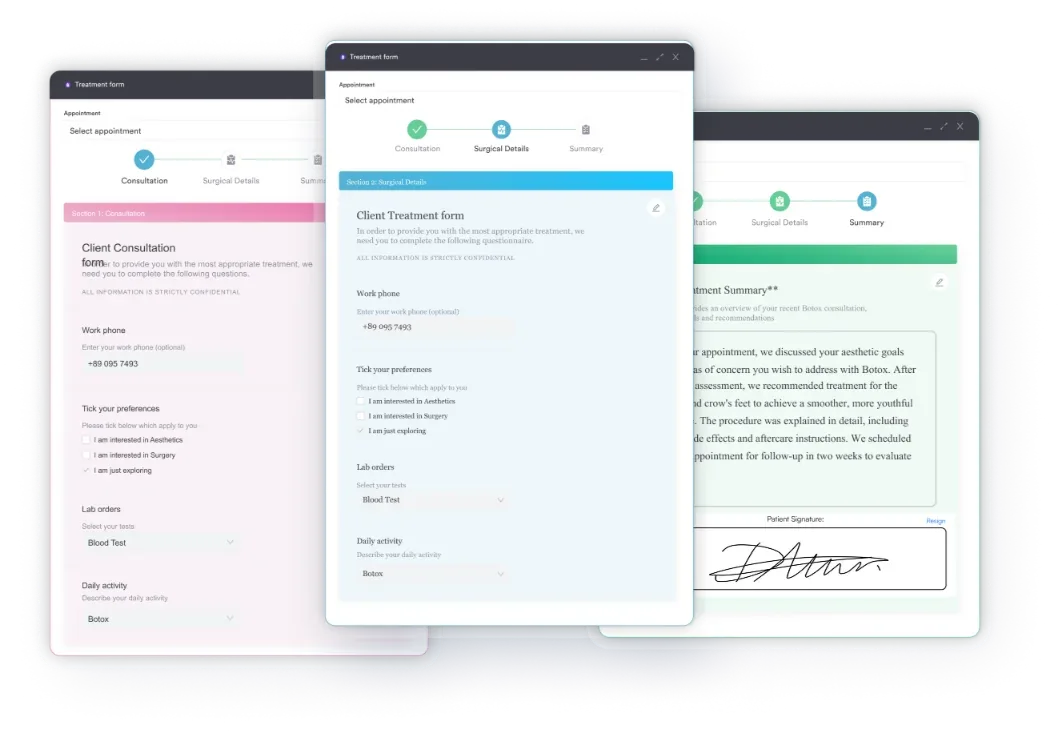
Upload this PDF, or any form you already use, and Pabau's AI Form rebuilds it with tick boxes, text fields and a signature. Attach it to the treatment once, and every patient gets it on time.
AI Form rebuilds the consent, history and aftercare forms you already use. You review each one, then publish.
Patients complete forms on their phone before they arrive, so the front desk stops retyping paper.
Every signed form is versioned and attached to the treatment record, ready when you need it.
Set how long a consent stays valid. Returning patients skip forms they have already signed.
Supports HIPAA and GDPR compliance AES-256 encryption 4.8 on G2 4.7 on Capterra Trusted by 4,000+ practices worldwide

Ulcerative colitis is a chronic inflammatory disease of the colon and rectum, and diet influences both flare severity and time spent in remission.
Low-fiber, low-residue eating helps during a flare, while remission allows careful reintroduction of higher-fiber foods under dietitian supervision.
Common triggers include raw vegetables, whole grains, spicy food, alcohol, caffeine and high-fat items, but tolerance differs from patient to patient.
The downloadable template is a goal-setting and review form rather than a menu, so it records goals, actions, support in place and review dates.
Use the dietary guidance on this page to write the goals and actions you enter on the form.
The file is a two-page clinical form with every field left blank. You complete it in consultation with the patient, then sign it alongside them.
The date fields follow day, month and year order. Check them before you distribute the form if your practice records dates month first.
The file carries no daily menus, no recipes, no portion tables and no shopping lists. Apart from the title on page one, nothing in it is specific to ulcerative colitis.
That shapes how you use it. The clinical judgment stays with you and your dietitian. You decide what the patient will eat, then record the agreed goals and actions on the form. Treat it as the record of the plan rather than the plan itself.
Ulcerative colitis (UC) is a chronic inflammatory bowel disease affecting the large intestine and rectum. Crohn’s disease can involve any part of the digestive tract, while UC is limited to the colon’s innermost lining. Flare symptoms include abdominal pain, diarrhea, urgency, rectal bleeding and fatigue. Patients in remission may have few or no symptoms, but dietary choices still influence how they feel. According to the Crohn’s & Colitis Foundation, nearly 3 million American adults live with IBD.
Diet does not cause ulcerative colitis, but specific foods can trigger or worsen a flare. Gentle eating reduces irritation to the compromised colon lining during active disease and supports recovery afterward. The goal is twofold. Reduce gut workload while symptoms are active, then hold remission by avoiding known triggers without letting nutrition slip.
Working with a registered dietitian lets you document which foods each patient tolerates. Structured patient intake forms keep that history with the rest of their record. Trigger patterns become easier to spot, and you can adjust the plan over time. That beats a one-size-fits-all colitis diet.
Well-tolerated foods are the sensible starting point for any colitis eating plan. The options below are gentle on an inflamed colon and still provide adequate nutrition.
Triggers vary between individuals, but the foods below commonly worsen symptoms during a flare.
A plan that ignores the difference between flare and remission fails in one direction or the other. During an active flare the colon is inflamed and sensitive. In remission, gradual food reintroduction is both possible and worth encouraging.
How food is prepared affects digestibility as much as which food is chosen. Gentle cooking methods soften fiber and make nutrients easier to absorb.
Frying, grilling and charring add fat and irritating compounds, so steer patients away from them during a flare.
Diarrhea during a flare costs the patient significant fluid and electrolytes. Encourage water, broth and electrolyte solutions throughout the day. Some patients with IBD need supplements, according to the National Institute of Diabetes and Digestive and Kidney Diseases. Probiotics, vitamin D, iron and omega-3 fatty acids are the common ones. Ask the patient to clear any supplement with their gastroenterologist first, since some interact with colitis medication.
Complete the header at the first appointment, then use the background box to explain why this patient needs a plan now. A recent flare, unintended weight loss or a new medication all belong there. The form runs in the order below, and each section holds a fixed number of entries.
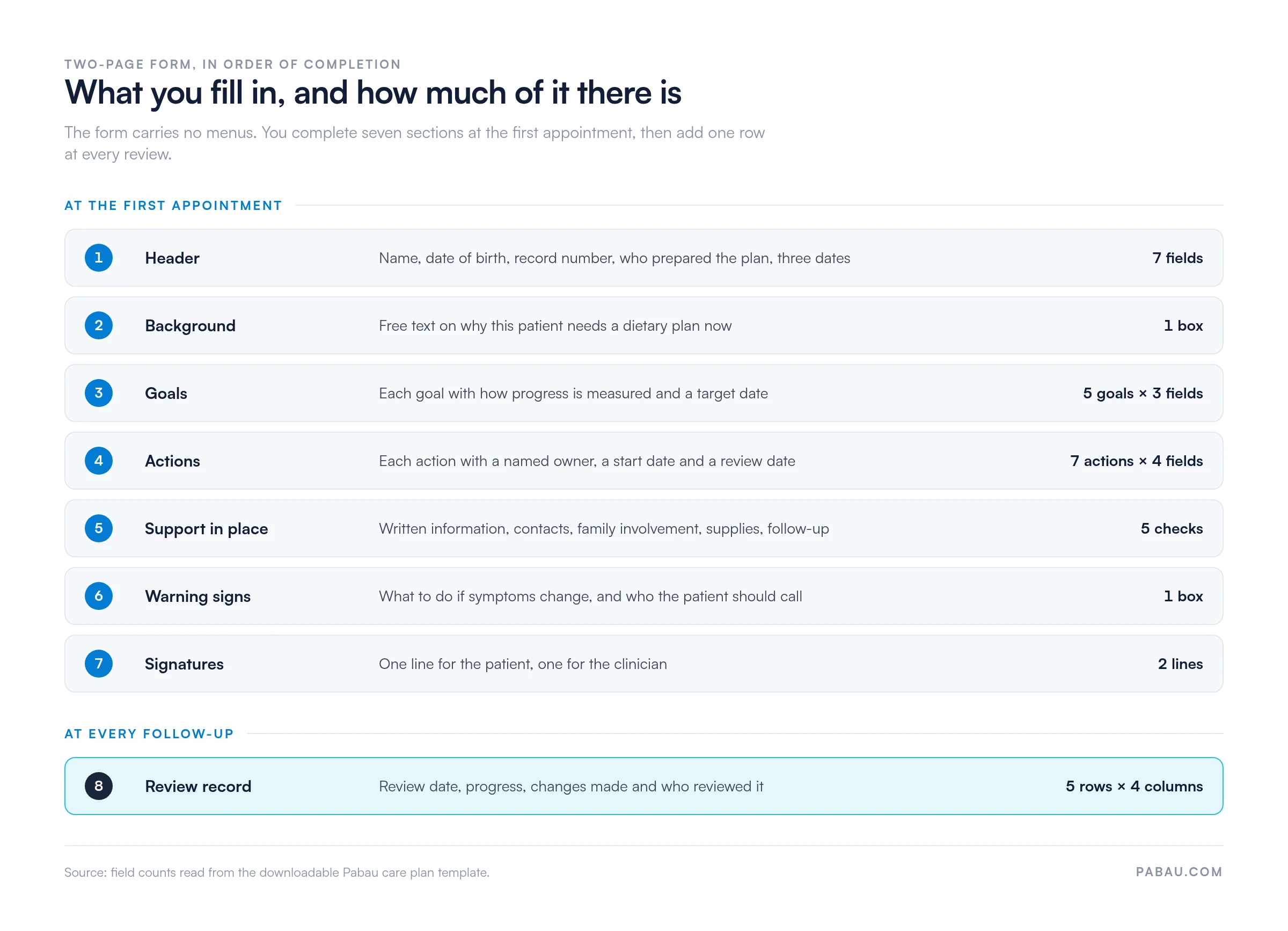
Write goals the patient can measure. Eating white rice at lunch on five days this week can be checked at review, whereas eating more healthily cannot. Give every goal a target date so the review has something to test.
The actions section records who does what. A dietitian referral, a food and symptom diary or a repeat blood test each gets a named owner, a start date and a review date. Name the person, not the department.
Work through the support checklist before the patient leaves the room. Check off only the items you completed. Then use the warning-signs box to write the symptoms that should prompt a call, and the number to call.
At each follow-up, fill one row of the review record with progress, any change you made and who reviewed it. Use automated follow-up workflows to reach the patient between visits, so review dates are met rather than missed.
A plan only helps for as long as the patient keeps to it. Restrictions that feel reasonable during a flare become hard to justify once symptoms settle, and the plan quietly lapses. Agree on meals the patient genuinely likes, build in flexibility, and revisit the goals as tolerance changes.
The Academy of Nutrition and Dietetics treats dietitian-led counseling as a core part of IBD symptom management. Documenting the goals you agreed, and what happened at each review, is what shows that work in the patient’s record.
Store the completed plan in the patient’s electronic health record, next to gastroenterology letters and lab results. The full clinical picture is then visible at the next visit.
Dietitians working inside a weight or metabolic service can file it the same way. A platform built for weight and metabolic practices keeps nutrition plans in the record the rest of the team already uses.
In most practices the completed form goes home with the patient and a scan lands in a shared folder. Months later the dietitian opens the appointment, hunts for that PDF and reconstructs which goals were set.
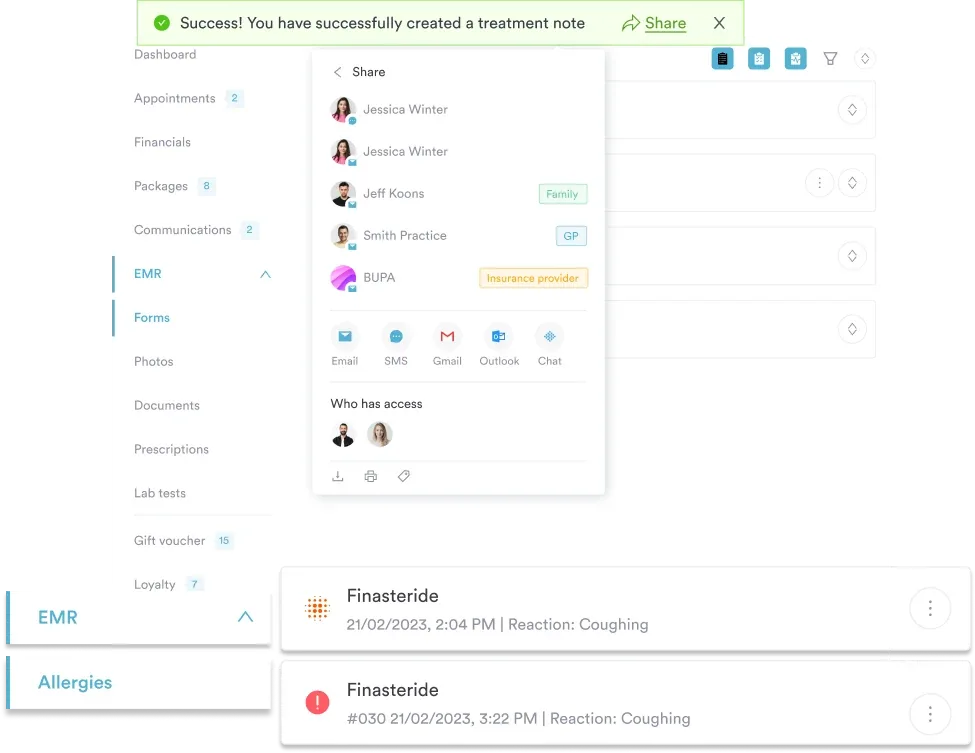
Practice management software like Pabau stores the plan against the patient’s record instead, alongside their gastroenterology letters and lab results. Digital forms capture the same goal and action fields at intake, so the answers stay searchable rather than locked inside a scanned page.
Automated reminders then chase the review dates you wrote on the form. The patient gets a prompt before their appointment. Your team can see which reviews are due, so dietary goals get revisited on schedule instead of at the next flare.

Pabau stores each patient’s dietary goals, agreed actions and review notes in their clinical record, then reminds your team when a review falls due.

Dietary advice for ulcerative colitis fails when it lives only in the consultation. Writing the goals down, naming who owns each action and setting a review date is what turns advice into a plan the patient can follow.
This template gives you that structure and nothing more, which is its strength. You bring the clinical content from the guidance above, agree two or three goals with the patient, and book the review before they leave. Book a demo to see how Pabau stores dietary care plans and prompts your team when a review is due.

Need a low-residue plan for a flare? Bland diet meal plan gives you a seven-day low-fiber template to work from.
Reintroducing fiber in remission? High fiber diet meal plan sets out a staged seven-day plan for clinicians.
Managing reflux alongside colitis? 7-day GERD diet plan covers the trigger foods that overlap with colitis.
Documenting the nutrition assessment itself? ADIME note template structures the assessment, diagnosis, intervention and monitoring write-up.
Want an anti-inflammatory plan to adapt? Anti-inflammatory meal plan lists the foods and swaps a patient can start with.
The template is a two-page clinical form. It holds patient identifiers, a background box, five goals with target dates, and seven actions with named owners. A support checklist, a warning-signs box and a five-row review record complete it. The file contains no menus or recipes.
During a flare, plan low-fiber proteins, refined grains such as white rice and white bread, and cooked vegetables without skin. In remission, reintroduce higher-fiber foods gradually. The template above records the goals you set from that guidance rather than the meals themselves.
Focus on low-residue, low-fiber, bland foods during a flare. Lean proteins, refined grains, well-cooked vegetables without skin and low-fiber fruits are usually tolerated. Avoid raw foods, whole grains, nuts and high-fat items. Individual tolerance varies, so record what your patient manages.
Low-fiber fruits tolerated in UC include ripe bananas, canned peaches without syrup, applesauce, ripe melon and white grape juice. Raw fruit, dried fruit, berries and high-fiber fruits are typically triggers, so avoid them during a flare.
Common triggers include raw vegetables, whole grains, nuts, seeds, spicy foods, alcohol, caffeine, high-fat foods and dairy if the patient is lactose intolerant. Triggers are individual, so a food and symptom diary is the reliable way to find each patient’s own list.
Yes. A registered dietitian improves symptom control and adherence to dietary advice. They can personalize the plan, spot subtle triggers and protect nutrition during a flare, which makes them a core part of the colitis care team.