GLP-1 diet plan
A GLP-1 diet plan is a structured eating framework for patients taking semagluti...

2
Last Updated: Oct 13, 2026
The Childhood Autism Rating Scale (CARS) is a 15-item, clinician-administered assessment of autism-related behavior in children. Each domain is rated 1 to 4, so a total score runs from 15 to 60. A total of 30 or above warrants referral for comprehensive diagnostic evaluation, and higher totals indicate greater severity.
Schopler, Reichler and Renner developed the scale in the 1970s, and Western Psychological Services publishes it. The second edition, CARS-2, arrived in 2010. It kept the 15 domains and the score bands, reworded the item descriptors, and split the rating into two forms with a separate caregiver questionnaire.
A printable questionnaire you can add to a child’s assessment file. The scored CARS-2 booklets stay under WPS license, so this sits alongside them rather than replacing them.
Download template
The Childhood Autism Rating Scale is a 15-item clinician-rated tool, scored 1 to 4 per domain for a total of 15 to 60.
Totals read against three bands: non-autistic at 15 to 29.5, mild to moderate at 30 to 36.5, and severe at 37 to 60.
CARS-2 has two rating forms: CARS2-ST for younger or less verbal children, and CARS2-HF for verbally fluent people aged 6 and over.
Only a trained clinician can administer it, and the score supplements a DSM-5 diagnosis rather than replacing it.
Practice management software like Pabau keeps the ratings, observation notes and clinical impressions in one structured patient record.
The scale measures the presence and severity of autism-related behavior in young children. It covers 15 behavioral domains spanning social interaction, communication, repetitive behavior and sensory processing. Each domain carries its own 1 to 4 descriptors, and the sum shows how far the child’s behavior is consistent with autism spectrum disorder (ASD).
It is not a diagnostic instrument on its own. It sits alongside clinical observation, developmental history, caregiver report and formal psychological testing, giving that work a consistent and measurable shape. A psychiatric evaluation template does the same for the written record.
The instrument has been validated across thousands of children. It is still widely cited in peer-reviewed research on autism diagnosis and early intervention outcomes.
The original CARS (1980) and CARS-2 (2010) serve the same clinical purpose. The second edition keeps the 15 domains and the same three score bands, and it rewords the item descriptors against contemporary research.
What the second edition adds is choice of form. CARS-2 ships a Standard Version rating booklet (CARS2-ST), a High-Functioning Version (CARS2-HF), and a Questionnaire for Parents or Caregivers (CARS2-QPC). The QPC gathers developmental history and is not scored into the total.
CARS-2 is the current standard and the version most teams are asked for. Both editions are published by Western Psychological Services and sold under qualified-clinician license only.
Each domain is rated from 1 (within normal limits for age) to 4 (severely abnormal). The 15 domains cover social interaction, communication, repetitive behavior and sensory processing:
Scoring depends on direct observation and clinical judgment. Each of the 15 items is rated 1 to 4 from behavior seen during the assessment and from information the caregiver provides.
Half-point ratings are permitted where behavior falls between two descriptors. The total is the sum of all 15 item ratings, with a minimum of 15 and a maximum of 60.
Three bands read the total, and they sit unevenly across the 15 to 60 range. The middle band is the narrowest of the three, which is where the referral decision is made.
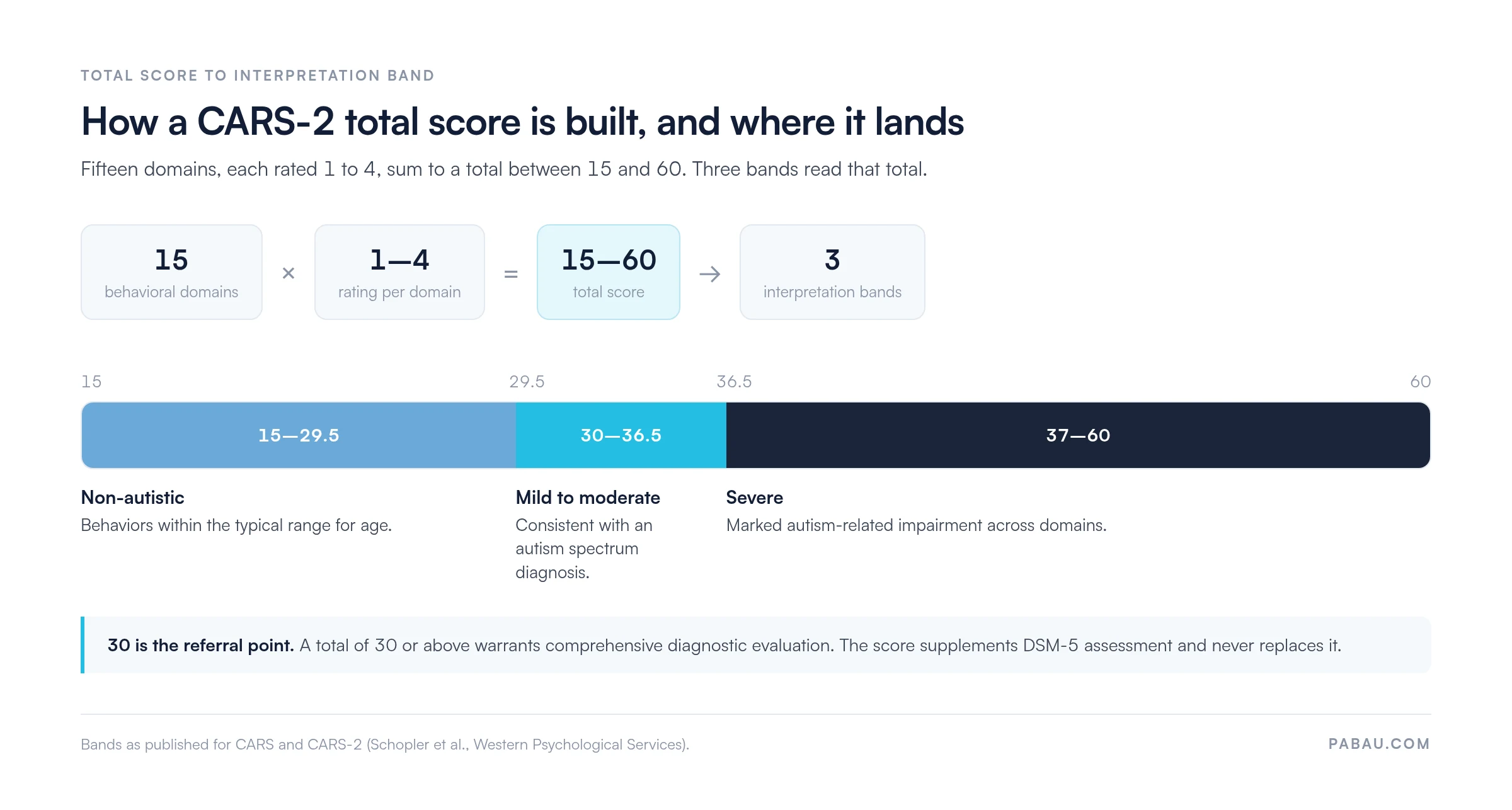
A score of 30 or higher warrants referral for comprehensive diagnostic evaluation. It also supports consideration of early intervention services under the Individuals with Disabilities Education Act (IDEA).
This is a clinician-administered tool that requires professional training and licensure. Parents and non-clinicians cannot complete it themselves, although caregiver observations are valuable input during administration.
Qualified administrators include:
Which form, rather than which age. CARS-2 is selected by form, not by a fixed age window. The Standard Version (CARS2-ST) suits children under 6. It also suits anyone older who has communication difficulties or a below-average estimated IQ.
The High-Functioning Version (CARS2-HF) is for verbally fluent individuals aged 6 and over with an estimated IQ above 80. It carries no upper age bound, so it is a second form of the same instrument rather than a separate tool. For toddlers, a screening instrument such as the M-CHAT-R/F comes first.
The CARS is a supplementary assessment tool, not a standalone diagnostic instrument. The DSM-5 diagnostic criteria for autism spectrum disorder require persistent deficits in social communication, plus restricted and repetitive behaviors. The CARS quantifies observable behavior in a way that informs that judgment without replacing it.
A CARS score of 30 or above does not confer a diagnosis by itself. The clinician still has to weigh developmental history, CDC developmental screening guidance, language assessment and family context before reaching a DSM-5-aligned conclusion.
Several instruments overlap with the CARS, and each answers a different question. The ADOS-2 remains the reference standard for diagnostic confirmation, while the CARS quantifies severity alongside it.
The CARS is widely used, and it has documented limitations that shape how far a single total can be trusted.
Observer variation: Rater experience and training influence scoring. Two clinicians with different levels of preparation can return different totals for the same child.
Limited cross-cultural standardization: The scale was developed and validated mainly in Western populations. Cultural norms around eye contact, social distance and communication can read as symptoms when they are not.
Not a standalone diagnosis: A total has to be integrated with DSM-5 criteria, developmental history and language assessment before anyone records a diagnosis.
Ceiling and floor effects: Very mild presentations can score below the cutoff. Severe global developmental delay can also mask the autism-specific pattern the items are looking for.
Light coverage of restricted interests: The items lean toward observable behavior in the room. Restricted and repetitive interests, which DSM-5 weighs heavily, get comparatively little room.
Administration combines structured observation, direct interaction with the child, and caregiver input. Documentation is what preserves the finding for team review and for comparison at the next visit.
Step 1: Prepare the environment. Use a quiet, low-distraction room. Have toys, pencils and other objects on hand to elicit behavior in the relevant domains, and allow 30 to 60 minutes.
Step 2: Gather caregiver information. Before rating, interview the parent or guardian about developmental history, early behaviors, current routines and concerns. Cover social interaction, communication milestones, sensory sensitivities and repetitive behaviors.
Step 3: Conduct direct observation. Interact with the child through play, structured tasks and free exploration. Note how the child initiates contact, responds to your cues, tolerates change, and engages with objects and people.
Step 4: Rate each domain. Use the manual’s descriptors to assign a 1 to 4 rating for each of the 15 items. Integrate what you observed with what the caregiver reported.
Step 5: Calculate the total. Sum all 15 ratings for a figure between 15 and 60, then read it against the band table above.
Step 6: Document the findings. Record the observations, the item ratings, the total, your interpretation and your recommendations in the child’s clinical record. Note the child’s age, behavior on the day, the sensory environment, and anything that limits validity such as illness or an unfamiliar room.
Step 7: Share with the team. Send the result and your clinical impression to the pediatrician, speech pathologist or school psychologist involved in the diagnostic process. Digital forms let you release a scored assessment to named colleagues without emailing a PDF around.
Reliable totals depend on examiner training and on sticking to the standardized procedure. The habits below are what separate a defensible rating from a rough impression:
CARS-2 is published by Western Psychological Services and sold to qualified clinicians under restricted license. Parents and non-professionals cannot buy the complete instrument.
How to obtain it: Licensed mental health professionals, psychologists and qualifying educational professionals order the manual, rating booklets and training materials from WPS. The published Complete Kit price is $371. That kit contains the manual plus 25 CARS2-ST booklets, 25 CARS2-HF booklets and 25 CARS2-QPC booklets.
There is no legitimate free PDF. The CARS-2 instrument is copyrighted and is not distributed as a free download. Any free PDF presented as the complete CARS-2 is unauthorized.
In most pediatric and psychology teams the CARS is scored on paper and typed up later into a note. It is then copied again into a report for the referring pediatrician. The ratings themselves rarely survive in a form anyone can query. A follow-up assessment then starts from the narrative rather than from the 15 item scores.
Pabau is practice management software for therapists and allied clinicians. Its digital forms hold each domain rating as a field on the patient record. The appointment, the caregiver intake and the clinician’s observation notes sit beside it. Nothing is retyped between the assessment room and the chart.
That means the next clinician opens the record and sees the item ratings behind the total, with the date and examiner attached. Re-administering the scale a year later becomes a comparison rather than a guess. Sharing the result with a multidisciplinary team takes a permission setting rather than an email.

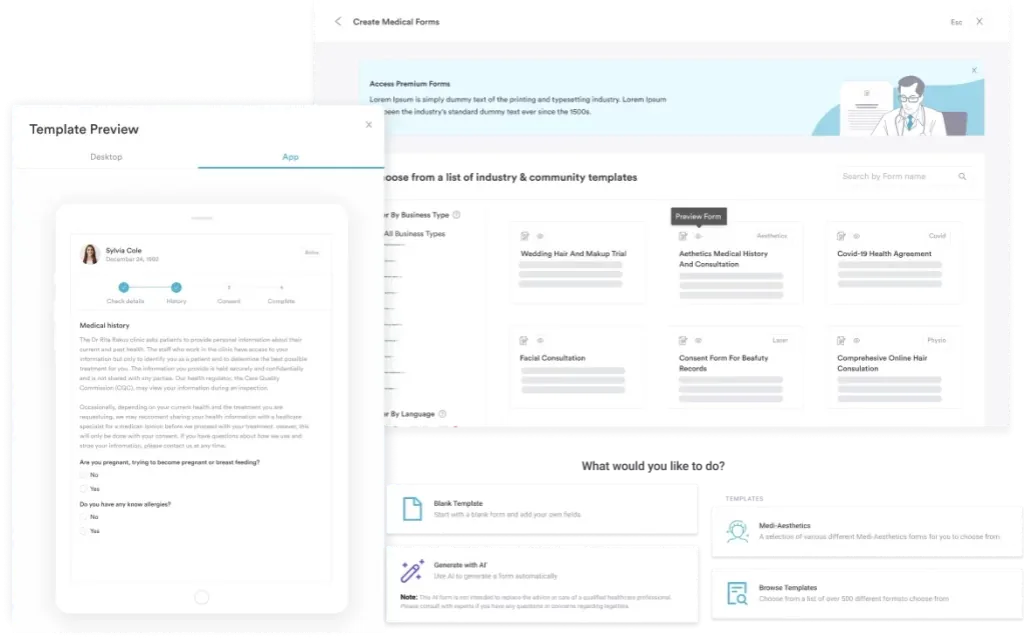
Pabau’s digital forms capture the 15 domain ratings, the total and your clinical impression as structured fields on the patient record. Your team can retrieve, compare and share a scored assessment without rebuilding it from a scanned form.

Treat the CARS total as a measurement, not a verdict. It tells you how far a child’s observed behavior sits from age norms across 15 domains. At 30, that reading justifies a full diagnostic workup.
The trade-off worth remembering is that the number is only as stable as the conditions it was collected in. A tired child in an unfamiliar room can move a total across a band boundary. That is why the environment, the examiner and the date belong in the record next to the score.
Get that documentation right and the scale earns its place in the diagnostic process rather than adding a form to it. Book a demo to see how Pabau keeps assessment ratings, notes and referrals on one patient record.

Looking to tighten your practice’s diagnostic workflow? Group therapy informed consent explains how to structure consent and documentation when children are assessed in collaborative settings.
Need the developmental picture behind the score? Developmental assessment template structures the milestone history a CARS rating is read against.
Documenting the full evaluation? Psychiatric evaluation template gives you a downloadable framework for DSM-5-aligned assessment records.
Confirming a diagnosis after the CARS? ADOS-2 assessment template covers the observation schedule most teams use for diagnostic confirmation.
CARS-2 (2010) keeps the 15 domains and the score bands of the original CARS. It rewords the item descriptors and adds a High-Functioning rating form plus a caregiver questionnaire.
No. The CARS is a clinician-administered tool that requires direct observation by a qualified professional. Parents and teachers may provide input during the assessment, but they cannot score the instrument independently.
There is no single age window. The Standard Version (CARS2-ST) suits children under 6, plus older people with communication difficulties or a below-average estimated IQ. The High-Functioning Version (CARS2-HF) covers verbally fluent individuals aged 6 and over with an estimated IQ above 80, and carries no upper age bound.
A score of 30 or above suggests autism-related behaviors and warrants formal diagnostic evaluation. The score alone does not confirm a diagnosis. A qualified clinician has to weigh it against DSM-5 criteria, developmental history and other assessments.
No. The CARS is a supplementary rating scale that quantifies autism-related behavior. A DSM-5 diagnosis requires a clinician’s full evaluation of social-communication deficits and restricted, repetitive behaviors across several sources of information.