HD Brows consultation form: Free template and guide
HD Brows is a seven-step brow treatment that combines consultation, tinting, wax...

2
Last Updated: Oct 13, 2026

The Blue Peel uses trichloroacetic acid (TCA) to deeply exfoliate and resurface skin, making it the most intensive Obagi offering for treating hyperpigmentation, fine lines, and acne scarring.
Clinicians must screen for contraindications including pregnancy, active infections, isotretinoin use within the past 6 months, and Fitzpatrick skin types IV-VI at higher risk of post-inflammatory hyperpigmentation.
Informed consent documentation covering risks, recovery expectations, and patient acknowledgment is non-negotiable. Regulatory bodies (CQC, GDPR) require written evidence of patient understanding.
Pabau’s digital consent forms, aftercare messaging, and treatment record templates eliminate paper-based workflows, improve compliance tracking, and centralize treatment history for audit readiness.
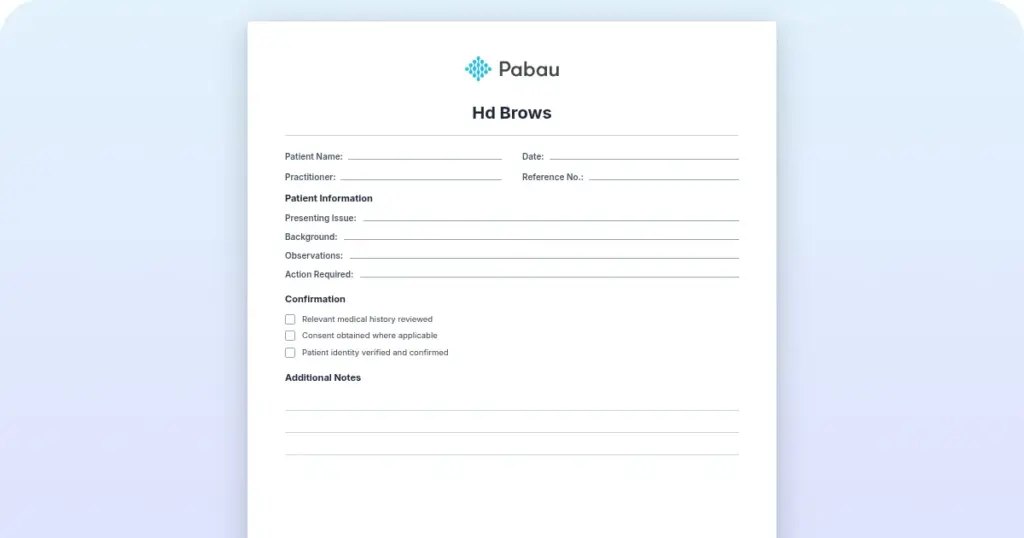
A two-page Blue Peel consent form and pre-treatment screening questionnaire you can hand to patients before their TCA chemical peel appointment.
Download templateThe blue peel is one of the most requested treatments in aesthetic practices today, and one of the most misunderstood. It is an advanced TCA chemical peel that demands careful screening, detailed informed consent, and a strict aftercare protocol, since one overlooked contraindication can turn a routine resurfacing session into a liability claim. Our guide to medical spa software covers the charting and HIPAA compliance side of recording that screening and consent.
Here is how to screen candidates safely, run the protocol with confidence, and document every step.
The blue peel is a professional-strength chemical peel developed by Obagi Medical, using trichloroacetic acid (TCA) as its active exfoliant.
The original formulation includes a blue pigment that slows TCA penetration, letting practitioners apply the solution methodically and control the depth of exfoliation. The blue dye washes away during neutralization, giving the treatment its name and its clinical safety advantage.
TCA is a non-selective exfoliant. It denatures skin proteins, triggers a controlled inflammatory response, and stimulates collagen remodeling.
Unlike gentler alpha-hydroxy acids (AHAs) used in superficial peels, TCA penetrates the dermis, making the blue peel a medium-to-deep procedure. This depth delivers dramatic results for sun damage, age spots, and acne scars, but it requires careful candidate selection, written consent, and realistic downtime communication.
Obagi also offers Blue Peel Radiance, a newer salicylic acid variant positioned as a gentler entry point into blue peel treatments. Understanding the difference between the two formulations is essential for practice scheduling and patient counseling.
Choosing between the original blue peel (TCA) and its successor (Radiance) depends on patient skin type, concern severity, and downtime tolerance.
Here is the clinical distinction:
The trade-off is clear. Blue peel (TCA) delivers superior results but requires real patient buy-in on recovery time, while Radiance offers a quicker turnaround but demands more frequent treatments for similar improvement.
Skin type often drives the decision. Darker skin (Fitzpatrick IV-VI) typically starts with Radiance to minimize post-inflammatory hyperpigmentation (PIH), while lighter skin tolerates the deeper action of the original blue peel.
A blue peel resurfaces the skin, and it does not lift tissue that has already loosened. When sagging along the jawline drives the inquiry, redirect the consultation to a focused ultrasound lift instead.
Teams using software to manage patient records can pull up prior scores before every reassessment.
Successful blue peel outcomes depend on a meticulous pre-treatment protocol. Skin must be primed, medications paused, and realistic expectations set. Use digital consent forms to send this checklist 1 to 2 weeks ahead, and track completion through your practice portal.

Document all pre-treatment steps in a treatment record template linked to the patient’s file. This creates a clear audit trail if complications arise.
The blue peel procedure typically takes 15 to 30 minutes. Here is the step-by-step sequence that practitioners and support staff should follow precisely:
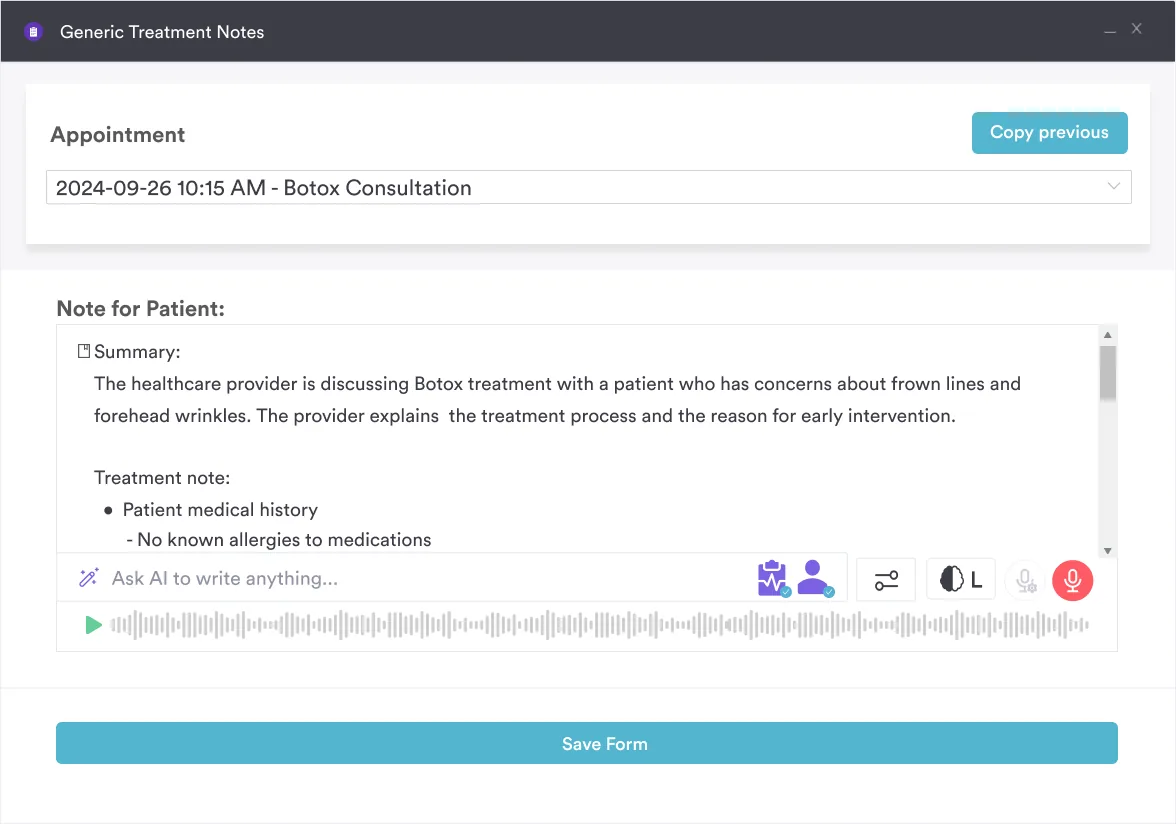
Document the treatment in the patient’s clinical record. Note the solution concentration, application time, frosting achieved, any complications, and aftercare recommendations. Practice management software like Pabau can capture that dictation in real time through Pabau Scribe, its AI scribe, so notes stay accurate without adding to your post-treatment admin.
Aftercare determines whether a patient heals beautifully or develops complications. Provide written instructions before they leave, then reinforce them by automated SMS or email within 2 hours of treatment.
Red flags requiring immediate contact: signs of infection (pus, warmth, fever), persistent blistering beyond day 3, or an allergic reaction (severe swelling, hives). Link aftercare documentation in the patient record for quick reference.
Patients often underestimate recovery. Set expectations clearly in your consent process to prevent dissatisfaction and negative reviews.
The original blue peel (TCA) has a longer downtime than Radiance. Make sure patients understand they are committing to about 1 to 1.5 weeks of visible recovery. Document the downtime discussion in compliance records to demonstrate informed consent.
A legally sound consent form is your practice’s first line of defense. It must cover the procedure description, expected results, material risks, and patient acknowledgment, without overwhelming or frightening the patient.
This is also where practice setup guides often fall short. Regulatory bodies (CQC in the UK, state medical boards in the US) expect detailed written evidence of informed consent.
Essential sections your blue peel consent form must include:
Use Pabau’s digital consent form builder to create a template that patients sign electronically before arrival. The system timestamps signatures and automatically files them in the patient record, satisfying GDPR and CQC audit requirements without manual paperwork.
Managing blue peel workflows, from consent to aftercare to compliance tracking, historically meant juggling paper forms, email reminders, and spreadsheets.
Pabau centralizes the entire blue peel journey. Digital consent forms go out before the appointment, automated aftercare messaging fires at treatment completion, treatment notes stay structured in the clinical record, and compliance documentation stays ready for audit.
Practices like Skin With Bea Esthetics now send consent forms before appointments instead of during them, and Pabau customers save an average of 10 hours a week on admin, according to Pabau’s 2025 Customer Impact Report.
The system’s pre-appointment screening forms can be customized to flag blue peel contraindications. Your staff knows before the patient walks in whether isotretinoin use or a darker skin type calls for special precautions. Post-treatment, automated SMS sends aftercare instructions with practice contact details, cutting down follow-up calls and improving patient adherence to the recovery protocol. If your practice also bills insurance for medically necessary treatments, such as actinic keratosis alongside cosmetic resurfacing, keep a CMS-1500 form on hand for that portion of care.

Pabau’s digital consent forms, automated aftercare messaging, and structured treatment notes take the admin out of every blue peel appointment, so your team can focus on patient care.

The blue peel remains one of the most dramatic and effective tools in aesthetic medicine, but only for practices that run pre-treatment screening, informed consent, and aftercare with precision. Use the downloadable consent form and the checklists above to standardize your protocol, reduce liability risk, and deliver consistent, safe outcomes your patients trust.
If your practice also offers dermal fillers, a separate dermal filler consent form keeps that workflow just as tight. For the blue peel itself, book a demo to see how digital consent, automated aftercare, and centralized treatment records simplify delivery at scale.

Need a gentler alternative on the menu? The green peel template gives you a consent and protocol framework for a lighter peel option.
Screening a new blue peel candidate? A skin analysis form helps you document baseline skin type and concerns before you commit to a protocol.
Running peels beyond the blue peel line? A general chemical peel consent form covers the broader TCA and AHA peel menu.
Need a structured first visit? An aesthetic consultation template captures goals and history before you recommend a peel.
Patients asking about gentler resurfacing? Dermabrasion aftercare instructions cover a comparable recovery process.
Pricing varies by practice and region. US practices commonly charge $400 to $2,000 for a full TCA peel, and $100 to $200 for Blue Peel Radiance. Ask your practice for an exact quote, since treatment area and package deals affect the price.
The VI Peel blends TCA with retinoic acid, salicylic acid, and other actives, and suits most Fitzpatrick skin types with 3 to 7 days of peeling. The original blue peel uses TCA alone at a higher strength, so it goes deeper but suits fewer skin types.
Most practices space full TCA sessions 4 to 6 weeks apart and rarely run more than 2 to 3 in one course, given the cumulative downtime. Once results settle, many patients return for a single maintenance peel every 6 to 12 months.
Most patients feel a strong tingling or burning sensation during application, plus a few minutes of stinging as the TCA reaches full depth. A cool air fan or an ice pack helps.
Collagen remodeling continues for 4 to 8 weeks after a single peel, and results typically last 6 to 12 months before sun exposure and aging gradually bring back some pigment and texture concerns.