Fertility clinic marketing: Strategies that attract & convert patients
Fertility clinic marketing is how a fertility practice attracts, educates, and c...

Last Updated: Oct 14, 2026

The SCOFF questionnaire is a five-question screen for probable anorexia nervosa or bulimia nervosa.
A score of 2 or more is a positive screen and calls for a specialist eating disorder assessment.
Administration takes under two minutes, which is why the screen survives a full appointment list.
NICE guideline NG69 names SCOFF, but tells clinicians not to use a screening tool as the sole method of deciding.
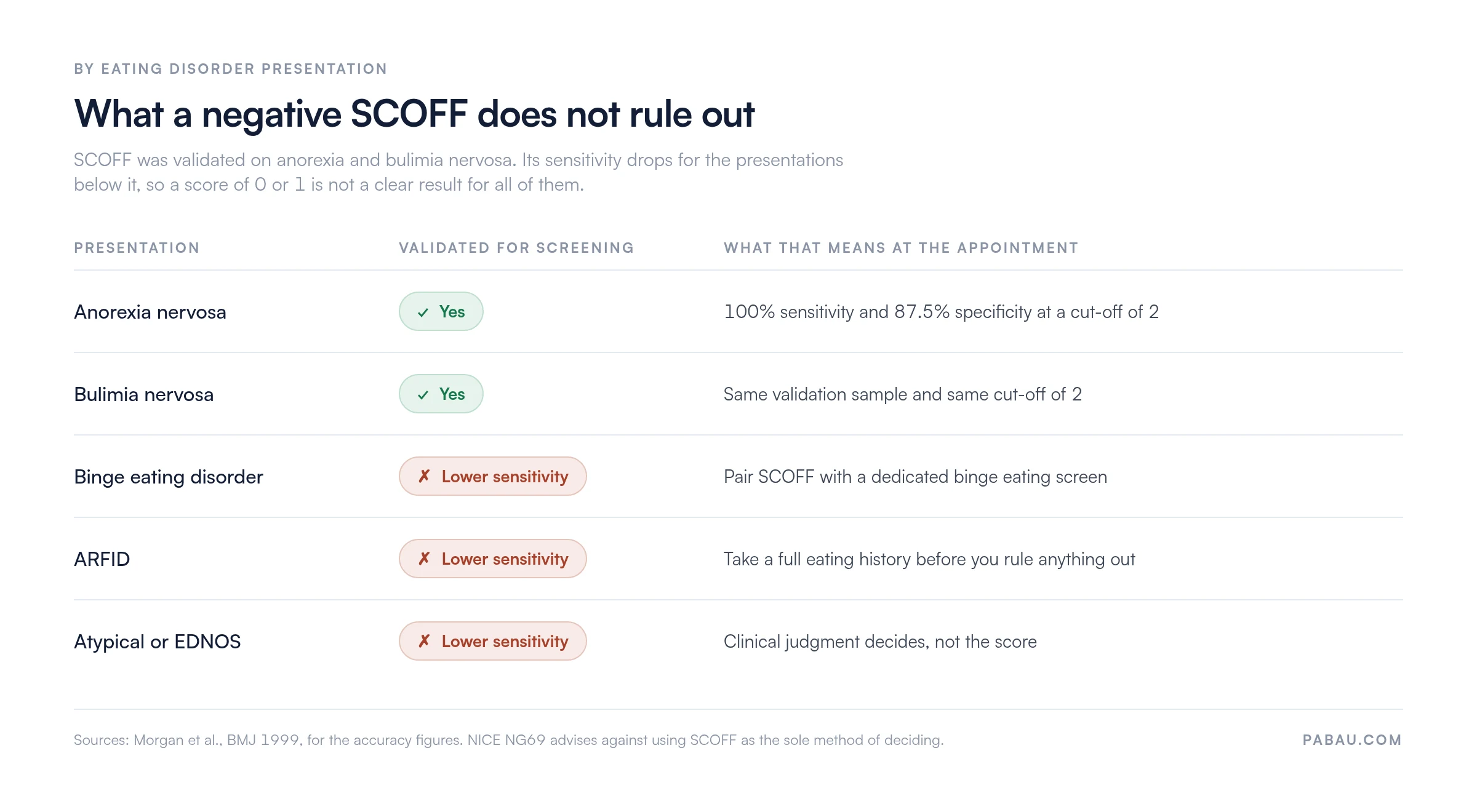
Sensitivity drops for binge eating disorder and ARFID, so a low score does not close the question.
Pabau turns the five items into a digital form, so the score lands in the patient record on submission.
A printable five-question screen with fields for patient details and each yes or no response. The scoring rule and the referral threshold sit on the same page, so nobody has to look them up.
Download templateThe SCOFF questionnaire is a five-question screen for probable anorexia nervosa or bulimia nervosa. Score one point per yes. A total of 2 or more is a positive screen, and the patient needs a specialist assessment. The whole screen takes under two minutes to administer.
Eating disorders carry one of the highest mortality rates in psychiatry, and early identification changes the outcome. Plenty of cases still go undetected, because a booked-out appointment leaves no room for a long assessment. Below are the five items, how to score them, and what a low score does not rule out.
The SCOFF questionnaire is a five-item screening instrument for probable anorexia nervosa or bulimia nervosa. Morgan and colleagues published it in 1999, working at St George’s Hospital Medical School in London. They wanted a screen any clinician could remember and run without specialist training.
The acronym stands for the five yes/no questions at the core of the screen. Each letter maps to one question, which is what makes the set easy to recall mid-appointment. Between them, the items cover induced vomiting, loss of control, weight loss, body image distortion, and preoccupation with food.
SCOFF screens rather than diagnoses. A positive result points to the need for a specialist eating disorder assessment, which confirms the diagnosis and shapes the treatment plan.
Each question scores as either yes (1 point) or no (0 points). Ask all five during the screening conversation and note the patient’s answers as you go. Here are the five validated items:
The phrasing is deliberately plain and conversational. You can adapt the wording slightly to suit the patient in front of you, as long as the substance of each question stays intact. Plain language reduces stigma and encourages honest answers, which matters here because shame and denial often block disclosure.
Scoring is straightforward. Award one point for each yes and zero for each no. The total runs from 0 to 5.
The threshold is a score of 2 or more, which counts as a positive screen and warrants referral for a detailed assessment. In the original 1999 validation study by Morgan et al., that cut-off caught every confirmed case of anorexia nervosa and bulimia nervosa in the sample.
SCOFF is built for primary care, private practice, and community health settings where clinicians already screen for mental health conditions. The main use cases:
UK clinicians should read the guidance carefully before leaning on the score. NICE guideline NG69 names SCOFF as an example of a screening tool. It then recommends against using such a tool as the sole method of deciding whether a patient has an eating disorder. Weight, growth, rapid weight change, and what family members report all belong in the same judgment.
That is a caveat, not a reason to skip the screen. Two minutes of structured questions still surfaces cases that a general conversation misses.
Morgan and colleagues reported 100% sensitivity and 87.5% specificity at a cut-off of 2. Those headline figures come from the original 1999 BMJ paper. The comparison ran 116 women aged 18 to 40 with confirmed anorexia or bulimia nervosa, recruited from a specialist eating disorders clinic. The control group was 96 students aged 18 to 39.
That design matters when you read those numbers. It was a case-control study of known cases against healthy students, not a consecutive sample of primary care patients. Performance in an unselected primary care list is lower, so treat 100% sensitivity as a ceiling rather than an expectation.
Later work confirmed the tool travels. Botella and colleagues pooled 15 studies in the Spanish Journal of Psychology in 2013, covering 882 cases and 4,350 controls. SCOFF also performs in both interview and self-report formats, and validated translations exist in Spanish, Dutch, Italian, and Swedish.
The caveat that matters most: SCOFF was built to detect anorexia nervosa and bulimia nervosa. Sensitivity drops for atypical eating disorders, binge eating disorder, and avoidant/restrictive food intake disorder (ARFID). The table below sets out which presentations a negative screen actually clears.
No screening tool is perfect. These are the limitations worth holding in mind when you read a SCOFF score:
Where body image distortion dominates and eating behavior looks unremarkable, a body dysmorphia questionnaire is the better fit. That is a different differential, and SCOFF was never built to separate the two.
If the screen comes back at 2 or more, refer to an eating disorder specialist or a mental health service for a full assessment. Do not diagnose or start treatment on a SCOFF score alone. Record the score, the date, and the referral plan in the patient’s notes.
Clinicians have alternatives. The EAT-26, or Eating Attitudes Test, runs to 26 items and covers a broader range of eating behaviors and attitudes. It gives more detail and takes longer. The EDE-Q, or Eating Disorder Examination Questionnaire, is a 28-item gold-standard assessment used mainly after diagnosis rather than for screening.
SCOFF wins on brevity, and brevity is what gets a tool used. In a booked-out practice, a five-question screen that takes two minutes gets run far more consistently than a 26-item questionnaire. That is why it stays the sensible first-line screen for probable eating disorders in general practice and community health.
Most practices still run SCOFF on paper. Someone prints the five questions, the patient ticks yes or no, and a clinician adds up the total by hand. The sheet then sits in a folder, away from the record it belongs to.
Practice management software like Pabau closes that loop. The five items become a digital patient intake form the patient completes before the appointment, and every answer lands in their record on submission. So you can open the notes and see the score without hunting for a printout.
From there, our software for therapy practices handles the follow-up. A positive screen can trigger an automated reminder and a booked follow-up appointment, so the referral does not depend on someone remembering it. Practically, that means:
Every Pabau subscription includes digital forms, automations, and reporting, so none of this sits behind a higher tier. New practices get structured onboarding to set the forms up properly before they go live.

Pabau captures the five SCOFF responses in a digital intake form, files the score against the patient record, and can trigger the referral follow-up automatically. Your team stops chasing paper and rekeying totals.

SCOFF earns its place because it is short enough to get used. That is its advantage over the EAT-26 and the EDE-Q. It is also why the score works better as a prompt than as an answer.
So treat a 2 as a referral trigger and a 0 as an open question. Take the eating history anyway when the clinical picture points that way, and write down what you asked and what you did about it.
The screen takes two minutes. The follow-up is where it usually breaks down. Book a demo to see how Pabau scores the form, flags a positive result, and files it against the patient record.

Worried SCOFF is missing something? SCOFF has lower sensitivity for binge eating disorder. The binge eating disorder questionnaire gives clinicians a dedicated screen for the presentation SCOFF is weakest on.
Screening a mental health caseload? Anxiety and depression commonly sit alongside eating disorders. The PHQ-9 and GAD-7 template covers both in one pass.
Supporting a patient after diagnosis? The eating disorder worksheets give therapists structured exercises to use in ongoing recovery work.
SCOFF stands for Sick, Control, One stone, Fat, and Food. Each letter represents one of the five yes/no questions about eating disorder behaviors and attitudes.
It screens for probable anorexia nervosa or bulimia nervosa. A score of 2 or more indicates a likely case and warrants referral for specialist assessment. It is a screening tool, not a diagnostic instrument.
Award 1 point for each yes and 0 points for each no. A total of 2 or more counts as a positive screen indicating probable eating disorder pathology.
A score of 2 or more is a positive screen for probable anorexia nervosa or bulimia nervosa, and it warrants referral for specialist evaluation. A score of 0 or 1 suggests low risk of an active eating disorder.
It was designed for primary care and has been validated across multiple peer-reviewed studies, including a 2013 meta-analysis of 15 of them. NICE guideline NG69 names SCOFF, but tells clinicians not to use a screening tool as the sole method of deciding.
SCOFF was built for anorexia nervosa and bulimia nervosa, so sensitivity is lower for binge eating disorder and atypical presentations. It also relies on patient honesty and clear communication. Always read the score alongside clinical judgment and a fuller assessment.