Cervix length during pregnancy chart
A cervix length during pregnancy chart records cervical length in millimeters ag...

Last Updated: Oct 14, 2026
A 7 day kidney stone diet chart is a structured weekly meal plan that applies stone-prevention rules to real meals. It sets a daily fluid target, caps sodium and animal protein, protects dietary calcium, and works citrate-rich foods into every day.
The National Institute of Diabetes and Digestive and Kidney Diseases (NIDDK) names dietary change as one of the most effective ways to prevent recurrence. That holds across all four stone types.
This template gives practices and dietitians a resource to hand a patient at the point of care. It covers stone-type rules, hydration targets, foods to eat and avoid, and a full week of meals.
A seven-day meal guide with breakfast, lunch, dinner, and snacks for each day. It also carries the stone-type rules, the foods to eat and avoid, and the daily hydration target.
Download template
A 7 day kidney stone diet chart applies stone-type-specific dietary rules across a structured week of meals.
Drinking enough fluid to produce about 2.5 liters of urine daily is the most consistent recommendation across all kidney stone types.
Dietary calcium from food lowers stone risk by binding oxalate in the gut, while supplements taken without food may raise it.
The plan caps sodium at 2,300 mg and animal protein at 6 to 8 oz per day.
Pabau’s digital intake forms let practices share the chart and file the completed copy inside the patient record.
The chart turns evidence-based dietary guidance into a day-by-day eating structure. It covers the five prevention levers (hydration, sodium restriction, protein limits, dietary calcium, and citrate). Each one is mapped onto meals a patient can cook at home.
Important disclaimer: this chart is a general dietary framework and does not replace individualized medical or dietitian advice. Patients should confirm their stone type with their physician before following stone-type-specific restrictions.
Dietary management varies by stone type. The table below shows the four main kidney stone types and the primary dietary adjustment for each. Patients cannot self-identify their stone type without laboratory analysis of a passed or removed stone. A 24-hour urine test then shows the urinary risk factors, so advise them to confirm with their physician first.
These five principles apply across most stone types and form the backbone of any kidney stone meal plan. In practice they come down to six numbers a patient has to hit every day.
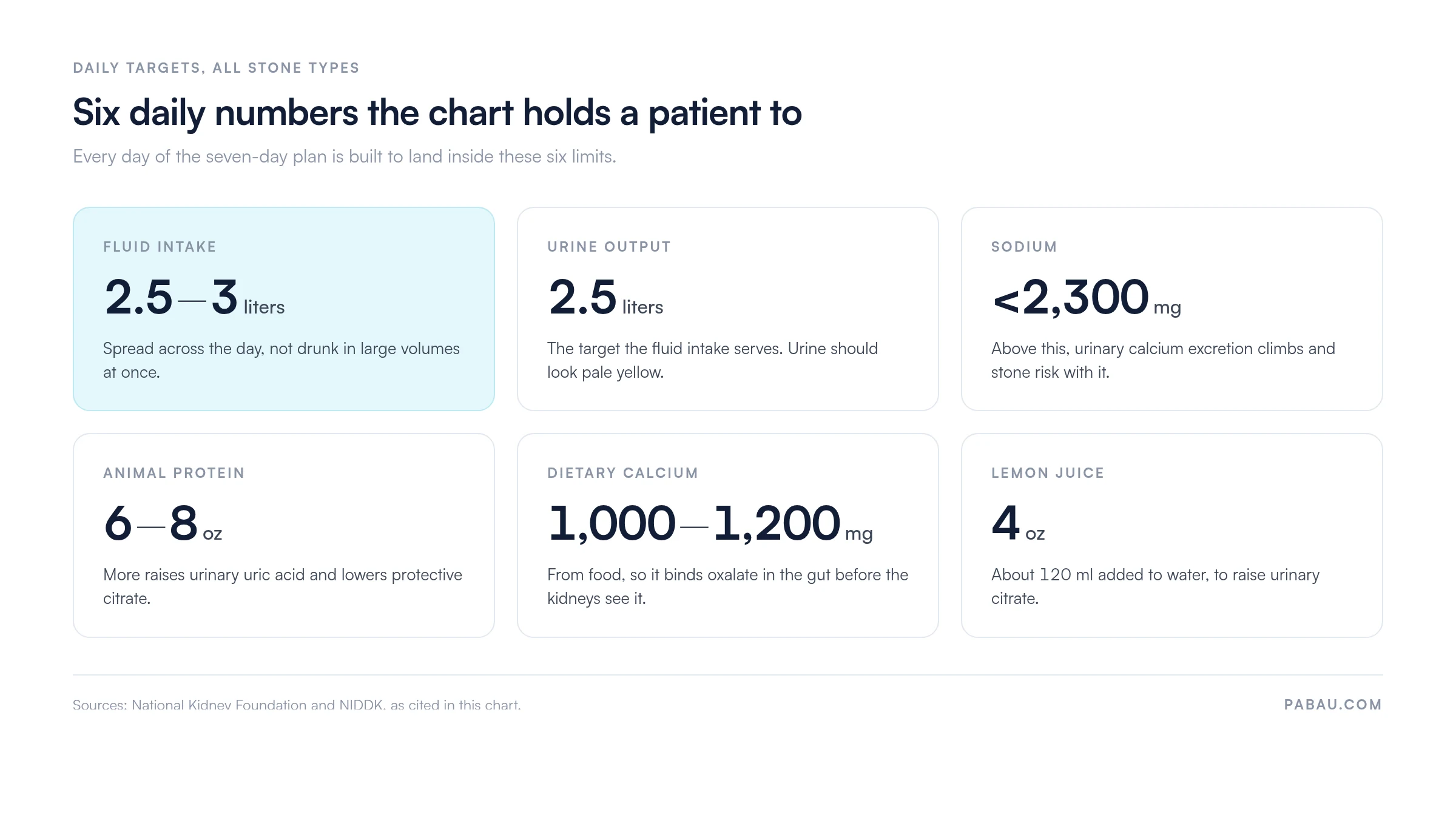
The National Kidney Foundation recommends drinking enough to produce about 2.5 liters (85 fl oz) of urine per day. For most adults that means roughly 2.5 to 3 liters of fluid. Plain water is the best choice.
Lemon water is particularly useful, because lemon juice contains citrate. Citrate inhibits calcium crystal formation in the urinary tract.
High sodium intake increases urinary calcium excretion, which raises the risk of calcium stone formation. The standard recommendation, per the NIDDK, is to keep sodium below 2,300 mg per day.
Excess animal protein drives up urinary uric acid while reducing urinary citrate. That creates conditions favorable to both uric acid and calcium stones. A practical limit is 6 to 8 oz of animal protein per day.
This is the most counter-intuitive finding in kidney stone nutrition. Dietary calcium from food reduces stone risk, because calcium binds oxalate in the gut. Bound oxalate is not absorbed into the bloodstream, so less of it reaches the urine.
Calcium supplements taken without food may increase stone risk instead. Patients should aim for 1,000-1,200 mg of calcium daily from food such as dairy, fortified plant milks, and low-oxalate greens like kale.
The table below is the core reference section of the chart. For calcium oxalate stones, oxalate restriction matters most. For uric acid stones, the priority is limiting high-purine animal proteins.
The table below is the core deliverable. Every day in the plan follows the same structure:
Citrus fruits and lemon water appear every day to boost urinary citrate, in line with guidance from the American Urological Association.
Dietitians and practice teams typically use the plan as a starting point rather than a fixed protocol. The Mayo Clinic recommends individualized dietary advice from a health care professional. Here is a practical five-step workflow:
Practices using digital patient intake forms can share the chart as part of the pre-appointment or post-appointment workflow. Completed copies are signed and filed in the patient record without any paper changing hands.

Check patients’ calcium supplement habits at every kidney stone follow-up. Many patients take over-the-counter calcium supplements without food, which may increase stone risk. Advise them to take any prescribed calcium supplement with meals, or to switch to dietary calcium sources where possible.
This template is particularly useful for:
A standardized chart gives the patient something to check against after they leave. Verbal instructions have to be remembered, while a printed week of meals can simply be followed.
For clinical teams, a ready-made template reduces consultation time. Rather than building a bespoke meal plan at each appointment, a practitioner annotates the existing chart with stone-type changes or caloric targets. Teams using pre- and post-care instructions can attach the chart to the post-appointment message automatically.
A structured chart also creates a consistent audit trail. Every patient gets the same foundational guidance, and any clinician changes are recorded. That supports clinical documentation standards and makes it easier to show that dietary counseling was provided.
Most practices still print the chart, hand it over at discharge, and write a line in the notes saying it was given. The annotated copy then lives only in the patient’s bag, and no one can tell later whether it was opened.
Pabau, the practice management platform we build, stores the chart as a digital form attached to the patient’s file. You send it before the appointment or with the post-care message, and the completed version returns to the same record. Signatures, annotations, and the date it was issued all sit with the clinical notes.
At the follow-up, the dietitian opens the record and sees which version the patient received and what was changed for them. That turns the 4-6 week review into a continuation of the first conversation.

Pabau stores, shares, and tracks patient-facing dietary templates alongside clinical notes, consent forms, and treatment records. Every chart you issue stays attached to the patient it was written for.

Kidney stone recurrence responds to consistent dietary management more than to any single intervention. A structured chart gives the patient a week they can follow without guessing, and gives the team a documented record of the counseling conversation.
Four principles hold across authoritative sources, the NIDDK included: high fluid intake, sodium restriction, moderate animal protein, and adequate dietary calcium. The chart earns its place by turning those four rules into meals and portions a patient recognizes.
Pabau’s AI-assisted clinical documentation and digital forms file templates like this one inside the patient record. Book a demo to see how dietary documentation and patient education fit into one workflow.

Treating a stone former whose urine chemistry needs adjusting? Acid alkaline food chart groups foods by their effect on acid load, which matters most for uric acid and cystine stones.
Need a neutral weekly eating framework to adapt? 7 day nutrition plan gives you a seven-day structure you can rebuild around any condition.
Managing stone risk alongside blood sugar? Type 2 diabetes diet plan covers carbohydrate structure and portion guidance in the same weekly format.
A 7 day kidney stone diet chart is a structured weekly meal plan that lowers recurrence risk through evidence-based dietary change. It maps the prevention principles (hydration, low sodium, moderate protein, dietary calcium, and citrate) onto breakfast, lunch, dinner, and snacks for all seven days.
For calcium oxalate stones, avoid high-oxalate foods including spinach, rhubarb, beets, Swiss chard, chocolate, almonds, cashews, and peanuts. For all stone types, limit high-sodium processed foods, organ meats and shellfish (high in purines), and alcohol. Dark colas are also best avoided due to their high phosphate content.
The National Kidney Foundation recommends drinking enough to produce about 2.5 liters of urine per day. For most adults that requires 2.5 to 3 liters of total fluid. NIDDK itself suggests six to eight 8-oz glasses a day. Pale yellow urine is a practical sign that intake is adequate, but confirm your own target with your physician.
Yes. The DASH (Dietary Approaches to Stop Hypertension) diet is specifically recommended by the NIDDK for kidney stone prevention. It emphasizes fruits, vegetables, low-fat dairy, whole grains, and lean protein while limiting sodium and red meat. For calcium oxalate stone formers, swap the highest-oxalate whole grains for white rice or pasta.
High sodium intake increases the amount of calcium excreted in urine. That raises the concentration available to combine with oxalate or phosphate and form stones. Keeping sodium below 2,300 mg per day reduces urinary calcium excretion and lowers stone formation risk. Processed foods, canned soups, and restaurant meals are the most common high-sodium culprits.
The standard guidance for kidney stone patients is to limit animal protein to approximately 6 to 8 oz (170-225 g) per day. Excess animal protein increases urinary uric acid and reduces urinary citrate, creating conditions that promote both uric acid and calcium stone formation. Plant-based proteins such as legumes and tofu are generally safer alternatives for stone formers.