CPT code 93503: Swan-Ganz catheter billing and modifiers
CPT code 93503: Official descriptor and procedure overview In the AMA CPT code s...

Last Updated: Oct 23, 2026
HCPCS code V2770 is the Level II code for an occluder lens, billed per lens. It describes an opaque spectacle lens that blocks the stronger eye, most often to treat amblyopia in children who won't tolerate an adhesive patch.
Coverage decides whether the claim pays. Medicare's refractive lens policy covers lenses only for aphakia or after cataract surgery, so most V2770 claims go to Medicaid or a commercial plan. Most denials trace to the payer, the laterality modifier or the diagnosis. Others come from confusing V2770 with lens add-on codes like V2750 and lens-material codes like V2783. The sections below take each in turn, from neighboring codes to the claim form.
Let Pabau's smart automation suggest the right codes, reduce claim denials, and keep your practice compliant—effortlessly.
Automate repetitive tasks and focus on what matters most—your patients.
Reduce coding errors and ensure compliance with the latest regulations.
Clean claims, fewer denials, and faster reimbursements.
Powerful insights and reporting to help your practice thrive.
HIPAA compliant SOC 2 certified GDPR-compliant Trusted by 4,000+ clinics worldwide

HCPCS code V2770 reports one opaque occluder lens fitted to a spectacle frame, billed as one unit per lens.
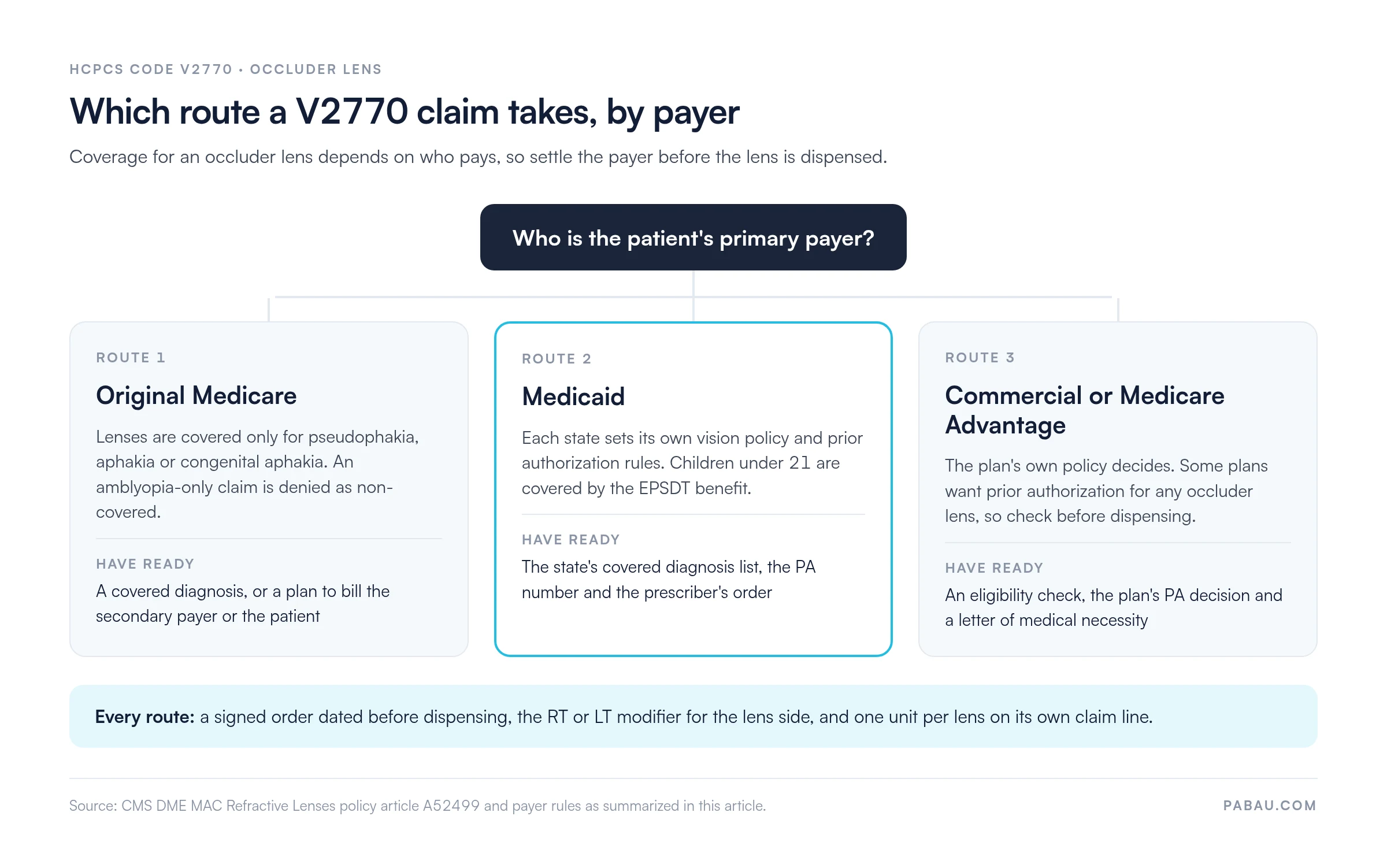
Original Medicare covers lenses only for pseudophakia, aphakia or congenital aphakia, so an amblyopia-only V2770 claim is denied as non-covered.
Most V2770 claims go to Medicaid or a commercial plan, where state or plan policy sets the covered diagnoses and prior authorization rules.
The RT or LT modifier names the occluded lens, which usually covers the stronger eye rather than the eye in the amblyopia diagnosis.
A signed order dated before dispensing, a linked diagnosis and a prior authorization number where required prevent the most avoidable denials.
HCPCS code V2770 is the CMS Level II code with the official descriptor Occluder lens, per lens. It sits in the V2700-V2799 range of miscellaneous vision services, which holds lens add-ons, tints, coatings and special lens types. The code reports the lens only, so the frame and any coating go on their own claim lines.
CMS maintains HCPCS codes and updates them quarterly. According to CMS’s HCPCS overview, Level II codes cover supplies and services that CPT doesn’t. CMS gives V2770 coverage status “C”, carrier judgment, so each payer decides whether to pay it.
V-series codes are supply codes, not procedure codes. That shapes the rest of the claim, because medical billing fundamentals like modifiers, place of service and frequency limits work differently for supplies.
An occluder lens is cut to the patient’s frame and made opaque, so it blocks most or all light to the eye behind it. Its main use is amblyopia, often called lazy eye. Covering the stronger eye makes the brain rely on the weaker one.
Medical necessity has to be on record. A treating physician or optometrist orders the lens, ties it to an active diagnosis and places it within a treatment plan. A cosmetic tint doesn’t qualify.
Billing any of the items below as V2770 invites a denial, and on audit it can turn into an overpayment finding.
Nearby lens codes are easy to confuse with V2770, and a wrong pick means a rejected line. Use the table to match the code to the item you dispensed.
Check payer and NCCI edits before billing V2750 with V2770. For Medicare, the refractive lens policy also expects the KX modifier and documented medical necessity on V2750.
Medicare excludes eyeglasses and lenses by statute, with one exception. Lenses that restore vision after cataract surgery, or for a patient with no natural lens, fall under the prosthetic device benefit.
The DME MAC Refractive Lenses policy article (A52499) limits covered diagnoses to pseudophakia, aphakia and congenital aphakia. It lists V2770 among its eyeglass lens codes. Unless a covered diagnosis applies, the claim is denied as non-covered, and that includes amblyopia.
Before billing V2770 to Original Medicare, read the DME MAC refractive lens policy article (A52499). Its covered diagnoses are pseudophakia, aphakia and congenital aphakia. An amblyopia-only claim will deny, so line up the secondary payer or the patient conversation first.
Since Medicare rarely pays, most occluder lens claims go to Medicaid or a commercial plan. Prior authorization (PA) rules differ by payer, so settle them before the lens is ordered from the lab. Start with insurance eligibility verification, because the plan on file decides which rules apply.
The diagram below shows the three routes.
If PA is denied, appeal with the prescriber’s letter of medical necessity and the clinical notes. Add evidence that patching was tried or isn’t suitable. File within the deadline printed on the denial notice.
Post-payment reviews look hard at supply claims, and the billing compliance requirements for vision supplies leave little room for missing paperwork. Have these in the file before the claim goes out.
Keep these records for at least seven years. One missing element can turn a paid claim into a recoupment demand.
Work through the claim in this order. Each step closes off one of the denials covered further down.
Laterality is the step that catches coders out, so here is a worked example. A six-year-old with left-eye amblyopia (H53.002) gets an occluder over the right lens. The claim line reads V2770-RT, one unit, linked to H53.002.
The modifier and the diagnosis point to opposite eyes, and that’s correct. Note in the record which eye is occluded and why, so a reviewer can follow it.
Each item below lines up with a denial reason in the next section, so a quick pass here saves a resubmission later.
V2770 denials follow a predictable pattern. The table maps each one to its claim adjustment reason code (CARC) and the fix.
Tracking denials by code shows where the workflow breaks. Repeated CARC 16 denials on V2770 usually mean the order was given verbally and never written up before dispensing. Repeated CARC 197 denials point to a PA step skipped at booking.
A pre-dispense checklist stops both. For wider denial management strategies across your vision billing, a structured workflow beats fixing claims one code at a time.
Medicare doesn’t price V2770 in the Physician Fee Schedule, because it’s a supply. Any Medicare allowable sits in the CMS DMEPOS fee schedule file, which CMS updates quarterly. Your DME MAC’s fee schedule lookup shows the same amount by state.
Don’t be surprised to find no usable Medicare figure. Because V2770 is non-covered outside the refractive lens policy, Medicare may list no allowable for your patient. Medicaid publishes its own fee schedule in each state, and commercial rates come from your payer contracts.
Getting the claim paid the first time matters more than the rate. A clean claim avoids rework, and every resubmission moves you closer to the timely filing limit.
Most V2770 rework starts with one missing detail, such as an order date, a PA number or a modifier on one lens line. Those details slip when they live in paper files and a separate billing tool.
Pabau, the practice management platform we build, creates the claim from the patient record. Its claims management software pre-fills the CMS-1500 with the codes already attached to the visit and includes HCPCS and ICD-10 lookup libraries. It also holds the claim until required fields, such as authorization numbers, are filled in.
For US practices, claims go out through Claim.MD, with eligibility checks, claim-status tracking and remittance posting in the same place. So your team can see whether the occluder lens was paid without logging in to a payer portal.

Pabau pre-fills claims from the patient record and checks required fields before submission. See how it handles HCPCS vision claims from order to payment.

V2770 is easy to code and easy to get wrong on coverage. Decide who pays before the lens is ordered, not after the denial arrives.
For an Original Medicare patient with amblyopia alone, plan the secondary claim or the patient conversation up front. For Medicaid and commercial plans, a PA number and a dated order do most of the work. Put RT or LT on each lens line, and the claim has what it needs to pay the first time.
Book a demo to see how Pabau helps your team send complete vision supply claims and track each one to payment.

Want to understand how clearinghouse edits catch claim errors before submission? Understanding the medical claims clearinghouse process explains how electronic claim validation works before claims reach payers.
Need a structured approach to reducing vision claim write-offs? Revenue cycle management fundamentals covers the end-to-end workflow from eligibility check to payment posting.
Need to decode a denial on a vision supply claim? Denial codes in medical billing maps CARC and RARC codes to the claim errors that trigger them.
Billing a low vision aid instead of an occluder? HCPCS code V2610 covers the single lens spectacle mounted low vision aid code.
Adding a vision accessory to the same claim? HCPCS code V2797 explains how the vision supply component code is reported.
Not when the lens is excluded by statute, as it is for an amblyopia-only diagnosis. A voluntary notice still helps set cost expectations. If a secondary payer needs a Medicare denial, append the GY modifier.
Usually, yes, when the lens is medically necessary. Medicaid’s EPSDT benefit requires states to cover vision services, including eyeglasses, for enrollees under 21. Each state sets its own prior authorization and replacement rules, so check the state manual.
V2770 is specific to an occluder lens. V2799 is the catch-all for a vision item or service with no specific code. Use V2799 only when no other V code fits, and attach a description of the item.
Not automatically. A Bangerter foil is a translucent film applied to an existing spectacle lens to blur vision, while V2770 describes an occluder lens. Payers differ on how they want it reported, so check the policy before choosing V2770 or V2799.
Amblyopia codes in the H53.0- category are the most common, such as H53.001, H53.002 and H53.003 for unspecified amblyopia by side. Strabismus codes in H50 may also apply. Confirm the code is on the payer’s covered list.