CCSD Code H3334: Low anterior resection billing guide
CCSD Code H3334: Definition and clinical scope CCSD Code H3334 covers an open an...

Last Updated: Oct 16, 2026
V2756 is the HCPCS Level II code for an eye glass case. It reports the protective case dispensed with a pair of spectacles, billed as one unit per case.
V2756 is not a contact lens code. Medicare's DME MAC policy denies eyeglass cases as noncovered, even after cataract surgery, so the case is a patient-pay item for Medicare patients.
Let Pabau's smart automation suggest the right codes, reduce claim denials, and keep your practice compliant—effortlessly.
Automate repetitive tasks and focus on what matters most—your patients.
Reduce coding errors and ensure compliance with the latest regulations.
Clean claims, fewer denials, and faster reimbursements.
Powerful insights and reporting to help your practice thrive.
HIPAA compliant SOC 2 certified GDPR-compliant Trusted by 4,000+ clinics worldwide

HCPCS code V2756 reports an eye glass case, the protective case dispensed with a pair of spectacles. It is not a contact lens code.
Bill one unit per case. The descriptor carries no per-lens wording, so a pair of glasses takes one case and one unit.
Medicare’s DME MAC policy denies eyeglass cases as noncovered, even when the glasses themselves are covered after cataract surgery.
Treat the case as patient-pay unless the patient’s plan lists V2756 on its fee schedule.
HCPCS Code V2756 is the code for an eye glass case. Its official descriptor is Eye glass case, with no unit qualifier. It sits in the V2700-V2799 miscellaneous vision services range of HCPCS Level II codes maintained by CMS.
Optical dispensaries, optometrists, and ophthalmology practices use the code when they supply a case alongside spectacles. The CMS HCPCS file gives V2756 pricing indicator 00, which means Part B does not price it separately. Its coverage code is C, so coverage is left to the contractor.
The Medicare contractors have made that call. The DME MAC Refractive Lenses policy article (A52499) states that eyeglass cases billed with V2756 will be denied as noncovered.
V2756 covers the case itself, whether hard-shell, soft pouch, or folding. The descriptor names no material or style, so any eyeglass case falls under the same code.
The code is often mistaken for a catch-all because it sits among lens add-ons in the V2700 range. It describes one product only. The codes below handle the items V2756 does not:
Cleaning cloths, lens solutions, and contact lens cases are not eyeglass cases either. Report them under the code a payer assigns, or sell them as retail items.
Bill V2756 as one unit per case dispensed. A patient who picks up one pair of glasses with one case gets a single line and a single unit.
Before the claim goes anywhere, decide whether it should exist at all. These steps keep the decision consistent across the front desk and the billing team:
The GY modifier tells Medicare that the item is statutorily excluded or falls outside any benefit category. Medicare then denies the line with the liability on the patient, which a secondary plan can act on. The two questions below settle which route a case takes.
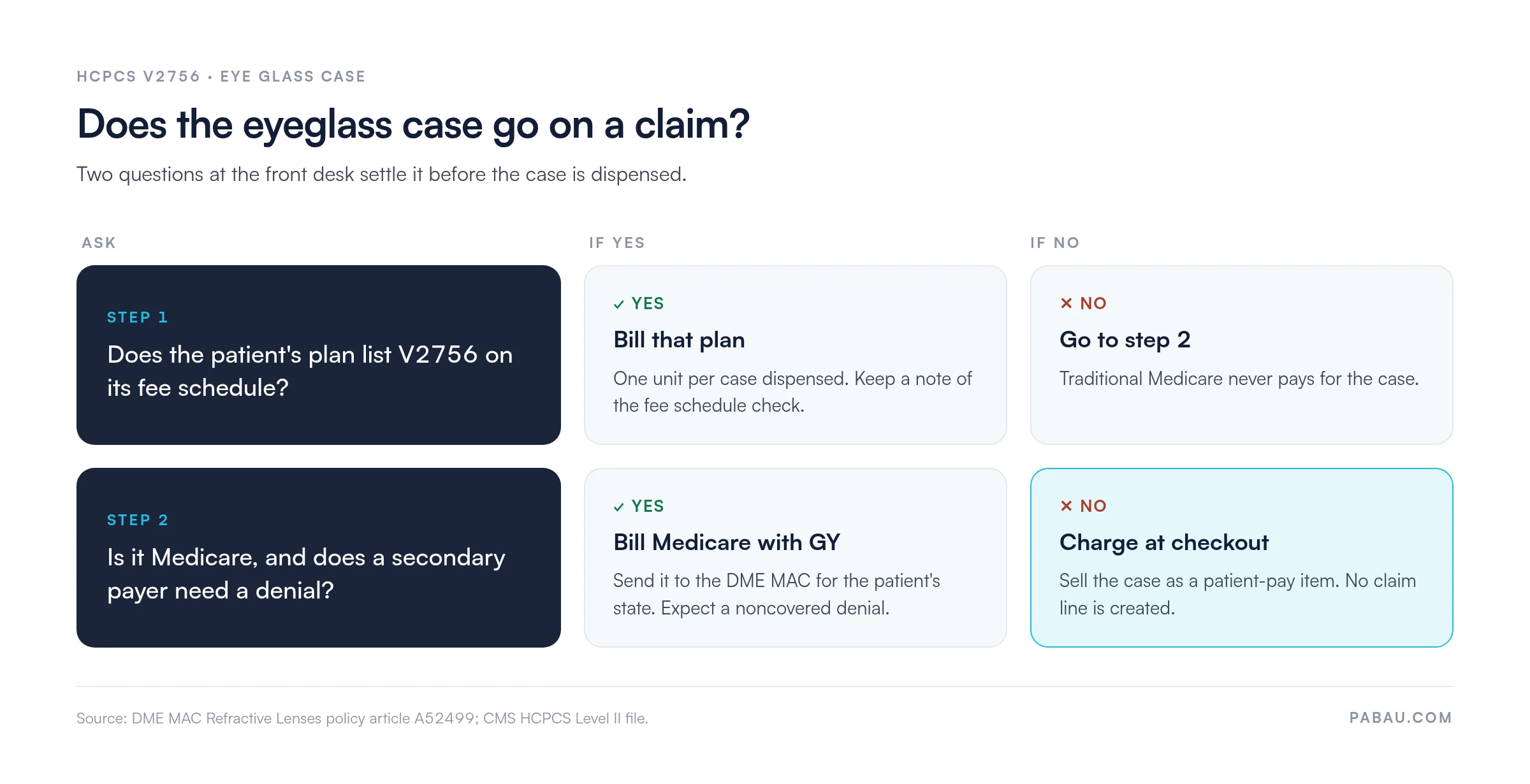
Decide your eyeglass case policy once and write it into the dispensing workflow. Include whether the case is free with every pair, sold at a fixed price, or billed to the plans that list V2756. A front desk that knows the answer never creates a claim Medicare will deny.
An eyeglass case needs far less paperwork than a lens or a coating, because no clinical judgment sits behind it. When a claim does go out, keep these records with it:
Medicare does not require an Advance Beneficiary Notice for items it excludes from coverage. Some practices still give a voluntary notice so the patient knows the case is their cost.
Traditional Medicare does not pay for eyeglass cases. Part B covers corrective lenses only under the prosthetic device benefit, for patients without a working natural lens.
After each cataract surgery with an intraocular lens implant, that benefit covers one pair of eyeglasses or contact lenses. Medicare pays for standard frames under V2020 within that benefit. The case does not ride along with them, and the DME MAC policy denies V2756 as noncovered.
Medicare Advantage plans set their own supplemental vision benefits. Check the patient’s plan before assuming the case is patient-pay.
There is no Medicare allowed amount for V2756. Its pricing indicator of 00 means Part B does not price it separately.
That leaves the price to the practice. Set a retail price for the case, or include it in the price of the frames. Whichever you choose, apply it the same way for every patient.
State Medicaid programs publish their own lists of covered vision codes. Nevada Medicaid’s vision billing guidelines, for example, have listed V2756 among its noncovered codes.
Before billing V2756 to any state program, find the current vision policy in that state’s provider portal. Never assume one state’s rule holds in another.
Commercial vision plans each set their own eyewear benefits and fee schedules. If the plan does not list V2756, the case is a patient-pay item, and a claim line will only come back denied.
Most V2756 denials come from billing a payer that never covered the case. The table pairs each common denial with the fix.
A short denial management process shows when V2756 denials repeat with one payer. When they do, stop billing that payer and switch the case to patient-pay.
When V2756 denials keep arriving from the same payer, set a front-desk rule for that plan. Mark the case as patient-pay at dispensing, and no claim line is created to deny.
The V2700-V2799 range mixes lens add-ons, accessories, and a miscellaneous code. Most of its codes, V2760 among them, are billed per lens, but V2756 is billed per case. The table shows the official descriptors around it.
If a product is not an eyeglass case and has no code of its own, V2799 is the code to consider. The HCPCS code guides cover the lens codes around V2756 in more depth.
Eyeglass case billing usually goes wrong at the front desk. A case gets added to the claim by habit, and the denial arrives weeks later for a small charge nobody wants to chase.
Claims management software such as Pabau helps you submit claims and track them through to payment. You see which V2756 lines a payer denied and can move that plan to patient-pay.
Pabau’s checkout puts the case on the patient’s invoice alongside the visit when no payer covers it. The charge is collected the same day, and the claim carries only the items a payer will consider.

Pabau helps optometry and ophthalmology practices submit and track vision claims, and charge patient-pay items like eyeglass cases at checkout. Book a demo to see it in your workflow.

Treat V2756 as a pricing decision more than a coding one. The code is narrow and the descriptor is plain, and Medicare’s answer is already written into DME MAC policy.
Set one house rule for cases and check the few plans that list V2756. Charge everyone else at checkout. That ends the cycle of small denials and keeps claims limited to lenses, frames, and services a payer will consider.
Book a demo to see how Pabau tracks your vision claims and puts patient-pay items on the same invoice as the visit.

Billing a coating on the same pair? HCPCS code V2760 covers scratch resistant coating, billed per lens.
Adding anti-reflective coating? HCPCS code V2750 explains the per-lens anti-reflective coating code.
Looking up another Level II code? HCPCS codes collects our HCPCS code guides in one place.
Want to read the denial codes on your remittances? Common denial codes in medical billing explains the CARC and RARC codes payers use.
Need a cleaner claim from the start? Clean claim requirements shows what payers expect before a claim is accepted.
HCPCS code V2756 is the Level II code for an eye glass case, the protective case supplied with a pair of spectacles. It sits in the V2700-V2799 miscellaneous vision services range and is billed as one unit per case.
No. The DME MAC Refractive Lenses policy article A52499 states that eyeglass cases billed with V2756 will be denied as noncovered. This holds even when Medicare covers the glasses themselves after cataract surgery.
No. V2756 describes an eye glass case only. Contact lenses are reported with V2500-V2531, or V2599 for another type of contact lens. The miscellaneous code for the vision range is V2799.
Bill one unit per case dispensed. The descriptor has no per-lens wording, so a pair of glasses with one case takes one unit, unlike the per-lens coating codes around it.
Use the GY modifier when you need a Medicare claim for the case, for example to get a denial for a secondary payer. GY marks the item as statutorily excluded or outside any benefit category.
Yes. When no payer covers the case, you can sell it as a patient-pay item. Medicare does not require an Advance Beneficiary Notice for excluded items, though a voluntary notice helps set expectations.