HCPCS Code E0235: Portable paraffin bath unit billing and coverage guide
HCPCS code E0235: Official descriptor and equipment classification HCPCS code E0...

Last Updated: Oct 16, 2026
V2702 is the HCPCS Level II code for a deluxe lens feature. It covers a premium spectacle-lens feature with no more specific V-code, such as lens edge treatment or lens drilling.
Medicare lists V2702 as non-covered, so the line is denied even alongside a covered post-cataract lens. Coatings, tints, polarization and high-index lenses each have their own codes, so V2702 applies only when none of those describes the feature.
Let Pabau's smart automation suggest the right codes, reduce claim denials, and keep your practice compliant—effortlessly.
Automate repetitive tasks and focus on what matters most—your patients.
Reduce coding errors and ensure compliance with the latest regulations.
Clean claims, fewer denials, and faster reimbursements.
Powerful insights and reporting to help your practice thrive.
HIPAA compliant SOC 2 certified GDPR-compliant Trusted by 4,000+ clinics worldwide

HCPCS code V2702 reports a deluxe spectacle-lens feature that has no more specific V-code, such as a lens edge treatment or lens drilling.
Coatings, tints, polarization and high-index lenses have their own codes (V2744, V2750, V2755, V2760, V2762, V2782, V2783), so they never go under V2702.
Medicare lists V2702 as non-covered, with no fee schedule amount, so the patient pays for it even after cataract surgery.
An ABN is voluntary for this statutorily excluded item, and your DME MAC sets the modifier, usually GY, plus GX after a voluntary ABN.
Outside Medicare, coverage depends on the patient’s vision benefit, so check the plan’s lens-option rules before you dispense.
HCPCS code V2702 is the Level II code for a deluxe lens feature on a spectacle lens. CMS policy article A52499 gives lens edge treatments and lens drilling as examples. The code applies only when a premium feature has no more specific V-code of its own.
V2702 sits in the V2700-V2799 range of miscellaneous lens codes, alongside the codes for prisms, tints, coatings and lens materials. It is billed with a base spectacle-lens code from the V2100-V2499 range, which describes the prescription itself. The rest of the series is covered in our HCPCS guides for billers, one code per page.
The October 2026 HCPCS file lists the official descriptor as “Deluxe lens feature”, with no per-lens wording. It gives the code Medicare coverage code M, meaning non-covered, and pricing indicator 00, meaning no Medicare fee schedule amount.
The table below sets out the code attributes for V2702 from the CMS HCPCS file and A52499.
V2702 covers a premium spectacle-lens feature that no other V-code describes. A52499 names lens edge treatments and lens drilling as examples of deluxe lens features.
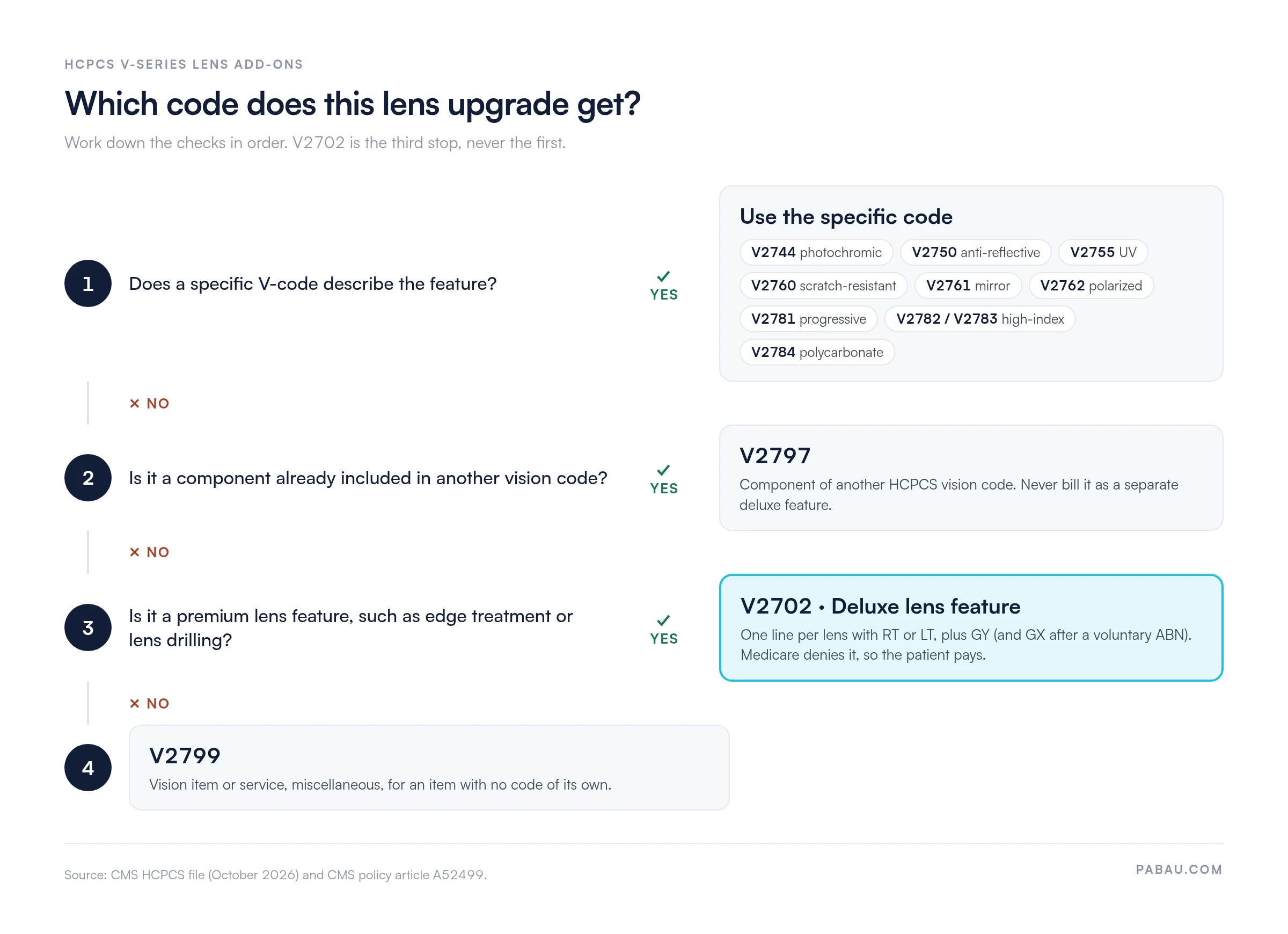
Most upgrades a patient asks for at the optical counter have a code of their own. Report these codes instead of V2702:
The descriptors above are taken from the October 2026 HCPCS file. Never report one feature under both V2702 and its specific code. If the feature appears in this table, V2702 is the wrong code, whatever name your lab gives the option.
The decision path below puts that check in order, from the specific codes through V2797 to V2702.
Medicare does not cover V2702. Section 1862(a)(7) of the Social Security Act excludes eyeglasses, and A52499 lists deluxe lens features (V2702) among the items that “will be denied as noncovered”.
That denial holds inside the post-cataract benefit too. Medicare covers one pair of eyeglasses or contact lenses after each cataract surgery with an intraocular lens. The base lenses on that claim can be paid, but a V2702 line on the same claim is still denied.
Because the exclusion is statutory, the patient is liable for V2702 whether or not they sign an ABN. CMS lets suppliers issue a voluntary ABN for an excluded item, which shows the patient the cost before the order is placed.
On the claim, append GY to mark the statutory exclusion, and GX where you issued a voluntary ABN. Follow your DME MAC’s instructions where they direct a different combination, such as GA.
V2702 has no Medicare allowed amount. Its pricing indicator 00 marks a service that Part B does not price separately. The code therefore carries no rate on the CMS DMEPOS fee schedule.
The patient pays the practice’s own charge for the feature. Commercial and vision plans that list the feature as a lens option pay their contracted rate instead. Set your self-pay price, and learn each plan’s rate, before you dispense.
Set one self-pay price for each V2702 feature in your price list before you dispense. Medicare publishes no rate for the code, so the quote the patient signs is the amount you collect.
Billing V2702 is one step in the wider medical billing workflow for vision supplies. The order matters, because the specific lens codes always come first.
This example shows a Medicare patient with covered post-cataract lenses who chose drilled lenses. Each base lens is V2100, a single vision sphere.
Add GX to lines 2 and 4 if the patient signed a voluntary ABN. Confirm the full modifier set with your DME MAC before you submit.
V2700 and V2702 sit two positions apart in the V-series, but they describe different items. The miscellaneous codes V2797 and V2799 are also easy to confuse with V2702.
NCCI procedure-to-procedure edits do not apply to DME MAC claims, so they are not the reference when several lens add-ons share a claim. Use A52499’s coding guidelines instead, such as its rule that V2782 and V2783 are never billed with V2784. For commercial and vision plans, follow the payer’s own bundling policy.
No diagnosis code makes V2702 payable by Medicare. The covered base lenses on a post-cataract claim still need one of the diagnoses A52499 accepts:
Commercial and vision plans may ask for the refractive diagnosis instead, such as myopia (H52.1-) or presbyopia (H52.4). Check the plan’s claim rules for lens options.
Keep the same record for V2702 whether the patient or a plan pays. It shows what was dispensed and why the generic code was used. Good billing compliance documentation protects the practice on audit.
The denials below follow from the coding rules in A52499 and the V2702 record in the HCPCS file. Most come from using V2702 for a feature with its own code, or from expecting Medicare to pay it.
Sorting expected denials from fixable ones keeps denial management in healthcare focused on the lines you can recover.
Run a monthly check of every V2702 line you billed. Any line that names a coating, tint, polarization or high-index material belongs under its specific code. Fixing it at the source stops the error repeating.
In many optical practices, a deluxe feature is priced at the counter, coded later, and chased with the patient once the denial lands. Pabau, the practice management and billing platform we build, keeps those steps in one patient record.
Pabau’s US claims management submits the claim and tracks its status, so a denied V2702 line sits next to the rest of the order. The checkout then invoices the patient’s share and takes payment at the desk.
Patients get fewer surprise bills, and your team closes V2702 lines instead of leaving them open on the aging report.

Pabau submits vision supply claims, tracks the status of each line, and invoices the patient’s share at checkout. See how it fits your optical billing workflow.

HCPCS code V2702 is a narrow code with a fixed Medicare outcome. Use it only for a premium lens feature that no specific V-code describes, and expect Medicare to deny it every time.
Practices that bill it cleanly settle the code and the price before the glasses are ordered. The patient knows the cost, the claim carries the right modifiers, and the denial closes without rework. To see how Pabau handles the claim and the patient invoice together, book a demo.

Need help managing optical billing denials across multiple claim lines? Denial management in healthcare covers the end-to-end workflow for identifying, working, and appealing denied claims.
Looking for a complete overview of what medical billing involves? What is medical billing explains the full revenue cycle from claim creation to payment posting.
Want to understand compliance requirements for billing documentation? Medical billing compliance outlines the documentation standards and audit risk areas for healthcare practices.
Billing an anti-reflective coating instead? HCPCS code V2750 covers the per-lens coating code that always takes priority over V2702.
Coding a high-index lens material? HCPCS code V2782 covers the mid-range high-index lens code and its index thresholds.
HCPCS code V2702 is the Level II code for a deluxe lens feature on a spectacle lens. It applies only to a premium feature with no more specific V-code, such as a lens edge treatment or lens drilling.
No. Medicare lists V2702 as non-covered, and policy article A52499 says it will be denied, even alongside a covered post-cataract lens. The patient is responsible for the charge.
Each has its own code. Use V2750 for anti-reflective coating, V2744 for photochromatic tint, V2762 for polarization, V2755 for UV and V2760 for scratch-resistant coating. High-index lenses use V2782 or V2783.
No. An ABN is voluntary for a statutorily excluded item like V2702, though many suppliers issue one so the patient sees the cost first. Append GY, and GX after a voluntary ABN, as your DME MAC directs.
On DME MAC claims, A52499 requires RT or LT on each line, with one unit per lens. Add GY for the statutory exclusion, plus any other modifier your MAC asks for, such as NU.
V2700 is a balance lens, a non-prescription lens that fills the second frame position when only one eye needs correction. V2702 is a premium feature added to a lens, so the two codes never substitute for each other.
Medicare denies V2702 because the code is non-covered, so that denial is expected. Other rejections come from billing a feature that has its own code, missing RT, LT or GY modifiers, or a plan that excludes lens options.