HCPCS Code G0163: Skilled nursing observation and assessment
What is HCPCS Code G0163? HCPCS Code G0163 is a deleted Level II code for skille...

Last Updated: Oct 15, 2026
S0596 is the HCPCS Level II code for a phakic intraocular lens supplied to correct refractive error. It covers the implanted device itself, not the surgery that places it.
Unlike the pseudophakic IOL codes used after cataract extraction, S0596 applies only to a phakic eye, where the patient's natural lens stays in place. It is billed alongside the surgical CPT code, and Medicare excludes it as an elective refractive service.
Let Pabau's smart automation suggest the right codes, reduce claim denials, and keep your practice compliant—effortlessly.
Automate repetitive tasks and focus on what matters most—your patients.
Reduce coding errors and ensure compliance with the latest regulations.
Clean claims, fewer denials, and faster reimbursements.
Powerful insights and reporting to help your practice thrive.
HIPAA compliant SOC 2 certified GDPR-compliant Trusted by 4,000+ clinics worldwide

HCPCS Code S0596 covers the phakic IOL device supply for refractive error correction, not the surgical implantation procedure itself.
Medicare excludes S0596 as an elective refractive service, and commercial payer coverage varies widely by plan.
Most commercial payers require prior authorization and medical necessity documentation before a phakic IOL implant.
Pabau’s claims management software helps ophthalmology billing teams track prior authorization status, flag missing documents, and submit clean S0596 claims.
HCPCS Code S0596 is a Level II S-series supply code with the official descriptor: Phakic intraocular lens for correction of refractive error. The Centers for Medicare and Medicaid Services (CMS) maintains the HCPCS Level II code set through the HCPCS National Panel. S0596 sits at the end of the S0500-S0596 vision supplies range.
The S-series designates temporary national codes used primarily by non-Medicare payers, including commercial insurers and some state Medicaid programs. CMS does not adopt S-codes for Medicare fee-for-service billing. S0596 therefore has no Medicare national payment indicator and no published Medicare Physician Fee Schedule rate.
A phakic intraocular lens implant is a surgical refractive procedure. The surgeon places a thin lens inside the eye without removing the patient’s natural crystalline lens. The phakic eye retains its own accommodative lens. That is why these devices carry the “phakic” designation and need a supply code separate from the pseudophakic IOL codes used in cataract surgery.
The most common FDA-approved phakic IOL device is the VISIAN ICL (Implantable Collamer Lens), manufactured by STAAR Surgical. Anterior chamber phakic IOLs such as the Artisan/Artiflex (Ophtec) represent an older category still used in some markets. Confirm the FDA approval status of any device before billing S0596, because the code’s scope is limited to approved phakic IOL devices for refractive correction.
Typical indications include high myopia (often -3.00 to -20.00 D), hyperopia, or significant astigmatism where corneal refractive surgery such as LASIK is contraindicated. Thin corneas, dry eye, or an extreme refractive error are the usual reasons. The patient’s refractive diagnosis drives the accompanying ICD-10-CM diagnosis code, not S0596 itself.
S0596 covers the phakic IOL device supply when it is billed alongside a surgical implantation procedure. Covered indications share three characteristics: the patient’s natural lens is intact, an FDA-approved device is being implanted, and the clinical purpose is refractive error correction.
Three categories generate most miscoding errors with S0596. First, pseudophakic IOL implants are not phakic procedures; coders should use CPT codes 66982, 66984, or 66985 with the appropriate IOL supply codes. Second, the code entirely excludes LASIK, PRK, and other corneal refractive procedures. Third, any device without FDA approval for phakic IOL use falls outside the code’s scope.
One question settles most of these cases at the coding desk, and the chart below follows it through to the code each answer produces.
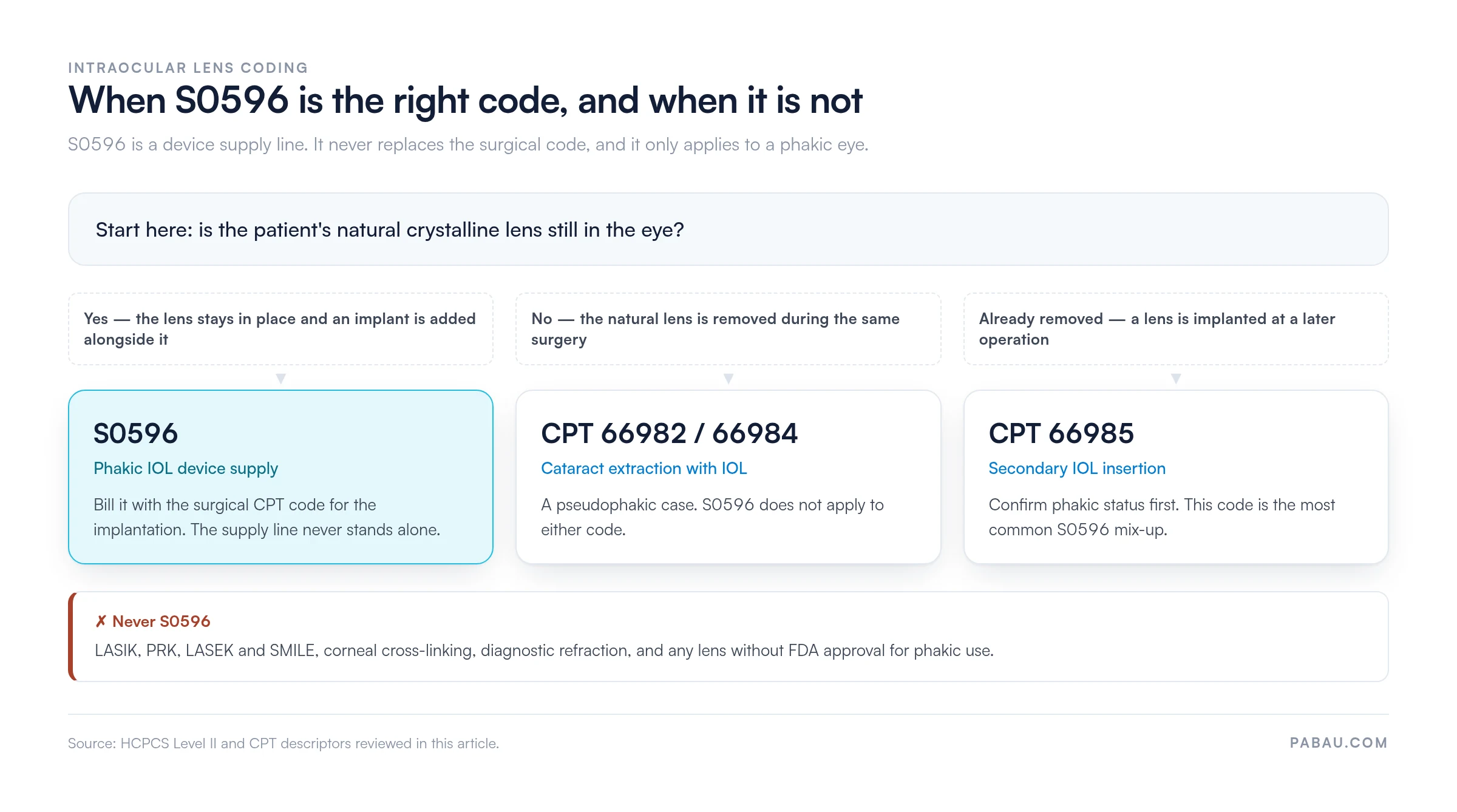
Ophthalmology billing teams often mix up S0596 with both CPT surgical codes and other HCPCS supply codes. S0596 is a device supply code rather than a surgical procedure code. It does not replace the CPT code for the implantation surgery; it accompanies it.
CPT 66985 is the most common surgical companion code for phakic IOL implantation, where the payer does not recognize a specific phakic IOL insertion code. Verify payer-specific instructions for which surgical CPT code pairs with S0596 as the device supply line.
Medicare does not cover HCPCS Code S0596. CMS treats phakic IOL implantation for refractive error as an elective cosmetic procedure. That places it under the eyeglasses and refractive error exclusion at 42 CFR 411.15(l). Because S-codes are temporary national codes used by non-Medicare payers, no Medicare Physician Fee Schedule rate exists for S0596.
Do not submit S0596 to Medicare fee-for-service without a specific CMS ruling or a Local Coverage Determination from the applicable Medicare Administrative Contractor. That determination has to cover phakic IOL as medically necessary for the patient in front of you.
Medicaid coverage varies by state. Some state Medicaid programs cover phakic IOL in cases of extreme myopia or anisometropia meeting medical necessity thresholds; others exclude it entirely as elective. Check the applicable state Medicaid fee schedule and policy manual before billing S0596 on a Medicaid claim. Confirm insurance eligibility verification for each patient’s plan before scheduling the procedure.
Commercial insurers who cover phakic IOL procedures usually require prior authorization before the procedure occurs. The authorization process usually follows these steps:
Thorough documentation is the strongest defense against S0596 denial. The records below should support every claim submission, confirming both the patient’s clinical need and the specific device supplied. Build the checklist into the pre-authorization workflow, so the file is complete at claim time rather than after a rejection.
Retain all documentation for a minimum of seven years, in line with standard ophthalmology audit defense timelines.
Because S0596 is an S-series temporary code, CMS publishes no national Medicare fee schedule rate for it. Commercial payer contracts and state Medicaid fee schedules determine reimbursement entirely, where coverage applies.
In practice, payers negotiate phakic IOL device reimbursement as a supply component within the surgical package, or bill it separately as a pass-through device cost. Rates vary widely by payer contract tier, geographic region, and device model. The CMS Physician Fee Schedule lookup tool can confirm whether a fee schedule references the code at all. For S-codes it usually returns no Medicare payment indicator.
For revenue cycle planning, request the payer’s allowed amount for S0596 directly from the contracting department. Confirm whether the device is reimbursed as a separate supply line or bundled into the surgical CPT rate. Practices using dedicated ophthalmology claims management software can track contracted rates per payer, and flag S0596 claims where reimbursement falls below the device acquisition cost.
Payers deny S0596 claims more often than most ophthalmic supply codes. The code sits at the intersection of elective coverage exclusions, prior authorization requirements, and supply-versus-procedure confusion. Five triggers account for the bulk of those denials.
Several modifiers apply to S0596 claims, depending on the payer and the clinical circumstances. When a modifier-related denial arrives, check it against the applicable denial codes in medical billing. The CARC reason code usually names the specific modifier issue.
Audit your S0596 claims monthly by filtering for denial reason codes CO-97 (bundling), CO-50 (non-covered), and CO-15 (missing authorization). These three codes account for the majority of phakic IOL supply claim rejections. Work through them step by step, starting with the highest-volume code, and the same rejection stops repeating on the next batch.
A phakic IOL case usually lives in three places at once. The authorization sits in a payer portal, the device invoice in a folder or spreadsheet, and the operative note in the chart. When a denial arrives months later, someone has to rebuild that file from all three before anyone can appeal.
Practice management software like Pabau keeps the case in one patient record. The prior authorization number, the pre-operative refraction, the corneal topography report and the device invoice attach to the patient as they are produced. By the time the claim goes out, the supporting file is already assembled.
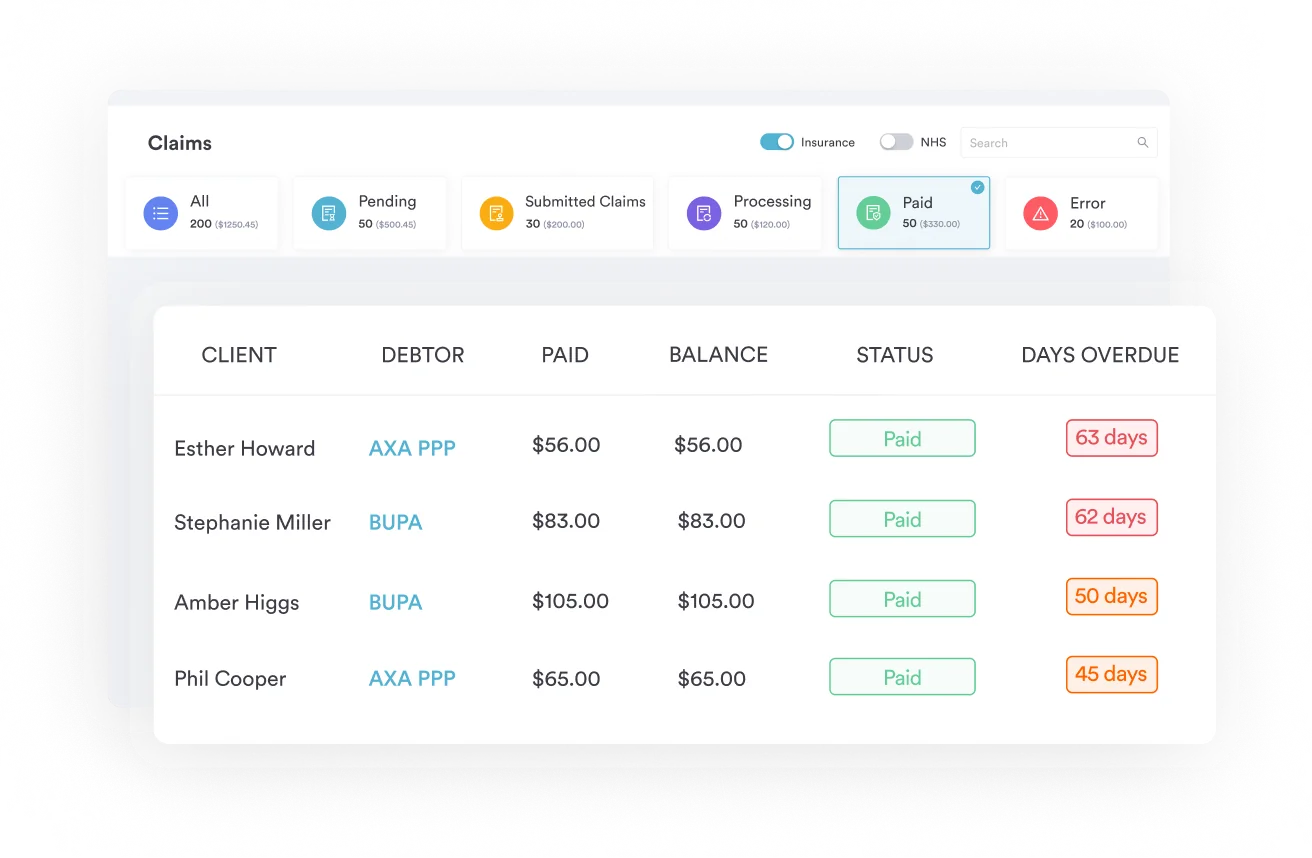
Claims submit from that same record, with the surgical CPT line and the S0596 supply line on one form. Billing staff can see which claims are pending, which have paid, and which came back with a modifier error. No one has to open a separate payer portal for each case.

Pabau helps ophthalmology billing teams track prior authorization status and attach supporting documentation to patient records. Supply codes then submit alongside surgical CPT claims from the same workflow.

S0596 rewards practices that settle the payment question before the operative date rather than after it. Coverage for a phakic IOL is the exception rather than the rule. The decision to treat is therefore also a decision about who pays for the lens.
That puts the weight on the pre-operative file. The refraction measurements, the topography, the contraindication narrative and the device invoice either exist before surgery, or they get reconstructed against an appeal deadline. Assemble them once and the claim becomes routine. Book a demo to see how Pabau keeps authorization records and supply-code claims in one patient record.

Need to understand how denials get resolved? Denial management in healthcare walks through the workflow for investigating and appealing common claim rejections.
Want a clean-claim checklist for complex supply codes? Submitting a clean claim covers the documentation and coding steps that reduce first-pass rejection rates.
Billing across multiple ophthalmology payers? Revenue cycle management fundamentals explains how to track contracted rates and measure reimbursement performance by payer.
Keeping documentation audit-ready? What a superbill includes sets out the line-item detail a payer expects to see behind a supply claim.
HCPCS Code S0596 covers the phakic intraocular lens device supplied for implantation to correct refractive error, including myopia, hyperopia, and astigmatism. It applies only where the patient’s natural crystalline lens is still intact. It does not cover the surgical implantation procedure itself; that is billed separately using the appropriate CPT code.
No. Medicare excludes phakic IOL procedures under the eyeglasses and refractive error exclusion at 42 CFR 411.15(l), and S0596 carries no Medicare fee schedule rate. Medicaid coverage varies by state; some programs cover phakic IOL for extreme myopia or medical necessity cases while others exclude it entirely. Verify the specific state Medicaid policy before billing.
A phakic intraocular lens corrects severe refractive errors, most commonly high myopia (-3.00 to -20.00 D). It is used where corneal refractive surgery is contraindicated by thin corneas, dry eye disease, or an extreme refractive error. Unlike cataract IOLs, the phakic IOL is implanted without removing the eye’s natural lens, preserving accommodation in younger patients.
No Medicare fee schedule rate exists for S0596 because it is an S-series temporary code not adopted for Medicare fee-for-service. Commercial payer rates are negotiated individually by contract. Practices should request the allowed amount directly from each commercial payer’s contracting department. Confirm whether S0596 is reimbursed as a separate supply line or bundled into the surgical procedure payment.