CCSD Code E1220: Caldwell-Luc procedure billing guide
CCSD Code E1220: definition and clinical descriptor CCSD Code E1220 is the proce...

Last Updated: Oct 16, 2026
S0590 is the HCPCS Level II code for integral lens service, miscellaneous services reported separately.
Medicare Part B never pays S0590. State Medicaid programs and contracted commercial plans are the payers that do. Both expect the code on its own claim line, with a clinical narrative attached.
Let Pabau's smart automation suggest the right codes, reduce claim denials, and keep your practice compliant—effortlessly.
Automate repetitive tasks and focus on what matters most—your patients.
Reduce coding errors and ensure compliance with the latest regulations.
Clean claims, fewer denials, and faster reimbursements.
Powerful insights and reporting to help your practice thrive.
HIPAA compliant SOC 2 certified GDPR-compliant Trusted by 4,000+ clinics worldwide

HCPCS code S0590 describes integral lens service, miscellaneous services reported separately, classified under vision supplies in the HCPCS Level II S-code range.
Medicare Part B does not cover S0590 or any S-code. Medicaid and commercial insurers are the primary payers, though coverage varies by state and plan.
S0590 is a catch-all code, used only when no other lens service code describes the service. Always report it separately from the primary procedure code.
Practice management software like Pabau attaches HCPCS S-codes to appointment records, so billing staff build claims from clinical data instead of retyping it.
S-codes sit outside the CMS HCPCS system maintained for Medicare, which is why no national Medicare fee schedule rate exists for HCPCS code S0590. Reimbursement depends entirely on individual payer contracts.
Medicaid programs that cover S0590 typically set their own state-specific fee schedules. Commercial insurers negotiate rates from regional cost data and contracted provider agreements. Because rates vary this widely, billing staff should check each payer’s current fee schedule rather than a published national rate.
Tracking denial patterns across payers matters more with a miscellaneous code than with a specific one. A record of which plans deny S0590, and which ask for extra documentation, tells billing staff where prior authorization is worth the time.
Medicare Part B excludes every HCPCS S-code, including S0590, from reimbursement. That exclusion is structural rather than clinical. S-codes are maintained by America’s Health Insurance Plans (AHIP), not by CMS, and Medicare reimburses only the codes it maintains.
Submitting S0590 to Medicare produces an automatic denial, and more documentation will not reverse it. Identify the patient’s coverage type before submitting, and route S0590 claims only to Medicaid or a qualifying commercial plan.
Medicaid programs in many states cover vision S-codes, including S0590. Coverage is not universal. Each state Medicaid agency sets its own covered code list, fee schedule, and prior authorization requirements. A state that covers S0590 today may revise its vision benefit at any time.
Checking eligibility before each visit prevents the most common cause of S0590 denials, which is submitting to a payer that does not cover the code. The check should confirm active coverage and whether that specific plan includes vision S-codes.
S0590 is a miscellaneous code, so it works as a catch-all. Use it only when the integral lens service does not match any other specific code in the S0500-S0596 range. Coders sometimes reach for it out of habit, which invites denials, because payers expect a specific code where one exists.
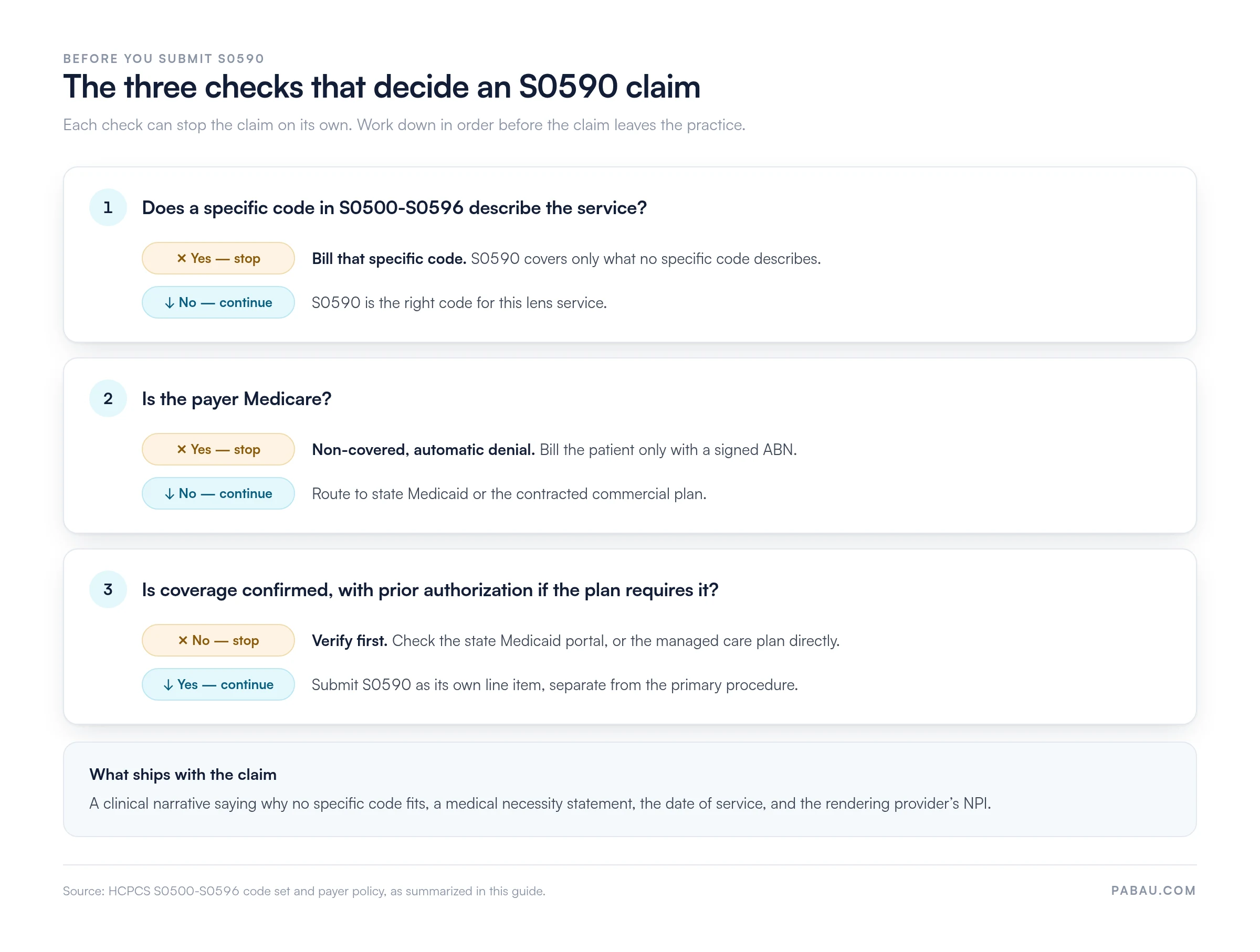
Three checks decide whether an S0590 claim gets paid, and each one can stop it before submission.
Ophthalmic practices with structured coding workflows see fewer miscellaneous code denials. A pre-submission review of the S0590 line, its narrative, and its payer routing catches most problems before the claim reaches the adjudicator.
Before using HCPCS code S0590, run through the adjacent S0500-S0596 range to confirm no specific code fits the service. Payers treat miscellaneous codes with heightened scrutiny, and a specific code that fits will process faster and with fewer documentation requests.
Miscellaneous HCPCS codes need stronger supporting documentation than specific codes, because the payer has to verify that no specific code applies. An S0590 claim with thin documentation is a predictable denial.
Document the rationale for choosing a miscellaneous code at the point of service, not retrospectively after a denial. Waiting until a claim is rejected to gather supporting documentation slows the revenue cycle.
Practices that keep thorough digital client records can pull clinical notes straight into billing, so documentation and claim submission happen closer together. Every detail the payer needs should already sit in the patient record before the claim leaves the practice.
Payer policies for S0590 vary more than for specific vision codes, because a miscellaneous code needs human review rather than automated adjudication. Knowing the common policy patterns saves billing staff time and reduces appeal volume.
When an S0590 claim is denied, review the denial code before writing it off. Many initial denials for miscellaneous codes are reversed on appeal once supporting documentation is added. A working knowledge of denial management helps practices separate correctable denials from genuine non-coverage.
Review your denied S0590 claims quarterly by payer. If a specific Medicaid managed care plan consistently denies this code, contact the plan’s provider relations team. Ask them for the prior authorization threshold and the required documentation format in writing, because that policy is often unpublished.
Before using HCPCS code S0590, check the adjacent codes in the vision supplies section of the HCPCS code directory. Several specific codes in the S05xx range describe common lens services precisely, and using one of them clears adjudication faster. A non-prescription safety, athletic, or sunglass lens, for example, bills under S0510 rather than the miscellaneous code.
A disposable contact lens bills under S0500, one unit per lens. A daily wear specialty contact lens has its own code, S0512. Both are specific, so neither service needs the miscellaneous code.
The AAPC HCPCS code lookup and the NLM HCPCS API are useful for browsing the full S0500-S0596 range.
The crosswalk check matters for revenue cycle efficiency. Practices that know their adjacent codes use fewer miscellaneous codes, which shortens adjudication timelines and lowers the documentation burden.
A quarterly review of the S05xx range keeps billing staff current on which specific codes exist, so the miscellaneous code stays the exception.
A code lookup tool tells you what S0590 means. It cannot tell you where the code sits in your clinical and billing workflow. That distinction matters when staff handle dozens of claims a day across payers with different coverage rules.
Practice management software like Pabau handles both sides in one place. Its connected claims management lets ophthalmic and vision practices attach HCPCS S-codes directly to appointment records.
That removes the manual transfer step where coding errors usually appear. Staff can flag the service at the point of care, attach the clinical note, and route the claim without changing systems.
Practices that rely on a standalone lookup tool still face the manual step of moving verified codes into a billing system. That handoff is where errors accumulate. Keeping the billing workflow in the same platform as the clinical record removes it.
A well-built superbill supports clean S0590 claims too. When it captures the integral lens service with its clinical context at the point of care, billing staff have what the payer wants. They can then submit a complete claim on the first attempt, instead of chasing notes after a denial.

Pabau connects ophthalmic and vision practice workflows from scheduling to claims, so billing staff catch missing documentation before submission and retype less data.

HCPCS code S0590 is a narrow tool. It belongs to integral lens services that fall outside every specific code in the S0500-S0596 range, and nowhere else.
Medicare never covers it, Medicaid coverage varies by state, and payers review it by hand rather than by rule. So the work that decides an S0590 claim happens before submission, not after the denial arrives.
Run the three checks, write the narrative at the point of service, and keep the code on its own claim line. Book a demo to see how Pabau routes HCPCS S-code claims from the appointment record to the payer.

Want to reduce billing errors across your practice? How to submit a clean claim covers the documentation and workflow steps that prevent common denial triggers.
Dealing with HCPCS S-code denials? Denial management in healthcare explains how to categorize, appeal, and prevent recurring claim rejections.
Need a structured approach to eligibility before billing? Insurance eligibility verification outlines the pre-visit checks that prevent non-covered payer submissions.
HCPCS code S0590 is a Level II HCPCS code that describes integral lens service, miscellaneous services reported separately. It is a catch-all code used in ophthalmic billing when no specific HCPCS code in the S0500-S0596 range adequately captures the lens service provided. It is maintained by AHIP and is active for 2026 dates of service.
No. Medicare Part B does not cover S0590 or any HCPCS S-code. S-codes are maintained by AHIP rather than CMS, and Medicare excludes them from its reimbursement schedule entirely. Submitting S0590 to Medicare will result in an automatic denial. If the patient has been informed of the non-coverage and signed an Advance Beneficiary Notice (ABN), you may bill the patient directly.
Medicaid programs in many states cover S0590, though coverage varies by state and managed care plan. Some commercial insurers also reimburse S0590 under contracted terms. Medicare Advantage plans with enhanced vision benefits may include coverage for vision S-codes. Always verify coverage with each specific payer before submitting a claim.
Use S0590 only when no other specific HCPCS code in the S0500-S0596 range adequately describes the integral lens service provided. If a specific code exists for the service, use that code instead. Defaulting to S0590 when a specific code applies is a coding error and increases the likelihood of a denial or audit.
S0590 requires a clinical narrative explaining why no specific code applies, plus a medical necessity statement tied to the patient’s condition. The claim also needs the date of service, the rendering provider’s NPI, and S0590 as its own line item. Some payers also require a letter of medical necessity or a prior authorization before processing a miscellaneous lens service code.
There is no national Medicare fee schedule rate for S0590 because Medicare does not cover S-codes. Reimbursement rates for Medicaid and commercial payers vary by state and contract. Check your state Medicaid fee schedule or your contracted payer’s rate table for the current allowed amount in your region.
HCPCS Level II S-codes are temporary codes maintained by AHIP rather than CMS. They are used primarily by Medicaid programs and commercial insurers to bill for services not covered by CPT codes or the HCPCS codes CMS maintains. Because Medicare does not recognize S-codes, they function only within Medicaid and commercial payer billing contexts.