CPT code 44625: Enterostomy closure with resection
CPT code 44625 needs three things in one operation CPT code 44625 reports an ope...

Last Updated: Oct 8, 2026
S0164 is the HCPCS Level II code for injection, pantoprazole sodium, 40 mg. CMS terminated it with effect from 30 June 2024, so it is no longer valid for claims after that date.
HCPCS code S0164 was the Level II code for injection, pantoprazole sodium, 40 mg, and it was deleted effective July 1, 2024. Its direct replacement is J2470, which carries the identical description and the identical 40 mg dose.
J2470 is active in the current code set, and Medicare Part B recognizes it. S0164 never had that status, because Medicare excludes the whole S-series from payment.
Two product-specific J-codes sit alongside J2470, and the right one depends on the vial or bag the practice dispensed.
Let Pabau's smart automation suggest the right codes, reduce claim denials, and keep your practice compliant—effortlessly.
Automate repetitive tasks and focus on what matters most—your patients.
Reduce coding errors and ensure compliance with the latest regulations.
Clean claims, fewer denials, and faster reimbursements.
Powerful insights and reporting to help your practice thrive.
HIPAA compliant SOC 2 certified GDPR-compliant Trusted by 4,000+ clinics worldwide

HCPCS code S0164 described injection of pantoprazole sodium 40 mg, an S-series code issued for non-Medicare payers.
S0164 was deleted effective July 1, 2024, and it cannot be used for dates of service on or after that date.
J2470 is the direct replacement. It carries the same description, injection of pantoprazole sodium 40 mg, and Medicare recognizes it.
Match the J-code to the product you dispensed. J2471 covers the Hikma formulation and J2472 covers the Baxter premixed bag.
J3490 is the unclassified-drug code. It applies only where no drug-specific code exists, and pantoprazole now has three.
Practice management software like Pabau supports HCPCS code assignment, payer-rule enforcement, and claim scrubbing for injection billing.
HCPCS code S0164 was the Level II code for injection, pantoprazole sodium, 40 mg, a parenteral proton pump inhibitor. CMS maintained it as part of the HCPCS Level II code set, which covers drugs, devices, and services that CPT does not describe.
The S-series was issued for non-Medicare payers such as Medicaid managed care plans and commercial insurers. The code is now deleted, but its historical record still matters for claim research, appeals, and audit response.
Pantoprazole sodium is a proton pump inhibitor that irreversibly blocks the hydrogen-potassium ATPase enzyme system of the gastric parietal cell. Blocking that enzyme suppresses acid secretion.
The drug is marketed under the brand name Protonix. The intravenous formulation is used when a patient cannot tolerate oral dosing, typically in inpatient or observation settings.
According to FDA-approved labeling for pantoprazole sodium, the drug’s clinical indications include:
The indications matter for billing because medical necessity documentation has to match the diagnosis codes on the claim. Payers running utilization review check that the billed ICD-10 diagnosis is consistent with the indication for parenteral PPI therapy.
S0164 is a deleted HCPCS code, removed in the quarterly update that took effect July 1, 2024. It cannot be used for dates of service on or after that date, and a claim carrying it is rejected on system logic.
CMS retires a code when a permanent code already covers the same drug, when usage falls away, or when a better pathway exists. S0164 was retired for the first reason, since J2470 already described the same drug at the same dose.
Billers who find S0164 on historical claims, remittances, or audit files should read it as valid for its own date of service. A 2023 remittance showing S0164 is not an error. For any current date of service, bill J2470 and confirm the payer’s drug policy first.
Build a quarterly HCPCS review into your billing calendar rather than an annual one. The comprehensive Level II update takes effect January 1, and CMS usually posts those files the previous November. Quarterly files then land in January, April, July, and October, and drug and temporary codes move on that cycle. S0164 itself was deleted in a July release.
J2470 is the replacement code for S0164. Both carry the same long description, injection of pantoprazole sodium 40 mg, so the crosswalk is one to one. Two product-specific codes sit alongside it, and which one applies depends on the vial or bag dispensed.
Key crosswalk rule: bill J2470 unless the dispensed product matches J2471 or J2472. One unit equals 40 mg, so a single 40 mg vial bills as one unit. Include the 11-digit NDC from that vial, with its unit qualifier and quantity, on the claim line. The chart below folds the date of service into that choice.
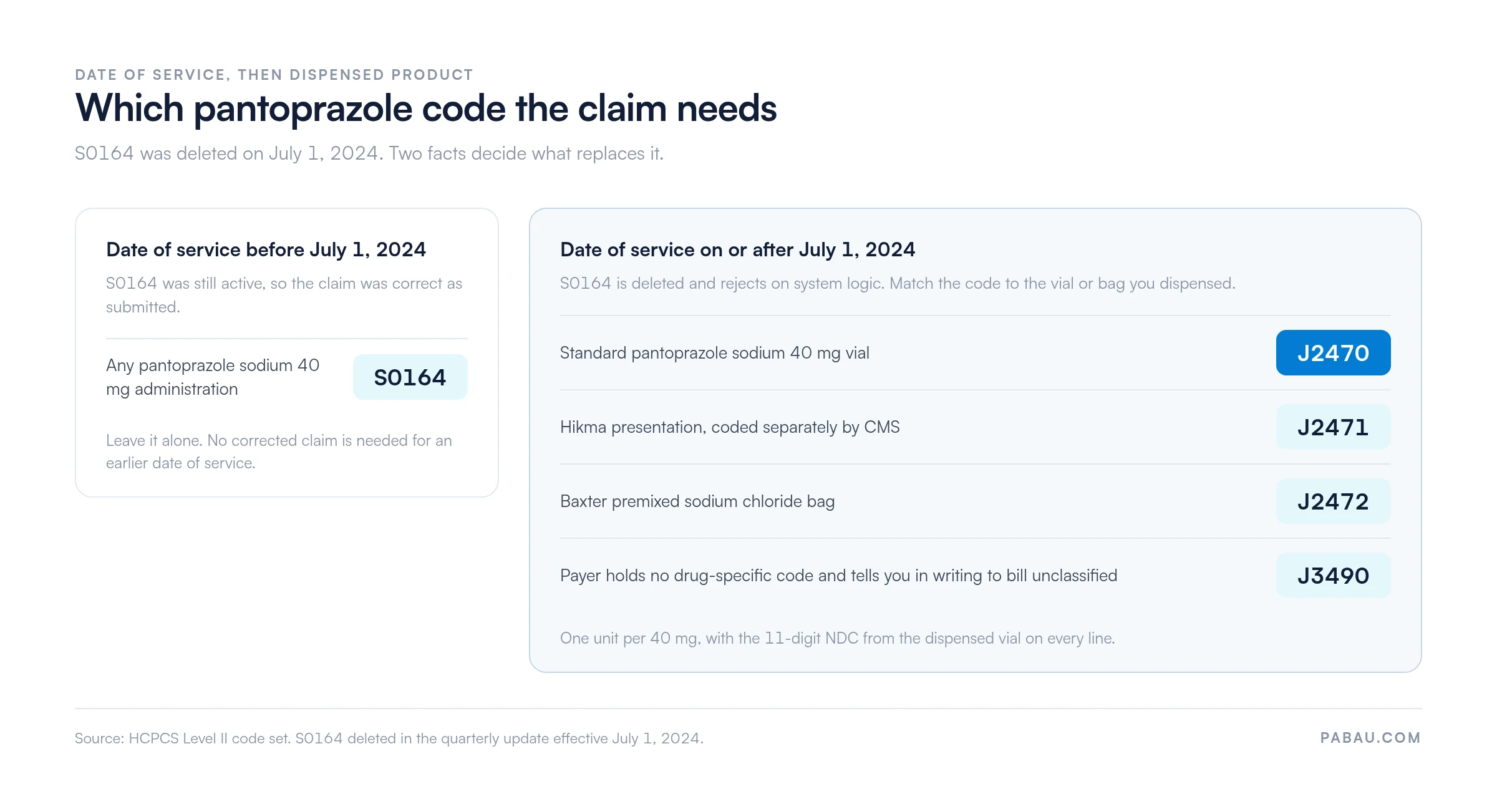
Not every S-code crosswalks at one unit for one unit. HCPCS code S0114 bills treprostinil in 0.5 mg units, so its J3285 replacement halves the unit count. Check the descriptor on both codes before you assume the units carry over.
J3490 is the unclassified-drug code, and it applies only where no drug-specific HCPCS code exists for the product. Pantoprazole now has three, so J3490 is a rare exception rather than the crosswalk.
Use it only where a payer has no J2470 entry on its fee schedule and tells you in writing to bill unclassified. The claim line then needs the drug name, the strength, the NDC, and the units in the narrative field.
Two neighboring codes get confused with J3490. J3590 covers unclassified biologics and J9999 covers unlisted antineoplastic drugs. Neither one fits pantoprazole, and neither is a crosswalk for S0164.
Coverage now runs through J2470 for every payer type, Medicare included. The table below shows where S0164 stood while it was active and what applies today. Verify the current drug policy with each payer through their provider portal before you order the drug.
S-codes are temporary codes reserved for non-Medicare payers. CMS created the series so Medicaid and commercial plans could bill drugs and services with no CPT or J-code of their own. Medicare runs a separate pathway, using J-codes for injectable drugs under Part B coverage.
An S-code sent to a Medicare Administrative Contractor is rejected by system logic, before any coverage decision is made. The exclusion is categorical. Reading the payer’s denial codes tells a team which rejection they are looking at, so the claim gets rerouted to J2470.
Payers require a medically appropriate ICD-10 diagnosis code on every claim line to establish medical necessity for parenteral pantoprazole.
The codes below are the ones most often linked to pantoprazole administration, based on the drug’s FDA-approved indications. Coverage still varies by payer, so treat this table as a clinical reference rather than a guarantee of reimbursement.
Use the most specific code the documentation supports. Submitting a less-specific code where a more specific one applies is a common audit finding. Verify each code’s validity for the claim date of service with the CDC ICD-10-CM web tool.
The National Drug Code has to appear on the claim line alongside J2470. NDC numbers identify the product, its manufacturer, and the package size. That is how a payer confirms the drug you billed is the drug you gave.
Generic manufacturers reissue NDCs when they reformulate or repackage, so check current numbers against the FDA NDC Directory. The table below sets out the format and the fields payers check.
Buy-and-bill is the model where the practice purchases the drug, administers it, and then bills the payer for both the drug and its administration.
These claims carry more detail than a simple service line, because the drug and the administration are priced separately. The steps below reflect current practice for pantoprazole sodium injection under J2470.
Commercial and Medicaid managed care payers run pre-payment or post-payment review on buy-and-bill drug claims. A clean submission for parenteral pantoprazole needs all of the following in the chart and on the claim:
A missing element on that list gives the payer grounds to deny the claim or claw the payment back. Checking each field at charge entry keeps the claim from going out incomplete.
Most rejections on a pantoprazole line trace back to six causes, and five of them are preventable at the point of charge entry. The table below pairs each denial with the control that stops it.
If a recent claim went out with S0164 by mistake, submit a corrected claim with J2470 and the dispensed vial’s NDC. Stay inside the payer’s timely filing window, which runs from 90 to 365 days after the date of service on most commercial plans.
HCPCS billing for injectable drugs has several moving parts. Teams have to track retired codes, manage NDC crosswalks, enforce payer-specific rules, and close out documentation before submission. Manual handling introduces error at each of those steps.
Practice management software like Pabau supports HCPCS code assignment, payer-rule enforcement, and claim scrubbing. A missing NDC or a retired code then surfaces before submission rather than after a denial.
Pabau’s claims management software flags outdated codes when a quarterly HCPCS update is applied. Billing staff then review a short exception list instead of the whole code library.
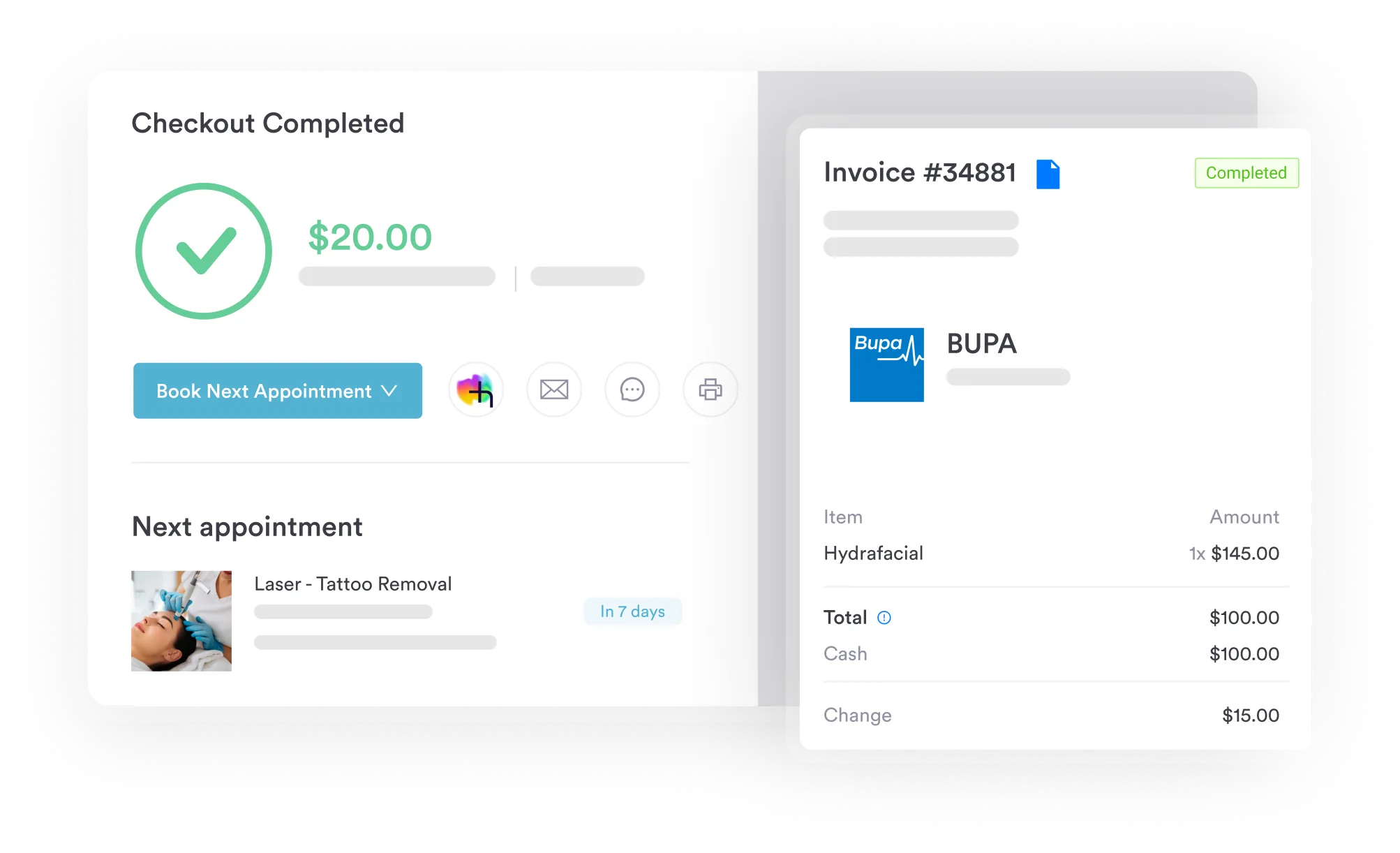
For practices running buy-and-bill drugs alongside other services, a single platform connects the clinical note to the billing queue. Administration notes, NDC data, and diagnosis codes then reach the claim without manual re-entry, which removes a common source of transcription error. Billing managers also get live claim status in one place.

Pabau connects clinical notes, HCPCS code assignment, NDC tracking, and claim submission in one platform. Your billing team catches errors before they turn into denials.

Set S0164 to retire in your code library and the rest of this falls into place. The date of service tells you whether the old code was legitimate, and the vial label tells you which J-code replaces it.
The trade-off worth remembering is that a deleted code rarely fails loudly. It rejects on system logic, weeks after the drug was given. A quarterly review of the code set catches the next S0164 before a claim does.
Buy-and-bill claims reward documentation discipline, from the physician order through to ERA reconciliation. Book a demo to see how Pabau keeps HCPCS code changes and NDC tracking off your billing team’s memory.

Need a framework for managing claim denials on drug injection codes? Denial management in healthcare covers the core workflow for categorizing, appealing, and preventing rejections.
Want to understand how HCPCS fits into the broader billing picture? What is revenue cycle management explains the end-to-end process from claim creation to payment posting.
Looking for guidance on payer credentialing to unlock commercial plan coverage? How to get credentialed with insurance companies walks through the enrollment steps for commercial and managed care plans.
HCPCS code S0164 was the Level II code for injection, pantoprazole sodium, 40 mg, issued under the non-Medicare S-code series. It was deleted effective July 1, 2024. For dates of service on or after that date, bill J2470, which carries the identical description.
S0164 is deleted and inactive. It was removed in the quarterly HCPCS update effective July 1, 2024, and it cannot be used for current dates of service. The code still appears correctly on older remittances and EOBs, but a new claim carrying it is rejected automatically.
J2470, injection, pantoprazole sodium, 40 mg. It is the direct successor to S0164, it is active in the current code set, and Medicare pays it. Bill J2471 for the Hikma presentation or J2472 for the Baxter premixed sodium chloride product. J3490 applies only in the rare case where a payer holds no drug-specific code on file.
No. Medicare does not cover any HCPCS S-series code, S0164 included, because S-codes are reserved for Medicaid managed care and commercial payers. For a Medicare patient receiving parenteral pantoprazole, bill J2470 instead. That code sits in the Part B drug pathway and is payable.
One. J2470 is defined per 40 mg, so a single 40 mg vial bills as one unit. Bill units against the milligrams given, not against the volume used to reconstitute the powder. The NDC quantity on the claim line is separate and follows the package, with its own unit qualifier.
Medicaid managed care organizations and many commercial insurers accepted S-codes while they were active, with coverage and rates varying by state and plan. Medicare and most federal programs exclude the series outright. Since S0164 is now deleted, that history matters mainly for appeals and audits on older dates of service.
J-codes are permanent HCPCS Level II codes maintained by CMS, and they identify a specific injectable drug at a specific dose. S-codes are temporary codes maintained for non-Medicare payers, covering items with no permanent code yet. Medicare accepts J-codes and never S-codes, which is why S0164 was retired in favor of J2470.
Only where the date of service falls on or after July 1, 2024. Claims with an earlier date of service were correct as submitted and need no correction. For a later date of service that went out with S0164, file a corrected claim with J2470 inside the payer’s timely filing window.