CCSD code H4430: Examination of rectum under anaesthetic
CCSD code H4430 pays for the examination alone CCSD code H4430 is the UK private...

Last Updated: Oct 20, 2026
S0132 is the HCPCS Level II code for injection, ganirelix acetate, 250 mcg.
HCPCS code S0132 has one full descriptor: Injection, ganirelix acetate, 250 mcg. The code sits in the HCPCS Level II system maintained by the Centers for Medicare and Medicaid Services (CMS). S0132 is an S-code, which places it in the Temporary National Codes (Non-Medicare) category. CMS created the S-code series for Medicaid and commercial payers. Medicare does not recognize S-codes for reimbursement.
The table below summarizes the key code attributes.
One billing unit equals one 250 mcg injection. If a patient receives several injections during a stimulation cycle, bill one unit per administration. Each one goes on its own claim line with its own date of service. Do not stack units on a single line date unless your payer's policy permits it.
Let Pabau's smart automation suggest the right codes, reduce claim denials, and keep your practice compliant—effortlessly.
Automate repetitive tasks and focus on what matters most—your patients.
Reduce coding errors and ensure compliance with the latest regulations.
Clean claims, fewer denials, and faster reimbursements.
Powerful insights and reporting to help your practice thrive.
HIPAA compliant SOC 2 certified GDPR-compliant Trusted by 4,000+ clinics worldwide

HCPCS code S0132 describes a single 250 mcg injection of ganirelix acetate, a GnRH antagonist used in IVF protocols to prevent premature LH surges.
S0132 is not covered by Medicare Part B. Submit it to Medicaid or to a commercial payer that covers fertility drugs.
A JW or JZ modifier belongs on every in-office S0132 claim billed under buy-and-bill. Missing both is a leading cause of denials.
Practice management software like Pabau keeps the S0132 line, its modifier, and its ICD-10 link attached to the patient’s treatment cycle.
Ganirelix acetate (brand names Orgalutran and the discontinued Antagon) is a synthetic gonadotropin-releasing hormone (GnRH) antagonist. It competitively blocks GnRH receptors in the pituitary gland. That suppresses the surge of luteinizing hormone (LH) that would otherwise trigger premature ovulation. Fertility practices use it in controlled ovarian hyperstimulation (COH) protocols for in vitro fertilization (IVF) and other assisted reproductive technology (ART) procedures.
The drug is given subcutaneously. Dosing typically starts on cycle day 5 or 6 of stimulation and continues daily until the trigger injection. The FDA-approved prescribing information via DailyMed indicates it for inhibiting premature LH surges in women undergoing controlled ovarian hyperstimulation.
Coverage for HCPCS code S0132 varies sharply by payer type. Here is the fact that matters most to billing staff: Medicare Part B does not cover S0132 or any other S-code. Submitting S0132 to Medicare is a claim error. Verify each patient’s eligibility and drug benefit before you administer ganirelix acetate under buy-and-bill.
For commercial payers, coverage turns on two questions. Does the plan include a fertility drug benefit, and does the patient’s state carry an IVF insurance mandate? Where the plan requires prior authorization (PA), get the reference number before administration. A denial with no PA on file is much harder to overturn after the fact.
Because S0132 is a non-Medicare S-code, no CMS Medicare Physician Fee Schedule rate exists for it. Reimbursement comes from state Medicaid fee schedules and individual commercial payer contracts. Rates vary widely, and each payer updates on its own cycle. Always verify against your current contract or your state fee schedule.
Track what each prefilled syringe costs you against what the payer actually pays. That margin decides whether buy-and-bill is worth running for ganirelix acetate, or whether the patient is better served filling the prescription at a specialty pharmacy.
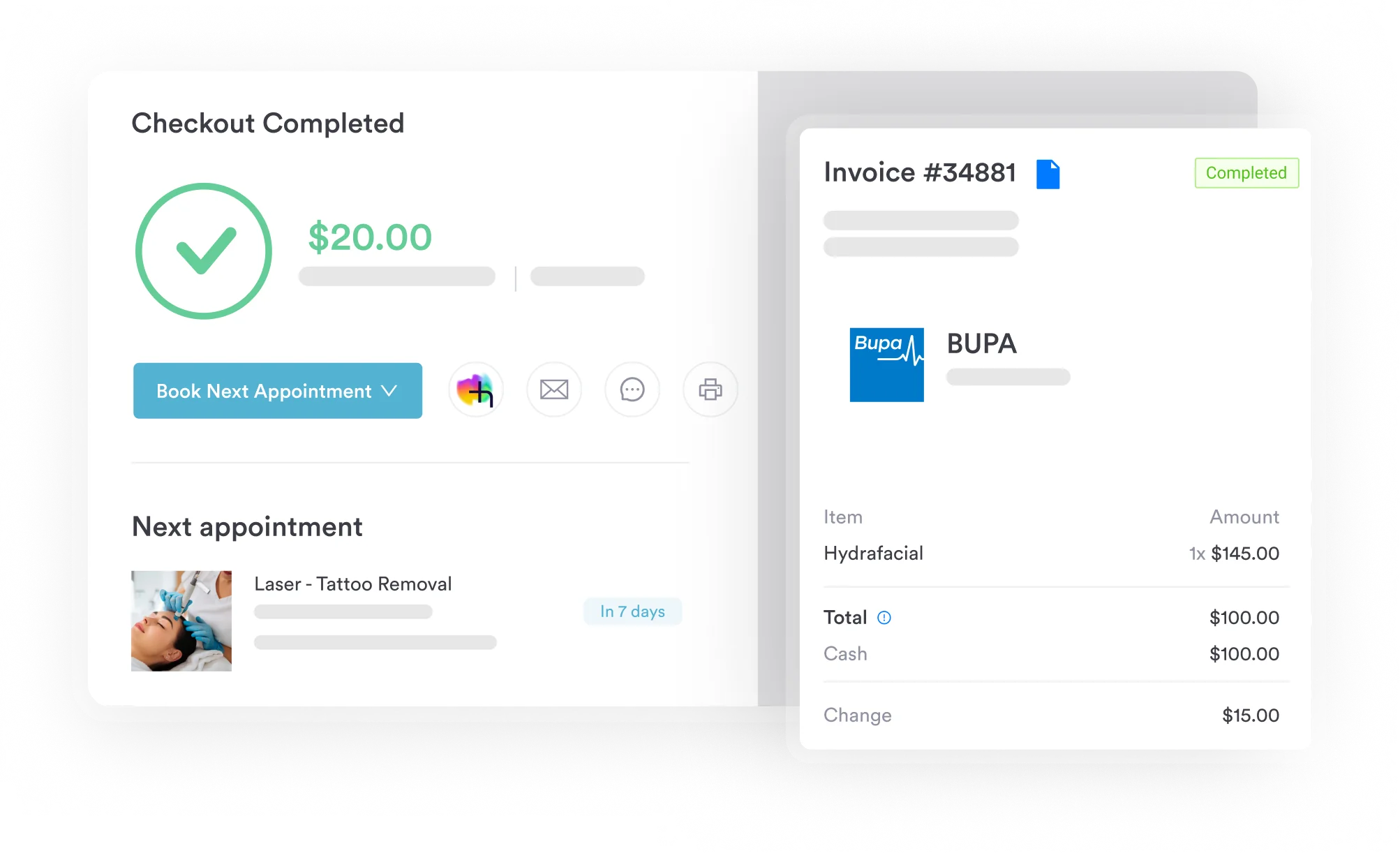
Request an electronic remittance advice (ERA) for every S0132 claim you send to a commercial payer. Reading the adjustment reason codes across a batch of claims shows whether denials cluster around one payer, a modifier error, or an ICD-10 mismatch. That pattern is much faster to spot than it is by opening explanation of benefits statements one at a time.
Two modifiers are central to billing HCPCS code S0132 under buy-and-bill: JW and JZ. CMS drug waste reporting rules call for one of them on claims for physician-administered drugs, S0132 included. Missing both is a frequent cause of rejection.
Ganirelix acetate comes as a 250 mcg/0.5 mL prefilled syringe. One syringe equals one billing unit, so JZ usually applies when the whole syringe is administered as directed. For a partial dose, such as a dose-adjustment protocol, bill the administered units on their own line. Add a separate JW line for the wasted portion. Confirm modifier policy with each payer first, since commercial rules may differ from Medicaid rules.
Every claim for HCPCS code S0132 needs a supporting ICD-10 diagnosis code that establishes medical necessity for the injection. Pairing the wrong code, or omitting one, triggers an automatic denial from most payers. The right code reflects the documented clinical reason the patient is undergoing assisted reproductive technology. Where the documented diagnosis falls outside the N97 range, our ICD-10 code lookup covers the wider code set.
Document the specific infertility diagnosis in the clinical record before you submit. Payers do audit S0132 claims for diagnosis-to-treatment alignment. A clinical note supporting the ICD-10 code is your first line of defense in an overpayment review. Verify current ICD-10-CM codes using the CDC/NCHS ICD-10-CM web tool.
Fertility practices that stock ganirelix acetate in-house usually bill it under buy-and-bill. The practice purchases the drug, administers it, and then bills the payer for the drug and the administration. Your money is tied up in the syringe until the payer pays, so each step below has to hold.
The NDC on an S0132 line trips up more practices than the modifier does. The NDC for ganirelix acetate 250 mcg/0.5 mL varies by manufacturer and package size. Confirm the correct 11-digit number against the lot you actually dispensed, and report the unit of measure the payer asks for.
Ganirelix acetate is one part of a broader ART drug protocol. Billing staff in reproductive medicine also work with the procedure codes for the cycle itself, which our guide to IVF procedure billing codes covers. The table below lists the fertility medication HCPCS codes that most often sit alongside S0132.
A single IVF cycle often carries several of these codes on the same episode of care. Each one brings its own ICD-10 linkage, modifier, and NDC requirement. A code crosswalk for your practice’s standard protocols cuts per-claim preparation time and catches omissions before submission. Use the AAPC HCPCS code lookup to check current descriptors.
HCPCS code S0132 denials cluster around five repeating errors. Each one is preventable with a single check before submission, and the claim line below shows what those checks are looking for.
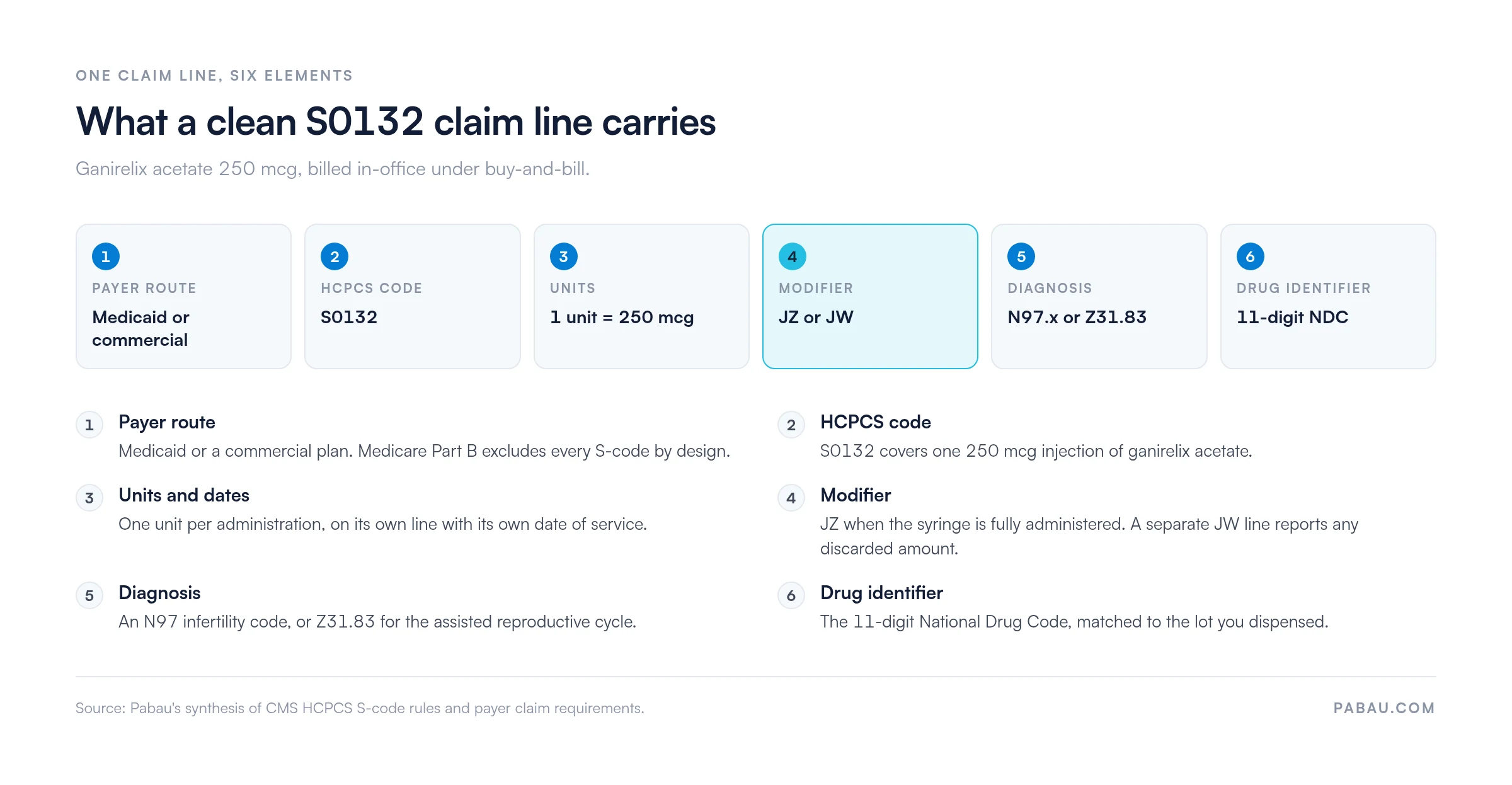
A pre-submission checklist catches these five before they cost you a resubmission cycle. Track which error your practice hits most often, then fix the step that produces it rather than the individual claims.
Build a payer-specific routing rule in your billing system that flags any S0132 claim where the payer ID matches a Medicare contractor before submission. A front-end edit that blocks Medicare submission for S-codes eliminates the most common HCPCS code S0132 denial before it reaches the clearinghouse.
Most fertility practices track S0132 in two places at once. The stimulation cycle lives in the clinical record, and the claim lives in a billing spreadsheet or a clearinghouse portal. Every handoff between them is a chance to lose the modifier, the diagnosis code, or the NDC.
Pabau keeps them in one record. The S0132 line, its JZ or JW modifier, the supporting ICD-10 code, and the NDC all sit on the patient’s cycle record. Our faster claims management tools submit from there. Nobody retypes a code between two systems.
That pays off at the point of denial. When a payer rejects an S0132 line, your team can see the administration note, the modifier, and the diagnosis that went out with it. A correction takes minutes instead of a hunt through records, and it lands inside the filing window.

Pabau connects HCPCS code documentation, ICD-10 linkage, and modifier tracking to the patient record. Your billing team works from one screen instead of two, so nothing gets retyped between systems.

S0132 is not a complicated code. It carries four narrow rules, and a claim that respects all four gets paid.
Settle the payer route before the syringe leaves the fridge. If the patient’s primary coverage is Medicare Part B, buy-and-bill is the wrong channel and no modifier will rescue it. If Medicaid or a commercial plan covers the cycle, put the modifier, the diagnosis code, and the NDC on the line the first time.
Practices that stop losing money on fertility drug claims are the ones checking those elements before submission rather than after a denial. Book a demo to see how Pabau keeps S0132 documentation and claim data on the same patient record.

Managing IVF procedure billing alongside drug codes? IVF procedure billing codes covers the CPT codes that pair with HCPCS S-series drug codes in a full ART cycle claim.
Seeing the same S0132 rejection twice? Denial management in healthcare sets out how to work denials by root cause instead of claim by claim.
Want to reduce medical billing errors across your practice? Medical billing fundamentals walks through the full claim lifecycle, from charge capture through ERA reconciliation.
HCPCS code S0132 bills a 250 mcg subcutaneous injection of ganirelix acetate. The drug is a GnRH antagonist given during controlled ovarian hyperstimulation in IVF and other assisted reproductive technology protocols. The code is used by Medicaid and commercial payers, not Medicare Part B.
No. Medicare Part B does not cover S0132 or any S-series HCPCS code. S-codes are classified as Temporary National Codes (Non-Medicare) and are excluded from the Medicare fee schedule. Submitting S0132 to Medicare Part B results in an automatic denial.
The JW and JZ modifiers apply to HCPCS code S0132 under drug waste reporting rules. Use JZ when the full 250 mcg prefilled syringe is administered with no waste. Use a separate JW line when part of the dose is discarded. One of the two belongs on every buy-and-bill S0132 claim, and omitting both is a coding error.
The codes paired most often are N97.0 (female infertility associated with anovulation), N97.1 (tubal origin), and N97.2 (uterine origin). Z31.83 covers an encounter for assisted reproductive fertility procedure cycle. The diagnosis code must reflect the documented reason for ART and be supported by the clinical record.
Medicaid coverage for S0132 varies by state. Some state Medicaid programs cover fertility drug injections, and many exclude ART medications entirely. Verify coverage with each patient’s own state Medicaid program, and confirm whether prior authorization is required before administering ganirelix acetate.
Under buy-and-bill, the practice purchases ganirelix acetate, administers it in-office, and bills S0132 to the payer. The claim carries the HCPCS code, a JW or JZ modifier, a supporting ICD-10 diagnosis code, and usually the drug’s 11-digit National Drug Code. Reimbursement follows the payer’s contracted rate or the state Medicaid fee schedule.
No CMS Medicare fee schedule rate exists for S0132, because Medicare does not cover S-codes. Medicaid rates are set by each state program, typically on WAC or MAC-based pricing. Commercial rates are contract-negotiated, often at AWP minus a discount. Contact your state Medicaid agency or your payer for current contracted rates.