CPT code 21011: Excision of soft tissue tumor of the face
CPT code 21011: Official descriptor and procedure overview CPT code 21011, as pu...

Last Updated: Oct 8, 2026
S0109 is the HCPCS Level II code for methadone, oral, 5 mg.
Coverage splits by payer. Medicaid and many private payers reimburse S0109 directly, at a per-unit rate. Medicare pays differently. Since January 1, 2020 it has paid OTPs through weekly bundled G-codes, and methadone dispensing sits inside that bundle.
Let Pabau's smart automation suggest the right codes, reduce claim denials, and keep your practice compliant—effortlessly.
Automate repetitive tasks and focus on what matters most—your patients.
Reduce coding errors and ensure compliance with the latest regulations.
Clean claims, fewer denials, and faster reimbursements.
Powerful insights and reporting to help your practice thrive.
HIPAA compliant SOC 2 certified GDPR-compliant Trusted by 4,000+ clinics worldwide

HCPCS Code S0109 describes methadone, oral, 5 mg, a temporary national S-code used by Medicaid and private payers.
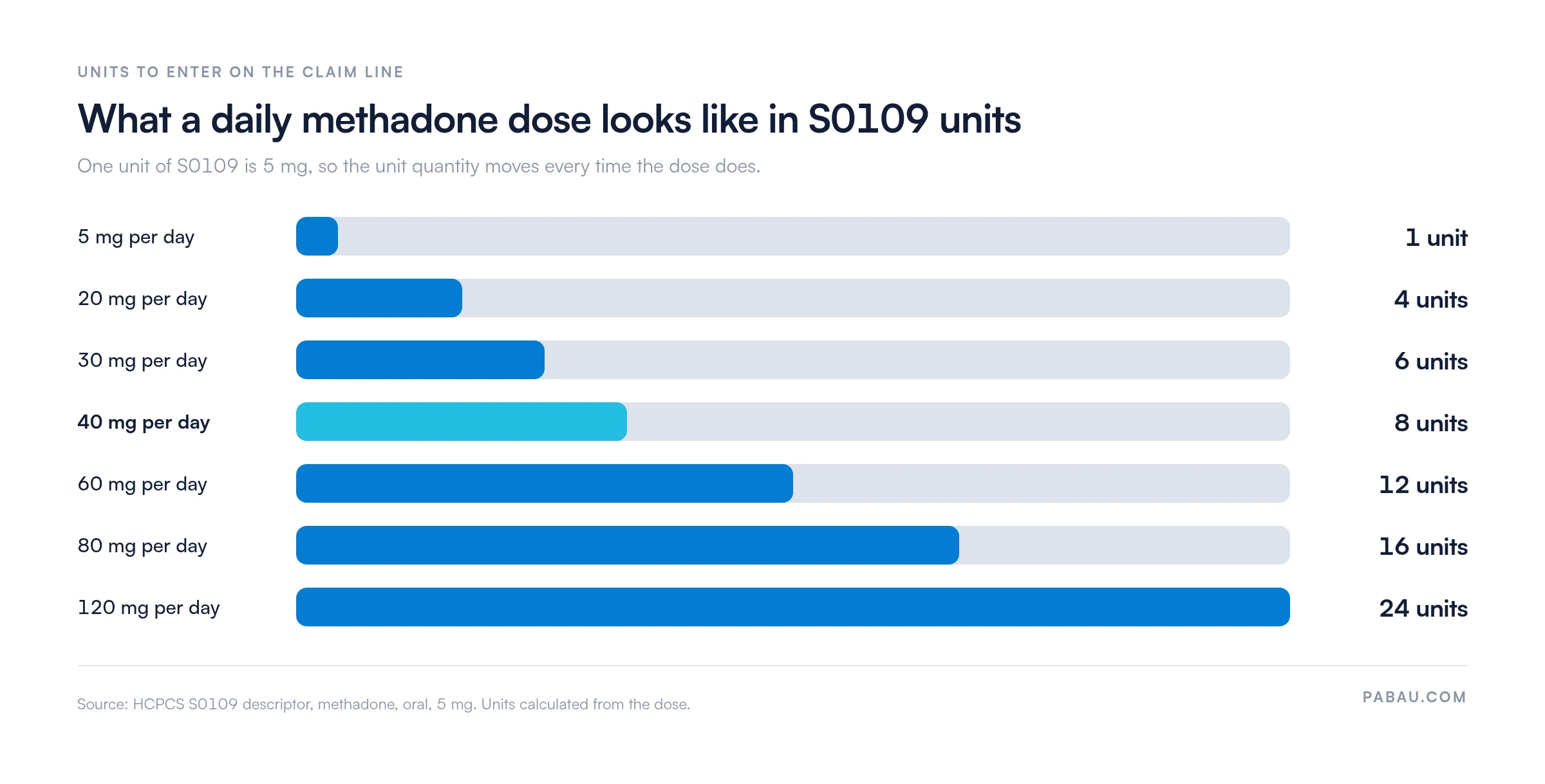
One unit is one 5 mg dose dispensed, so a 30 mg daily dose is billed as 6 units.
Medicare bundles methadone into weekly OTP codes such as G2067, so S0109 is never billed to Medicare on its own.
ICD-10 codes F11.20 and F11.21 are the diagnoses most often paired with S0109 on OTP claims.
Practice management software like Pabau supports HCPCS drug code entry and unit-based billing for OTP providers.
HCPCS Code S0109 is a temporary national Level II code for methadone, oral, 5 mg. The Centers for Medicare and Medicaid Services (CMS) maintains it in the S-code series. S-codes are non-Medicare codes created mainly for Medicaid programs and private payers, so they carry no Medicare Physician Fee Schedule rate.
The full official descriptor is “Methadone, oral, 5 mg.” The code type is Drug, filed under S Codes (Temporary National Codes, Non-Medicare).
It has been active since the early 2000s and stays billable in the 2026 HCPCS code set, with no published termination date. S0109 sits alongside the J-codes and G-codes an OTP billing team meets on the same claims, which our HCPCS code directory lists in full.
S0109 applies when a SAMHSA-certified opioid treatment program dispenses oral methadone to a patient in medication-assisted treatment (MAT) for opioid use disorder (OUD). Methadone for OUD is a Schedule II controlled substance under DEA regulations.
Only SAMHSA-certified OTPs may dispense it for that indication, and prescribers must hold the matching DEA registration. No software changes that certification requirement.
Patients visit the OTP to take their dose under observation, or collect take-home doses once they are stable. The billing team then codes each dispensed unit. S0109 does not cover methadone prescribed for pain management, which follows a different coding path.
Medicare does not reimburse S0109 as a standalone per-unit drug code. The CMS Medicare OTP benefit, effective January 1, 2020, pays OTPs through a bundled episode-of-care model. Methadone dispensing, counseling, toxicology and related services all sit inside a weekly bundled rate, billed with OTP G-codes.
A standalone S0109 line sent to Medicare Part B will usually be denied. OTPs that accept Medicare bill through the G-code framework instead. Flagging any Medicare-bound S0109 claim before it goes out is the cheapest place to catch that error.
G2067 is the Medicare OTP weekly bundle for methadone treatment. It covers the full week of services, including drug dispensing, individual and group counseling, toxicology and intake. The codes around it cover the other MAT drugs, the buprenorphine implant procedures, and weeks where no drug is dispensed at all.
Medicaid generally covers S0109 for SAMHSA-certified OTPs enrolled in the state program, but the policy varies by state. Some states reimburse per unit at a published fee schedule rate. Others fold methadone dispensing into a daily or weekly OTP rate, much like Medicare. A few require prior authorization for MAT drug codes.
Verify coverage and the reimbursement method with the state Medicaid agency before billing. Coverage churn is common in OTP populations, so check eligibility at enrollment and again at every renewal period.
S0109 is a non-Medicare S-code, so no Medicare Physician Fee Schedule (MPFS) rate exists for it. Rates come from individual state Medicaid fee schedules and private payer contracts. The table below sets out how each payer type treats the code. Confirm current rates with the payer before you rely on any published figure.
Use the CMS Physician Fee Schedule lookup tool to check the related OTP G-codes, G2067 through G2075. S0109 itself returns no Medicare fee schedule entry, because it is a non-Medicare S-code.
Pull your state Medicaid agency’s HCPCS drug fee schedule directly rather than trusting a third-party database. Neighboring states set their own OTP rates, so the figure next door tells you nothing about yours. Download the file each quarter and keep it with your billing policy documentation.
Getting an S0109 claim right starts with the unit. One unit is one 5 mg dose of oral methadone dispensed, so the quantity on the claim line moves whenever the prescribed dose does. A patient on 40 mg a day is billed at 8 units for that day. The chart below converts the doses an OTP dispenses most often.
Audit trails matter more here than on most drug codes, because methadone is a DEA Schedule II substance. Records showing who dispensed, what dose, and on which date have to be retained for both DEA and payer requirements. Capture the dose, the units billed, and the dispensing staff member in one place, and the billing record and the dispensing record stop drifting apart.
Before submitting, confirm the patient’s coverage is active and the OTP is enrolled with the payer. A clean claim submission, with accurate NPI, units, diagnosis codes and place of service, is what keeps first-pass denial rates down.
Build a monthly S0109 audit into your billing calendar. Pull every claim billed in the prior month and compare the units submitted against the dispensing records. Then reconcile the paid amounts to your state Medicaid fee schedule. Catching a systematic unit error early prevents months of incorrect billing, and the payer audit that tends to follow it.
Every S0109 claim needs a valid ICD-10-CM diagnosis code reflecting the patient’s opioid use disorder. The licensed clinician makes the diagnosis, and billing staff apply the code the documentation supports. The codes below are the ones most often paired with S0109 on OTP claims, drawn from ICD-10-CM chapter F11.
Use the most specific code the documentation supports, covering both severity and current clinical status. Payers audit OTP claims and ask for the supporting notes, so the severity on the claim has to match what the clinician wrote.
An OTP billing team repeats the same three steps for every dispensed dose. Someone enters the unit quantity, submits the claim, and reconciles what the payer pays back. Practice management software like Pabau carries all three, with claims software for OTPs built into the same record as the clinical note.
Pabau supports HCPCS Level II drug code entry and unit-based billing, so an OTP can bill methadone units without recalculating them by hand. Billing staff configure the service record once with the unit logic. The system then applies it across every claim line, which removes the quantity errors behind most S0109 denials.
On the reporting side, Pabau tracks HCPCS code utilization, units billed, and payer reimbursement over time. That gives an OTP billing manager the evidence to spot a payer shortfall and confirm the per-unit rate. It also answers a compliance audit without rebuilding the year from paper.

Pabau supports HCPCS drug code entry, unit-based billing, and payer-specific claim rules. Your OTP billing team spends less time correcting unit quantities and more time on patient care.

Two habits protect an OTP’s revenue on this code. Bill the units that match the dispensing record for that day, and pair every claim with the F11 code the clinician documented. Practices that get both right rarely see an S0109 denial worth appealing.
The harder judgment is the payer split. Send S0109 to Medicaid and to commercial payers, and send the Medicare patient’s week to G2067 instead. Build that rule into the claim setup rather than the billing team’s memory. When it slips, it costs a full week of bundled payment.
Book a demo to see how Pabau handles drug code entry, unit-based billing, and payer rules for OTP and MAT providers.

Need guidance on building a compliant OTP billing process? Medical billing compliance covers the documentation, audit and payer-policy standards that matter most for substance use treatment providers.
Unclear on how HCPCS drug codes move through the claims lifecycle? Medical billing fundamentals explains how drug codes, units and diagnosis codes combine into a paid claim.
Want to reduce first-pass denial rates on S0109 claims? Clean claim submission breaks down the elements that decide whether a claim pays the first time.
Already sitting on a stack of denied OTP claims? Denial management in healthcare sets out how to work a denial queue and stop the same rejection repeating.
SAMHSA-certified opioid treatment programs (OTPs) use HCPCS Code S0109 to bill for oral methadone dispensed in 5 mg units. The patients are those receiving medication-assisted treatment for opioid use disorder. It is a temporary national S-code accepted by Medicaid and many private payers, and it is not billed as a standalone code to Medicare.
No, S0109 is not reimbursed as a standalone code under Medicare. Since January 1, 2020, Medicare pays OTPs through a bundled episode-of-care model using weekly G-codes such as G2067, which includes methadone dispensing. Billing S0109 separately to Medicare Part B results in a denial.
There is no fixed daily unit cap for S0109. Units billed must equal the milligrams of methadone dispensed, divided by 5. A 40 mg daily dose is billed at 8 units. Payer policies and SAMHSA clinical guidelines govern the maximum dispensed dose, and billing must always match the dispensing record.
S0109 is a per-unit drug code for 5 mg of oral methadone, used by Medicaid and private payers. G2067 is a weekly bundled Medicare OTP payment code covering methadone dispensing, counseling, toxicology and other services for the full week. Medicare-enrolled OTPs bill G2067. Medicaid OTPs typically bill S0109 per dose dispensed.
Yes, most state Medicaid programs cover S0109 for enrolled OTP providers, but the reimbursement method varies by state. Some pay per unit at a published fee schedule rate. Others bundle methadone into a daily or weekly OTP rate. Always verify coverage with your state Medicaid agency, and with any managed care organization involved in the patient’s coverage.
The most commonly paired ICD-10-CM codes are F11.20 (opioid use disorder, moderate or severe, uncomplicated) and F11.21 (opioid use disorder, moderate or severe, in remission). F11.10 and F11.11 apply to mild OUD. The correct code depends on severity level and clinical status as documented by the treating clinician.