CPT code 48152: Whipple procedure without pancreatojejunostomy
CPT code 48152: Official description and procedure overview CPT code 48152 descr...

Last Updated: Nov 13, 2026
S0091 is the HCPCS Level II code for granisetron hydrochloride, 1 mg. It is a temporary national S code that private payers and some state Medicaid programs use to report this antiemetic, at one unit per milligram.
Medicare does not pay S codes. For a Medicare patient, the code's own descriptor points to Q0166 for oral granisetron given with chemotherapy, and an injected dose goes on J1626.
Let Pabau's smart automation suggest the right codes, reduce claim denials, and keep your practice compliant—effortlessly.
Automate repetitive tasks and focus on what matters most—your patients.
Reduce coding errors and ensure compliance with the latest regulations.
Clean claims, fewer denials, and faster reimbursements.
Powerful insights and reporting to help your practice thrive.
HIPAA compliant SOC 2 certified GDPR-compliant Trusted by 4,000+ clinics worldwide

HCPCS Code S0091 reports granisetron hydrochloride, 1 mg, an antiemetic drug. One unit equals 1 mg.
S0091 is a temporary national S code for private payers and some Medicaid programs. Medicare does not pay it.
For Medicare, bill Q0166 for oral granisetron given with chemotherapy, or J1626 for the injection, billed per 100 mcg.
Pabau, the practice software we build, sends US claims through Claim.MD and posts the remittance against the patient record.
HCPCS Code S0091 is the HCPCS Level II code for granisetron hydrochloride, 1 mg. Granisetron is an antiemetic that prevents the nausea and vomiting caused by chemotherapy and radiation. One unit of S0091 equals 1 mg, so a 2 mg dose is billed as two units.
The full official descriptor reads: “Granisetron hydrochloride, 1 mg (for circumstances falling under the Medicare statute, use Q0166).” The note in brackets is part of the code. It tells you that S0091 is the non-Medicare version, and that Medicare claims take a different code.
S0091 belongs to the S code range of temporary national codes. CMS publishes these codes in its HCPCS files, but it does not create them. The Blue Cross Blue Shield Association and AHIP (formerly the Health Insurance Association of America) request them for private-sector use.
Private insurers use S codes for drugs, supplies and services that no permanent national code describes the way they need. State Medicaid programs may use them too. The range covers oral drugs as well, such as tacrine hydrochloride, 10 mg, under S0014.
Medicare does not pay them, and the CMS file gives S0091 coverage code “I”, which means not payable by Medicare. Oral dolasetron follows the same split, with S0174 for private payers and Q0180 for Medicare.
The table below summarizes the reference data for HCPCS Code S0091 in the October 2026 CMS HCPCS Level II file.
Granisetron blocks serotonin 5-HT3 receptors, which trigger the vomiting reflex after chemotherapy or radiation. The FDA label for granisetron hydrochloride 1 mg tablets covers two uses. The first is preventing nausea and vomiting from initial and repeat courses of emetogenic cancer therapy, including high-dose cisplatin.
The second is nausea and vomiting from radiation, including total body irradiation and fractionated abdominal radiation. The usual adult oral dose for either use is 2 mg a day. That is two 1 mg tablets once daily, or 1 mg twice daily for chemotherapy.
That dosing is why units matter on an S0091 line. A 2 mg dose is two units, and a 1 mg twice-daily regimen over a day is also two units. Granisetron also comes as an injection, an extended-release injection and a skin patch, and each of those has its own coding rules.
The right granisetron code depends on two things: who pays the claim, and how the drug was given. S0091 is the code for non-Medicare payers that accept it. Q0166 and J1626 are the Medicare codes.
Q0166 is narrower than it looks. Its descriptor limits it to an oral antiemetic used as a complete therapeutic substitute for an IV antiemetic at the time of chemotherapy.
It is capped at a 24-hour dosage regimen. A prescription for oral granisetron filled for use at home is usually a Part D pharmacy claim instead.
J1626 counts in 100 mcg units, so a 1 mg IV dose is 10 units of J1626 but one unit of S0091. Mixing the two unit sizes is the fastest way to underbill or overbill granisetron. Extended-release granisetron injection has its own code, J1627, billed per 0.1 mg.
The chart below runs those rules in the order a biller meets them: payer first, then route.
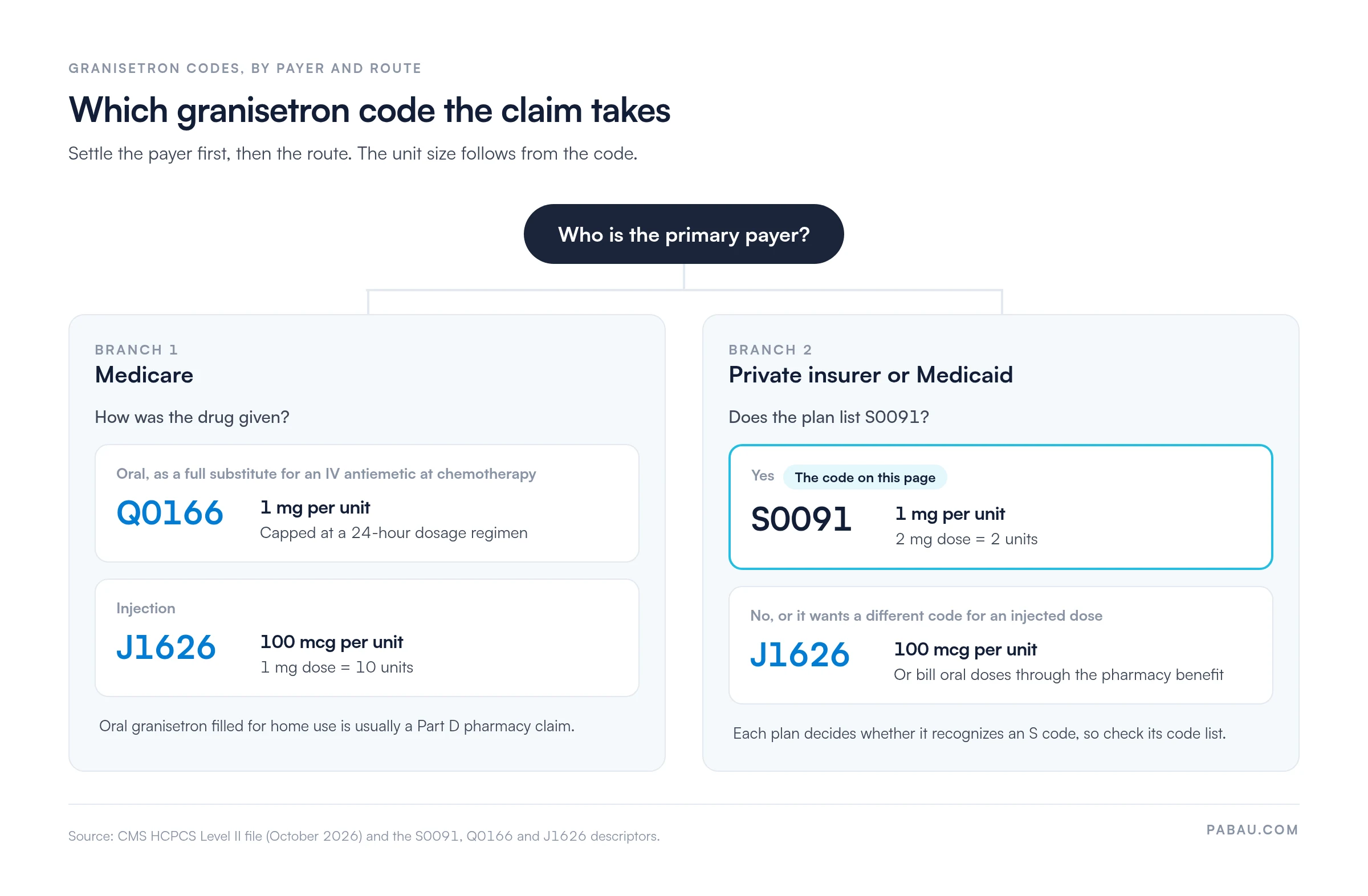
Check the patient’s primary payer before you choose the granisetron code. Medicare primary means Q0166 or J1626, never S0091. For a private or Medicaid plan, check whether it lists S0091 or expects J1626 for an injected dose.
Private insurers and some state Medicaid programs accept HCPCS Code S0091, and Medicare never does. Each payer decides for itself whether to recognize an S code, so acceptance varies plan by plan.
Knowing how medical billing works across payer types explains why one code can be valid on one claim and rejected on the next.
Report units of S0091 as total milligrams given, because one unit equals 1 mg. A clean drug line needs five details to agree with each other.
An S0091 line with one unit for a 2 mg dose underpays by half. A line with 20 units, copied from a J1626 habit, will be denied or flagged for review.
Pair S0091 with a diagnosis that shows why the antiemetic was needed and what treatment it supported. When the nausea is an adverse effect of chemotherapy, ICD-10-CM guidelines put the nature of the effect first. The drug that caused it comes second.
Add the code for the cancer being treated as well, since most payer policies tie antiemetic coverage to an active cancer treatment. Each payer’s drug policy sets the diagnoses it accepts, so check it before you rely on a pairing.
The medical record has to support the drug, the dose and the reason for it. Good medical billing compliance for an S0091 claim means the chart shows each of these.
Most S0091 denials come from billing the wrong payer, the wrong unit count or an unsupported diagnosis. Strong denial management treats each one as a check before submission.
The CARC tells you which rule the payer applied, and the remark code that comes with it narrows the reason further. Our guide to denial codes in medical billing explains how to read both before you correct or appeal the claim.
An antiemetic claim touches three records: the chemotherapy schedule, the drug administration note and the claim itself. When they live in separate systems, billing staff re-type the dose and the NDC by hand. That is where unit errors and wrong-payer codes come from.
Pabau keeps the patient record, the clinical notes and the claim in one place. The dose on the administration note is the dose that reaches the claim.
Its claims management software sends US claims through the Claim.MD clearinghouse. It also runs eligibility checks, so the team knows the primary payer before choosing between S0091, Q0166 and J1626.
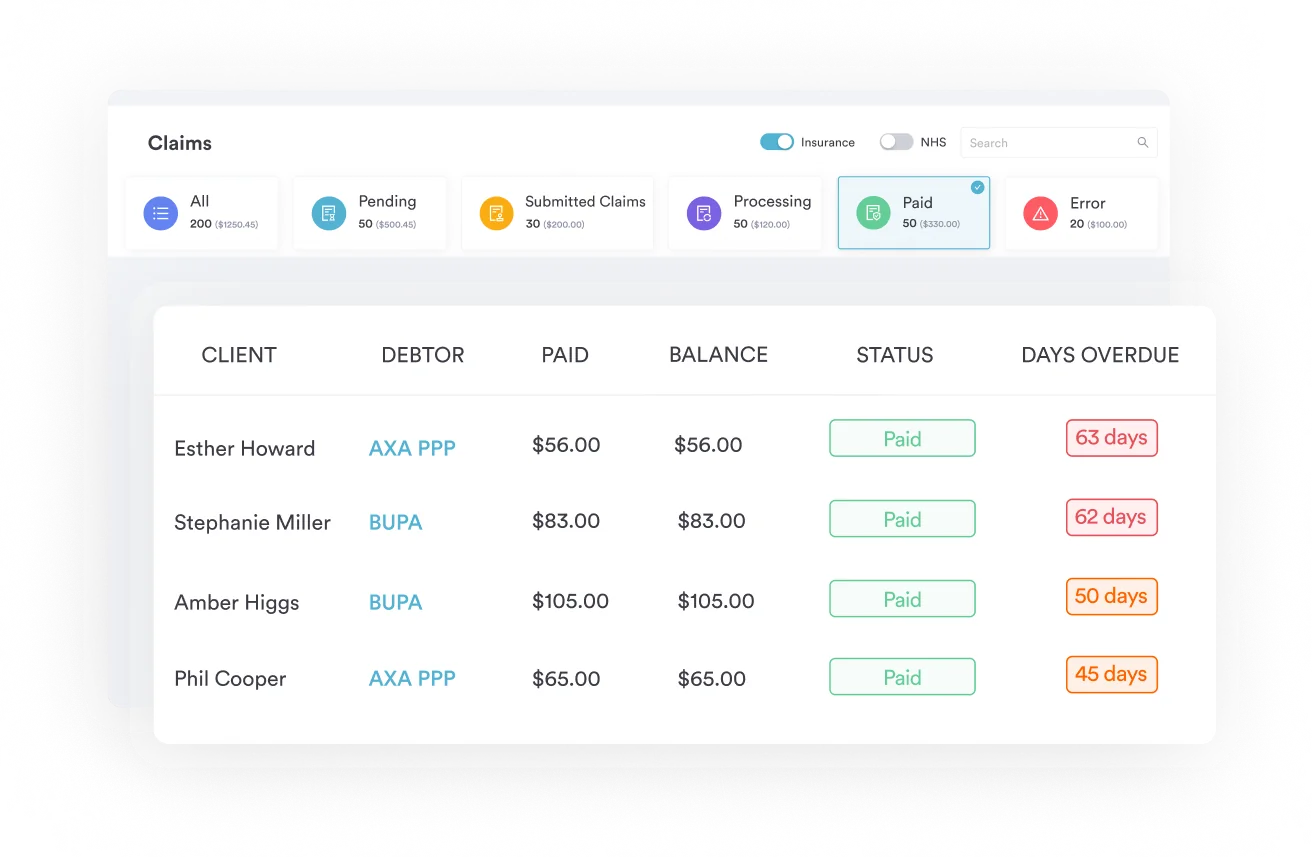
Electronic remittances post back against the same patient record. A practice can see which payers paid S0091 and which wanted J1626, then submit clean claims from the first attempt next time.

Pabau checks eligibility, sends claims through Claim.MD and posts remittances against the patient record. See how it handles drug billing for oncology support care.

S0091 is a simple code with one trap built into its own descriptor. It bills granisetron at 1 mg per unit, and only for payers outside Medicare. The bracketed note sends Medicare claims to Q0166, and an injected dose usually belongs on J1626 at 100 mcg per unit.
Get the payer right first, and the code and unit count follow from it. Book a demo to see how Pabau keeps eligibility, drug records and claims in one workflow.

Billing another antiemetic drug code? HCPCS Code J8650 covers oral nabilone and what to bill since its 2026 deletion.
Need a broader view of how HCPCS fits into your revenue cycle? What is revenue cycle management explains the process from encounter to payment.
HCPCS Code S0091 is the code for granisetron hydrochloride, 1 mg, an antiemetic that prevents nausea and vomiting from chemotherapy and radiation. It is a temporary national S code for private payers and some Medicaid programs. One unit equals 1 mg.
No. S codes are not payable by Medicare, and the CMS HCPCS file marks S0091 with coverage code “I” to say so. For a Medicare patient, bill Q0166 for oral granisetron given with chemotherapy, or J1626 for the injection.
Both describe granisetron hydrochloride, 1 mg. S0091 is for non-Medicare payers and names no route. Q0166 is the Medicare code for oral granisetron used as a complete substitute for an IV antiemetic at chemotherapy, limited to a 24-hour regimen.
Bill one unit per milligram given. A 2 mg dose of granisetron is two units of S0091. Injected granisetron on J1626 counts in 100 mcg units instead, so the same 1 mg dose is 10 units of J1626.
Yes. S0091 appears in the October 2026 CMS HCPCS Level II file with no termination date. Its action effective date is July 2001, and it was added to HCPCS in January 2002.
R11.2, nausea with vomiting, unspecified, is the most common primary diagnosis. When chemotherapy caused the nausea, add T45.1X5A after it, plus Z51.11 for the chemotherapy encounter and the cancer diagnosis. Check each payer’s drug policy for the codes it accepts.