

CCSD code G5100: Bypass of duodenum billing guide
CCSD code G5100 bills a bypass that leaves the duodenum in place CCSD code G5100...

Last Updated: Oct 16, 2026
J8650 is the HCPCS Level II code for nabilone, oral, 1 mg. CMS terminated it with effect from 31 December 2025, so it is no longer valid for claims after that date.
Claims carrying J8650 after that date deny on submission. Bill the code named in the CMS January 2026 crosswalk file instead. Settle whether the charge belongs under Part D or Part B before you resubmit.
Let Pabau's smart automation suggest the right codes, reduce claim denials, and keep your practice compliant—effortlessly.
Automate repetitive tasks and focus on what matters most—your patients.
Reduce coding errors and ensure compliance with the latest regulations.
Clean claims, fewer denials, and faster reimbursements.
Powerful insights and reporting to help your practice thrive.
HIPAA compliant SOC 2 certified GDPR-compliant Trusted by 4,000+ clinics worldwide

HCPCS Code J8650 described nabilone, oral, 1 mg (Cesamet), a Schedule II synthetic cannabinoid approved for chemotherapy-induced nausea and vomiting.
J8650 was deleted from HCPCS Level II effective January 2026, and claims submitted with it after that date deny automatically.
Billing teams should confirm the replacement code against the CMS HCPCS annual update crosswalk file and correct every charge master entry.
Practice management software like Pabau supports HCPCS code updates, clean claim submission, and denial tracking for oral oncology billing.
HCPCS Code J8650 is the HCPCS Level II billing code for nabilone, oral, 1 mg. It sits in the J8500-J8999 range that CMS maintains for oral anticancer and antiemetic drugs. One unit equaled 1 mg, so billing teams reported units equal to the total milligrams dispensed or administered in the billing period.
The J8xxx range follows Medicare billing rules that differ from the injectable J-codes in the J0100-J8499 range. That distinction matters once you start looking for the code or the NOC entry that carries nabilone after the January 2026 deletion.
CMS maintains HCPCS Level II, which covers drugs, supplies, and services that CPT does not. CPT codes are Level I and belong to the AMA. For oral anticancer and antiemetic agents, the J8xxx codes are the billing vehicle whenever Medicare Part B applies.
Not every oral chemotherapy drug sits in the J8xxx range. Chlorambucil taken by mouth bills under S0172, a temporary S-series code built for Medicaid and private payers rather than Medicare.
The table below summarizes the reference data for HCPCS Code J8650 as it stood in the CMS HCPCS Level II annual update files.
Nabilone is a synthetic cannabinoid that mimics the action of delta-9-tetrahydrocannabinol (THC) without being derived from the cannabis plant. The FDA approved it as Cesamet for chemotherapy-induced nausea and vomiting (CINV) in patients who did not respond to conventional antiemetics. That narrow indication shapes how you link diagnosis codes on the claim.
Nabilone is also a Schedule II controlled substance under the Controlled Substances Act. Prescribing and dispensing records have to stand up to a clinical audit and a billing audit alike. The schedule drives payer behavior too, since many commercial plans want clinical justification before they approve a Schedule II antiemetic.
Assembling that justification before the claim goes out is cheaper than appealing afterward. It heads off the denials that arrive on medical necessity or compliance grounds.
No, J8650 is not a valid billable HCPCS code as of January 2026. CMS deleted it in the January 2026 annual update. Medicare Administrative Contractors (MACs) including Noridian and CGS confirmed it in their 2026 HCPCS bulletins. Any claim submitted with J8650 after the effective date is rejected by Medicare and by commercial payers whose edits follow the CMS HCPCS master file.
HCPCS deletions happen for a few reasons. The drug may have been assigned a newer and more specific code, the product may have been discontinued, or CMS may have restructured the range. For J8650, the CMS HCPCS annual update crosswalk file carries the deletion rationale and the authoritative replacement designation.
MAC bulletins are the practical first stop. Noridian, CGS, and the other regional contractors summarize deleted codes and their crosswalks in plain language, usually ahead of the effective date.
Audit your charge master and any standing order sets quarterly for HCPCS J8xxx codes. CMS HCPCS updates go live each January 1 and can include deletions with little advance notice to individual practices. Catching a deleted code before a claim is submitted saves the write-off cost and rework time of a denial cycle.
No named replacement code for nabilone is confirmed in the CMS January 2026 materials published so far. Until one is, work from the crosswalk file rather than from a code someone posted in a forum. Five steps settle it.
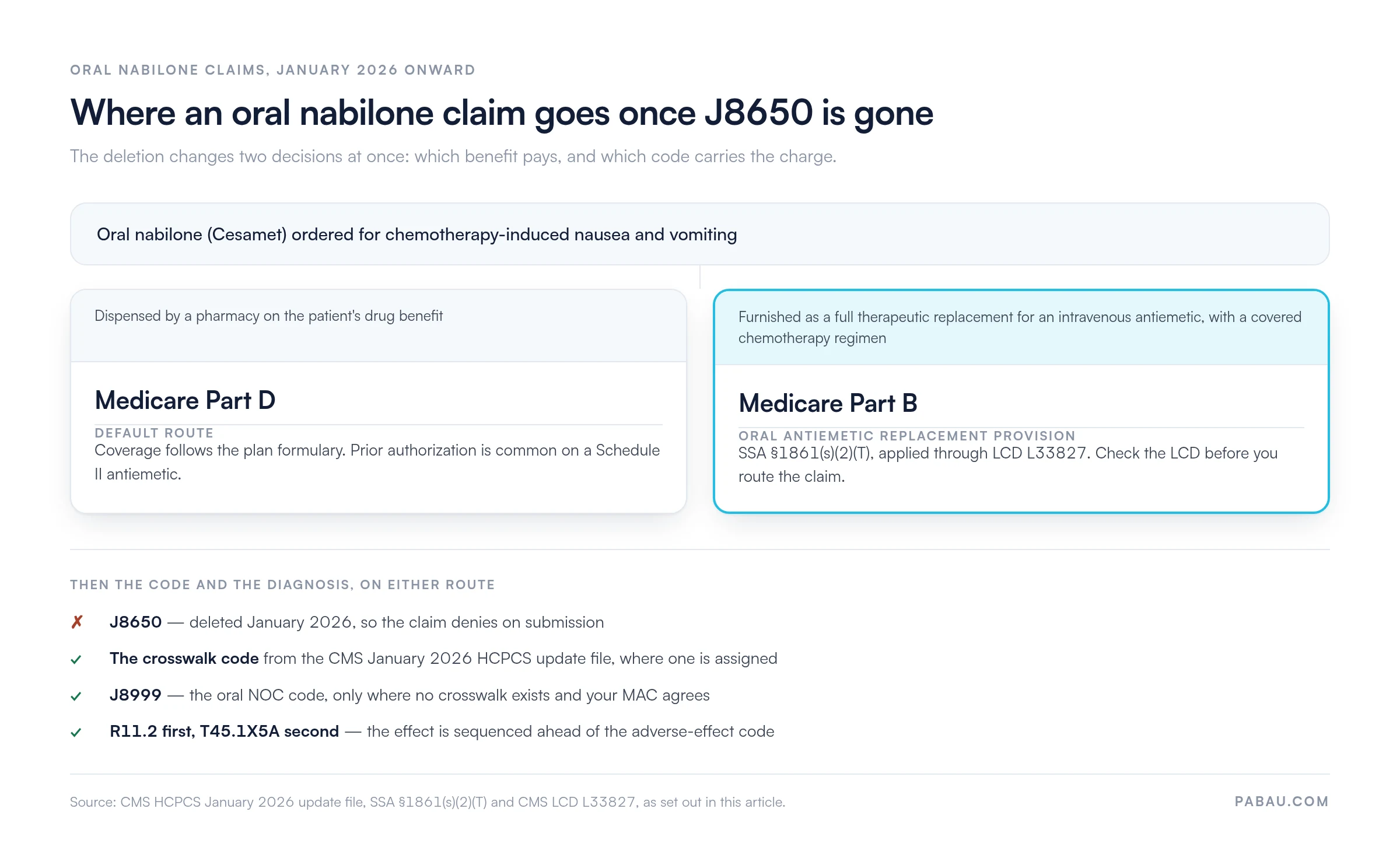
Medicare coverage for nabilone splits between Part D and Part B, and the split decides where the claim is routed. Most oral prescription drugs, nabilone included, sit under Part D, the pharmacy benefit.
Part B can apply through the oral antiemetic drug replacement provision at SSA section 1861(s)(2)(T). That provision governs oral antiemetics rather than oral anticancer agents, which is the distinction that trips practices up. CMS applies it through LCD L33827. The LCD sets out when an oral antiemetic used in place of an intravenous one is covered alongside a chemotherapy regimen.
Whether a given nabilone order qualifies depends on that LCD and on the patient’s regimen. Do not route a nabilone claim to Part B without reading it first.
For practices that billed nabilone under Part B with J8650, the deletion raises two questions at once. Which code replaces it, and does the replacement carry the same coverage pathway?
Fee schedule amounts change every year, so quote the current allowable rather than a figure from a previous cycle. The CMS Physician Fee Schedule lookup tool returns the rate for the applicable code, adjusted for your locality.
Billing an oral antiemetic under HCPCS Level II starts with matching the code to the drug and its dosage unit. The next step is linking the diagnosis codes that establish medical necessity. The J8500-J8999 range exists for that job and sits apart from the injectable J-codes. The diagram below shows the two decisions a nabilone charge has to clear before it reaches a payer.
The checklist below applies to nabilone’s replacement code and to the other agents in the same range.
Charge entry is where most of this is won or lost. A clean claim checklist covers the fields that have to be complete before submission. Oral drug charges usually fail on units, on diagnosis sequence, or on a missing authorization number.
Commercial and Medicaid coverage for nabilone varies more than Medicare does, so treat each payer as its own policy review. A few patterns hold across most plans.
Verifying the patient’s drug benefit before the visit costs less than working the denial afterward. For an oncology-adjacent drug, check the specific drug tier rather than stopping at active or inactive coverage.
Five errors account for most denials on an oral antiemetic charge, and each one has a specific fix at charge entry.
A structured denial workflow recovers deleted-code denials faster, because the reason code, the corrected code, and the resubmission all sit in one queue. Without one, these claims age past the timely filing window and turn into write-offs.
Grouping denials by reason code from the remittance advice is what turns a payer file into a work list. It also makes a pattern obvious, such as a whole cohort of J8650 claims denying after January 2026. Knowing the denial codes to watch shortens the time between the rejection and the corrected claim.
Practices billing oral chemotherapy and antiemetic drugs carry an annual risk. The J8xxx codes change each January, and a single missed deletion can produce a month of denied claims before anyone notices the pattern.
Pabau’s accurate claims management software structures charge entry, holds claims for review before they go out, and tracks denials by reason code. Billing staff see the HCPCS code, the unit count, and the linked diagnoses on one screen while the claim is still editable.
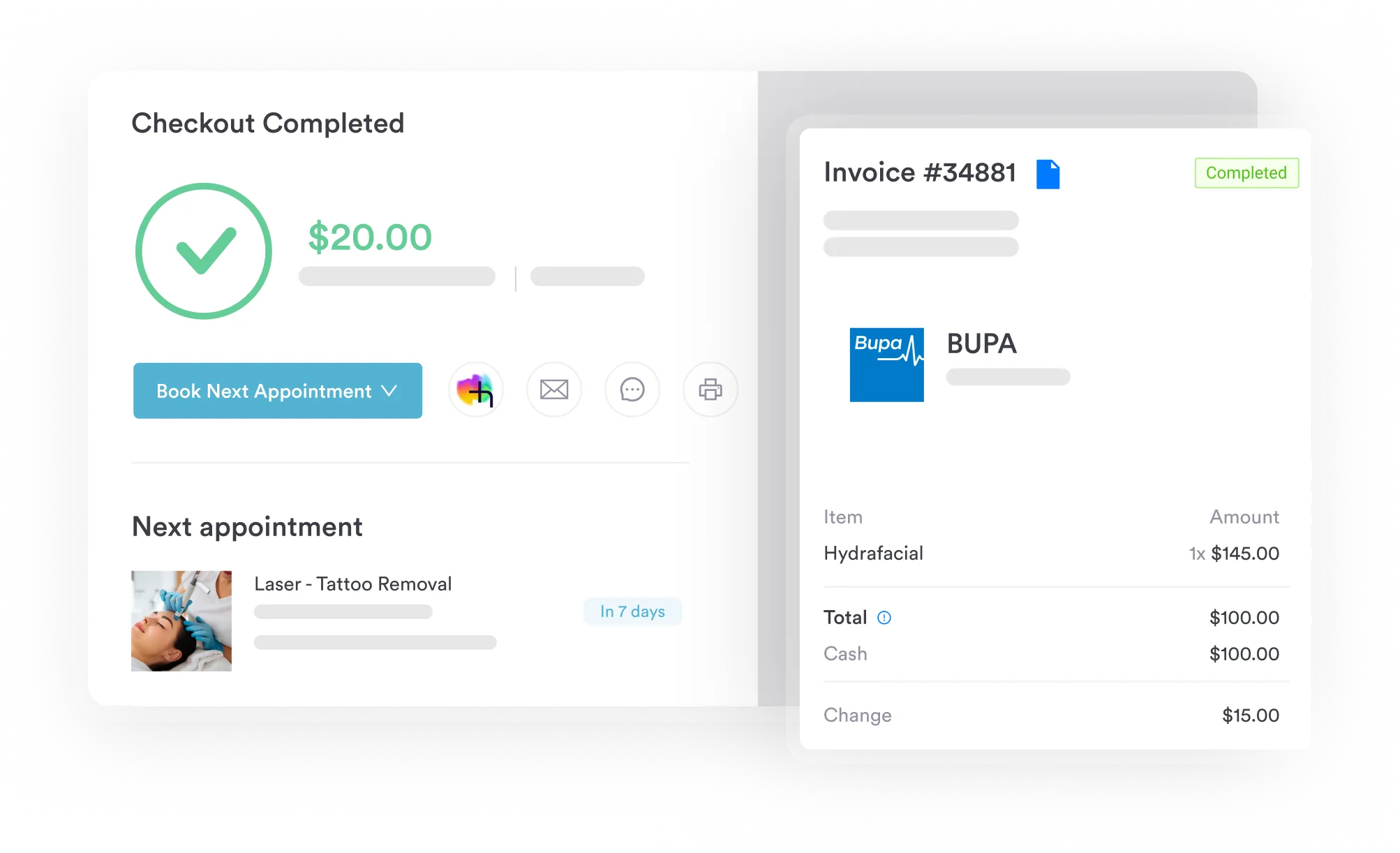
Authorization paperwork can sit on the patient’s record rather than in a separate folder, so the number is on hand when the claim is built. Denials that do land are grouped by reason code, which makes a wave of post-update rejections visible within days instead of at month end.

Pabau structures charge entry and reviews claims before they go out. It also tracks denials by reason code, so an annual HCPCS update does not cost you a month of rework. See how it works for oral drug billing.

J8650 is gone, and the cost of ignoring that shows up as denied claims rather than as a coding technicality. Pull the CMS January 2026 crosswalk, correct the charge master, then work the open receivable for J8650 claims still inside the filing window.
The judgment worth keeping is that a deleted drug code is rarely only a code change. Nabilone’s deletion reopens the Part B question as well, and the answer sits in LCD L33827 rather than in your charge master. Book a demo to see how Pabau keeps an annual HCPCS update from turning into a month of denials.

Need guidance on billing compliance for specialty drugs? Medical billing compliance covers the regulatory framework practices follow when billing controlled substances.
Want to reduce your first-pass denial rate on drug claims? Denial management in healthcare walks through a workflow for identifying, appealing, and preventing HCPCS denials.
Looking for a primer on how revenue cycle workflows connect to HCPCS billing? Revenue cycle management explained covers the process from charge capture through payment posting.
HCPCS Code J8650 was the HCPCS Level II code for nabilone, oral, 1 mg. Nabilone is a synthetic cannabinoid antiemetic used for chemotherapy-induced nausea and vomiting (CINV). The code sat in the J8500-J8999 range for oral anticancer and antiemetic drugs, and it was deleted from the active code set effective January 2026.
No. J8650 was deleted effective January 2026. Claims submitted with it after that date are denied by Medicare and by commercial payers that follow the CMS HCPCS master file. Identify the replacement code and correct the charge master before the next batch goes out.
CMS has not published a confirmed replacement code for nabilone. Download the CMS January 2026 HCPCS crosswalk file and check your MAC’s 2026 update bulletin for the authoritative mapping. Where no replacement has been assigned, the NOC code J8999 may apply, but confirm that pathway with your MAC before you submit.
Medicare covers nabilone under Part D, the pharmacy benefit, in most cases. Part B can apply through the oral antiemetic drug replacement provision at SSA section 1861(s)(2)(T). That provision covers an oral antiemetic used in place of an intravenous one. CMS applies that provision through LCD L33827, so read the LCD before routing a nabilone claim to Part B.
CMS deletes HCPCS codes each year for several reasons, including discontinuation, reassignment to a more specific code, or a restructured range. The reason for J8650 is documented in the CMS January 2026 HCPCS update files. Your MAC’s bulletin carries the same deletion rationale along with the crosswalk guidance.



