CPT code 21011: Excision of soft tissue tumor of the face
CPT code 21011: Official descriptor and procedure overview CPT code 21011, as pu...

Last Updated: Oct 8, 2026
S0017 is the HCPCS Level II code for injection, aminocaproic acid, 5 grams. CMS terminated it with effect from 31 March 2025, so it is no longer valid for claims after that date.
Any claim submitted with S0017 today will be denied, and a legacy charge master is the usual reason it still appears.
Let Pabau's smart automation suggest the right codes, reduce claim denials, and keep your practice compliant—effortlessly.
Automate repetitive tasks and focus on what matters most—your patients.
Reduce coding errors and ensure compliance with the latest regulations.
Clean claims, fewer denials, and faster reimbursements.
Powerful insights and reporting to help your practice thrive.
HIPAA compliant SOC 2 certified GDPR-compliant Trusted by 4,000+ clinics worldwide

HCPCS Code S0017 described an injection of aminocaproic acid (Amicar), 5 grams per unit, for antifibrinolytic use in surgical and bleeding-control settings.
S0017 was deleted effective March 31, 2025. Any claim submitted with it today will be denied at the payer’s claim-editing stage.
CMS published the crosswalk in Transmittal 13135 (CR 13993): S0017 maps to J0281, injection, aminocaproic acid, 1 gram, effective April 1, 2025.
J0281 is billed per gram, so a 5-gram dose needs about five units instead of one. Confirm each payer’s unit limits before submitting.
S-codes are not covered by original (traditional) Medicare. S0017 applied to Medicaid managed care plans and commercial payers that recognized HCPCS Level II S-codes.
Practice management software like Pabau flags retired codes before submission, which reduces denials caused by an outdated charge master.
HCPCS Code S0017 is a deleted HCPCS Level II S-code that described an injection of aminocaproic acid, 5 grams, billed as a single unit dose. The code sat in the S0000-S9999 series, which covers temporary codes maintained by the Blue Cross Blue Shield Association for non-Medicare payers.
During its active period, S0017 gave Medicaid managed care plans and commercial insurers a specific line-item code for aminocaproic acid injections. The code was deleted effective March 31, 2025, and aminocaproic acid injections now bill with J0281, effective April 1, 2025.
HCPCS Code S0017 is deleted and no longer active in the HCPCS Level II code set. It was deleted effective March 31, 2025, so that date is the last valid date of service.
The deletion is recorded in the CMS HCPCS Level II quarterly update files and in AAPC’s deleted code registry. Submitting a deleted HCPCS code produces an automatic denial at the payer’s claim-editing stage, with no route of appeal on code validity.
Deleted HCPCS codes sometimes persist in practice management systems, legacy charge masters, or superbill templates that have not been updated since the code was active. Audit the charge description master at least once a year against the current CMS CPT/HCPCS code list. That catches retirements like S0017 before they reach a payer.
When a deleted code slips through, start with the ERA response codes and work the claim from there. Our guide to denial management workflows covers the rest of that process.
The replacement code for S0017 is J0281, injection, aminocaproic acid, 1 gram. CMS published the crosswalk in Transmittal 13135 (Change Request 13993), the April 2025 update to the outpatient prospective payment system.
Table 18 of that transmittal lists newly established HCPCS codes for drugs, biologicals, and radiopharmaceuticals as of April 1, 2025. It names S0017 as the old code and J0281 as the new one. CMS published that mapping itself, so the replacement is settled.
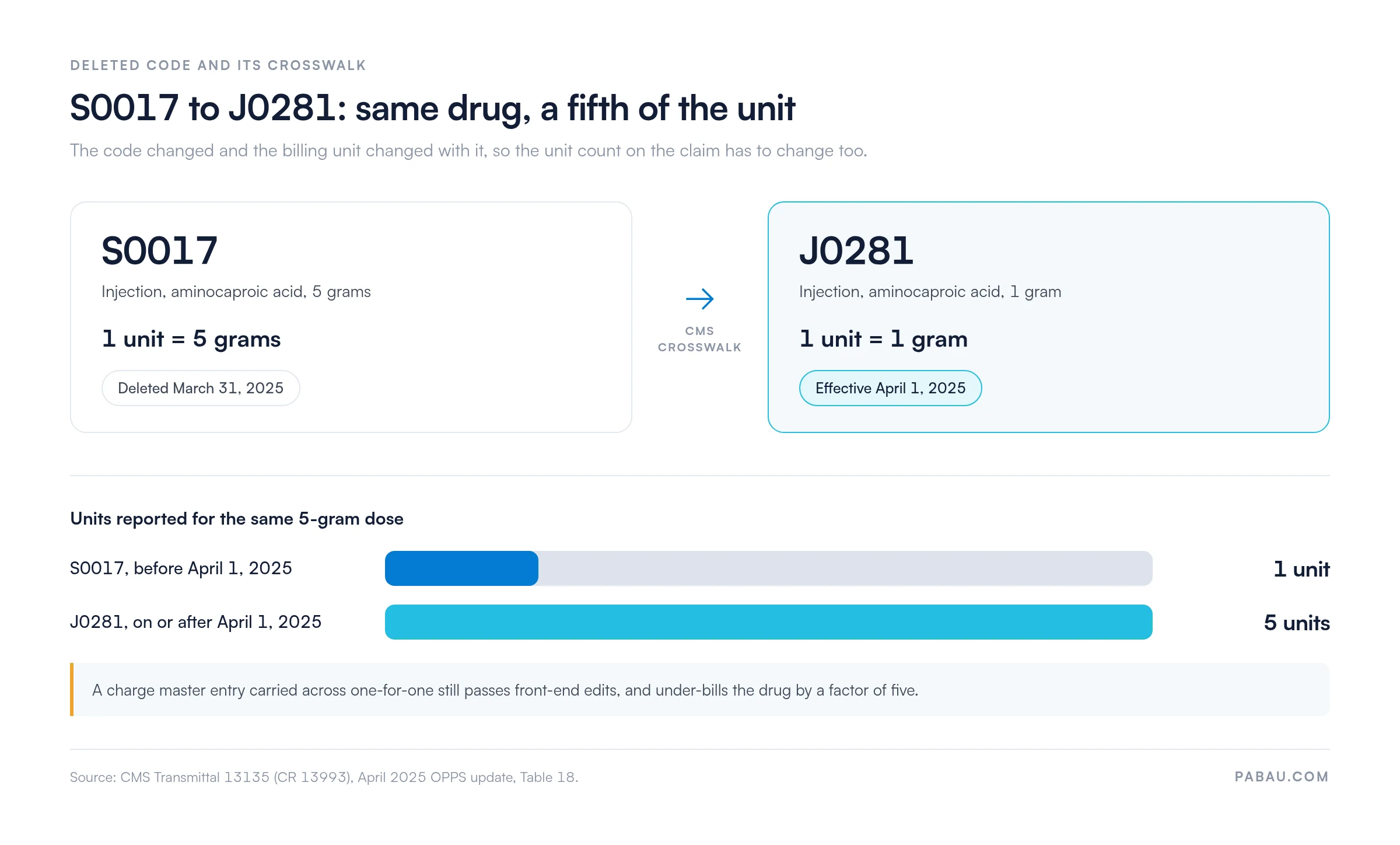
The billing unit changed along with the code, and that is where claims go wrong. S0017 described 5 grams per unit, while J0281 describes 1 gram per unit.
A 5-gram dose that billed as a single unit of S0017 needs approximately five units of J0281 to match the same dose. A charge master entry carried across one-for-one will under-bill the drug by a factor of five, and the claim will still pass front-end edits. The chart below sets both codes side by side, with the unit count each one needs for the same dose.
Unit limits vary from one payer to the next. Medi-Cal, for example, caps the quantity of J0281 it will pay and restricts the code to patients aged 18 and over. Confirm the unit limit, any age restriction, and the contracted rate with each plan before you submit.
The unlisted drug codes do not belong on these claims. J3490 (unclassified drugs) and J3590 (unclassified biologics) apply only where no specific HCPCS code describes the drug administered.
A specific code now exists, so an unlisted code on an aminocaproic acid claim invites a records request or an outright denial. When one of these claims is denied, check the unit count on the J0281 line before you work the common denial codes.
Aminocaproic acid is an antifibrinolytic agent that inhibits the enzymes which break down blood clots. That slows bleeding in settings where clot stability is critical. According to AAPC’s HCPCS code reference, the drug is marketed under the brand name Amicar and is given intravenously.
The FDA-approved indications cover bleeding from fibrinolysis, a condition where the body’s clot-dissolving system becomes overactive. It is used in cardiac surgery, liver transplantation, and hematologic conditions such as hemophilia-related bleeding episodes.
The 5-gram unit dose in S0017’s descriptor reflects a standard IV loading or maintenance dose. J0281 describes the same drug in 1-gram units, so the dose administered now drives the unit count on the claim line.
Providers billing for this drug typically administer it in hospital outpatient, ambulatory surgical center, or infusion settings. The administration route, setting, and dosage all influence which codes and modifiers sit alongside the drug code.
When billing an antifibrinolytic drug injection in an infusion setting, check how the drug code and the infusion service interact. Confirm whether the drug code bundles the administration, or whether a separate infusion code from the CPT 96365 series also belongs on the claim. Payers vary on whether drug and administration codes are separately reimbursable for the same encounter.
HCPCS S-codes are not covered by original (traditional) Medicare. The Blue Cross Blue Shield Association maintains the S-series for use by non-Medicare payers. CMS never assigned Medicare payment status to S0017 or to most other S-codes.
Billing S0017 to a traditional Medicare plan would have been incorrect even when the code was active, and it remains incorrect today. Since April 1, 2025, aminocaproic acid has carried its own J-code, J0281, which Medicare does recognize.
Verifying the patient’s coverage before administering aminocaproic acid in a billable setting is the first step. Medicaid managed care organizations and commercial payers that accepted HCPCS S-codes each maintained their own fee schedules.
Reimbursement varied by state, payer contract, and plan year. Rates are not published universally, so practices should request the current contracted rate for J0281 directly from the payer.
Clean claim submission on aminocaproic acid starts with accurate superbill documentation. Record the drug name, NDC number, dosage administered, and route of administration alongside the J0281 line and its unit count.
Complete drug documentation reduces the likelihood of a medical necessity or drug-not-covered denial at adjudication. Pabau’s claims software for practices tracks drug codes and claim status, so these problems surface before they age into write-offs.
HCPCS Level II is a standardized coding system maintained by CMS that covers products, supplies, and services not included in CPT (HCPCS Level I). Within Level II, codes are grouped by letter prefix, each series with its own maintenance body and intended use.
Knowing which body owns a series tells a billing team when a code like S0017 applies and when it does not.
The S-series (S0000-S9999) is a temporary code series maintained by the Blue Cross Blue Shield Association, not CMS directly. That ownership explains why traditional Medicare does not cover S-codes. CMS did not create them, and it has never assigned Medicare payment rates to them.
The Blue Cross Blue Shield Association introduced S-codes so that non-Medicare payers could track services and drugs separately in claims data. Those codes covered what CPT and the CMS-maintained J-code series did not describe at the time.
The Blue Cross Blue Shield Association controls the S-series, so S-codes are retired and added on its own schedule. That schedule does not align with the annual CMS HCPCS update each January 1. S0017 is a case in point, since it ended mid-quarter on March 31, 2025.
The CMS annual file is not enough on its own here. When an S-code turns up in a claim, check the HCPCS Level II lookup tool and the payer’s own code bulletins. Remittance remark codes will also surface patterns of S-code non-coverage before they compound into accounts-receivable problems.
Run a quarterly HCPCS S-code audit on your charge master. Filter for any code beginning with ‘S’, then check each one against the current Blue Cross Blue Shield Association code file. S-codes can be retired without triggering the same level of industry notification as a major CPT code revision. Catching a deleted code like S0017 before it reaches a payer saves a denial cycle and the administrative cost of correcting the claim. Check the unit definition on the replacement too, since a per-gram code will not match a per-5-gram charge line.
A quarterly change like S0017 to J0281 usually reaches the billing team twice. The first arrival is a payer bulletin that goes unread. The second is a denial, weeks later, on a claim that has already started to age.
Practice management software like Pabau keeps the charge master and the claim in one system. A drug line gets updated once, with its unit multiplier, and that change follows every superbill and claim that uses the code. A retired code cannot quietly survive in a template nobody has opened since last year.
Pabau’s claims management software tracks claim status and remittance responses in the same place. When a payer rejects the unit count on a J0281 line, the billing team sees it against the claim itself. That turns a month-end reconciliation exercise into a same-week correction, and it keeps drug revenue off the write-off list.

Pabau’s claims management tools help practices track active codes, flag retirements, and submit clean claims to non-Medicare payers. See how it works in a live demo.

The crosswalk from S0017 to J0281 leaves a billing team two jobs, and neither one calls for judgment. Replace the code in the charge master, then set the unit multiplier so a 5-gram dose reports as five units instead of one.
Skip the second job and the claims still pay, at a fifth of what the drug earned. That is the failure worth guarding against, because the remittance gives no sign of it. Book a demo to see how Pabau keeps drug codes and unit counts accurate across non-Medicare submissions.

Need a broader overview of how drug injection billing codes work? Medical billing fundamentals covers the full claims lifecycle from code assignment through payment posting.
Seeing denials from outdated codes in your ERA responses? Denial management workflows outlines how to categorize, appeal, and prevent recurring code-related denials.
Reading remark codes off the remittance file? Electronic remittance advice explains what each ERA segment carries and how to work it.
Want fewer drug claims coming back at all? Clean claim submission sets out the documentation a payer needs the first time round.
Want to understand how revenue cycle health connects to code accuracy? Revenue cycle management explains the end-to-end process and where billing code errors cause the most financial drag.
HCPCS Code S0017 is a deleted HCPCS Level II S-code that described an injection of aminocaproic acid (Amicar), billed in 5-gram units. It was used by non-Medicare payers, including Medicaid managed care plans and commercial insurers. It was deleted effective March 31, 2025 and cannot be submitted on a current claim.
S0017 is deleted. It was retired from the HCPCS Level II code set effective March 31, 2025, which is the last valid date of service for the code. Any claim submitted with S0017 today will be denied at the payer’s claim-editing stage, regardless of the clinical documentation supporting the service.
The replacement code is J0281, injection, aminocaproic acid, 1 gram. CMS published the crosswalk in Transmittal 13135 (Change Request 13993), the April 2025 outpatient prospective payment system update. Table 18 of that transmittal lists S0017 as the old code and J0281 as the new one, effective April 1, 2025. Because J0281 is billed per gram rather than per 5 grams, a 5-gram dose needs approximately five units. Confirm each payer’s unit limits and authorization rules for J0281 before submitting.
Approximately five. S0017 described 5 grams per unit, while J0281 describes 1 gram per unit. A 5-gram dose that billed as one unit of S0017 now bills as about five units of J0281. Report the units that match the dose administered. Check the payer’s quantity cap as well, since some plans limit the units they will pay per date of service.
No. Unlisted drug codes such as J3490 (unclassified drugs) and J3590 (unclassified biologics) apply only when no specific HCPCS code describes the drug administered. J0281 is specific to aminocaproic acid, so an unlisted code on these claims will usually trigger a records request or a denial.
HCPCS S-codes are not covered by traditional (fee-for-service) Medicare. During their active period, S-codes like S0017 were accepted by Medicaid managed care organizations in many states. Commercial plans, including Blue Cross Blue Shield affiliates, accepted them too, as did some Medicare Advantage plans. Coverage varied by payer, contract, and plan year, and there was no universal acceptance policy.
Aminocaproic acid is an antifibrinolytic agent used to control excessive bleeding where clot stability is critical. Common applications include cardiac surgery, orthopedic procedures such as joint replacement, liver transplantation, and bleeding episodes in patients with hemophilia or other coagulopathies. It is administered intravenously and marketed under the brand name Amicar.
The Blue Cross Blue Shield Association maintains the HCPCS Level II S-series, not CMS. CMS has never assigned Medicare payment rates to S-codes. Traditional Medicare uses only CMS-maintained HCPCS codes (A through V series) and CPT codes. Because S-codes sit outside CMS’s payment framework, original Medicare does not recognize them as billable procedure codes.