CPT code 21011: Excision of soft tissue tumor of the face
CPT code 21011: Official descriptor and procedure overview CPT code 21011, as pu...

Last Updated: Oct 8, 2026
Q4188 is the HCPCS Level II code for amnioarmor, per square centimeter (add-on, list separately in addition to primary procedure).
Coverage runs through the wound diagnosis. The claim also needs an ICD-10 code listed on your Medicare Administrative Contractor (MAC) local coverage determination.
Let Pabau's smart automation suggest the right codes, reduce claim denials, and keep your practice compliant—effortlessly.
Automate repetitive tasks and focus on what matters most—your patients.
Reduce coding errors and ensure compliance with the latest regulations.
Clean claims, fewer denials, and faster reimbursements.
Powerful insights and reporting to help your practice thrive.
HIPAA compliant SOC 2 certified GDPR-compliant Trusted by 4,000+ clinics worldwide

HCPCS code Q4188 describes Amnioarmor, per square centimeter, a Q-series HCPCS Level II code for amniotic membrane skin substitutes billed under Medicare Part B.
Q4188 is always paired with a CPT application code from 15271 to 15278, chosen by the wound’s body region and size.
The wrong CPT pairing is one of the top denial reasons on Q4188 claims.
Coverage needs a documented diabetic foot ulcer or venous leg ulcer, with an ICD-10 code on your MAC’s covered list.
Practice management software like Pabau keeps wound measurements, product details, and application dates with the claim, so the record supports the units billed.
HCPCS code Q4188 is a Q-series HCPCS Level II code for Amnioarmor, billed per square centimeter of product applied. The Centers for Medicare and Medicaid Services (CMS) assigns it.
Individual Q codes are given to specific skin substitute products so Medicare can track utilization and apply product-level payment rules. Q4188 is active and billable under Medicare Part B for approved wound care indications.
The code sits in the Q4100 to Q4299 range that CMS maintains for skin substitutes. Q codes are temporary HCPCS Level II codes, so CMS can reassign, deactivate, or reclassify one in an annual update. Check the code’s status before the first claim of a new plan year.
CMS classifies every skin substitute Q code as high-cost or low-cost, using an annual per-square-centimeter cost threshold. The classification decides how Medicare pays for the product.
The threshold is revised each calendar year. Verify Q4188’s current classification in the CMS fee schedule file before you submit claims for a new plan year. A shift from high-cost to low-cost removes the separate product payment, so the same claim pays differently.
Medicare reimburses Q4188 per square centimeter applied. Rates vary by locality, because geographic practice cost indices apply, and by whether the service is performed in a facility or non-facility setting. Confirm the current rate for your MAC jurisdiction in the CMS Physician Fee Schedule search tool, as rates update each January.
Q4188 is never billed alone. It must be submitted on the same claim as a CPT application code from the 15271 to 15278 range. The wound’s body region and its size in square centimeters pick the code. Choosing the wrong pairing is one of the most common reasons Q4188 claims are denied.
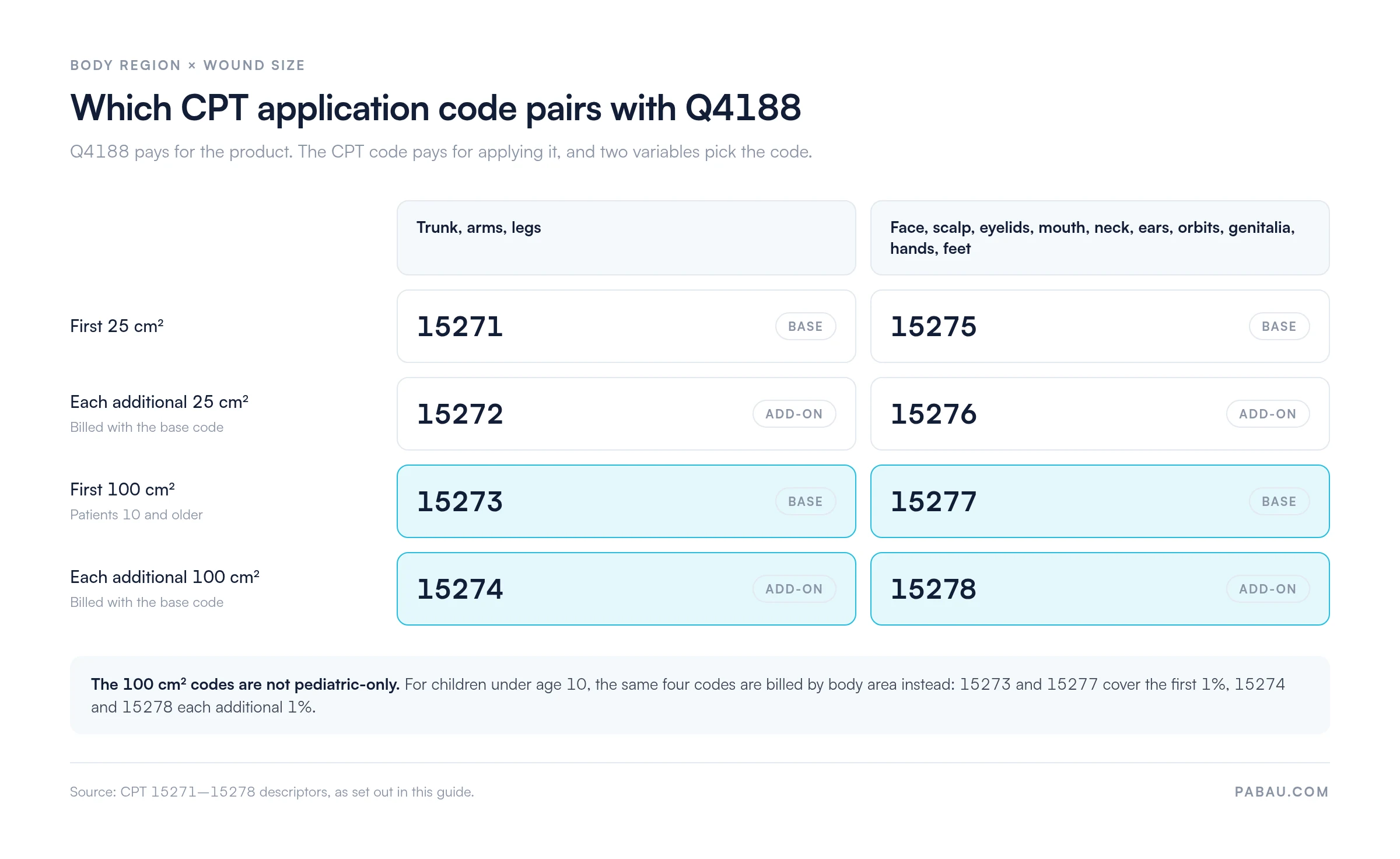
The full descriptors, and the case each code is written for, are below.
Units for Q4188 are calculated from the square centimeters of product applied to the wound, rounded up to the nearest whole centimeter. Document the wound measurement and the product size used at the time of application. Your claims management software should capture that measurement as a billable data point, rather than leaving it to a manual calculation at submission.
Medicare covers Q4188 only when the wound meets the medical necessity criteria in the applicable MAC local coverage determination (LCD). A Q4188 line billed against a non-covered ICD-10 code is denied automatically.
The two primary covered categories are diabetic foot ulcers and venous leg ulcers. MACs may add other wound types, so check the current LCD for your jurisdiction.
Diabetic foot ulcers are the most common covered diagnosis on a Q4188 claim. The ICD-10-CM codes have to be specific about laterality and ulcer severity. Commonly covered codes include:
Sequence the diabetes code first, then a code for the ulcer site and depth. The L97 series covers a non-pressure ulcer of the lower limb. Coverage may extend to further E-code combinations, so read your MAC’s LCD for the full list.
Venous leg ulcers are the second major covered diagnosis category. Commonly covered codes include:
Laterality is required on every venous leg ulcer code, and the left-side codes differ from the right-side ones listed above. Some contractors cover additional ulcer etiology codes, so confirm the full list in your MAC’s LCD. Our ICD-10-CM codes reference is a quick way to check a code before it goes on the claim.
Insufficient documentation is the reason cited most often when a Q4188 claim is denied on post-payment audit. MACs expect the medical record to show medical necessity at the time of service, not after the fact. Meeting the requirements upfront is what prevents a recoupment later.
Wound measurement fields that feed the claim directly remove one transcription step. Nobody retypes a number from a paper note into the billing system. The units on the claim and the units in the chart stay the same.
Run the same three checks on every Q4188 claim before it goes out. Confirm the CPT code matches the wound’s body region and size. Verify the ICD-10 code appears on your MAC’s covered-diagnosis list, and attach a wound measurement note naming the product size used. Three checks catch most Q4188 denials before the payer ever sees the claim.
Q4188 denials cluster around a predictable set of errors, and front-end claim edits catch most of them before submission.
Effective denial management for skin substitute claims starts with tracking denials by reason code. That shows which pattern repeats in your practice, so you can fix it at the source. A claim that reaches post-payment audit without adequate documentation can trigger a repayment demand far larger than the original reimbursement.
CMS made significant skin substitute coding changes for 2025, and each one lands on how a Q4188 claim is put together.
CMS reviews skin substitute Q code assignments and cost thresholds every year. The following year’s code changes are usually published each fall, alongside the Medicare Physician Fee Schedule final rule.
Q4188 is one of dozens of skin substitute Q codes in the Q4100 to Q4299 range. Knowing which neighboring code belongs to which product keeps the wrong one off the claim when a practice stocks several amniotic products.
Each Q code is product-specific. Billing Q4186 when Amnioarmor was applied is incorrect coding, however similar the two products are clinically. Track product usage at the point of care and map it to the right Q code before the claim is built. The AAPC HCPCS code reference confirms the active code for any skin substitute your practice stocks.
Skin substitute billing depends on clinical documentation reaching the claim without being retyped, and that handoff is where errors get in. A wound care or regenerative medicine service needs wound measurements, product details, and application dates held as structured data, not free text.
Practice management software like Pabau keeps the documentation and the billing in one platform. Wound measurement fields, treatment history, and product identification move from the clinical record into the claim with no separate data-entry step.
That removes the transcription errors behind a large share of Q4188 denials. Remittance advice is processed in the same platform, so denial reason codes sit alongside the claim they belong to.
For a MAC audit, Pabau holds an audit-ready record of every encounter, including the clinician’s wound notes, product lot numbers, and application measurements. Insurance eligibility is checked in the pre-visit workflow, so Medicare coverage and any secondary payer are confirmed before the appointment rather than at submission.

Pabau records wound measurements, product lot numbers, and application dates in the clinical note, then carries them into the claim. Your billing team submits from the record instead of retyping it.

Q4188 pays when the paperwork lines up, and not at all when it doesn’t. Three decisions settle the claim, and each is made before submission. Pick the CPT code from the wound’s body region and size, pick the ICD-10 code from your MAC’s covered list, and record what was applied.
A Q4188 claim can pass every front-end edit and still fail a post-payment audit two years later. The wound note is what protects the payment that long after the fact. Keep the note and the claim in one system, and an audit answers itself. Book a demo to see how Pabau keeps wound documentation and Q4188 billing in the same record.

Need guidance on medical billing fundamentals? What is medical billing covers the end-to-end revenue cycle process for healthcare practices.
Want to reduce claim denials across your practice? Denial management in healthcare explains how to track, categorize, and appeal denied claims.
Looking for a billing compliance framework? Medical billing compliance outlines the documentation and coding standards that reduce audit risk.
Want claims to go out clean the first time? What is a clean claim sets out what a payer needs before it can pay without rework.
Building the encounter form your coders work from? Superbill explains what belongs on it and how the codes reach the claim.
HCPCS code Q4188 is used to bill Medicare Part B for Amnioarmor, an amniotic membrane skin substitute, reimbursed per square centimeter applied. It is billed in wound care settings for covered diagnoses such as diabetic foot ulcers and venous leg ulcers, once conservative treatment has failed.
Q4188’s classification as high-cost or low-cost depends on the CMS annual cost threshold at the time of billing. CMS revises that threshold each calendar year, so the classification can change between plan years. Verify the current classification in the CMS fee schedule file, or with your Medicare Administrative Contractor, before submitting claims.
Q4188 is billed with CPT application codes 15271 through 15278, chosen by the wound’s body region and its size in square centimeters. CPT 15271 covers the first 25 cm² on the trunk, arms, or legs, with 15272 for each additional 25 cm². CPT 15275 covers the same first 25 cm² on the face, scalp, hands, or feet. The 100 cm² codes, 15273 and 15277, apply to patients aged 10 and older, with a 1% body area alternative for children under 10.
Medicare covers Q4188 mainly for diabetic foot ulcers, such as E10.621 and E11.621, and for venous leg ulcers in the I83 and I87 series. The code has to appear on the covered-diagnosis list in the applicable MAC local coverage determination. The wound must also meet the chronicity and prior-treatment-failure requirements in that LCD, and coverage for other wound types varies by jurisdiction.
Five errors account for most Q4188 denials. The first is a non-covered ICD-10 diagnosis code. The second is a CPT application code that does not match the wound’s body region or size. The third is missing wound measurements in the medical record. The fourth is units billed above the documented product size. The fifth is no record of prior conservative treatment failure. A pre-submission claim edit routine catches each of them.
CMS revised the high-cost classification threshold for skin substitutes in 2025, which may change how Q4188 is paid. Some MAC LCDs were updated to tighten wound chronicity requirements and limit application frequency. CMS also added new Q codes for several skin substitute products and retired others in the same annual cycle. Verify Q4188’s active status and classification in the current year’s fee schedule file.