CPT code 21011: Excision of soft tissue tumor of the face
CPT code 21011: Official descriptor and procedure overview CPT code 21011, as pu...

Last Updated: Oct 8, 2026
Q4155 is the HCPCS Level II code for neoxflo or clarixflo, 1 mg.
Q4155 appears on the non-covered product list in all three Medicare Administrative Contractor (MAC) skin substitute policies that are still active. In Novitas, First Coast and CGS jurisdictions the claim is denied by policy, not by coding error. Elsewhere no skin substitute LCD applies at all, so the claim is decided case by case.
Payment changed on January 1, 2026 as well. Skin substitutes are now paid as incident-to supplies, but only sheet-form products were unpackaged into the new per-square-centimeter rate. NeoxFlo and clarixFlo are flowable, so they stayed packaged in the hospital outpatient setting.
Let Pabau's smart automation suggest the right codes, reduce claim denials, and keep your practice compliant—effortlessly.
Automate repetitive tasks and focus on what matters most—your patients.
Reduce coding errors and ensure compliance with the latest regulations.
Clean claims, fewer denials, and faster reimbursements.
Powerful insights and reporting to help your practice thrive.
HIPAA compliant SOC 2 certified GDPR-compliant Trusted by 4,000+ clinics worldwide

HCPCS code Q4155 describes NeoxFlo or clarixFlo, 1 mg, a flowable amniotic membrane and umbilical cord allograft now owned by BioStem Technologies
Q4155 is listed as non-covered in the active Novitas, First Coast and CGS skin substitute billing articles A54117, A57680 and A56696
LCD L33831 does not govern Q4155, because it is the DME MAC surgical dressings policy paired with article A54563
From January 1, 2026, a non-sheet product line needs an application code from G0681 to G0684 rather than CPT 15271 to 15278
Sheet-form products moved into APCs 6000 to 6002 at $127.14 per sq cm, while non-sheet products such as Q4155 stayed packaged
Pabau’s claims management software checks application codes and modifiers before a Q4155 claim leaves the practice
Q4155 is a temporary HCPCS Level II Q-code. CMS assigns Q-codes to products and supplies that have no permanent code, and reviews them periodically. A code can be revised, replaced or deleted in any annual or quarterly update.
NeoxFlo and clarixFlo are cryopreserved amniotic membrane and umbilical cord allografts. Both are supplied as a particulate or flowable preparation rather than a sheet.
BioStem Technologies acquired the Neox and Clarix trademarks from BioTissue on January 21, 2026. It markets them as 361 HCT/Ps under 21 CFR Part 1271, and BioTissue keeps manufacturing them under a three-year supply agreement.
The flowable form drives most of what follows. A flowable product is not anchored to the wound bed, so the sheet-graft application codes never described it well. CMS finally gave non-sheet products their own application codes in 2026.
No national coverage determination applies to skin substitutes. Coverage sits entirely with the MACs, and it is not uniform across the country. Two jurisdictions can reach opposite conclusions about the same product on the same wound.
Verifying the patient’s eligibility before the procedure confirms the plan and the jurisdiction. It does not tell you whether the product is on the covered list, so check that separately.
Three A/B MACs maintain an active skin substitute LCD. Each one has a companion billing and coding article that carries the covered and non-covered product lists.
A replacement set of DFU and VLU policies was due to take effect on January 1, 2026. That set included Palmetto GBA L39806, Noridian L39760 and L39764, National Government Services L39828 and WPS L39865.
The A/B MACs withdrew all of them on December 24, 2025. So outside Novitas, First Coast and CGS there is currently no skin substitute LCD, and a Q4155 claim is adjudicated on medical necessity alone.
Verify the position for your own jurisdiction in the CMS Medicare Coverage Database before each billing cycle. Policy on this product class has moved several times in two years.
Plenty of coding pages cite LCD L33831 and article A52498 as the authority for skin substitute billing. Both citations are wrong, and an appeal built on either one will fail.
If a payer or a vendor template cites L33831 on a Q4155 line, treat that as a red flag for the rest of the template. Replace it with the correct LCD and article for your jurisdiction.
Q4155 sits on the non-covered CTP list in articles A54117, A57680 and A56696. That means the product is excluded by policy for lower extremity chronic wounds, however strong the clinical documentation is.
A denial on that basis is not a coding problem, so recoding the claim will not fix it. The practical responses are an advance beneficiary notice before treatment, a documented appeal with published evidence, or a different product from the covered list.
Where a skin substitute LCD does apply, coverage of a listed CTP generally turns on the same clinical picture.
Acute surgical wounds, burns, cosmetic use and wounds with no documented conservative care remain outside every version of these policies.
CMS retired the high-cost and low-cost skin substitute tiers on January 1, 2026. Products not licensed as biologics under Section 351 of the Public Health Service Act are now paid as incident-to supplies. Q4155 is a 361 HCT/P, so it falls inside that methodology.
The low-cost application codes C5271 to C5278 were deleted at the same time. A claim that still carries one of them is rejected outright.
Check every row against your own MAC before you rebuild a charge template. Jurisdictions differ on claim edits and on when documentation has to arrive.
The headline figure from the 2026 rules is $127.14 per square centimeter. It is widely quoted as though it now applies to every skin substitute. It does not apply to Q4155 in the hospital outpatient setting.
Under OPPS, CMS unpackaged sheet-form products into three new ambulatory payment classifications. APC 6000 covers premarket approval products, APC 6001 covers 510(k) products and APC 6002 covers 361 HCT/Ps. Each carries status indicator S1 and pays per square centimeter.
CMS declined to change the outpatient arrangement for products that are not in sheet form. The new non-sheet application codes G0681 to G0684 were given status indicator N, which packages the payment. A hospital therefore sees no separate payment for NeoxFlo or clarixFlo.
Sheet versus non-sheet now decides separate outpatient payment. The old high-cost and low-cost split was retired with the tiers, and the product’s price no longer affects the outcome. The comparison below sets the two forms side by side.
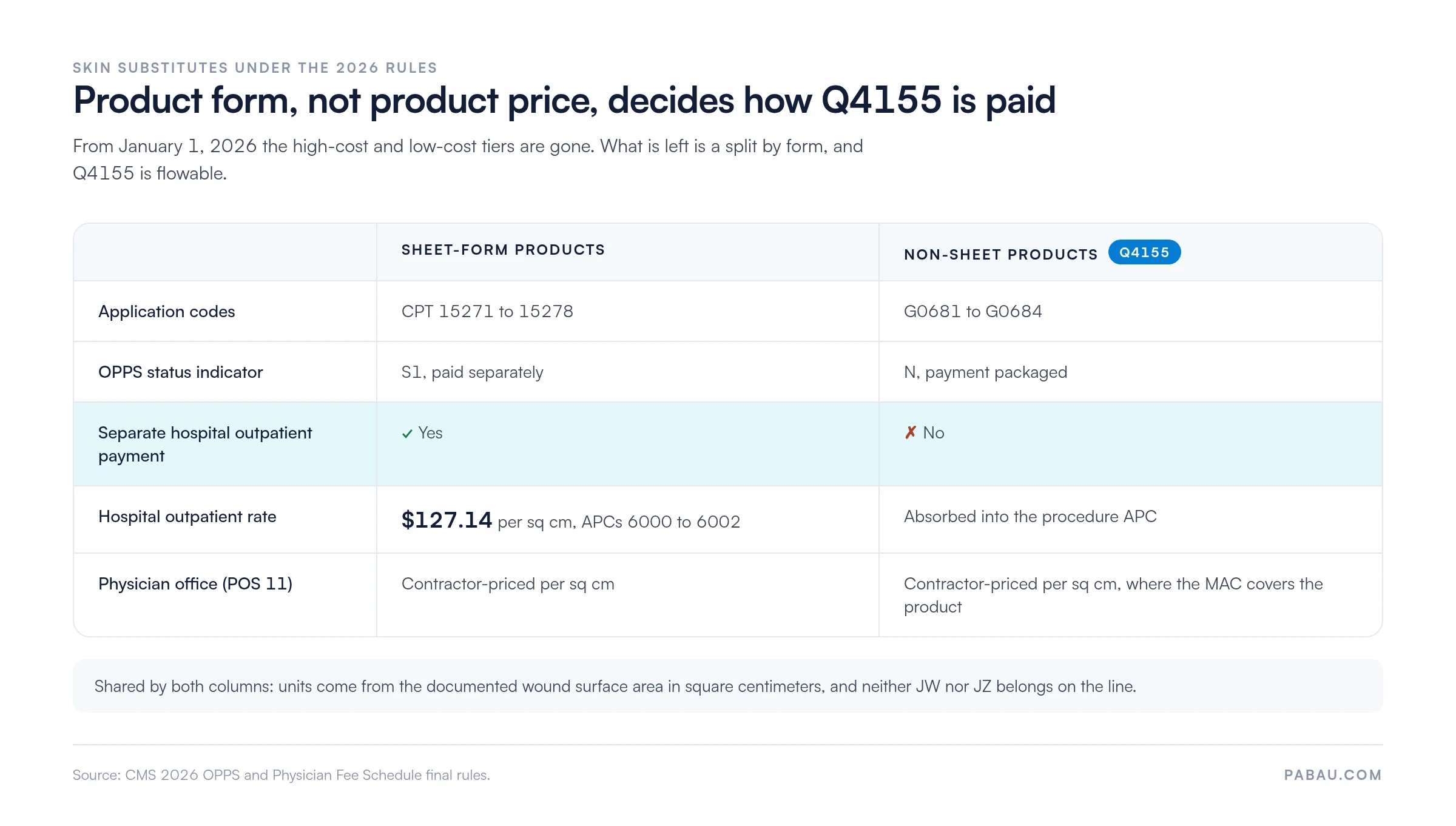
In the physician office, non-sheet products are separately payable as incident-to supplies, and the MACs set the price. There is no single national allowance published for Q4155.
First Coast shows how the math works. It assigns 3.81 practice expense relative value units per square centimeter to non-sheet product codes, with no work and no malpractice RVUs attached.
Multiply those 3.81 RVUs by your locality practice expense GPCI and by the 2026 conversion factor of $33.4009. That lands near $127 per square centimeter nationally, which is why the office and outpatient figures line up for sheet products.
Treat any national figure as a planning number. Confirm your own locality amount with the CMS Physician Fee Schedule lookup tool, and remember that a non-covered product pays nothing at any rate.
An incorrect place-of-service code is one of the most common reasons a skin substitute claim comes back for correction. Capture it at scheduling rather than fixing it after the remittance. Reconciling each remittance against the expected allowance by setting catches the rest.
Measure and record the wound before you open the vial. From 2026 the documented wound surface area in square centimeters sets the payable units on a non-sheet skin substitute line, not the milligrams drawn. An unmeasured wound caps the claim at whatever you can prove afterward. Record the measurement, the method used, the date and the clinician in the procedure note.
Q4155 is a supply code and never stands alone on a claim. It needs an application code, a diagnosis that supports medical necessity, and a unit count taken from the wound. Submitting the product code without a non-sheet application code is a common reason for denial.
Modifier selection changed with the payment methodology, and the two waste modifiers that used to belong on a skin substitute line are now wrong. Charge templates built before 2026 still carry them.
The KX modifier is an attestation, not a coverage override. Appending it to a product that sits on the non-covered list does not make the line payable, and doing so knowingly is a compliance exposure.
Anatomic modifiers such as LT and RT belong on the application code rather than the product code. Confirm the current list with your own MAC before you update a template.
Skin substitute claims are high value and are reviewed often. The record has to show the wound, the failed conservative care, the product and the person who applied it.
Consistency across encounters matters more here than on most codes, because Recovery Audit Contractors target skin substitutes. The record has to support the claim before the claim goes out, not once a reviewer asks for it.
Traditional Medicare does not require prior authorization for Q4155. Coverage is settled by the LCD, so the useful pre-visit check is the product list rather than an authorization request.
Commercial payers are stricter and less consistent. Many classify flowable amniotic products as investigational for chronic wounds and deny them outright. Others cover them with a frequency cap, often three or four applications per wound episode in a rolling 12 months.
Medicare Advantage plans may follow the local LCD or impose tighter criteria of their own. Treating them as commercial payers for authorization purposes is the safer operational default until the plan policy is confirmed in writing.
Verify benefits before scheduling rather than at check-in. The call should establish whether Q4155 is on the plan formulary, the frequency limit, the authorization requirement, and the diagnoses the plan accepts.
Billing a Q-code for a product you did not use is a compliance violation, however similar the two products are clinically. Match the code to the product name, the lot number and the unit in the descriptor.
The table below groups the codes most often confused with Q4155 by product form. Form now decides both the application code and the outpatient payment rule.
Use the AAPC HCPCS code reference to confirm a descriptor before you add a code to a charge template. Q-codes are temporary, so a code that was valid last year may have been revised or deleted.
Q4155 denies more often than most supply codes, and the reasons have shifted since the 2026 rules landed. The denial codes on the remittance tell you which of the reasons below applies. Only some of them can be fixed by recoding.
Reviewing clean claim requirements for skin substitute lines before each billing cycle catches the coding failures. It cannot fix the coverage failure at the top of the table, which is a purchasing decision rather than a billing one.
Run a pre-submission check on every skin substitute claim. Confirm the product is on your MAC covered list and that the unit count matches the measured wound. Then check that a G0681 to G0684 application code is present and that JW and JZ are absent. Last, confirm the ICD-10-CM code matches a covered indication. A one-minute check beats a six-week appeal.
The wound measurement lives in the clinical note, while the charge is entered from a stale template. Nobody compares the two until the denial lands weeks later.
Pabau is practice management software built for clinical practices, and it keeps the note and the claim in one record. Wound measurements captured in a structured medical form stay attached to the encounter. The person coding the visit can see the square centimeters that set the unit count.
Pabau’s tools for medical claims management then build the claim from that record. Charge templates hold the current application codes and modifier rules. A retired code or a stray JW modifier is caught before submission rather than after.
Reporting groups denials by code and reason. That separates a template error you can fix from a coverage decision you cannot. The distinction tells the practice whether to retrain the coders or rethink the product.

Pabau keeps wound measurements, charge templates and modifier rules in one record. Q-code claims go out with the right units, the right application code and the documentation attached.

The hardest part of billing HCPCS code Q4155 is not the coding. It is establishing whether your MAC will pay for the product at all, because three of them currently will not.
Settle that question first, then get the mechanics right. Units come from the measured wound, the application code comes from the G0681 to G0684 set, and the waste modifiers come off the line entirely.
Where the product is non-covered, an advance beneficiary notice signed before treatment is the difference between a transferable balance and a write-off. That is a front-desk workflow, not a billing one.
Pabau ties the clinical record to the claim so these checks happen once, in the right order. To see how that works on skin substitute billing, book a demo.

Need to understand how claim errors reach payers? Clean claim best practices walks through the pre-submission checks that catch HCPCS errors before the remittance cycle.
Tracking denials across your billing team? Denial management in healthcare covers how to build a systematic denial tracking and appeal process.
Billing another flowable skin substitute? HCPCS code Q4112 covers Cymetra, a non-sheet product that follows the same 2026 application code rules.
Building an audit-ready billing process? Medical billing compliance sets out the laws, the common violations and a checklist to run against your records.
Capturing charges at the point of care? What is a superbill? explains which fields the form must carry before a claim can be built from it.
HCPCS code Q4155 is the temporary Level II supply code for NeoxFlo or clarixFlo, 1 mg. Both are flowable amniotic membrane and umbilical cord allografts, and BioStem Technologies has owned the brands since January 2026. The code identifies the product only. A separate application code describes the procedure.
Not everywhere. Q4155 is listed as non-covered in the active skin substitute billing articles from Novitas (A54117), First Coast (A57680) and CGS (A56696). Other jurisdictions have no skin substitute LCD in force after the 2026 policies were withdrawn. Those claims are judged on medical necessity, case by case.
It depends on your jurisdiction. The three active skin substitute LCDs are Novitas L35041, First Coast L36377 and CGS L36690. LCD L33831 is sometimes cited for skin substitutes. It is the DME MAC surgical dressings policy and does not apply to CTPs.
Take the units from the documented wound surface area treated, in square centimeters, rather than from the milligrams drawn. Product left in the vial is not payable under any circumstance. Record the measurement and the method in the procedure note before the product is opened.
Use the non-sheet application codes. G0681 covers the first 25 sq cm or less of a wound under 100 sq cm and G0682 covers each additional 25 sq cm. For a wound of 100 sq cm or more, use G0683 then G0684. CPT 15271 to 15278 describe sheet grafts and do not fit a flowable product.
No. From January 1, 2026 skin substitutes are paid as incident-to supplies rather than drugs or biologicals, so neither wastage modifier belongs on the line. MACs reject claims that carry them.
Not in the hospital outpatient setting. CMS unpackaged only sheet-form products into APCs 6000, 6001 and 6002. Non-sheet products such as Q4155 stayed packaged into the procedure APC. In the office, the product is contractor-priced per square centimeter where the MAC covers it.