

CCSD code G5100: Bypass of duodenum billing guide
CCSD code G5100 bills a bypass that leaves the duodenum in place CCSD code G5100...

Last Updated: Oct 16, 2026
Q4115 is the HCPCS Level II code for Alloskin, per square centimeter (add-on, list separately in addition to primary procedure).
Alloskin is AlloSource's cryopreserved, meshed human dermal allograft (split-thickness dermis). Practices bill it per square centimeter of graft applied to an acute or chronic wound, alongside a separate CPT application code. Coders often confuse it with Q4116 (AlloDerm) and Q4128 (FlexHD or AlloPatch HD), which describe different products.
Let Pabau's smart automation suggest the right codes, reduce claim denials, and keep your practice compliant—effortlessly.
Automate repetitive tasks and focus on what matters most—your patients.
Reduce coding errors and ensure compliance with the latest regulations.
Clean claims, fewer denials, and faster reimbursements.
Powerful insights and reporting to help your practice thrive.
HIPAA compliant SOC 2 certified GDPR-compliant Trusted by 4,000+ clinics worldwide

HCPCS code Q4115 describes Alloskin, AlloSource’s cryopreserved, meshed human dermal allograft, billed per square centimeter of graft applied.
Q4115 is billed with a CPT application code from 15271-15278 on the same claim. The wound’s site and total surface area decide which one.
Medicare coverage requires documented wound chronicity of at least 30 days and failure of standard care before the skin substitute is applied.
Pabau’s practice software keeps wound measurements and graft details in the patient record, and its claims management submits Q4115 claims and tracks denials.
HCPCS code Q4115 is defined in the CMS HCPCS Level II file as Alloskin, per square centimeter (add-on, list separately in addition to primary procedure). According to the Centers for Medicare and Medicaid Services (CMS) HCPCS overview, Q-series codes are temporary codes. In the Q4101-Q4440 skin substitute range, each code is assigned to specific products, so Medicare can tell one graft from another on a claim.
The product billed under Q4115 is Alloskin, a meshed human dermal allograft from AlloSource, a nonprofit tissue bank. In addition, it is a meshed, split-thickness dermal graft, cryopreserved by controlled-rate freezing to maintain natural cell morphology. Importantly, it is human tissue, not a synthetic or xenograft product.
However, AlloSource sells two related grafts under their own codes: AlloSkin RT (Q4123) and AlloSkin AC (Q4141). Q-code assignments can change each year when CMS adds, reassigns or deletes codes. Verify the current product mapping in the active HCPCS Level II file before billing. Our HCPCS procedure codes library covers the other skin substitute codes in the range.
Alloskin is used on acute wounds such as burns and dehisced surgical wounds, and on chronic ulcers. Therefore, Medicare coverage rules focus on the chronic ones. For a chronic ulcer, most LCDs expect at least 30 days of documented standard wound care that failed before the first application. However, the exact threshold and wording vary by Medicare Administrative Contractor (MAC) jurisdiction.
The failed standard care you document typically includes debridement, moist wound therapy, offloading (for diabetic foot ulcers), and compression therapy (for venous leg ulcers). Without this documented treatment history, Medicare will deny Q4115 as not medically necessary.
Also, the wound must be measured and photographed at baseline and at each subsequent application visit. In particular, size in sq cm must appear in the clinical note and must match the units billed on the claim.
Q4115 is a product code. In other words, it describes the skin substitute itself, not the act of applying it. Therefore, providers bill a separate CPT application code on the same claim to capture the surgical work of placing the graft. CMS expects both codes together, and Q4115 submitted without an application CPT will hit a claim edit or denial.
The correct application CPT depends on two facts: the wound’s anatomical site and its total surface area. For example, the grid below shows how those two choices lead to one of four code pairs.
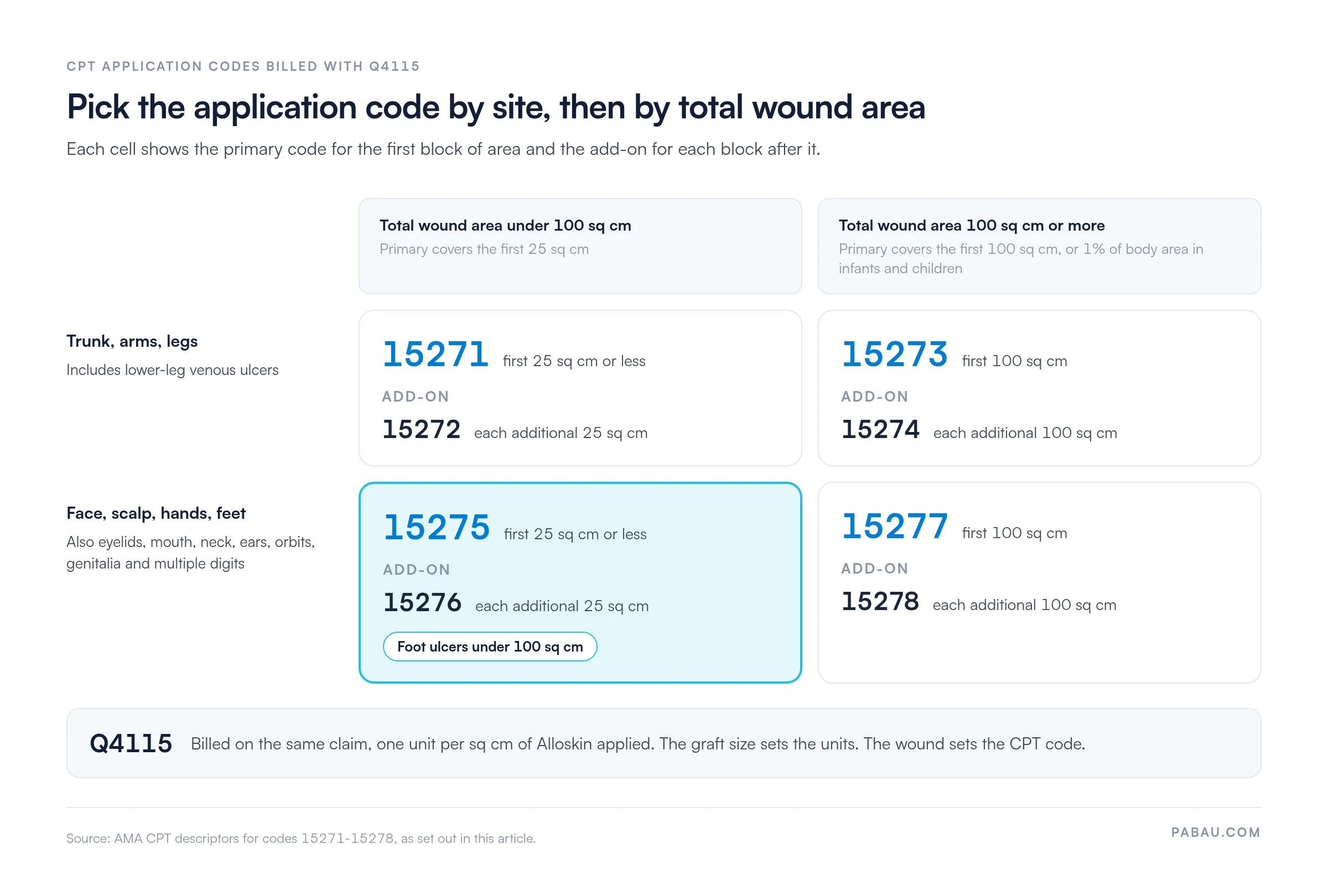
Foot ulcers use 15275/15276 when the total wound area is under 100 sq cm, or 15277/15278 when it is 100 sq cm or more. In contrast, venous ulcers on the lower leg, above the foot, use 15271/15272 under 100 sq cm, or 15273/15274 at 100 sq cm and above. Billers who pick the code before confirming the anatomical site make an avoidable error on Q4115 claims.
Medicare and most commercial payers require the diagnosis code to demonstrate medical necessity at the specificity level the applicable LCD demands. Furthermore, codes must capture laterality, depth (where required), and the underlying condition. As a result, unspecified codes are a leading denial cause on Q4115 claims.
When billing diabetic ulcers, use E11.621 as the primary code and sequence L97.x as an additional code to document the ulcer’s site and depth. Moreover, the LCD for your MAC may require the L97 code to be present, not just the diabetes code. Check the applicable LCD documentation requirements before submitting.
From January 1, 2026, Medicare pays for Q4115 as an incident-to supply rather than as a biological. This change comes from the CY 2026 Physician Fee Schedule final rule (CMS-1832-F). Likewise, the CY 2026 OPPS final rule applies the same approach in hospital outpatient departments. Skin substitutes that are not licensed biologics now share one national rate of $127.14 per square centimeter, set after a November 2025 correction.
Alloskin is a human tissue allograft, not a product licensed under a Biologics License Application (BLA), so it falls under that flat rate. Consequently, product-specific average sales price (ASP) pricing and quarterly ASP updates no longer set its payment in the office or the hospital outpatient setting. Claims with dates of service through December 31, 2025 still follow the old ASP-based rules.
Good revenue cycle management for skin substitute codes now means checking each remittance against the flat rate multiplied by the billed units. Every product pays the same rate, so the unit count, and the graft measurement behind it, decides the payment. Practices that do not reconcile at the code level often find underpayments months later.
CMS sets the skin substitute rate in the annual fee schedule rules, effective each January 1. Check the new rate when the final rule publishes in November, and update your fee schedule before the first January claim.
Medicare coverage for Q4115 is governed by the Local Coverage Determination (LCD) of the MAC with jurisdiction over the provider’s service area. Meanwhile, LCD numbers, criteria and effective dates vary by MAC. New multi-MAC LCDs for skin substitutes on diabetic foot and venous leg ulcers were due on January 1, 2026. However, CMS withdrew them on December 24, 2025.
The CY 2026 reclassification of skin substitutes as incident-to supplies went ahead anyway, so payment and coverage now follow separate rules. Therefore, verify the active LCD in the CMS Medicare Coverage Database or on your MAC’s website.
The core coverage criteria shared across most MACs include:
Sound medical billing compliance for wound care codes means auditing every Q4115 claim against the LCD criteria. Run that audit before submission, instead of only at the point of service. Building the criteria into the clinical documentation template keeps that coverage support consistent from visit to visit.
Commercial payers usually require prior authorization (PA) for Q4115 before the first application. Traditional Medicare has no national PA requirement for skin substitutes, but a 2026 pilot adds one in four states.
Under the CMS WISeR model, which began on January 1, 2026, skin substitutes need PA or pre-payment review in four states. Specifically, those states are New Jersey, Ohio, Oklahoma and Texas. Arizona and Washington are also in the model, but CMS removed skin substitutes there because no skin substitute LCD applies. Check your MAC’s current WISeR guidance before the first application.
For commercial payers, PA is typically required before the first application. The documentation package submitted with a PA request should include:
Unfortunately, incomplete PA packages are a common cause of delayed approvals on skin substitute claims. A clean claim for Q4115 starts with a complete PA package, assembled before the graft is applied.
Clean claims for Q4115 depend on three documentation pillars: wound measurement accuracy, product traceability, and chronicity evidence. Missing any one of them generates either a payer edit or an auditor flag.
Two measurements drive a Q4115 claim. First, the wound’s surface area, read with its site, decides the CPT application code. Second, the size of the graft applied decides the Q4115 units. Both must be recorded in the clinical note for the same date of service. Therefore, you cannot estimate them or carry them forward from a prior visit.
For this reason, a standard wound care visit template helps practices follow these steps the same way every time. Each visit then closes with the full evidence set attached to the encounter.
Q4115 denial reasons follow predictable patterns. The table below maps the most frequent denial causes to their root problems and corrective actions. Overall, it draws on the LCD and CMS billing instructions for skin substitute codes.
Effective denial management strategies for Q4115 require tracking denial reason codes at the individual claim level, not just as aggregate rejection rates. Also watch for CO-50, CO-97, N130 and similar remittance advice remark codes. In fact, patterns in denial reason codes reveal whether the root problem is documentation, coding, or payer policy.
The Q4100 series contains dozens of individual skin substitute product codes. Selecting the wrong one when multiple products are stocked is an easy error that generates a product-code mismatch denial. The table below compares Q4115 with the codes it is most often confused with, including the two other AlloSource grafts.
Practices that also stock Flowerderm need a separate code for it. That human skin allograft bills under Q4179, again per square centimeter, so the two cannot be billed interchangeably.
The fastest way to confirm correct code assignment is to cross-reference the product label’s HCPCS code against the current CMS HCPCS alpha-numeric file. According to AAPC’s HCPCS code lookup, product-to-code assignments can be searched by product name to verify before billing. Run the same check when a new product joins your formulary mid-year.
Build a laminated quick-reference card for your wound care supply room. Map each stocked skin substitute product to its current HCPCS code and its CPT application code pair. Update it every January when HCPCS revisions take effect. The card prevents the product-code mismatch described above.
Many wound care practices bill Q4115 from two records that never meet. The wound measurement and graft size sit in the clinical note, while the units sit in a separate billing system. Consequently, each retype between them is a chance to bill units the chart cannot support.
Instead, Pabau keeps the clinical side in one patient record. Its customizable medical forms capture wound length, width, area, graft size and lot number at the visit, next to dated wound photos.
Pabau’s claims management then submits the claim through Claim.MD and tracks its status. As a result, your team sees each rejection or denial and works it from one place. When a MAC requests records, the measurement, graft details and photos are already on the encounter.

Pabau keeps wound measurements and graft details in the patient record, then submits your Q4115 claims and tracks each denial until it is resolved.

Q4115 pays on two numbers the chart has to prove. One is the graft size behind the units, and the other is the wound area behind the CPT code. Under the 2026 flat rate, every non-BLA product pays the same per square centimeter, so those numbers now decide the payment.
Record both at the application visit, with the lot number and dated photos, and code the site before choosing between 15271 and 15275. Then confirm your MAC’s active LCD, and any WISeR review in your state, before the first graft goes on. Book a demo to see how Pabau keeps Q4115 documentation and claim tracking in one patient record.

Need to understand denial patterns across your wound care claims? Denial management in healthcare covers the systematic approach to identifying, appealing, and preventing recurring claim rejections.
Want a reference for how the HCPCS system is structured? What is medical billing explains the coding systems, payer types, and claim lifecycle that underpin Q4115 billing.
Want fewer Q4115 claims sent back? What is a clean claim explains what a payer needs to see to process a claim on the first pass.
HCPCS code Q4115 describes Alloskin, AlloSource’s cryopreserved, meshed human dermal allograft, billed per square centimeter of graft applied. It is an add-on code, so it is always billed with a CPT skin substitute application code for the same wound.
Most commercial payers require prior authorization for Q4115 before the first application. Traditional Medicare has no national rule. Since 2026, though, the CMS WISeR model has added prior authorization or pre-payment review in New Jersey, Ohio, Oklahoma and Texas. Always verify with the specific payer before scheduling the procedure.
Bill one unit of Q4115 for each square centimeter of Alloskin applied, taken from the graft size recorded in the note. The wound’s surface area decides the CPT application code, not the Q4115 units. Follow your MAC’s instructions on rounding, and never bill more units than the graft size applied.
The primary code is 15271 (trunk, arms, legs, first 25 sq cm) or 15275 (face, hands, feet and similar sites, first 25 sq cm). Larger wounds use 15273 or 15277 for the first 100 sq cm. Add-ons are 15272/15276 for each additional 25 sq cm and 15274/15278 for each additional 100 sq cm. Diabetic foot ulcers use 15275/15276, or 15277/15278.
The most common denial reasons are missing prior authorization and wound chronicity that is not documented for at least 30 days. Incorrect sq cm units, the wrong CPT application code for the site, and a diagnosis missing from the LCD’s covered list follow close behind.
Q4115 is Alloskin, a cryopreserved, meshed human dermal allograft from AlloSource. Q4116 is AlloDerm, an acellular dermal matrix from LifeCell. They are different products, so bill the code that matches the graft applied, even when both are stocked.



