

CCSD code G5100: Bypass of duodenum billing guide
CCSD code G5100 bills a bypass that leaves the duodenum in place CCSD code G5100...

Last Updated: Oct 16, 2026
Q4179 is the HCPCS Level II code for Flowerderm, per square centimeter (add-on, list separately in addition to primary procedure). It is billed with a skin substitute application CPT code.
Flowerderm is a human skin allograft product (HCT/P) used as a skin substitute on chronic wounds, such as diabetic foot ulcers. From January 1, 2026, Medicare pays Q4179 as an incident-to supply at a flat national rate of about $127.14 per sq cm. A mismatched Q-code can cause a denial or a review.
Let Pabau's smart automation suggest the right codes, reduce claim denials, and keep your practice compliant—effortlessly.
Automate repetitive tasks and focus on what matters most—your patients.
Reduce coding errors and ensure compliance with the latest regulations.
Clean claims, fewer denials, and faster reimbursements.
Powerful insights and reporting to help your practice thrive.
HIPAA compliant SOC 2 certified GDPR-compliant Trusted by 4,000+ clinics worldwide

HCPCS Code Q4179 identifies Flowerderm, a human skin allograft used as a skin substitute, billed per square centimeter.
LCD unit limits and documentation rules apply only where your MAC still has an active LCD. Elsewhere, claims are judged as reasonable and necessary.
Claims need a companion application code from 15271 to 15278 and a linked diagnosis, such as E11.621 for Type 2 diabetes with foot ulcer.
Medicare Advantage plans, Medicaid managed care, many commercial payers, and Original Medicare in WISeR states may require prior authorization.
From January 1, 2026, Medicare pays Q4179 as an incident-to supply at a flat national rate of about $127.14 per sq cm.
HCPCS Code Q4179 is the Level II code that the Centers for Medicare and Medicaid Services (CMS) assigns to Flowerderm, billed per square centimeter. Unlike CPT codes, which describe procedures, Q4179 identifies the product itself. It sits in the Q4100-Q4299 skin substitute block, a range CMS revises in its quarterly HCPCS updates.
Flowerderm is a human skin allograft product (HCT/P) used as a skin substitute on chronic wounds. Q4179 is an add-on code, so it always travels with a skin substitute application CPT code on the same claim. Check the product name on the invoice against the current CMS HCPCS file before each claim cycle.
If the invoice names Neopatch or Therion instead, the claim carries Q4176, not Q4179. Both codes bill per square centimeter, so the product name decides which one is correct.
Q4179 is used on chronic wounds that have failed conservative care, mainly diabetic foot ulcers (DFU) and venous leg ulcers (VLU). LCD rules apply only where your Medicare Administrative Contractor (MAC) still has an active LCD. Those LCDs typically require four or more weeks of documented chronicity and evidence that standard wound care failed. Where no LCD applies, the MAC decides each claim on reasonable-and-necessary grounds.
Billing units for Q4179 are reported per square centimeter (sq cm). Measure wound length by width at the time of application and round to the nearest whole square centimeter. Where an active LCD applies, it may cap the units billable per session or per episode of care. Overstating units without documented wound measurements draws OIG audit scrutiny for skin substitute claims.
Photograph and measure the wound immediately before application. Document the date, wound dimensions in centimeters, wound bed condition, and the product lot number in the same clinical note. That single note holds up under post-payment audit without a separate addendum.
Q4179 identifies the product, and a companion CPT application code identifies the procedure. Without the matching application code, most payers will reject the claim. The right code depends on two facts from the wound note: wound site and total area.
The grid below asks site first, then size. Most diabetic foot ulcers take 15275 plus its add-on, 15276. Most venous leg ulcers take 15271 plus 15272.
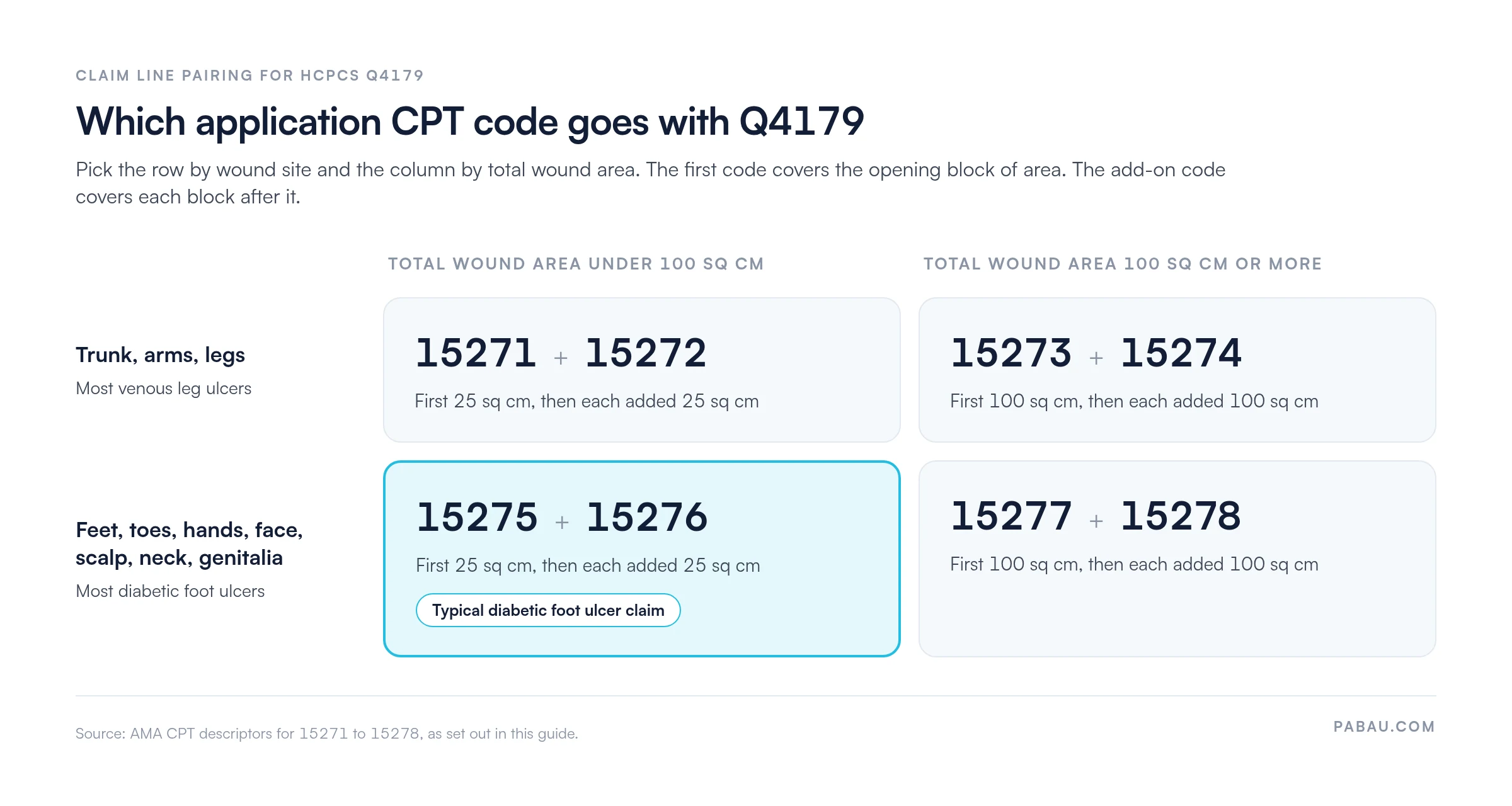
Check payer bundling edits before billing debridement with application codes. Some payers bundle 97597/97598 into the application code on the same date. Others allow separate billing with modifier 59.
Every Q4179 claim must carry an ICD-10-CM diagnosis code that supports medical necessity. Where your MAC still has an active LCD, the code must also be on its covered list. A non-covered diagnosis code is a common denial cause. The code should reflect the wound type being treated, at the highest specificity the documentation supports.
For a diabetic foot ulcer, E11.621 goes first, followed by the L97 code that names the ulcer site and depth. Wound care records should map each visit’s documented wound type to a specific ICD-10 code. Never assign the most general ulcer code when the record supports a more specific one, because auditors read specificity as a sign of documentation quality.
The Q4100-Q4299 range holds dozens of skin substitute codes whose descriptors differ only by product name and unit. Q4152 covers DermaPure, a dermal allograft billed per square centimeter. Q4179 has two close neighbors from the same Flower product family, which makes a picking error easy in a code lookup tool. The table below shows how they differ.
The practical rule is to match the Q-code to the product name on the manufacturer invoice and the current CMS HCPCS file. Never select a Q-code from memory or a static code list. The HCPCS codes index, the AAPC HCPCS code lookup, and the PGM Billing HCPCS search all help you cross-check descriptors before each claim.
Since January 1, 2026, Medicare Part B pays HCPCS Code Q4179 as an incident-to supply. CMS pays non-BLA skin substitutes such as Flowerderm at one flat national rate of about $127.14 per square centimeter. The same rate applies in physician offices, hospital outpatient departments, and ambulatory surgical centers. It is set for the calendar year and is not based on the product’s average sales price.
LCD rules apply to Q4179 only where your MAC still has an active LCD. Most skin substitute LCDs were withdrawn in December 2025. Novitas, First Coast, and CGS keep older LCDs, which set covered diagnoses, documentation rules, and application limits. Palmetto GBA, NGS, WPS, and Noridian have none, so they decide each claim on reasonable-and-necessary grounds.
Outside the WISeR states (and where no LCD applies), traditional Medicare does not require prior authorization for Q4179. CMS’s WISeR model took effect in January 2026 in Arizona, New Jersey, Ohio, Oklahoma, Texas, and Washington. It applies prior authorization to skin substitutes in Original Medicare where an active LCD still applies.
Medicare Advantage plans, Medicaid managed care organizations, and commercial payers frequently require prior auth. UnitedHealthcare, Wellcare, Fidelis Care, and PA Health and Wellness list skin substitute Q-codes as needing pre-authorization. Check each payer’s current authorization list before each episode of care, because the lists change with annual plan updates.
Skin substitute claims draw close review because the Office of Inspector General (OIG) has flagged spending in this code range. The table below shows seven preventable denial patterns and the fix for each.
Catching these before submission, with a checklist or claims management software, costs far less than an appeal.
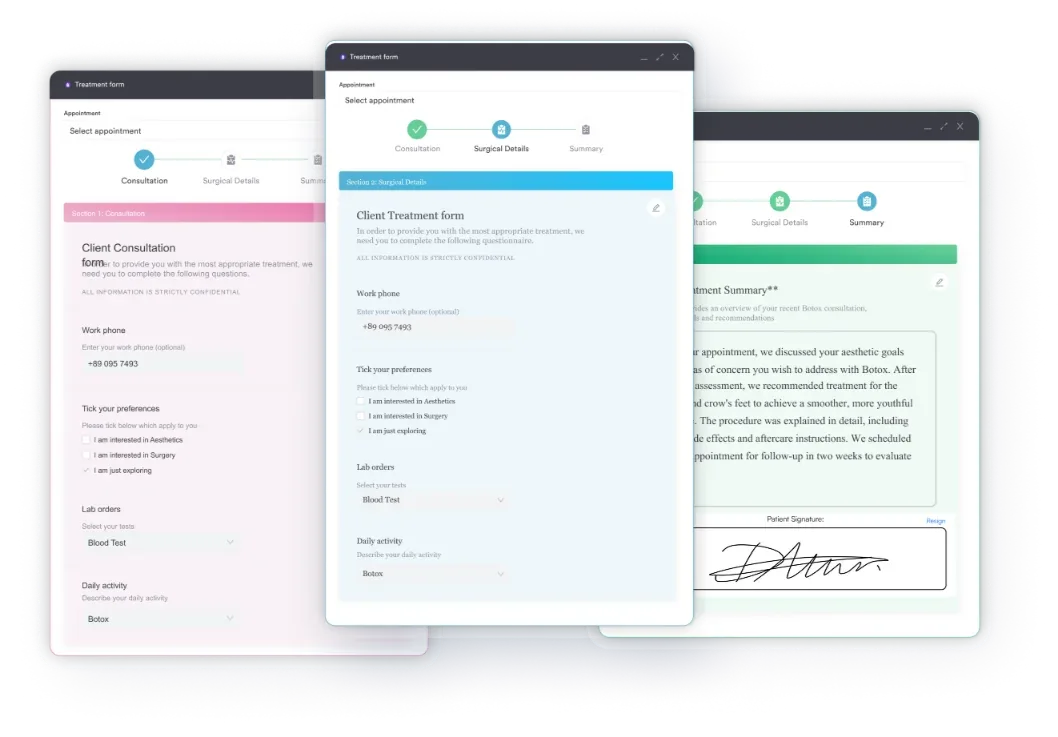
Post-payment auditors reviewing Q4179 claims look for a specific set of record elements. Missing any one of them can trigger a recoupment demand. Structured intake and wound assessment forms, completed at every visit, collect those elements the same way each time.
The checklist below reflects the elements the remaining MAC LCDs and OIG audit criteria ask for on skin substitute claims.
Set a quarterly calendar reminder to re-check the Q4179 descriptor against the current CMS HCPCS file. CMS adds, revises, and deletes codes in the Q4100-Q4299 range in its quarterly updates. A claim for a deleted Q-code is denied outright, and a medical necessity appeal cannot fix it.
Most wound care practices keep the pieces of a skin substitute claim in different places. Wound photos sit in one system, product invoices in another, and authorization numbers in a spreadsheet. When an auditor asks for the record behind a Q4179 line, someone has to rebuild it by hand.
Practice management software like Pabau keeps that record in one patient file. Clinicians complete structured wound assessment forms at each visit, so measurements, wound bed notes, and consent are captured the same way every time. Wound photos are stored against the visit they belong to.
Pabau’s claims management tools then submit the claim and track its status. Your billing team sees a rejection as soon as it comes back, with the visit record one click away. The result is fewer Q4179 claims lost to missing documentation, and a faster response when a post-payment audit arrives.

Pabau’s claims management tools help wound care practices document wound measurements, submit claims, and track claim status.

Payment for Q4179 got simpler in 2026, because one flat rate now applies in every setting. Coverage did not. Whether a claim clears still depends on whether your MAC kept an LCD, and on whether you practice in a WISeR state.
So put the effort where claims still fail. Confirm the invoice says Flowerderm, and pick the application code from the wound’s site and size. Then make sure the note shows why a skin substitute was needed. A claim built from a complete note is far easier to defend when an auditor calls.
Book a demo to see how Pabau keeps wound measurements, photos, and claim status in one patient record.

Billing a Flower product with a similar name? HCPCS code Q4178 covers Floweramniopatch, the per-sq-cm sibling most often confused with Q4179.
Treating a large leg or trunk wound? CPT code 15273 explains the application code for wounds of 100 sq cm or more.
Comparing another amniotic graft claim? HCPCS code Q4159 walks through Affinity billing under the 2026 incident-to supply rate.
Working a keratin-based product instead? HCPCS code Q4165 covers Keramatrix and Kerasorb claims, units, and coverage.
Chasing a denied skin substitute claim? Denial codes in medical billing decodes the top CARC codes and how to fix each one.
HCPCS Code Q4179 covers Flowerderm, a human skin allograft product (HCT/P) used as a skin substitute. It is applied to chronic wounds, mainly diabetic foot ulcers and venous leg ulcers that have failed conservative care. It is billed per square centimeter as an add-on to a skin substitute application CPT code.
Outside the WISeR states (and where no LCD applies), traditional Medicare does not require prior authorization for Q4179. CMS’s WISeR model, effective January 2026 in Arizona, New Jersey, Ohio, Oklahoma, Texas, and Washington, applies prior authorization where an active LCD still applies. Many Medicare Advantage plans, Medicaid managed care organizations, and commercial payers also require it. Confirm the rule with each plan before each application, because authorization lists change annually.
Q4179 units are billed per square centimeter. Calculate wound length by width and round to the nearest whole square centimeter. Where your MAC still has an active LCD, it may cap the units per session or per wound episode. Where no LCD applies, the claim is judged on reasonable-and-necessary grounds. Either way, documented wound measurements must support every unit billed.
Yes. Medicare Part B covers Q4179 as an incident-to supply, paid at a flat national rate of about $127.14 per square centimeter in 2026. Where your MAC still has an active LCD, its covered diagnoses and documentation rules apply. Where it has none, the MAC decides each claim on reasonable-and-necessary grounds. The claim also needs a companion application CPT code and documented failure of standard wound care.



