HCPCS Code T5999: Billing, Medicaid coverage, and documentation guide
HCPCS Code T5999 is the Level II code for a supply, not otherwise specified, bil...

Last Updated: Nov 24, 2026
P7001 is the HCPCS Level II code for culture, bacterial, urine; quantitative, sensitivity study.
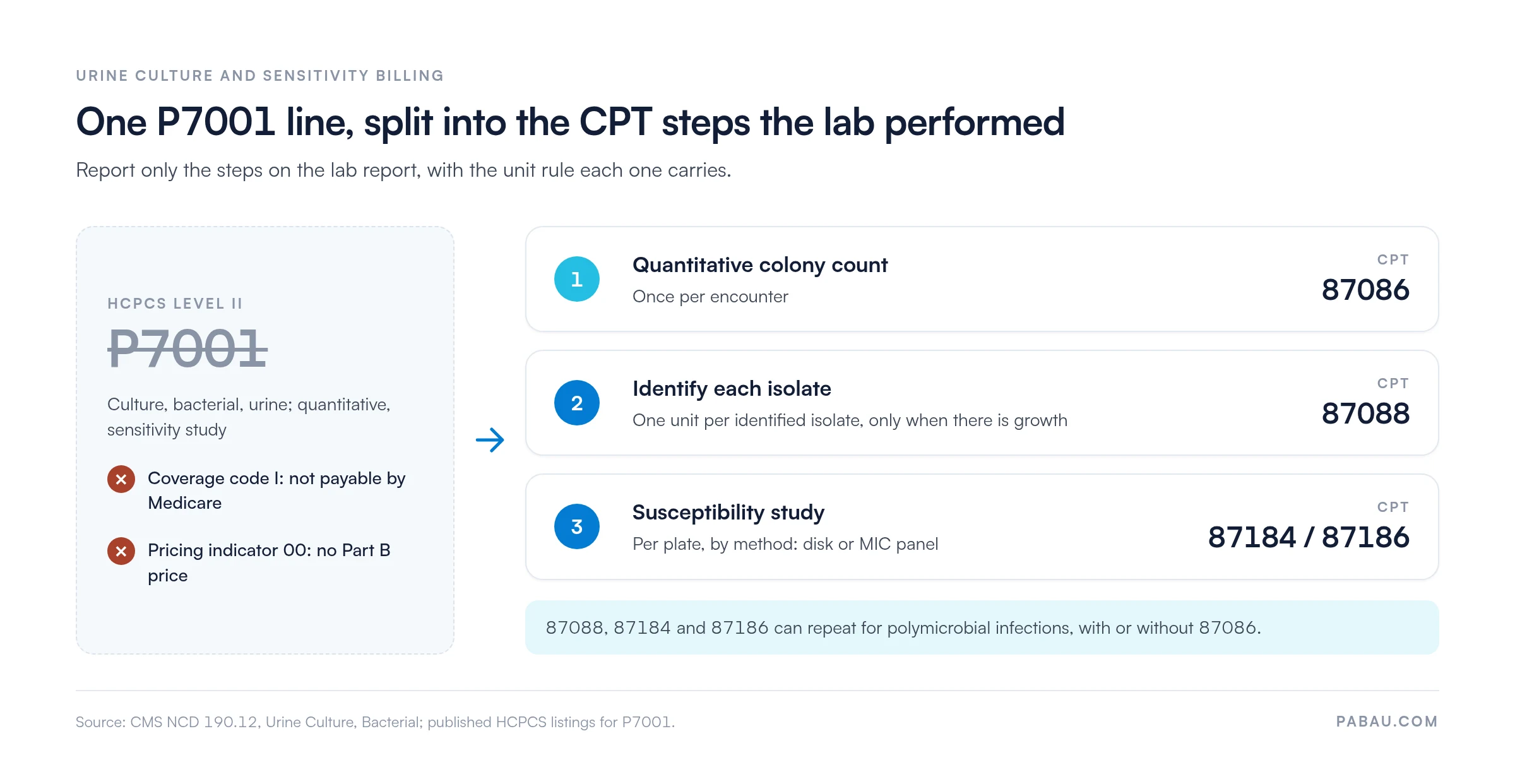
Medicare does not pay for P7001. Bill the urine culture with CPT 87086 or 87088, and the sensitivity study with CPT 87184 or 87186.
Let Pabau's smart automation suggest the right codes, reduce claim denials, and keep your practice compliant—effortlessly.
Automate repetitive tasks and focus on what matters most—your patients.
Reduce coding errors and ensure compliance with the latest regulations.
Clean claims, fewer denials, and faster reimbursements.
Powerful insights and reporting to help your practice thrive.
HIPAA compliant SOC 2 certified GDPR-compliant Trusted by 4,000+ clinics worldwide

HCPCS code P7001 describes a quantitative bacterial urine culture with a sensitivity study, and it is the only code in its sub-group.
Published HCPCS listings give P7001 Medicare coverage code I, so Medicare does not pay a claim line that carries it.
Bill the urine culture with CPT 87086 or 87088, and report the sensitivity testing with CPT 87184 or 87186.
Medicare coverage for those urine culture codes follows NCD 190.12, so the diagnosis on the claim has to support the test.
Most P7001 denials trace back to a non-payable code, mixed code systems or a diagnosis that doesn’t show medical necessity.
HCPCS code P7001 covers a quantitative bacterial urine culture with a sensitivity study. AAPC lists the official descriptor as “Culture, bacterial, urine; quantitative, sensitivity study,” which matches a routine “urine C&S” order on paper. Medicare doesn’t pay the code, though. So a biller who picks it from a lookup ends up with a denied line and a rework queue.
The fix is simple, because Medicare pays for urine cultures and sensitivity studies under CPT codes instead. The sections below name those codes, explain the denials and give you a pre-submission check.
Here are the code’s published reference values at a glance.
The last three rows carry the billing message. The code is still on the list, but Medicare doesn’t pay it, and Part B sets no price for it. These values come from published HCPCS listings. Before you quote them in an appeal, confirm them against the current CMS HCPCS quarterly file.
Coverage code I tells you Medicare doesn’t recognize P7001 for payment. Pricing indicator 00 adds that Part B has no fee attached to it. Put together, a Medicare claim line with P7001 has nothing to pay against.
Medicare still pays for urine cultures. It just pays for them under CPT codes, and coverage for those codes follows the national coverage determination NCD 190.12, Urine Culture, Bacterial. The NCD text sets out the covered indications, and the NCD’s linked ICD-10 covered code list carries the diagnosis codes. So your claim needs a diagnosis that supports the test.
Other payers set their own code lists. A commercial or Medicaid plan could still recognize a P code in its fee schedule. If you plan to bill P7001 to one, check that payer’s policy in writing first.
One P7001 line describes work that CPT splits into separate steps. You report each step that the lab performed.
NCD 190.12 allows 87086 once per encounter, while 87088, 87184 and 87186 can repeat for polymicrobial infections. Report one 87088 unit for each organism the lab identifies. Susceptibility codes follow the method the lab used, so check the lab report before choosing 87184 or 87186.
Put together, one P7001 line splits into up to three CPT steps, each with its own unit rule.
A patient comes in with dysuria and frequency. The physician orders a urine culture with sensitivity. The lab finds significant growth of a single organism, identifies it and runs one MIC panel.
Each line points to the diagnosis that prompted the order. Here, that is an unspecified urinary tract infection, coded N39.0. Check that diagnosis against the NCD 190.12 ICD-10 covered code list before you submit. P7001 appears nowhere on this claim.
When a P7001 claim comes back unpaid, the cause is usually one of these three.
Track these denials by reason rather than by code. Each denied line comes back with a reason code, and our guide to medical billing denial codes explains the most common ones. If the same reason keeps coming back, the fix belongs upstream, in your chargemaster or order set. Our guide to denial management in healthcare shows how to set that tracking up.
Run through these points before a urine culture claim leaves the building.
A claim that clears this list has a much better chance of going through as a clean claim on the first pass.
Most P7001 errors start when someone keys a code by hand under time pressure. A check before the claim leaves catches that slip while it’s still cheap to fix.
Pabau, a practice management platform with built-in claims management, raises each claim straight from the patient’s invoice. Before the claim is sent, Pabau scrubs it for missing or invalid details.
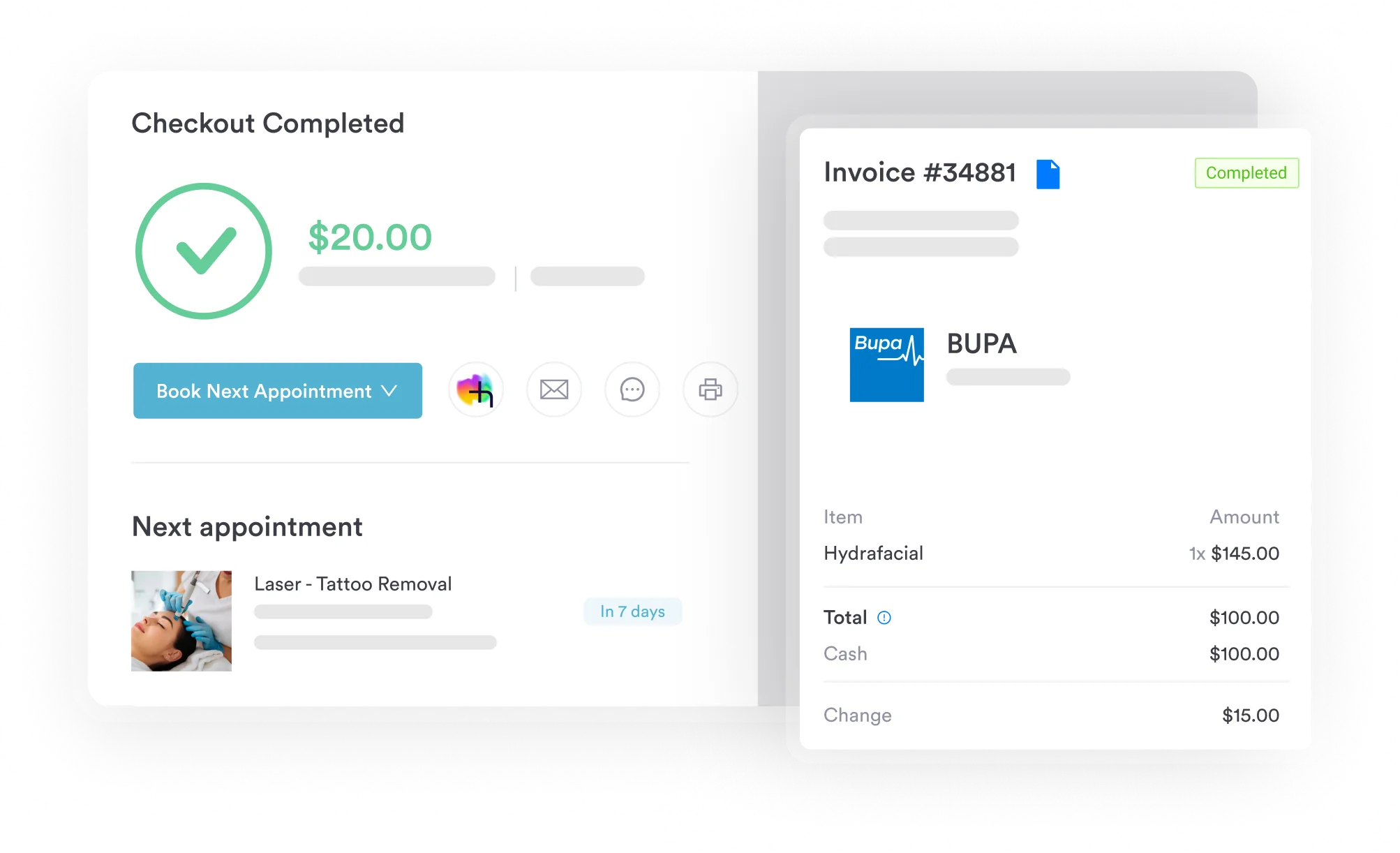
That check runs on every claim before it leaves. US practices submit through Claim.MD, which adds eligibility checks and ERA remittances, so payments settle from the ERA files. UK practices submit through Healthcode, and Australian practices through Tyro Health. Our claims management software page covers each setup.

Pabau raises each claim from the invoice and checks it for missing or invalid details before it is sent.

P7001 belongs in your reference notes and never on a Medicare claim. If it turns up on one, your chargemaster or lookup step needs attention.
Fix it once at the source and the denials stop. Map urine cultures to 87086 and 87088, map sensitivity to 87184 or 87186, and link a covered diagnosis every time.
Book a demo to see how Pabau checks lab claims before they are sent, so a non-payable code like P7001 gets caught early.

Billing the colony count step? CPT code 87086 explains the quantitative urine culture code that replaces most P7001 lines.
Identifying more than one organism? CPT code 87088 covers isolation and presumptive identification, including units per isolate.
Reporting an MIC sensitivity panel? CPT code 87186 walks through the microdilution susceptibility code and its unit rules.
Want fewer resubmissions overall? What is a clean claim sets out what payers check before a claim is accepted.
No. P7001 still appears in published HCPCS listings with action code N, meaning no maintenance since January 1, 1996. It stays on the list, but Medicare doesn’t pay it.
Only if that payer’s policy lists it. Check the fee schedule or ask provider relations in writing. If the payer doesn’t list P7001, bill the CPT codes instead.
It means the lab counts the bacteria, reported as colony-forming units per milliliter. The count helps separate a likely infection from contamination.
No. P7001 is the only code in its HCPCS sub-group. A urine culture without sensitivity testing is billed with CPT 87086, plus 87088 when an organism is identified.
No. A dipstick or urinalysis has its own CPT codes, in the 81000 range. A culture grows and counts organisms, so it needs a culture code.