HCPCS Code G0163: Skilled nursing observation and assessment
What is HCPCS Code G0163? HCPCS Code G0163 is a deleted Level II code for skille...

Last Updated: Oct 15, 2026
P2033 is the HCPCS Level II code for thymol turbidity, blood.
Billing staff usually meet P2033 on legacy claims, reference lab panels, or specialty hepatology requisitions. Modern liver-function and protein-electrophoresis panels have replaced the assay in most laboratories. A clean claim needs a supported ICD-10-CM diagnosis code, a signed physician order, and documentation that the test was reasonable and necessary.
Let Pabau's smart automation suggest the right codes, reduce claim denials, and keep your practice compliant—effortlessly.
Automate repetitive tasks and focus on what matters most—your patients.
Reduce coding errors and ensure compliance with the latest regulations.
Clean claims, fewer denials, and faster reimbursements.
Powerful insights and reporting to help your practice thrive.
HIPAA compliant SOC 2 certified GDPR-compliant Trusted by 4,000+ clinics worldwide

HCPCS Code P2033 describes thymol turbidity, blood, a P-series pathology and laboratory code that sits outside the modern liver-panel CPT codes.
Medical necessity documentation and a signed physician order are required on every P2033 claim, and missing either is the leading denial cause.
P2033 is not separately reimbursed under the Medicare Clinical Laboratory Fee Schedule in most cases, so check payer coverage before you submit.
Pabau’s claims management software flags missing or mismatched fields and unsupported code pairings before submission, so fewer claims come back denied.
HCPCS Code P2033 is the Level II code with the official descriptor “Thymol turbidity, blood.” It sits in the P-series, which covers pathology and laboratory services not fully captured by CPT Level I codes. Unlike CPT codes maintained by the AMA, HCPCS Level II codes are maintained by CMS and used for Medicare, Medicaid, and many commercial payer claims.
P-series codes run from P2028 through P9615 and cover pathology and laboratory procedures billed outside the standard CPT framework. For example, the AAPC’s HCPCS Level II code reference lists P2033 among the clinical chemistry codes. Related tests in the same block include P2028 (cephalin flocculation) and P2031 (hair analysis).
Thymol turbidity is a colloidal precipitation assay. A thymol-barbital buffer is added to a serum sample, and the resulting cloudiness is measured photometrically. In other words, that cloudiness comes from abnormal globulins and lipoproteins dropping out of solution. A higher reading signals elevated serum proteins or lipids consistent with hepatocellular disease or dysproteinemia.
The test dates to the 1940s and was once standard in hepatology workups. Instead, modern clinical laboratories have largely replaced it with alanine aminotransferase (ALT), aspartate aminotransferase (AST), and serum protein electrophoresis. As a result, those assays give more precise, exact results. Coders who encounter P2033 today are often working with:
This clinical context matters at the billing desk. A payer expects the record to show why the physician wanted this assay instead of a common liver-function panel. In short, without that evidence, the claim is a documented denial trigger.
Medical necessity for P2033 requires a documented clinical indication supported by an ICD-10-CM diagnosis code. CMS and most commercial payers apply the standard lab medical-necessity rule. A physician or an authorized nonphysician practitioner must order the test. It must also be reasonable and necessary for diagnosing or treating the patient’s condition.
The diagnosis codes most often paired with P2033 cover hepatic function abnormalities, serum protein disorders, and liver disease evaluation. Pairing the claim with an unsupported or unrelated diagnosis code is the most frequent reason P2033 claims are denied. In fact, medical necessity is where those denials land.
Only cite diagnosis codes with documented clinical support in the patient record. Instead, ICD-10 pairings should reflect the ordering physician’s documented clinical findings, not a code selected solely to satisfy payer requirements.
A clean P2033 claim follows a clear chain from the initial physician order through to remittance. A denial almost always traces back to one broken link in that chain. The six steps below show where the paperwork has to hold.
Check whether the standing order for thymol turbidity is still clinically active before billing P2033. Practices that have transitioned to modern liver panels sometimes leave legacy standing orders in their EHR. Billing against an inactive or superseded order is a compliance risk and a denial waiting to happen.
P2033 coverage under Medicare is limited. Many historical P-series lab codes do not appear as separately reimbursable line items on the current CMS Clinical Laboratory Fee Schedule (CLFS). In fact, P2033 falls into that category for most billing cases. Check the current-year CLFS before you assert reimbursement, because coverage status and rates change with annual CMS updates.
For private payers, coverage policy varies widely. Some commercial insurers follow the Medicare CLFS as their reference schedule. In contrast, others use their own lab fee schedules, which may or may not include P2033. Request a coverage determination or read the payer’s lab fee schedule before you send that insurer its first P2033 claim.
When Medicare is the payer and coverage is in doubt, issue an Advance Beneficiary Notice of Noncoverage (ABN) before the test is performed. A signed ABN shifts financial liability to the patient if Medicare denies the claim, which protects the practice from a write-off. Our Medicare waiver template gives you a form to hand the patient at collection.
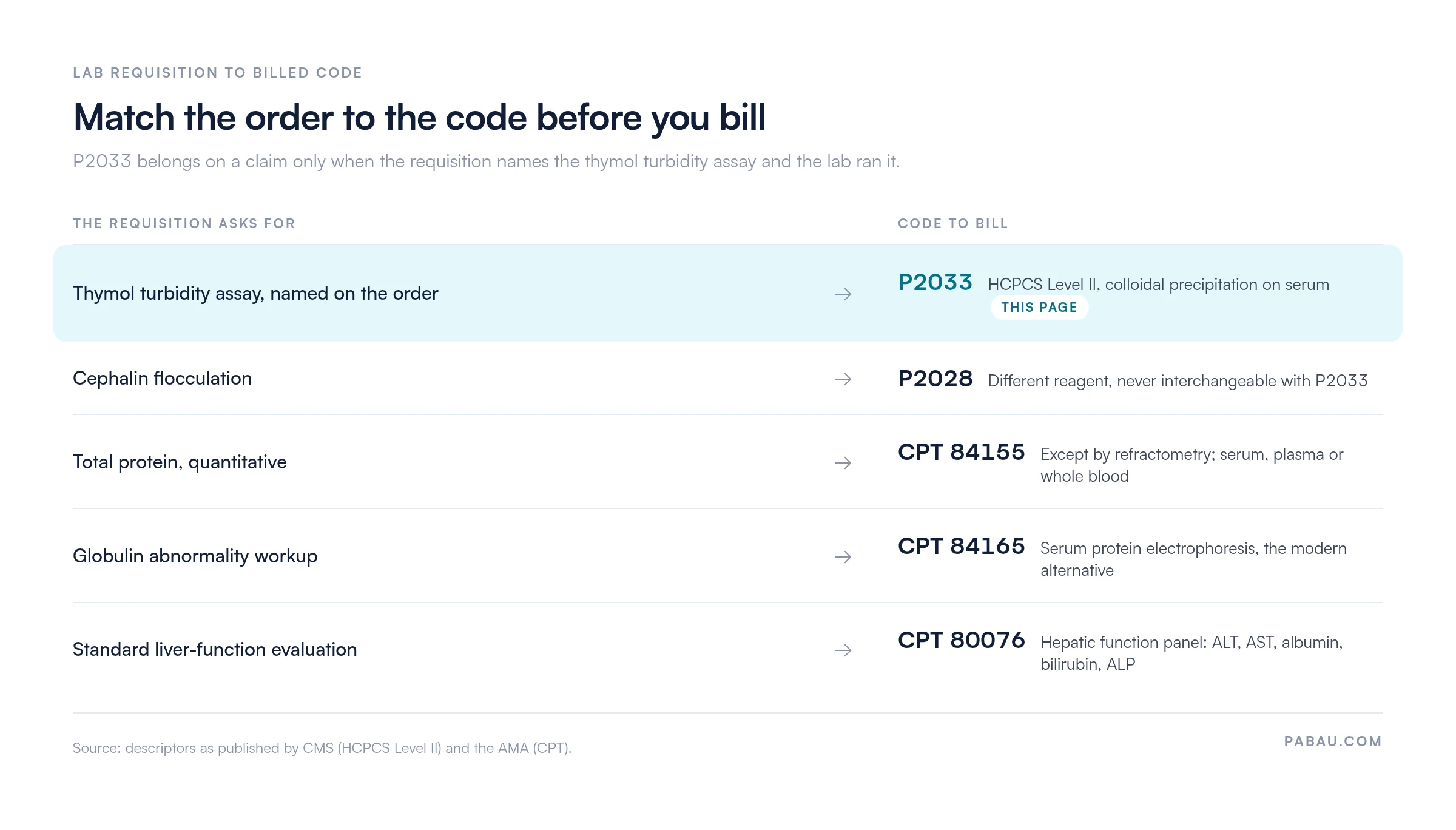
Coders sometimes confuse P2033 with adjacent lab codes that cover the same clinical territory. The distinctions come down to specimen type, analyte, and assay method. Using the wrong code produces a claim that does not match the procedure performed. In short, that is both a billing error and a compliance risk.
If the ordering physician’s intent was a standard liver-function evaluation, CPT 80076 or its components are almost always the better choice over P2033. Reserve P2033 for cases where the requisition names the thymol turbidity assay and the lab has run that method. Overall, working back from what the order asks for settles most of these cases quickly.
P2033 claims deny at a higher rate than most modern lab codes. Payer reviewers meet the test rarely, and the paper trail on a legacy order tends to be thinner. Knowing the denial patterns lets billing staff repair the claim before it goes out, which costs far less than an appeal.
A pre-submission documentation audit is the best way to protect P2033 claims from denial. The checklist below covers the minimum requirements for Medicare and most commercial payers. In other words, treat the audit as a standard step in the lab billing workflow, not something you run once a denial arrives.
Run a pre-submission audit on every P2033 claim using this checklist as a template. Pull the physician order, the medical record note, the lab result, and the diagnosis code together. If any element is missing or inconsistent, resolve it before the claim goes out. Appeals on historical P-series codes take longer to process than appeals on common lab codes.
P-series HCPCS codes like P2033 carry a documentation burden that manual billing workflows don’t always catch. An unsigned order, a mismatched diagnosis code, or a missing CLIA number each sinks a claim on its own. For that reason, those are the checkpoints that claims management software is built to catch before submission.
Practice management software like Pabau embeds HCPCS code lookup directly in the billing workflow. It cross-references the selected code against the paired diagnosis and flags missing required fields before the claim leaves the practice. For labs billing a mix of P-series HCPCS codes and standard CPT panels, that pre-submission scrubbing cuts the back-and-forth with payers.
Practices that handle reference lab billing or legacy panel codes benefit most from this automation. The checklist runs on every claim, so no biller has to hold every rule for every code in their head.
Tracking P2033 denials alongside the rest of the code set also shows where revenue leaks across multi-payer lab billing. That view is hard to assemble from remittance advice one claim at a time.

Pabau’s claims management tools flag missing physician orders, empty diagnosis fields, and unsupported code pairings while the claim is still being built. See how that fits a lab billing workflow.

HCPCS Code P2033 rewards care at every stage of the billing cycle. Modern labs have largely replaced the assay it describes, so billing staff meet the code rarely. By the time a P2033 claim reaches processing, its paper trail is often already incomplete.
The judgment worth making on each requisition is whether the order really called for a thymol turbidity assay. Where it did, run the pre-submission audit and expect to defend the claim. Otherwise, the modern CPT code will be paid faster and queried less.
Either way, the check belongs in front of the claim rather than behind the remittance. Book a demo to see how Pabau scrubs lab claims before they reach the payer.

Need a denial management framework for lab codes? Denial management in healthcare covers systematic approaches to identifying and resolving recurring claim denials across code types.
Want to understand how clean claims reduce rework? Clean claim best practices explains the elements payers check first and how to ensure claims pass initial edits.
Looking for guidance on billing compliance standards? Medical billing compliance outlines the documentation and coding standards that apply across laboratory and clinical billing.
HCPCS Code P2033 covers the thymol turbidity, blood test. The assay measures serum turbidity as an indicator of abnormal globulin or lipoprotein levels. Laboratories once used it to assess hepatic function and dysproteinemia.
P2033 is not separately reimbursed under the Medicare Clinical Laboratory Fee Schedule in most billing cases. Check it on the current-year CMS CLFS before submitting. Issue an Advance Beneficiary Notice of Noncoverage where you cannot confirm coverage for the patient’s diagnosis.
The most often paired diagnosis codes are K76.9, K70.9, E88.09, and R79.89. They cover liver disease, alcoholic liver disease, plasma-protein disorders, and abnormal blood chemistry findings. The selected code must be supported by documentation in the patient’s medical record.
Yes. Medicare and most commercial payers require a signed, dated order from an authorized ordering provider. That provider can be a physician or a qualified nonphysician practitioner. Claims submitted without a valid order are often denied under CO-16.
P2033 uses an older colloidal precipitation method and is billed under HCPCS Level II. Modern liver-function codes such as CPT 80076 and CPT 84165 are CPT Level I codes using quantitative assay methods. Bill P2033 only where the thymol turbidity assay was ordered and performed.
Required documentation includes a signed physician order and a clinical indication note in the patient’s medical record. You also need a matched ICD-10-CM diagnosis code and the lab result report with its CLIA number. Medicare patients need a signed ABN before specimen collection where coverage is uncertain.