HCPCS Code L0472: Hyperextension TLSO billing guide
HCPCS code L0472: Official descriptor and device definition HCPCS code L0472 des...

Last Updated: Nov 5, 2026
M1007 is the HCPCS Level II quality data code for ≥50% of total number of a patient's outpatient RA encounters assessed. It reports Performance Met on MIPS Quality ID #177, Rheumatoid Arthritis (RA): Periodic Assessment of Disease Activity.
The code tells CMS that RA disease activity was scored with an ACR-preferred tool at half or more of the patient's in-person RA visits. Accepted tools include CDAI, SDAI, RAPID3, DAS28 and PAS-II. M1007 carries no payment of its own, but it feeds the practice's MIPS quality score.
Let Pabau's smart automation suggest the right codes, reduce claim denials, and keep your practice compliant—effortlessly.
Automate repetitive tasks and focus on what matters most—your patients.
Reduce coding errors and ensure compliance with the latest regulations.
Clean claims, fewer denials, and faster reimbursements.
Powerful insights and reporting to help your practice thrive.
HIPAA compliant SOC 2 certified GDPR-compliant Trusted by 4,000+ clinics worldwide

M1007 is the Performance Met quality data code for MIPS Quality ID #177, which tracks periodic assessment of RA disease activity.
Report it when disease activity was scored with an ACR-preferred tool at ≥50% of the patient’s outpatient RA encounters in the performance period.
M1006 and M1008 are the two Performance Not Met codes, covering no assessment and assessment at fewer than half of encounters.
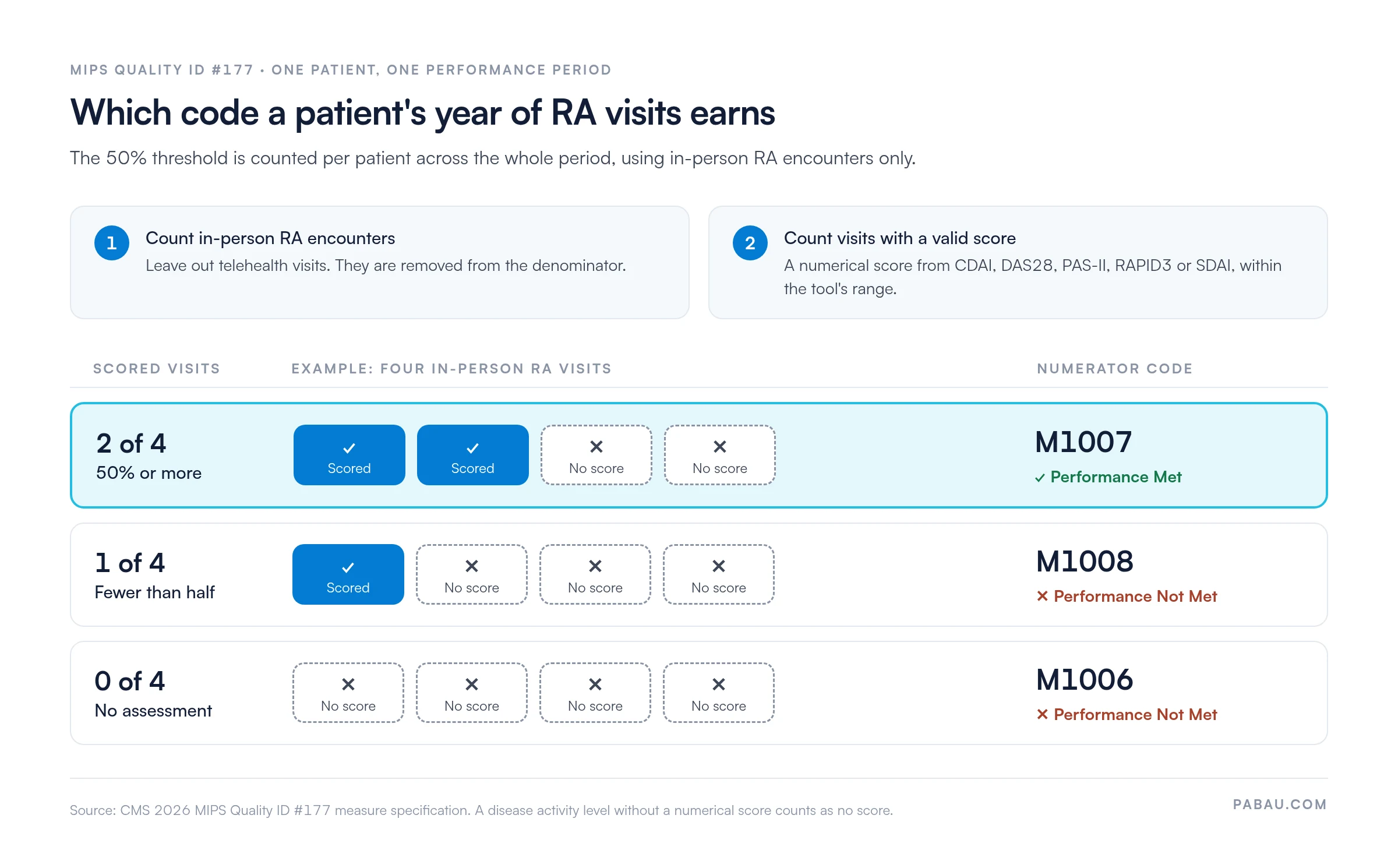
Telehealth visits leave the denominator, and a disease activity level recorded without a numerical score does not count toward the threshold.
M1007 is usually reported at a $0.00 charge with no standalone payment, but it feeds the MIPS score behind the payment adjustment.
HCPCS code M1007 is a Level II quality data code (QDC) used in the Merit-based Incentive Payment System (MIPS). It reports one outcome of Quality ID #177, Rheumatoid Arthritis (RA): Periodic Assessment of Disease Activity. The table below sets out the official wording and the measure details coders need.
Check the measure’s status on the Quality Payment Program measures page before each performance year. CMS revises measure specifications every year and can retire a measure through the annual Physician Fee Schedule rule. The code itself appears in the CMS HCPCS Level II data files. To compare M1007 with the neighboring M-codes, use our searchable HCPCS code library.
M1007 confirms that the clinician assessed RA disease activity with a standardized tool at half or more of a patient’s outpatient RA visits. The measure asks whether a practice scores disease activity systematically at each visit, rather than by impression.
The 2026 specification names five ACR-preferred tools:
Two details decide whether a visit counts toward the 50%. The score must fall within the tool’s valid range, so a CDAI of 101 does not count when the maximum is 76. A disease activity level such as low or high, recorded without a numerical score, does not count either.
The threshold is calculated per patient across the whole performance period. A patient seen for RA at four in-person visits needs a valid score at two or more of them for M1007. One scored visit out of four makes the case M1008. No scored visits makes it M1006.
MIPS eligible clinicians who manage RA report M1007, and most of them are rheumatologists. Primary care physicians, internists and other clinicians who manage a patient’s RA can report the measure too.
A patient enters the denominator only when all of these apply:
Not every M06 code qualifies. Adult-onset Still’s disease (M06.1) and inflammatory polyarthropathy (M06.4) are absent from the 2026 list, so those patients never enter the denominator.
M1007 is a numerator code, so it travels with the encounter that puts the patient in the denominator. No paired procedure sits behind it. The denominator comes from the E/M or listed HCPCS encounter code plus a qualifying RA diagnosis.
In 2026, Quality ID #177 is collected as a MIPS CQM, usually through a registry or another third-party intermediary. The specification says clinicians using that collection type do not need to submit the quality data codes. Intermediaries that build their data from Medicare Part B claims may still use them, so your registry may ask for M1007 on the claim.
M1007 generates no payment on its own. The Quality ID #177 performance rate feeds the MIPS quality category score. That score drives the payment adjustment applied to Medicare Part B payments two years later.
The chart must show a numerical disease activity score at each visit counted toward the threshold. A note that says RA is well controlled does not support M1007.
Store the score in a structured field rather than in free text. A registry or auditor can then count scored visits per patient without re-reading every note.
Because M1007 carries a $0.00 charge, an error rarely shows up as a lost payment. It shows up as a lost or mis-scored quality case. Strong denial management in healthcare starts with knowing which of these responses needs action.
All three codes report the numerator of Quality ID #177, and each patient gets one outcome per performance period. The choice depends on how many in-person RA encounters carried a valid score.
The 2026 specification lists no denominator exception for this measure, so a missed assessment cannot be excused with a medical or patient reason. Check the current descriptors on the QPP measures page each year.
Run these checks before a registry submission, or before M1007 goes on a claim. Submitting a clean claim also protects the encounter line that M1007 travels with.
Most M1007 errors start in the chart. A score recorded in free text, or a visit logged as telehealth by mistake, changes the patient’s outcome at year end.
Pabau, the practice management and EHR platform we build, lets a practice add structured CDAI or RAPID3 score fields to its visit notes. Each score is stored against the encounter date, so your team can count scored visits per patient before reporting.
When M1007 goes on a claim, your coder adds it to the encounter. Pabau’s claims management software then submits the claim and tracks its status. That keeps the quality line visible alongside the rest of your medical billing work.

Pabau stores structured disease activity scores against each visit and submits your claims, so your team can confirm M1007 before reporting.

M1007 is decided in the exam room. The code is earned when the clinician records a numerical score from an ACR-preferred tool. It is lost when that score is missing, out of range or tied to a telehealth visit.
Build the score into every in-person RA visit, count scored encounters before submission, and recheck the measure’s status each year. Book a demo to see how Pabau keeps RA disease activity scores structured and ready for quality reporting.

Need to understand how claims move through your billing cycle? What is revenue cycle management covers the end-to-end process from patient encounter to payment posting.
Want to reduce claim rejections before they reach the payer? Denial management in healthcare explains the patterns behind common claim failures and how to address them systematically.
Looking for guidance on building cleaner claim submissions? Submitting a clean claim outlines the pre-transmission checks that reduce first-pass rejection rates across your billing team.
HCPCS code M1007 is the Performance Met quality data code for MIPS Quality ID #177, Rheumatoid Arthritis (RA): Periodic Assessment of Disease Activity. It reports that RA disease activity was scored with an ACR-preferred tool at 50% or more of the patient’s outpatient RA encounters.
No. M1007 is usually reported at a $0.00 charge and has no standalone payment. It feeds the MIPS quality score, which drives the payment adjustment on later Medicare Part B payments.
No modifier is needed to report M1007. Telehealth status still matters, because telehealth encounters are removed from the denominator. Only in-person RA visits count toward the 50% threshold.
M1007 does not count when the patient falls outside the denominator or misses the threshold. Common causes are telehealth visits in the count, levels recorded without scores, out-of-range scores and a non-qualifying diagnosis. Remark code N620 on the $0.00 line is expected and only confirms receipt.
M1007 means valid disease activity scores were recorded at 50% or more of the patient’s outpatient RA encounters, which is Performance Met. M1008 means scores were recorded at fewer than half of those encounters, which is Performance Not Met. M1006 covers patients with no assessment at all.
The patient needs an RA diagnosis from the measure’s ICD-10-CM list, which covers the M05 codes and most M06 codes. Adult-onset Still’s disease (M06.1) and inflammatory polyarthropathy (M06.4) are not on the 2026 list. The diagnosis must appear at two encounters at least 90 days apart.