

HCPCS code E0198: Water pressure pad billing guide
HCPCS code E0198 is a water pad for a standard mattress HCPCS code E0198 is the ...

Last Updated: Oct 13, 2026
HCPCS code L1951 covers a spiral ankle-foot orthosis of the Institute of Rehabilitative Medicine type. The brace arrives prefabricated, then someone with expertise trims, bends, molds or assembles it to fit one patient. That fitting work is the whole test. Build the same brace from a cast and it is L1950. Hand it over unmodified and it is L1952.
Two Medicare checks have to clear before the brace is handed over. Prior authorization must come back affirmed, and PDAC must have verified the model for this code. Neither can be repaired after delivery.
Let Pabau's smart automation suggest the right codes, reduce claim denials, and keep your practice compliant—effortlessly.
Automate repetitive tasks and focus on what matters most—your patients.
Reduce coding errors and ensure compliance with the latest regulations.
Clean claims, fewer denials, and faster reimbursements.
Powerful insights and reporting to help your practice thrive.
HIPAA compliant SOC 2 certified GDPR-compliant Trusted by 4,000+ clinics worldwide

HCPCS code L1951 covers a prefabricated spiral ankle-foot orthosis that someone with expertise customizes to fit one patient.
L1950 is the custom-fabricated spiral AFO, and L1952 is the same spiral design supplied off the shelf since April 2025.
The three codes share one device shape, so the claim turns on how the brace was made and fitted.
Medicare has required prior authorization on L1951 nationwide since August 12, 2024, and it has to be affirmed before delivery.
Only models PDAC has verified for L1951 can be billed under it, for dates of service from December 1, 2024.
Practice management software like Pabau holds the authorization, the fitting note and the delivery receipt on one patient record.
HCPCS code L1951 is the Level II code for an ankle-foot orthosis, spiral, of the Institute of Rehabilitative Medicine type. The brace arrives prefabricated, and an individual with expertise then customizes it to the patient.
Three phrases in that descriptor do all the work. Spiral fixes the device design. Prefabricated rules out anything built from raw materials for this patient. The customization clause then rules out a brace handed over with no adjustment at all.
L-codes sit inside HCPCS Level II, the code set CMS maintains for orthotic and prosthetic devices that CPT does not cover. L1951 is a DMEPOS item, billed to Medicare Part B by an enrolled DMEPOS supplier. The table below collects the details a biller reaches for most often.
A spiral ankle-foot orthosis wraps around the calf and foot in one continuous helical band of thermoplastic. It carries no mechanical ankle joint.
That is the physical difference from a posterior solid AFO, which runs straight down the back of the leg. It also separates the spiral from an articulated AFO, which has a hinge at the ankle.
The wrap gives rotational control as well as dorsiflexion assistance, so the tibia can still rotate a little as the patient walks. Clinicians reach for it in foot drop, supinator spasticity, and ankle instability after a stroke.
Recognizing the shape does not finish the job. Three separate L-codes describe this same brace, and what separates them happens in the workshop and at the fitting.
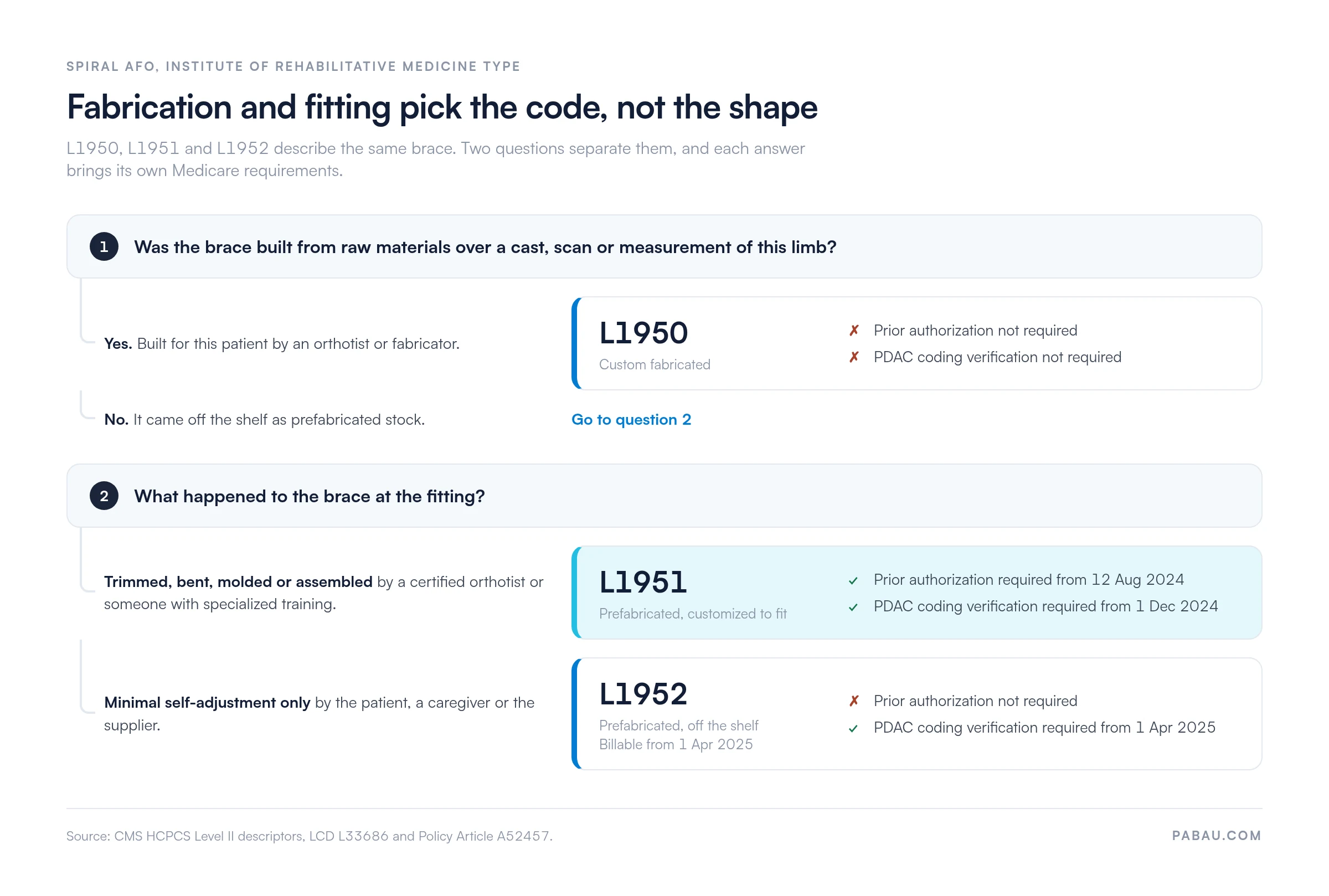
All three codes describe the same spiral IRM brace. The code turns on how the device was produced and how much work the fitting took. Reading the shape alone will pick the wrong one.
L1950 is custom fabricated. The orthotist builds the brace from raw materials over a cast, a scan, or direct measurement of that patient’s limb.
L1951 and L1952 both start as prefabricated stock. L1951 is the one an individual with expertise trims, bends, molds or assembles so it fits the patient. L1952 is the one handed over needing only minimal self-adjustment.
L1952 came out of the second 2024 HCPCS coding cycle and is billable for devices delivered on or after April 1, 2025. Before that date there was no off-the-shelf code for a spiral AFO, which is why older guidance still treats L1951 as the only prefabricated option.
Two questions settle almost every one of these claims. Was the brace built for this patient from raw materials? If it was, the code is L1950.
If it was not, ask what happened at the fitting. Expert trimming, bending, molding or assembly points to L1951, and a brace worn straight out of the box points to L1952. Record the answer in the fitting note, and the code selection stays auditable later.
Worth noting for anyone reading older material: the payment is the same either way. CMS set the L1952 fee schedule amount equal to L1951’s, so choosing between them is a compliance question rather than a revenue one.
Watch one trap in particular. A posterior solid AFO is easy to file under a spiral code when the paperwork only says “custom AFO”. That device belongs under L1960, and the fabrication record is what proves which one was dispensed.
Two more codes sit just outside that table. A plain prefabricated plastic AFO with no spiral wrap is billed under HCPCS code L1930. A rigid anterior tibial shell built from a cast or scan rather than trimmed from stock belongs to L1945, the custom-fabricated floor reaction design.
Off-the-shelf items need only minimal self-adjustment at delivery. Medicare defines that as an adjustment the patient, a caregiver, or the supplier can make without the services of a certified orthotist.
Custom fitted means more than that. The item has to be trimmed, bent, molded with or without heat, or otherwise modified to give an individualized fit. The work needs a certified orthotist, or someone with specialized training in providing the orthosis.
L1951 is billed against that definition, not against a product catalog. A brace marketed as custom fit still bills as L1952 when nobody modified it at delivery.
Here is how that plays out in a fitting room. A patient with left foot drop is fitted with a stock spiral AFO. The orthotist then heats and reshapes the calf section to clear a bony prominence. That is L1951. The same brace, handed over with one strap pulled tighter, is L1952.
Policy Article A52457 is explicit about the record. Documentation has to describe why the modifications were necessary and what was performed at the time of fitting. A note reading “fitted and dispensed” does not meet that standard.
So the fitting note is the document that carries an L1951 claim. Four things belong in it.
That note settles the code. Two further Medicare requirements sit upstream of it, and both have to be finished before the brace reaches the patient.
L1951 sits on the Medicare required prior authorization list for DMEPOS. The requirement took effect nationwide for dates of service on or after August 12, 2024, alongside knee orthoses L1843 and L1845.
The request goes to the DME MAC before the brace is delivered, not before the claim is filed. That timing is what catches suppliers out, because the device is often already fitted by the time billing looks at the file.
The contractor returns an affirmed or non-affirmed decision. An expedited review is available where a standard timeframe could seriously jeopardize the patient’s health.
A claim submitted without an affirmed decision is denied. Authorization can still be requested afterwards and the claim resubmitted, so the immediate cost is time rather than the payment itself.
L1952 is not on the required list. That difference matters at intake, because a supplier who codes an off-the-shelf brace as L1951 also inherits an authorization step it never completed.
Prior authorization and coding verification are two different checks, and L1951 needs both. Clearing one does not clear the other.
Only products with a written Coding Verification Review from the Pricing, Data Analysis and Coding contractor may be billed under L1951. The requirement applies to dates of service on or after December 1, 2024.
The manufacturer or distributor submits the product to PDAC. PDAC assigns the code and adds the device to the Product Classification List, which suppliers then search by product name, manufacturer, or code at dmepdac.com.
If the model dispensed is not on that list for L1951, the line is denied as incorrect coding. Keep a copy of the listing in the patient’s file, next to the delivery receipt.
L1952 carries the same requirement from April 1, 2025. So an off-the-shelf spiral AFO has to be verified under its own code rather than riding on an L1951 listing.
Run the PDAC lookup and the prior authorization request at intake, before the patient is measured. Both take minutes at that stage. After the brace is delivered, neither can be fixed without a new order or a write-off.
Medicare coverage for L1951 is set by CMS LCD L33686, the ankle-foot and knee-ankle-foot orthosis policy administered by the four DME MACs.
Policy Article A52457 then sets out what the claim file has to show. Read both, because one names the indication and the other names the evidence.
Coverage rests on findings the treating practitioner records. There has to be a neuromuscular or musculoskeletal condition causing weakness or instability at the ankle. The brace has to be expected to give a functional benefit. And the condition must not be expected to resolve to the point where the device becomes unnecessary.
Final Rule 1713 also requires a face-to-face encounter and a written order prior to delivery for the codes it lists. An item delivered before that order is on file is denied as not reasonable and necessary.
Verify every diagnosis code against the current year’s official code set using the CDC ICD-10-CM web tool. Codes change each fiscal year, and an expired one is an instant technical denial.
Thin documentation denies more L1951 claims than any coding mistake. What trips suppliers up is rarely the list itself. It is the timing, because several of these documents have to exist before the brace reaches the patient.
Build that packet as the order moves, rather than pulling it together once an auditor asks. In that order it becomes the audit trail that keeps the supplier whole on post-payment review.
KX is the one that catches most billers. Its absence tells the DME MAC that the coverage criteria were never documented. Add it once the file supports the claim, and never as a habit.
L1951 can be billed bilaterally when both limbs need a spiral AFO and each has its own documented necessity. Bill two separate line items on one claim, one with LT and one with RT. Two units on a single line reads as a quantity error in most DME MAC systems, and it denies.
Medicare does not infer bilateral need from a bilateral diagnosis. The notes need a functional assessment for each limb, and the fitting note has to record the modifications made to each brace.
There is no single national price for L1951. CMS publishes a DMEPOS fee schedule amount each year, and it varies by DME MAC jurisdiction. Rates change every January 1.
L1951 is paid as a purchase rather than a rental, so the allowed amount comes on the initial claim. There is no rental period to track and no monthly line to renew.
The patient owes the usual 20% coinsurance once the Part B deductible has been met. Fitting is not billed separately, because the adjustment work is part of dispensing the orthosis under this code.
For a current figure, query the DMEPOS fee schedule with your jurisdiction and the code. Third-party fee databases lag the published schedule, so they are a cross-check rather than a source.
L1951 denials follow a short and repetitive list. Match each reason code to its root cause, then fix that cause in the pre-submission workflow rather than in the appeal.
Notice the pattern. Nearly every row is a documentation or sequencing failure rather than a coverage dispute, which is why appeals are the slow way to fix them.
When a remittance comes back, map the payer’s reason code to the row it belongs to. Our reference on denial codes covers the codes you are most likely to see on a DMEPOS remittance.
Most L1951 denials would not survive a two-minute review of the file. Work down this list on the day the claim goes out, and answer each line with a document rather than a memory.
Any line you cannot answer is worth a phone call before submission. Fixing an order takes a day. Reversing a recoupment takes months.
Most suppliers run this process across three systems. The authorization request sits in a payer portal, and the clinical and fitting notes live in the EMR. The delivery receipt gets scanned into a shared drive. Nobody sees the whole file until a claim denies and someone rebuilds it by hand.
Pabau, our practice management software, brings those pieces onto one patient record instead. The order, the clinical notes, the fitting note and the signed delivery receipt all attach to the same patient, in date order. So the sequence is visible while the brace is still on order.
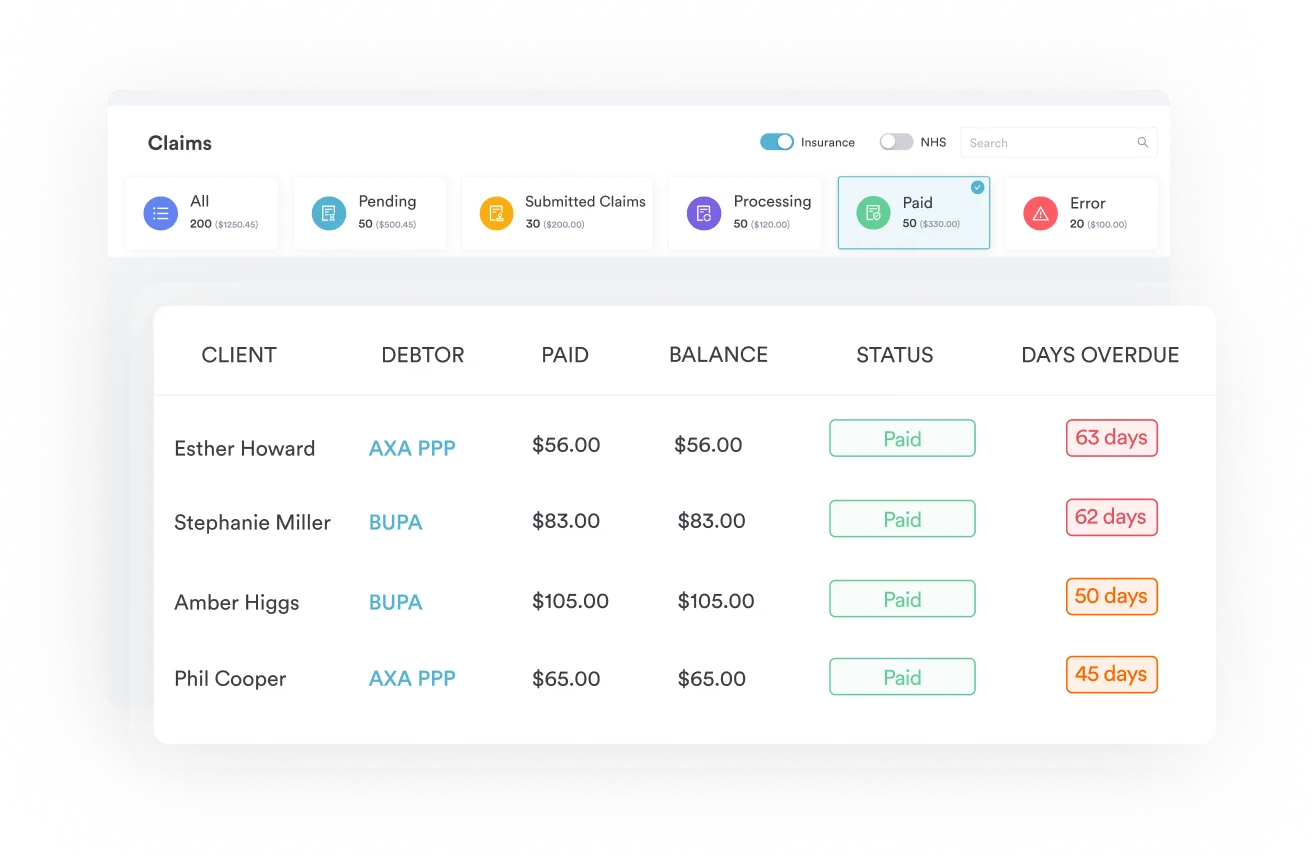
Pabau’s claims management software then builds the claim from that record. It pre-fills the claim from what is already charted, and it offers code lookup libraries instead of retyped codes.
Required fields get checked before the claim is submitted. That will not judge whether a brace was modified enough to count as custom fitted, and it does not read the LCD for you. What it does is stop a claim leaving with an empty field behind it.

Pabau pre-fills claims from the patient record, offers code lookup libraries, and checks required fields before submission. See how that fits the way your billing team already works.

L1951 is a narrow code, and the narrowness is where the denials come from. The brace has to be prefabricated, and the fitting has to involve genuine modification by someone with expertise. Both facts have to be on the record.
Two gates sit in front of the claim as well. Prior authorization has been required nationwide since August 2024, and only PDAC-verified products have been billable under the code since that December. Neither can be repaired after delivery.
If your L1951 files are spread across a portal, an EMR and a scanned drive, the sequence is where the risk sits. Book a demo to see how Pabau holds the authorization, the notes and the delivery record on one patient file before the claim goes out.

Billing the custom-fabricated version of this brace? HCPCS code L1950 sets out the coverage and documentation rules for the spiral AFO built from a cast or scan.
Dispensing a posterior solid ankle brace instead? HCPCS code L1960 covers the non-spiral custom-fabricated AFO that L1951 is most often confused with.
Need a framework for handling claim denials? Denial management in healthcare covers the root-cause approach to reducing first-pass denial rates across DMEPOS claims.
Want the wider billing picture? What is medical billing explains the end-to-end workflow from code assignment through to payment posting.
A standard request gets a decision within 10 business days of receipt. A resubmitted request takes up to 20 business days. An expedited review is answered within 2 business days, where a delay could seriously jeopardize the patient’s health.
Medicare sets a reasonable useful lifetime of five years for a lower-limb brace. Inside that window it pays for a replacement only when the device is lost, stolen or irreparably damaged. Repairs are the usual route instead.
L4205 bills the labor, per 15 minutes. L4210 bills the replacement of minor parts. Attach a short narrative saying why the repair was needed, because the DME MAC will not assume it.
No. Each plan sets its own authorization rules, network requirements and orthotic policy. Many track the DME MAC criteria closely, but read the plan’s own policy before the patient is measured.
Only a supplier enrolled with Medicare and holding a DMEPOS supplier number can bill it. Enrollment carries accreditation and surety bond requirements. A practice without one refers the fitting to an enrolled supplier.



