

Pabau Engage inbox

Pabau Engage is here: every patient conversation in one inbox.

Learn more
HCPCS Code

HCPCS code L1840 – Custom derotation knee orthosis


Code Definition

L1840 is the HCPCS Level II code for knee orthosis, derotation, medial-lateral, anterior cruciate ligament, custom fabricated.

It belongs to the L1810-L1860 knee orthosis range and covers only braces fabricated from the individual patient's measurements. A prefabricated brace with similar controls is billed under a different L-code, never as L1840.

Level
Level II
Category
L — Orthotic and prosthetic procedures
Code range
L1810-L1860 Knee Orthoses (CMS Policy Article A52465)
Billable
No
Code also known as
ACL brace, derotation brace, custom knee brace, functional knee orthosis, ligament stabilization brace
Save time. Improve accuracy. Get paid faster.
Automate coding with Pabau

Let Pabau's smart automation suggest the right codes, reduce claim denials, and keep your practice compliant—effortlessly.

  • AI-powered code suggestions
  • Real-time compliance checks
  • Faster claims, fewer denials
Why practices choose Pabau
Save hours every week

Automate repetitive tasks and focus on what matters most—your patients.

Improve accuracy

Reduce coding errors and ensure compliance with the latest regulations.

Get paid faster

Clean claims, fewer denials, and faster reimbursements.

Grow with confidence

Powerful insights and reporting to help your practice thrive.

HIPAA compliant SOC 2 certified GDPR-compliant Trusted by 4,000+ clinics worldwide

Key takeaways

Key takeaways

L1840 applies only to custom-fabricated knee orthoses, so a prefabricated brace is billed under a different code in the L1810-L1860 range.

CMS policy article A52465 governs medical necessity, and the clinical record must document ACL insufficiency or ligamentous instability.

The KX modifier is required on every Medicare L1840 claim to certify that medical necessity documentation is on file.

Two DME MACs process these claims: Noridian for Jurisdictions A and D, and CGS for Jurisdictions B and C.

Claims management software like Pabau keeps the order, notes, and delivery records on the patient file, then pre-fills and tracks the claim.

HCPCS code L1840: definition and official descriptor

HCPCS code L1840 is a Level II orthotic code describing a custom-fabricated knee orthosis with derotation, medial/lateral, and anterior cruciate control. The official long descriptor reads: Knee orthosis, derotation, medial-lateral, anterior cruciate ligament, custom fabricated. Several elements in that descriptor carry billing weight, and each must be reflected in the supplier’s documentation.

FieldValue
HCPCS CodeL1840
Code systemHCPCS Level II (CMS-maintained)
Code categoryKnee Orthosis (KO) – L-code range L1810-L1860
Device typeCustom fabricated (not prefabricated)
Benefit categoryMedicare Part B DME benefit
Competitive biddingCustom orthotics are generally exempt; confirm with current CMS CBIC list

According to the Centers for Medicare and Medicaid Services (CMS), HCPCS Level II L-codes cover orthotics, prosthetics, and related supplies under Medicare’s Part B program. For code lookups and descriptor verification, the AAPC HCPCS code range reference provides the full L1810-L1860 listing with short and long descriptors.

What L1840 covers: inclusions, exclusions, and adjacent L-codes

These checks decide whether a brace qualifies for L1840.

  • Included: A custom-fabricated knee orthosis with a derotation mechanism, ACL control, and medial and lateral uprights, made from the individual patient’s measurements
  • Excluded: Prefabricated braces, custom-fitted or off the shelf, and any brace without derotation, ACL control, medial/lateral uprights, or individual measurements

Neighboring codes in the L1810-L1860 range cover prefabricated braces and simpler supports. L1830 and L1845 are most often mistaken for L1840. Confirm the code in the table below.

CodeShort descriptorCustom or prefabKey differentiator from L1840
L1810KO, elastic with jointsPrefabricatedNo derotation; elastic shell; prefab only
L1820KO, elastic with condylar padsPrefabricatedNo derotation; condylar pads only
L1830KO, immobilizer, canvasPrefabricatedImmobilizer, no derotation; most often confused with L1840
L1840KO, derotation, medial-lateral, ACL, customCustom fabricatedThe code in this article; derotation + ACL + custom required
L1845KO, double upright, adjustable flexion and extension joint, medial-lateral and rotation controlPrefabricated, custom-fittedA different design. Its custom-fabricated counterpart is L1846; off-the-shelf is L1852.
L1850KO, Swedish, customCustom fabricatedCustom but no derotation or ACL control
L1860KO, modification, additionAddition codeAdd-on for modifications, not a standalone code

Practical tip: a catalog-ordered derotation brace can’t be billed as L1840, because it wasn’t fabricated to the patient’s measurements. Code it by its own design and PDAC listing. L1845, for example, is a prefabricated, custom-fitted double-upright brace.

Applying L1840 to a prefab device is a false claim under Medicare and a common PDAC verification finding. Confirm fabrication status on every claim. The decision path below runs the three checks in order.
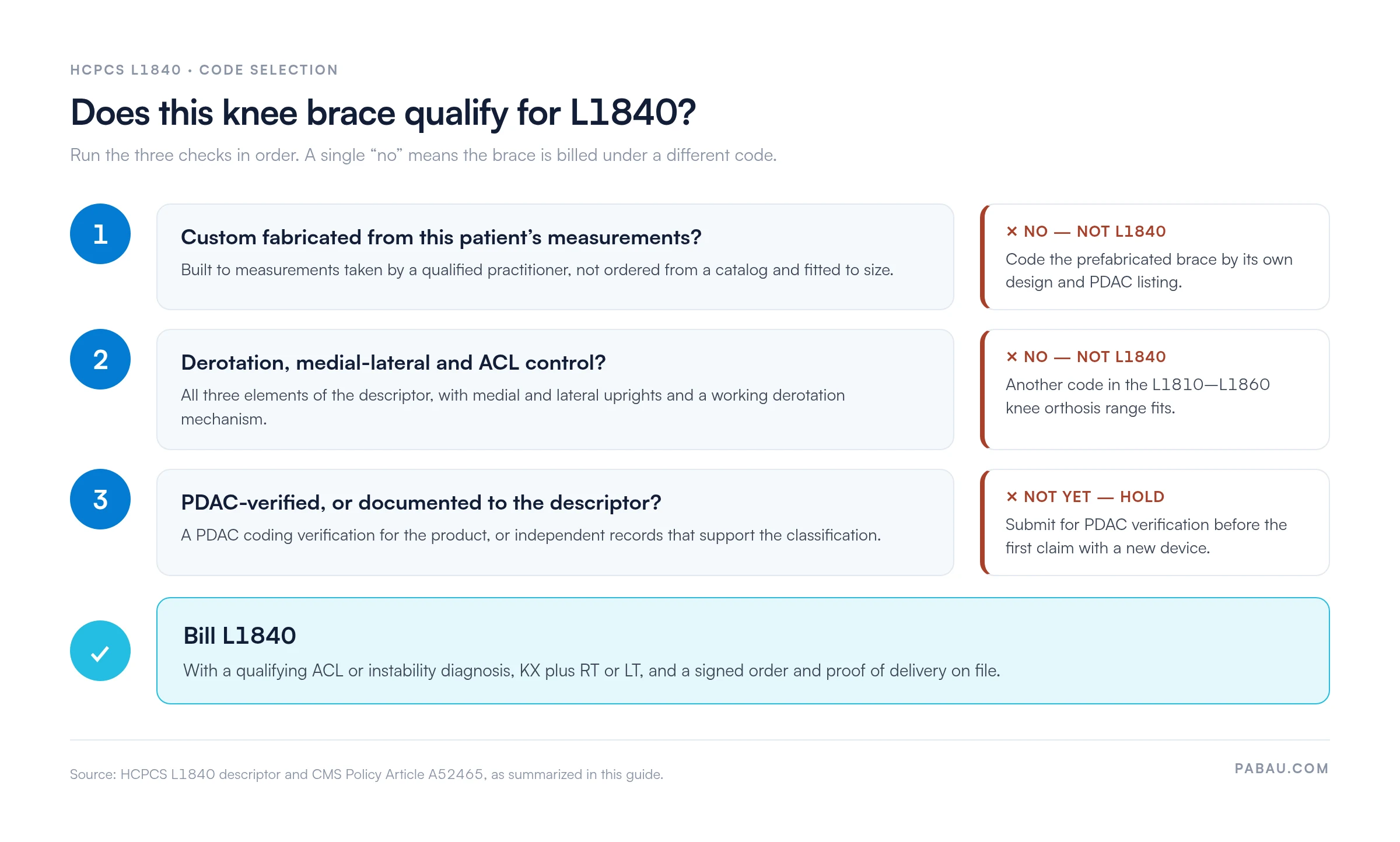
Decision path for HCPCS L1840
Fabrication status is the first check because no diagnosis or modifier can rescue a prefabricated brace billed as L1840. Based on the HCPCS descriptor and CMS Policy Article A52465.

Medicare coverage policy for L1840 (CMS article A52465)

CMS policy article A52465 sets the Medicare coverage criteria for knee orthoses. For L1840 to be covered, the beneficiary must meet every condition below.

  • The patient has a diagnosis of ACL insufficiency, ligamentous instability, or another qualifying knee condition documented in the medical record
  • A physician has ordered the orthosis and the order includes the qualifying diagnosis and the functional need for derotation control
  • The device is custom fabricated – measurements from the individual patient are documented
  • The supplier is enrolled in Medicare as a DMEPOS supplier
  • The PDAC (Pricing, Data Analysis and Coding contractor) has verified that the product meets the L1840 coding criteria. Otherwise, the supplier holds independent documentation supporting the classification

Two DME Medicare Administrative Contractors (DME MACs) process Medicare knee orthosis claims. Noridian covers Jurisdictions A and D, and CGS covers Jurisdictions B and C. Jurisdiction E is a Part A/B jurisdiction and handles no DME claims. Palmetto GBA runs the PDAC, which verifies product coding but doesn’t process claims.

Both DME MACs publish supplier guidance on documentation timing and proof of delivery alongside A52465. Check your DME MAC’s guidance as well as the national policy article. If your practice fits and supplies knee orthoses, a checklist built from that guidance keeps every claim file consistent.

Pro Tip

Check the PDAC website before billing L1840 for any new product your practice has not previously submitted claims for. PDAC coding verifications confirm whether a specific device meets the L1840 descriptor. Without that confirmation, a post-payment audit can reclassify the claim to a lower-paying prefab code and trigger recoupment.

ICD-10 diagnosis codes that support L1840

Every L1840 claim needs a paired ICD-10 diagnosis code that establishes medical necessity. The code must describe the knee condition that makes a derotation orthosis with ACL control clinically appropriate. The codes below are common pairings, not a complete list, so check each one against current CMS guidance and your DME MAC’s policy.

ICD-10 CodeDescriptionNotes
M23.61Other spontaneous disruption of ACLPrimary code for ACL insufficiency; specify laterality (M23.611 right, M23.612 left)
S83.511Sprain of ACL of right kneeAcute ACL injury; requires appropriate 7th character for encounter type
S83.512Sprain of ACL of left kneeAcute ACL injury, left side; requires 7th character
M23.50Chronic instability of knee, unspecifiedAcceptable but specify laterality where possible
Z96.651Presence of right artificial knee jointPost-surgical support use; verify MAC policy for post-arthroplasty orthosis coverage
M25.361Stiffness of right knee, not elsewhere classifiedGenerally insufficient alone for L1840; pair with primary ligamentous instability code

Codes to avoid pairing with L1840: osteoarthritis alone (M17.x), general knee pain (M25.561), and contusions (S80.x). None of them establishes medical necessity for a derotation orthosis with ACL control. Claims that list these as the primary or only diagnosis are routinely denied. Check each pairing against your DME MAC’s coverage policy before submission.

Documentation requirements and modifiers for L1840 claims

Build the complete file below before you submit an L1840 claim. A single missing item can trigger a denial, and an appeal adds weeks before payment.

  • Physician order/prescription: must identify the qualifying diagnosis, state the need for a custom-fabricated derotation KO, and be dated before the device is delivered
  • Detailed product description (DPD): describes the specific device, its components, and the custom features
  • Fabrication measurements: the clinical record must show patient-specific measurements taken by a qualified practitioner, distinguishing the device from a prefab fit
  • Proof of delivery (POD): signed delivery receipt with date, beneficiary signature, and device description
  • Clinical notes: document ACL insufficiency or ligamentous instability, functional limitation, and the clinical rationale for the prescribed level of control
  • Certificate of medical necessity (CMN): required by some MACs for certain custom orthotics; check your MAC’s specific requirements

Modifiers required when billing L1840

ModifierMeaningRequired or optional
KXMedical necessity documentation is on file and meets the payer’s coverage criteriaRequired on all Medicare L1840 claims; omitting it results in automatic denial
GAAdvance Beneficiary Notice (ABN) on fileRequired when coverage is uncertain and the supplier has obtained an ABN
GKReasonable and necessary item billed with GA modifierUsed alongside GA when the supplier believes the item is covered despite ABN
RT / LTRight side / Left sideRequired to identify which knee received the orthosis
NUNew equipmentRequired for purchase of new device; distinguishes from rental or used equipment
RRRentalFor rental billing; verify MAC policy as custom orthotics are typically purchased

Appending KX certifies that the supplier’s file holds documentation meeting every coverage criterion. Add KX only when the file supports it. A KX claim without that file is a compliance exposure that any post-payment audit will surface.

L1840 fee schedule and reimbursement rates

L1840 reimbursement is set by the Medicare DMEPOS fee schedule, which publishes purchase allowables by state. Rates are updated every year. For the current allowable, open the CMS DMEPOS fee schedule files and find L1840 for your state.

  • Custom orthotics and competitive bidding: custom-fabricated orthoses are generally not subject to the competitive bidding program. Confirm with the current CMS Competitive Bidding Implementation Contractor (CBIC) list before assuming exemption
  • Commercial payer rates: most commercial payers set their own fee schedules for L-codes, which may sit above or below Medicare allowables. Verify rates through payer contracts or provider portals
  • Prior authorization and L1840: PA requirements for L1840 vary by MAC jurisdiction and commercial payer. Some MACs require prior authorization for high-cost custom orthotics; others apply prior auth only to specific situations, such as bilateral fittings or post-surgical use. Always verify PA requirements with the specific payer before fabricating the device

Treat any third-party fee table as an estimate, and pull the current CMS file before you bill or quote a patient.

Common denial reasons for L1840 claims and how to fix them

The eight denial patterns below map to the documentation and coding requirements in A52465 and DME MAC guidance. Each one has a fix you can build into the workflow before submission.

  1. Wrong code: prefabricated device billed as custom L1840. Fix: verify fabrication records before code selection. A catalog brace fitted to size is coded by its own design under the prefabricated knee orthosis codes.
  2. KX modifier missing. Fix: make KX a required field in your claims workflow; no KX, no submission for Medicare L1840.
  3. No physician order on file. Fix: collect a signed, dated order with the qualifying diagnosis before scheduling fabrication.
  4. ICD-10 code does not establish medical necessity. Fix: review the ICD-10 pairing against A52465 before submission; osteoarthritis or knee pain alone is not sufficient.
  5. Proof of delivery missing or incomplete. Fix: collect a signed POD at delivery, including the device description and beneficiary signature.
  6. Prior authorization not obtained. Fix: check PA requirements with the payer before fabrication; PA cannot be obtained retroactively.
  7. PDAC coding not verified for a new product. Fix: submit the product for PDAC coding verification before billing L1840 for the first time with a new device.
  8. Supplier not enrolled as a DMEPOS supplier. Fix: confirm Medicare DMEPOS enrollment is active before billing any DME code.

When a denial does arrive, our guide to reading denial codes explains the remittance reason codes and how to build an appeal.

Pro Tip

Run a quarterly audit of your L1840 claims and filter by denial reason code. If more than two denials in a quarter share a reason, trace them to the workflow step that caused them and change that step.

How to bill L1840 correctly: step-by-step

Work through these eight steps in order. A skipped step leaves the claim file incomplete, and a post-payment audit will find it.

  1. Confirm custom fabrication qualifies. The device must be fabricated from individual patient measurements. If it is prefabricated, it can’t be billed as L1840, so code it by its own design.
  2. Obtain a physician order. The order must include the qualifying diagnosis (ACL insufficiency or ligamentous instability), the clinical need for derotation control, and the date.
  3. Verify PDAC coding for the specific product. Confirm the device meets the L1840 descriptor through PDAC or maintain independent documentation supporting the classification.
  4. Check prior authorization requirements. Contact the payer or check the MAC’s guidance before fabricating the device. PA cannot be obtained after delivery.
  5. Assemble the complete documentation file. Physician order, DPD, fabrication measurements, CMN (if required by MAC), and clinical notes establishing medical necessity.
  6. Apply correct modifiers. KX is mandatory for Medicare. Add RT or LT. Use NU for purchase. Add GA and GK if an ABN is in place.
  7. Submit with the paired ICD-10 code. Use a diagnosis code that reflects ACL insufficiency or ligamentous instability, as documented in the clinical record.
  8. Retain proof of delivery. File the signed POD with the claim documentation. Submit once all documents are in the file.

For the PDAC step, CGS publishes coding verification guidance with DME MAC detail on how verification requests work.

How claims management software keeps L1840 claims complete

An L1840 file often comes together from several places. The order arrives by fax, the measurements sit in fitting notes, and the signed delivery receipt stays on paper until someone scans it.

Practice management software like Pabau keeps those documents on one patient record. Its error-checked claims management pulls details from that record into a pre-filled claim and flags missing required fields before submission. In the US, claims go out through Claim.MD, which also runs eligibility checks and posts ERA remittances.

Your team then sees which claims are pending, submitted, paid, or rejected in one dashboard. When a denial comes back, the appeal starts from a file that is already complete.
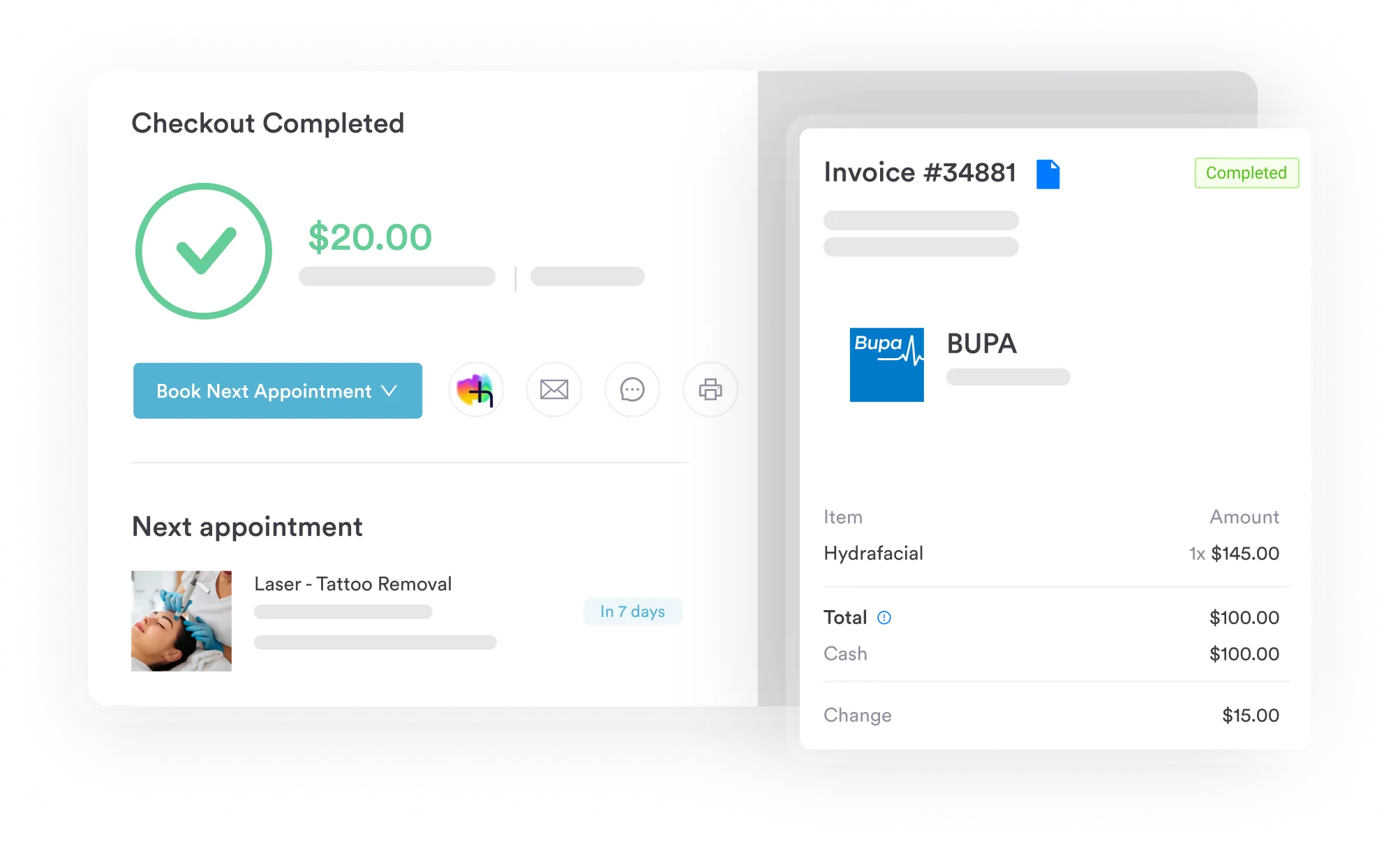

Pabau claims management dashboard listing claims by status
Pabau’s claims dashboard shows each claim’s stage, so a stalled L1840 claim is spotted before the payer’s deadline passes.

Streamline your DME and orthotic billing

Pabau helps DME suppliers and orthotic practices manage documentation, modifiers, and claim submissions in one place, reducing denials and speeding up reimbursement cycles.

Pabau claims management dashboard

Conclusion

Treat fabrication status as the first decision on every L1840 claim. If the brace wasn’t built from the patient’s own measurements, no diagnosis or modifier turns it into an L1840 claim.

Once that is settled, the claim rests on file discipline. A signed order before delivery, a qualifying ACL diagnosis, KX backed by the file, and a signed delivery receipt carry it through review. The same file answers any later audit.

Book a demo to see how Pabau keeps each orthotic claim file on the patient record, from the first order to the paid claim.

Continue your research

Continue your research

Need a structured denial resolution framework? Denial management in healthcare covers how to categorize, appeal, and prevent claim rejections across DME and clinical codes.

Want to understand the full claims submission process? What is revenue cycle management explains the end-to-end billing lifecycle from order to payment posting.

Looking for a step-by-step guide to cleaner claims? Clean claim submission outlines the documentation and coding standards that reduce first-pass denial rates across payer types.

Frequently asked questions

What does HCPCS code L1840 cover?

HCPCS code L1840 covers a custom-fabricated knee orthosis that provides derotation control, anterior cruciate ligament (ACL) support, and medial/lateral stabilization. The device must be fabricated from the individual patient’s measurements. A prefabricated brace can’t be billed as L1840 and is coded by its own design instead.

Is L1840 a custom or prefabricated knee orthosis code?

L1840 is exclusively a custom-fabricated code. The official HCPCS descriptor states “custom fabricated,” meaning the device must be made from measurements taken directly from the individual patient. L1840 has no listed prefabricated twin, so a prefabricated brace is coded by its own design, never as L1840.

Does Medicare require prior authorization for L1840?

Prior authorization requirements for L1840 vary by MAC jurisdiction and commercial payer. Some MACs require PA for high-cost custom orthotics while others do not; PA requirements can also differ for bilateral fittings or specific clinical scenarios. Always verify PA requirements with the specific payer before the device is fabricated.

How does L1840 differ from L1830 and L1845?

L1830 is a prefabricated canvas immobilizer with no derotation or ACL control, making it clinically and structurally different from L1840. L1845 is a different design too. It is a prefabricated, custom-fitted double-upright orthosis with adjustable flexion and extension joints. Its custom-fabricated counterpart is L1846, and L1840 has no listed prefabricated twin.


Avatar photo
Despina Petrushevska
Content Writer

Despina Petrushevska is a content writer covering aesthetics, dermatology, and clinic operations, known for making detailed clinical concepts clear and engaging. Outside of work, she enjoys photography, weekend getaways, and finding inspiration in everyday experiences.
×

