HCPCS code A4714: Treated water for peritoneal dialysis billing guide
HCPCS code A4714: Official descriptor, code type, and payment status HCPCS code ...

Last Updated: Oct 15, 2026
L1680 is the HCPCS Level II code for a custom fabricated hip orthosis with dynamic abduction control of the hip joints. The full descriptor adds pelvic control, adjustable hip motion control, and thigh cuffs, a configuration known as the Rancho hip action type.
L1685, its closest neighbor, covers a custom fabricated postoperative brace that holds the joint still instead. Because both codes describe custom fabricated devices, the record has to show which job the brace was built to do.
Let Pabau's smart automation suggest the right codes, reduce claim denials, and keep your practice compliant—effortlessly.
Automate repetitive tasks and focus on what matters most—your patients.
Reduce coding errors and ensure compliance with the latest regulations.
Clean claims, fewer denials, and faster reimbursements.
Powerful insights and reporting to help your practice thrive.
HIPAA compliant SOC 2 certified GDPR-compliant Trusted by 4,000+ clinics worldwide

HCPCS code L1680 covers a custom fabricated hip orthosis with dynamic abduction control, pelvic control, adjustable hip motion control, and thigh cuffs.
Both L1680 and L1685 describe custom fabricated devices, so the record has to show whether the brace controls motion or immobilizes the joint.
The KX modifier belongs on the claim only when the medical record already documents that Medicare’s coverage requirements are met.
Medicare pays L1680 from the DMEPOS fee schedule, and the allowed amount changes by locality and by calendar year.
Missing proof of delivery, and device records that never show custom fabrication, are the two fastest routes to a denial.
HCPCS code L1680 is a Level II code maintained by the Centers for Medicare and Medicaid Services (CMS). It bills a custom fabricated hip orthosis to Medicare, Medicaid, and most commercial payers. CMS publishes one long descriptor for the code.
It reads: Hip orthosis (HO), abduction control of hip joints, dynamic, pelvic control, adjustable hip motion control, thigh cuffs (Rancho hip action type), custom fabricated.
Every clause in that sentence is a claim you have to support at review. The device has to control hip abduction while the patient moves. It has to anchor at the pelvis, offer adjustable motion limits at the hip joints, and pass that control to the limb through thigh cuffs.
It also has to be custom fabricated for one named patient. L1680 sits in the L-code series, which covers orthotic devices billed to Medicare under the DME benefit, and it remains active with no termination date.
A hip orthosis with abduction control limits hip adduction while allowing a set range of movement at the joint. On an L1680 device the pelvic control section anchors the brace.
The hip joints carry adjustable stops that cap flexion, extension, and abduction. The thigh cuffs then pass that control down to the limb. Orthotists know this configuration as the Rancho hip action type.
Clinical purpose separates L1680 from its closest neighbor, L1685, because both codes describe custom fabricated devices. L1680 controls hip motion dynamically while the patient moves. L1685 holds the joint in position while a surgical repair heals.
These braces are fitted in orthotic labs and in practices that manage ongoing hip stability rather than short-term immobilization. Pediatric Legg-Perthes protocols use a separate L-code series outside the L1680 family. Four clinical pictures account for most L1680 orders.
Medicare pays L1680 from the DMEPOS fee schedule, which CMS updates every January 1. Allowed amounts vary by geographic locality, so a supplier in Manhattan and one in rural Mississippi collect different amounts for the same device. Check the current year’s rate for the applicable locality before you quote an allowable to a patient or a payer.
Because those amounts change every calendar year, this page publishes no dollar figure. Quoting a stale allowed amount on an advance beneficiary notice is how a practice ends up absorbing the difference. Reading the remittance advice on L1680 claims is also the quickest way to spot a payer applying the wrong rate.
Modifier selection is where most L1680 clean-claim failures start. Each modifier carries a distinct clinical or administrative meaning. Apply the wrong one, or leave a required one off, and the claim comes back denied or underpaid.
The KX modifier, in practice. KX certifies that the treating provider’s documentation already supports medical necessity for the device. Adding it without those notes on file is a compliance problem, not a shortcut past one.
Leaving it off where the payer expects it returns an automatic denial, usually CO-50 or CO-119. Check your DME MAC’s supplier manual and policy articles first, because hip orthoses carry no Local Coverage Determination of their own.
Medicare coverage for L1680 runs through the DME MACs, and there are only two. Jurisdictions B and C belong to CGS Administrators, and Jurisdictions A and D belong to Noridian Healthcare Solutions. The two contractors publish their guidance separately, so confirm which jurisdiction the beneficiary falls into before you bill.
Hip orthoses have no Local Coverage Determination of their own. Coverage therefore rests on the general DME medical necessity and documentation rules, together with each contractor’s published policy articles. Five conditions decide the outcome.
A coverage check belongs at the point of order, not after the brace has been dispensed. Unwinding an ineligible indication after delivery costs far more than a short eligibility check beforehand.
Run a coverage and eligibility check before you dispense any L1680 device. Confirm the beneficiary’s DME MAC jurisdiction and pull that contractor’s documentation requirements. Check that the diagnosis supports abduction control, then confirm the ordering provider’s NPI is on file. Ten minutes here prevents weeks of appeals.
The evidence behind an L1680 claim is created by three different people, and the claim only pays when all three have finished their part. Here is the sequence a clean claim follows.
Stage four is the one that quietly breaks. The brace leaves the building, the receipt never gets signed, and the omission surfaces months later in a post-payment review. By then the patient is hard to reach and the money is already booked.
DME orthotic claims draw more audit attention than most of the code set. For L1680, the documents have to be complete before the claim goes out, not assembled once a records request arrives. One missing element gives the DME MAC grounds to deny or recoup.
Practices that run this check in-house catch problems before a denial does. Steady medical billing compliance habits cost a couple of minutes per claim and save whole appeal cycles.
Several L-codes describe hip orthoses with overlapping profiles, and choosing between them turns on two questions. What is the brace built to control, and was it custom fabricated or prefabricated?
The grid below answers both at once.
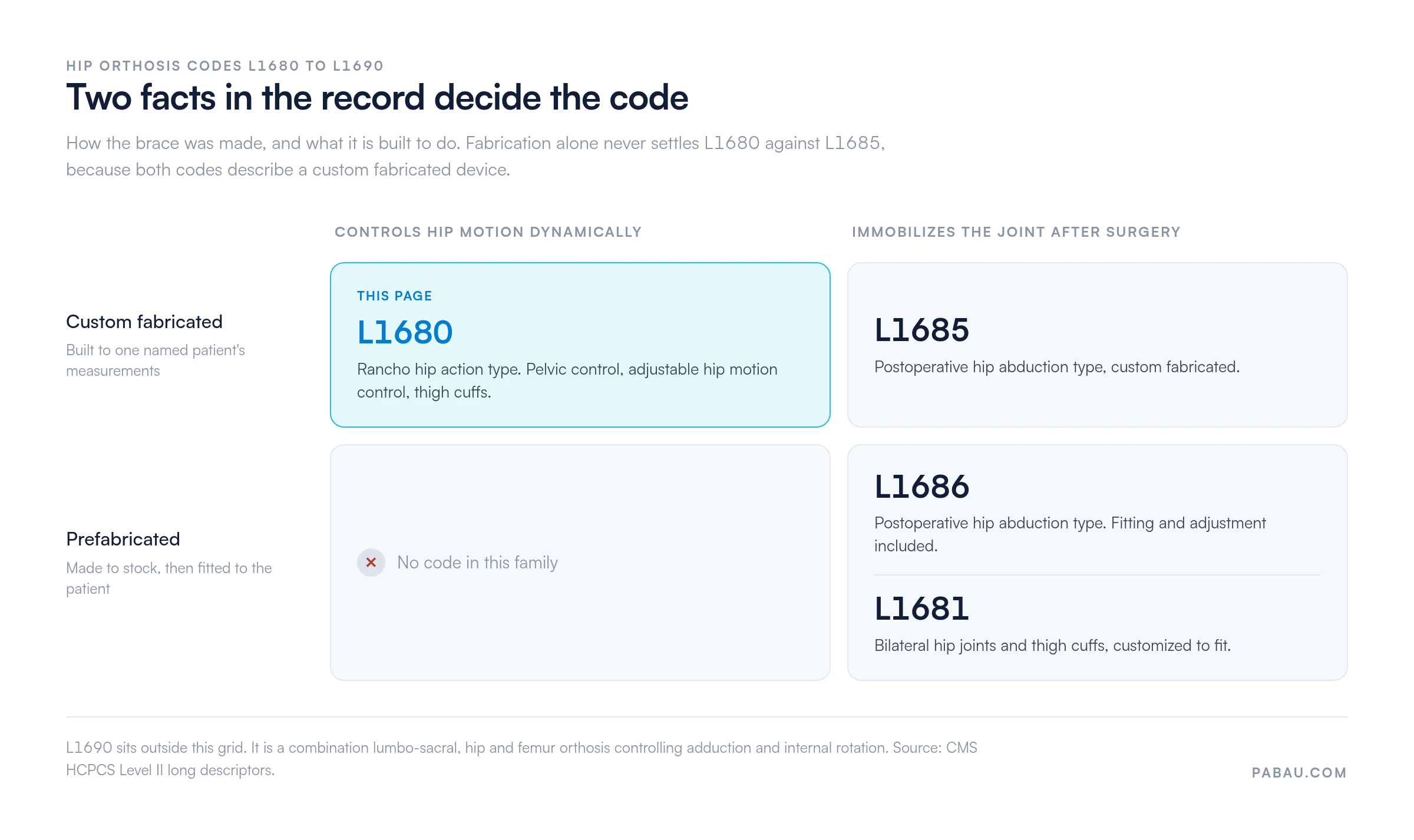
L1680 against L1685, the most common crosswalk error. Both describe a custom fabricated hip orthosis with abduction control, so fabrication settles nothing. L1680 covers a Rancho-type device that controls hip motion dynamically through adjustable joints and thigh cuffs. L1685 covers a postoperative brace that holds the hip in a set position while a repair heals. The prescriber notes and the device records have to show which job the brace was built to do.
The same range also holds prefabricated designs that L1680 cannot cover. A static, plastic abduction brace supplied ready-made is L1660, which folds fitting and adjustment into the fee. A flexible Frejka type with cover is L1600, a prefabricated item customized to fit the patient by a qualified individual.
A flexible Pavlik harness sits in that same prefabricated group and bills as L1620 when customized to fit the patient. A ready-made postoperative abduction brace whose code covers fitting and adjustment is L1686, the prefabricated counterpart to L1685.
Full descriptors for the whole range sit in the AAPC HCPCS code lookup, which is worth having open when you build payer-specific billing templates.
L1680 claims fail more often than many DME L-codes because the descriptor is narrow. The record has to show custom fabrication and dynamic motion control, not simply carry the code on a claim line.
The patterns below turn up again and again in post-payment reviews and commercial payer audits. Reading the denial codes on the remittance tells you which pattern you are looking at.
A pre-submission check that fires on every L1680 claim beats a review that only starts once the denials arrive. Practices that read their denial patterns monthly catch a systemic problem, such as a standing KX omission, before it turns into a write-off.
Audit your last 20 L1680 claims for modifier accuracy. Check that KX appears wherever the medical record supports necessity, and that LT or RT matches the clinical documentation. A 30-minute internal audit often recovers several hundred dollars in claims denied for a fixable reason.
L1680 has been in the CMS Level II code set for decades and carries no termination date. CMS publishes HCPCS updates each October, effective the following January 1. Load each year’s changes into your billing system before January billing starts. A retired descriptor or a new sibling code changes which line you bill.
L1681 is the recent example. It joined the hip orthosis family on October 1, 2023 and took the bilateral postoperative prefabricated slot, which had no dedicated code before.
Right now the L1680 document set usually lives in four places. The prescriber’s order sits in one system and the encounter notes in another. The delivery receipt waits in a folder at the front desk, and the fabrication record stays with the orthotist.
Practice management software like Pabau holds all four against the same patient record. Orders, clinical notes, uploaded delivery receipts, and device photographs attach to the patient file instead of a separate billing folder. When a DME MAC asks for the record months later, the file is already assembled.
Pabau’s software for billing teams then submits the claim electronically and tracks the remittance that comes back. A denial surfaces in days rather than at month-end. Choosing the modifier stays a human judgment, and the evidence behind that judgment sits in the same record.
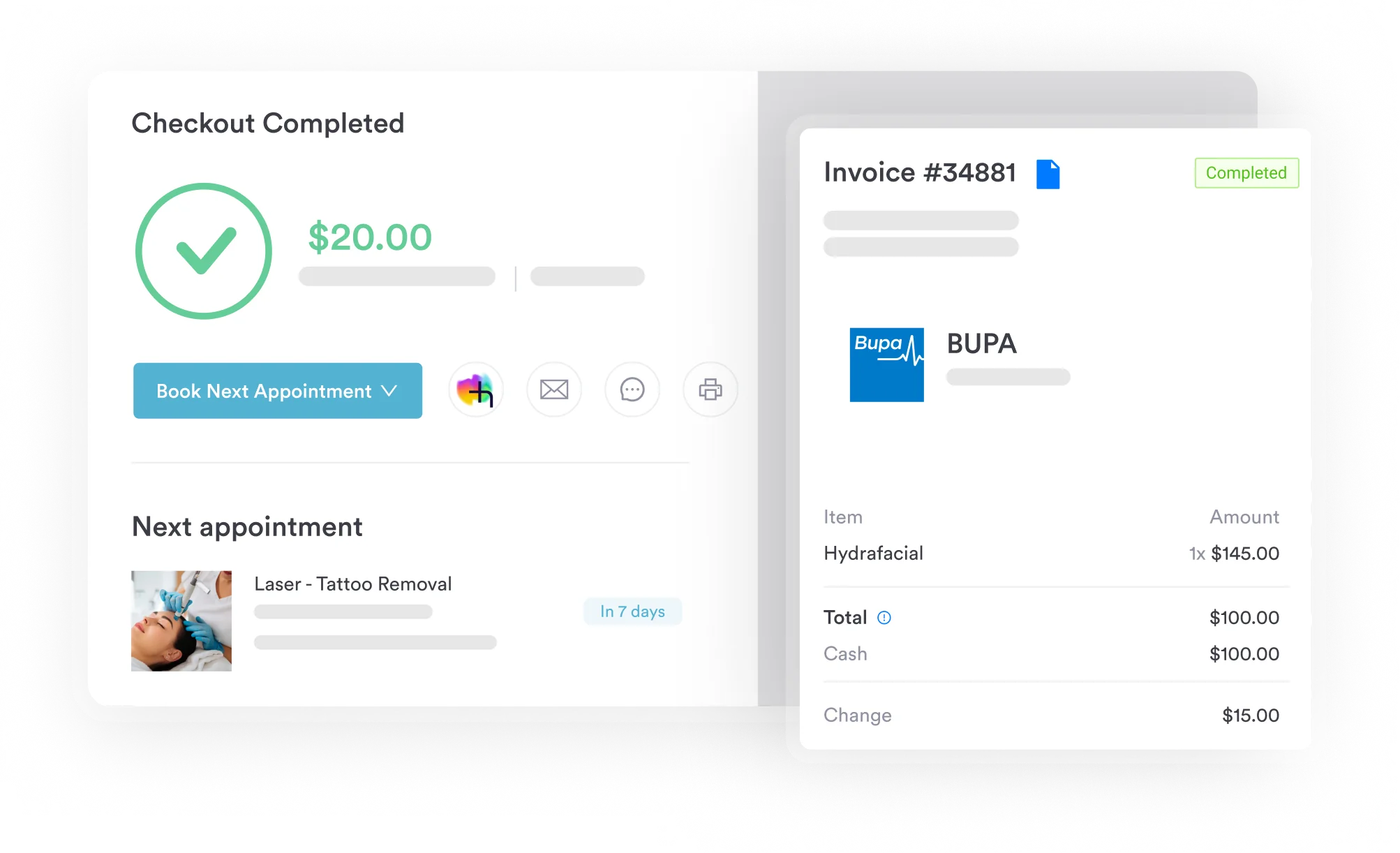

Pabau stores orders, clinical notes, and delivery receipts against the patient record, then submits and tracks the claim. Your billing team works from one file instead of four.

L1680 has a narrow descriptor, and claims fail wherever the record stops short of it. Three failures account for most denials. They are a missing KX modifier, an unsigned delivery receipt, and device records that never mention custom fabrication.
All three are fixable before the claim leaves the building, and each one comes down to visibility. Whoever builds the claim needs the order, the notes, the receipt, and the device record in front of them. Fix that and the L1685 mix-up stops happening too, because the device record is right there to read.
If that evidence currently lives in four systems, consolidating it is the single change that moves your L1680 denial rate. Book a demo to see how Pabau keeps DME documentation and claims in one patient record.

Need to read the denial on the remittance? Denial codes in medical billing covers the CARC and RARC codes that show up on DME adjudication.
Building a document set that survives an audit? Medical billing compliance explains the documentation standards that hold up in a DME MAC review.
Denials piling up across code types? Denial management in healthcare sets out how to track and resolve payer denials systematically.
Billing a postoperative hip abduction brace instead? HCPCS code L1685 covers the custom fabricated postoperative code that L1680 is most often confused with.
No. The CMS required prior authorization list for orthoses names specific lumbar-sacral and knee orthosis codes, and L1680 is not among them. Commercial payers set their own rules, so check the plan’s policy before the device is fabricated.
Medicare gives you one calendar year from the date of service. Miss that window and the claim is denied for timely filing, with no appeal route back. Commercial payers often allow less, so work to the shortest deadline on your payer grid.
Only if the patient signed an advance beneficiary notice before delivery. The ABN has to name the item, the reason you expect a denial, and the estimated cost. Bill the claim with modifier GA. Without a signed ABN on file, the charge is not collectible from the beneficiary.
Repairs use the orthotic repair codes rather than L1680 again. L4205 covers the labor component in 15-minute units, and L4210 covers minor replacement parts such as straps and fasteners. Adjustments made within 90 days of delivery are generally included in the original payment.