

CCSD code G5100: Bypass of duodenum billing guide
CCSD code G5100 bills a bypass that leaves the duodenum in place CCSD code G5100...

Last Updated: Oct 16, 2026
L1110 is the HCPCS Level II code for a ring flange addition to a CTLSO or scoliosis orthosis. The flange is plastic or leather, and it is molded to the patient model. It is an addition code, so Medicare pays it only when base code L1000 sits on the same claim.
Two problems cause most L1110 denials. The first is missing proof that the flange was molded to a cast or scan rather than pulled from stock. The second is a modifier error on Medicare Part B claims, usually a missing KX.
Let Pabau's smart automation suggest the right codes, reduce claim denials, and keep your practice compliant—effortlessly.
Automate repetitive tasks and focus on what matters most—your patients.
Reduce coding errors and ensure compliance with the latest regulations.
Clean claims, fewer denials, and faster reimbursements.
Powerful insights and reporting to help your practice thrive.
HIPAA compliant SOC 2 certified GDPR-compliant Trusted by 4,000+ clinics worldwide

HCPCS code L1110 covers a ring flange molded to the patient’s own model, which is what separates it from L1100.
L1110 is an addition code, so Medicare denies it as not separately payable unless base code L1000 sits on the same claim.
Five base codes are all-inclusive, and attaching L1110 to one of them reads as unbundling rather than a second line item.
The KX modifier attests that the LCD criteria are met, and claims that omit it route to manual review.
Pabau’s claims management software pre-fills claims from the patient record and checks required fields before submission.
HCPCS code L1110 pays for one part of a brace, not the brace itself. That part is a ring flange in plastic or leather, molded to the patient’s own model and fitted to a CTLSO or scoliosis orthosis.
The code sits in HCPCS Level II, maintained by the Centers for Medicare and Medicaid Services (CMS). The table below summarizes the attributes billers check first.
That last row is the one worth memorizing. L1110 is an addition code rather than a base device code, and Medicare pays it only when the base orthosis appears on the same claim. Most L1110 trouble starts there, so it is worth understanding the component before the pairing rule.
A ring flange is a circumferential plastic or leather band fitted at the upper or lower edge of the orthosis. It spreads load across the torso and stops the brace from shifting.
On the Milwaukee brace, the classic CTLSO, the pelvic ring flange is usually the part that needs custom molding. Adolescent growth reshapes the anatomy underneath it, and the original flange stops fitting.
Molding that flange to the patient’s model is a separate fabrication step, which is why it carries its own code. The orthotist takes a cast or a digital scan, builds the flange to that model, then fits it to the existing brace. A prefabricated flange skips all of it.
The time, material and skill involved are why CMS prices the two differently.
The scoliosis orthotic range runs from L1000 through L1120, and it splits cleanly in two. L1000 is the base device. The codes from L1010 to L1120 are additions that attach to it.
Reading that split correctly is what keeps an L1110 claim payable, so the adjacent codes are worth knowing by sight. Check the official descriptors on AAPC’s HCPCS code lookup rather than a third-party summary.
Two rows in that table trip billers up regularly. L1020 and L1025 are listed as Milwaukee brace codes in plenty of third-party references, and both descriptions are wrong. Each one is a kyphosis pad addition, so neither can serve as the base code for an L1110 line.
L1110 is payable alongside L1000 and no other base code. The DME MACs and the PDAC contractor say so directly in their scoliosis brace correct coding guidance. Addition codes L1010 through L1120 belong to L1000, and a claim that omits L1000 is denied as not separately payable.
A second trap sits on the other side of the range. Five scoliosis base codes are all-inclusive, which means their allowance already covers the pads, straps and interfaces fitted to them. Adding an L1110 line to one of those codes counts as unbundling.
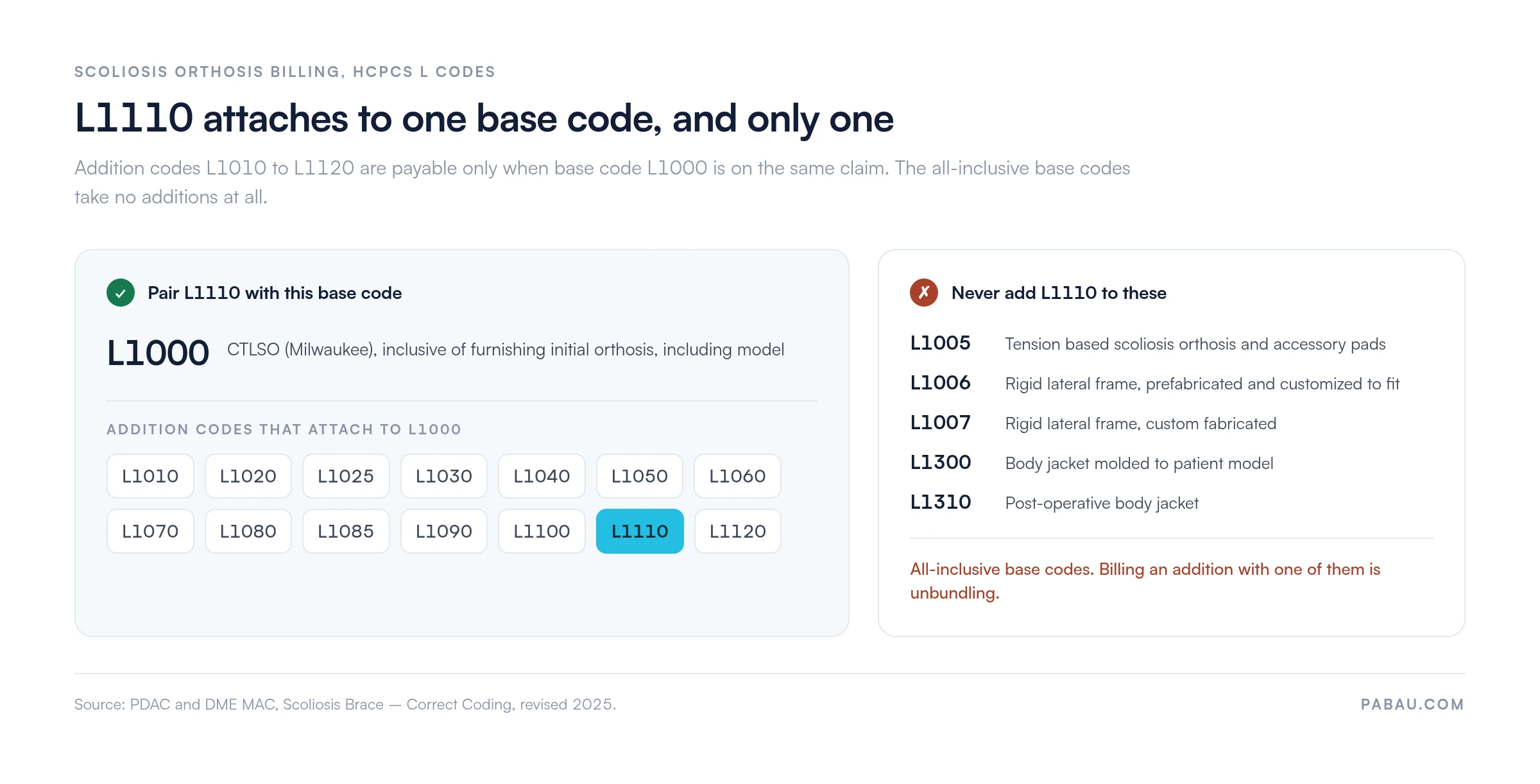
In practice this becomes a two-question check before submission. Is L1000 on the claim? And is the base code one of the all-inclusive five? A yes to the second question means the flange is already paid for inside the base allowance.
L1100 and L1110 describe the same component, and only the fabrication separates them. L1100 covers a ring flange fitted from stock or adapted from a prefabricated part. L1110 adds the phrase “molded to patient model,” which makes custom fabrication the billing criterion.
So bill L1110 when the orthotist takes a cast or a digital scan and builds the flange to it. Bill L1100 when the flange came off the shelf. Using L1110 for a stock flange is the miscoding that post-payment auditors look for first.
Medicare Part B covers L1110 under the durable medical equipment benefit, administered by the DME MACs. Coverage is never automatic. The claim needs a qualifying diagnosis, a compliant written order, and documentation showing why the molded flange was necessary for this patient.
Regional variation matters more here than billers expect. One MAC region’s allowed amount can differ noticeably from another’s, particularly in high-cost metropolitan areas. Practices billing across state lines pull the fee schedule for each jurisdiction separately.
Every L1110 claim carries at least one ICD-10-CM code explaining why the brace and its molded flange were necessary. The M41 scoliosis series does most of that work.
Your DME MAC’s LCD may accept a narrower list, so check the codes against the ICD-10-CM code library and the policy together.
Code to the specificity the record supports. Defaulting to M41.9 when the physician documented “adolescent idiopathic scoliosis, thoracic region” throws away M41.24 and weakens the medical necessity argument. Match the code to the treating physician’s documented diagnosis, not the orthotist’s clinical impression.
Run a crosswalk check between the ICD-10 scoliosis codes on your order and your DME MAC’s LCD before submitting. Some MACs maintain a covered diagnosis list for spinal orthoses that is narrower than the M41 range on its own. Confirming the code is on that list takes under two minutes and prevents a denial that takes weeks to appeal.
Thin documentation causes more L1110 denials and post-payment recoveries than any coding error. Medicare expects a specific chain of records, and each link has to be in the file before the claim goes out.
Hold that file for at least seven years from the date of service, or longer where state law says so. CERT and UPIC contractors request orthotic records years after the payment cleared.
KX is the modifier that matters most on an L1110 claim. It tells the DME MAC that the LCD criteria are met and the documentation is on file. GA and GY cover the two situations where coverage is doubtful, and RT or LT apply only to a lateralized component.
It helps to picture where those modifiers land. The supplier bills L1000 and L1110 on one electronic claim. Front-end edits at the DME MAC run first, checking the base-code pairing and the modifiers.
Clean lines then price against the DMEPOS fee schedule for that jurisdiction. A line that fails the edit drops out, usually with a not separately payable message.
KX carries compliance risk of its own. Appending it when the LCD criteria are not met is a false attestation, and it can pull the practice into an audit referral. Add KX only after the documentation is complete and the diagnosis clears the policy.
Denials cluster around a short list of mistakes, and a pre-submission routine catches nearly all of them. Build the habit at order intake rather than at clean claim submission.
Not from traditional Medicare, at least for now. The DMEPOS Prior Authorization Program does not list L1110 among the spinal orthosis codes requiring prior authorization.
That program expands periodically, and spinal orthotic L-codes have sat on the consideration list before, so re-check it each year.
Commercial payers behave differently. Many require prior authorization for custom orthotic additions, especially above a dollar threshold or where the patient received a device within the past 12 months.
Check the plan’s provider portal before fabrication starts, not after.
Build a payer-specific authorization matrix for the top five commercial payers your practice bills. For each one, note whether L-code additions need authorization, how the request is submitted, and the usual turnaround. Reviewing that matrix at order intake stops you fabricating a device the payer will later refuse to pay for.
An orthotics practice bills L1110 against several base orthoses in a single week, and each claim carries its own order, cast record and delivery receipt. Manual claim entry is where the pairing errors and missing modifiers creep in.
Practice management software like Pabau keeps the claim tied to the record it came from, so the checks happen at entry instead of at appeal.
Pabau’s cleaner claims management pulls claim details straight from the patient record. The diagnosis, the device and the dates of service arrive already filled in.
A built-in code lookup lets the biller find the right HCPCS and ICD-10 entries without leaving the claim. Required-field validation then flags an incomplete claim before submission. Choosing the modifier and the base code stays with your biller, where that judgment belongs.
The documentation lives in the same place. Cast records, signed orders and delivery receipts attach to the patient record and stay searchable by date. When an auditor asks for an L1110 file two years later, answering is a file retrieval rather than a paper hunt.

Pabau’s claims management software pre-fills claims from the patient record and keeps HCPCS and ICD-10 lookups within reach. Required-field checks run before you submit.

An L1110 claim turns on two documented facts. The ring flange was molded to the patient’s own model, and base code L1000 was on the claim beside it. Miss either one and the line is not payable, however sound the clinical decision behind it was.
That puts the work upstream of billing. Capture the cast or scan at fabrication. Get the written order signed before the device is built, and code the curve to the specificity the physician documented. Do that consistently and L1110 stops being an audit risk.
Pabau helps orthotics and DME teams build those habits into the order-to-claim workflow. Book a demo to see how it handles HCPCS billing for your practice.

Want to see how a claim moves from submission to payment? What is revenue cycle management walks through the billing process end to end for healthcare and DME practices.
Chasing a denial on an orthotic line? Denial codes in medical billing lists the reason codes you will meet most often and how to answer each one.
Need a cleaner submission routine? Clean claim submission sets out what a claim needs to clear the payer’s front-end edits without manual review.
Building the paperwork behind the claim? Superbill documentation explains which details belong on the document a payer or patient actually reads.
Denials piling up faster than you can appeal? Denial management in healthcare covers triage, resubmission and the reporting that stops repeats.
No. L1110 attaches to L1000, the CTLSO base code. A TLSO is billed under L1200, and its addition codes run from L1210 to L1290. Putting L1110 on a TLSO claim mixes two code families, and the DME MAC edit rejects the line.
Yes. A plaster cast, a foam box impression and a digital scan all document that a model was taken. What matters is that the record exists, carries a date before delivery, and names the patient. Auditors ask for the model record more often than any other L1110 document.
An enrolled, accredited DMEPOS supplier with an active Medicare supplier number. Fabricating the flange does not by itself create a right to bill for it. A practice that fits orthoses without holding a supplier number bills through a supplier partner instead.
Both are additions to L1000, but they describe different parts of the brace. L1110 is the molded ring flange. L1120 is a cover for an upright, and it is billed per upright rather than per brace. A brace can carry both, each with its own documentation.
Only where the brace carries two separate ring flanges and the record shows that one was molded and one was not. For a single flange you pick one code. Billing both for the same component duplicates one part and will not survive review.



